How to Select an EHR Vendor: A Step-by-Step Guide

Picking the wrong EHR vendor doesn't just cost you money, it costs you years of workflow headaches, staff frustration, and missed integration opportunities down the road. If you're researching how to select an ehr vendor, you already know the stakes are high: system choice affects everything from daily clinical documentation to how easily third-party tools connect to your patient data. This isn't a decision to rush through with a generic vendor comparison chart.
This guide gives you a practical evaluation framework, not just a feature checklist. You'll learn how to weigh clinical usability against technical architecture, assess vendor support models, and factor in something many buyers overlook until it's too late: interoperability and app ecosystem strength. Whether you're a hospital system, a clinic, or a digital health company evaluating EHR partners, the criteria matter just as much as the vendor's reputation.
We'll walk through each step in order, from defining your organization's requirements to running structured demos and checking references. Along the way, we'll flag where EHR integration capability becomes a deciding factor, since a platform that plays well with SMART on FHIR apps and third-party vendors will save your organization real time and money later.
What to know before you start evaluating EHR vendors
Before you request a single demo, you need to understand the terrain you're navigating. The EHR market isn't a level playing field: a handful of vendors control most of the hospital and health system market, while dozens of smaller players compete for specialty clinics, behavioral health practices, and ambulatory groups. Choosing an EHR system without first mapping this landscape means you'll waste weeks talking to vendors who were never a realistic fit for your organization's size or specialty.
The market is more concentrated than most buyers expect
Epic and Oracle Health (formerly Cerner) dominate the large hospital and health system segment, while athenahealth, eClinicalWorks, and NextGen serve a large share of ambulatory and specialty practices. Knowing where a vendor sits in this hierarchy tells you a lot about their support model, pricing structure, and how much leverage you'll have in negotiations.

| Vendor Tier | Typical Buyer | Common Strength |
|---|---|---|
| Epic, Oracle Health | Large hospital systems, academic medical centers | Deep clinical functionality, large app ecosystems |
| athenahealth, eClinicalWorks | Mid-size practices, ambulatory groups | Faster implementation, lower upfront cost |
| Specialty EHRs (behavioral health, dental, etc.) | Niche practices | Workflow templates built for that specialty |
Interoperability determines your long-term flexibility
Going in without a clear view of interoperability requirements is one of the most common mistakes buyers make. Every EHR now claims to support HL7 FHIR APIs and third-party integrations, but the actual depth of that support varies enormously. Some vendors offer robust developer sandboxes and an active app marketplace, like Epic's App Orchard and Showroom. Others technically comply with federal interoperability rules but make it painfully slow to connect outside tools. If your organization plans to work with digital health vendors, remote patient monitoring platforms, or clinical decision support tools down the road, this distinction matters more than almost any other feature on your checklist.
The EHR you pick isn't just a documentation tool, it's the foundation your entire digital health strategy will be built on.
Set realistic expectations for timeline and cost
Healthcare organizations frequently underestimate what an EHR selection process actually costs in time and money. A full evaluation and implementation cycle for a mid-size practice typically runs six to twelve months, and larger health systems can take eighteen months or longer. Budget conversations need to include not just licensing fees but implementation services, data migration, staff training, and ongoing support contracts. Vendors rarely volunteer the full cost picture upfront, so you'll need to ask directly about:
- Per-provider or per-user licensing costs
- One-time implementation and data migration fees
- Annual maintenance and support contracts
- Costs for third-party integrations or API access, including app marketplace listing fees
Regulatory compliance is table stakes, not a differentiator
Understand that HIPAA compliance, ONC certification, and support for the 21st Century Cures Act's information blocking rules are baseline requirements, not competitive advantages. If a vendor markets these as unique selling points, treat it as a signal to look deeper at what actually sets them apart, whether that's usability, integration flexibility, or the strength of their support team. You can verify a vendor's certification status directly through the ONC Certified Health IT Product List before you invest time in a demo.
Step 1. Define your organization's needs and goals
Start with a written needs assessment before you contact a single vendor. Documenting your requirements forces you to separate what your organization actually needs from what a slick sales demo makes you want. Skip this step and you'll end up buying features you never use while missing the ones that actually solve your daily workflow problems.
Map your clinical and administrative workflows first
Gather input from the people who'll use the system every day: physicians, nurses, front-desk staff, billing teams, and IT. Ask each group what slows them down in their current system and what they'd change if they had a blank slate. This is also the moment to think about EHR vendor selection criteria specific to your specialty. A behavioral health clinic needs different documentation templates than an orthopedic surgery group, and a multi-site health system needs different reporting tools than a single-location practice.
Prioritize your must-haves versus nice-to-haves
Once you've collected feedback, sort it into tiers. This keeps your team from getting distracted by flashy features that don't move the needle on your actual goals.
| Priority Tier | Example Requirement | Why It Matters |
|---|---|---|
| Must-have | Specialty-specific documentation templates | Directly affects clinician efficiency and accuracy |
| Must-have | FHIR API access for third-party integrations | Determines future flexibility with digital health tools |
| Nice-to-have | Built-in patient engagement portal | Useful but often replaceable with a standalone tool |
| Nice-to-have | Advanced analytics dashboards | Valuable long-term, rarely a launch blocker |
If you can't articulate what problem the new EHR needs to solve, no vendor demo will fix that for you.
Goals should extend beyond the software itself. Consider where your organization wants to be in three to five years: are you planning to add telehealth services, integrate remote patient monitoring devices, or expand into new specialties? Factor those growth plans into your evaluation now, because switching EHR platforms again in two years is far more expensive than choosing one with room to grow. Write these goals down and circulate them to your evaluation team so everyone is scoring vendors against the same criteria, not their own individual preferences.
Step 2. Set your budget and build a selection team
Money conversations need to happen before you talk to a single sales rep, not after you've fallen in love with a demo. Setting a realistic budget upfront keeps your evaluation grounded and stops vendors from steering the conversation toward their preferred price point instead of yours. Pull in your finance team early so they understand the full cost structure you're evaluating, not just the sticker price on a licensing agreement.
Build a budget that covers the whole lifecycle
Your budget needs to account for more than the software subscription. Include implementation services, data migration from your legacy system, staff training hours (which means lost productivity during the transition), hardware upgrades if needed, and ongoing support fees. Many organizations budget for year one and forget that support and maintenance costs continue indefinitely. Ask each vendor for a five-year total cost of ownership estimate, not just an annual quote, so you're comparing apples to apples.
A vendor's sticker price tells you almost nothing about what the system will actually cost your organization over five years.
Assemble a cross-functional selection team
No single department should own this decision. Building a selection team with representatives from clinical staff, IT, finance, compliance, and administration ensures you catch blind spots that any one group would miss on their own. A physician might flag documentation burden issues that IT never considers, while your compliance officer catches contract language that would otherwise slip through unnoticed.
Here's a practical starting roster for most mid-size organizations:
- Project lead: coordinates the timeline, vendor communication, and internal decision-making
- Clinical representative(s): at least one physician and one nurse who'll use the system daily
- IT/technical lead: evaluates integration capability, security architecture, and hosting requirements
- Finance representative: tracks total cost of ownership and negotiates contract terms
- Compliance/privacy officer: verifies HIPAA safeguards, BAAs, and audit trail capabilities
- Front-desk or billing staff: represents administrative workflow needs
Give this team defined decision-making authority before the process starts, including who has final sign-off. Without that clarity, you'll end up in circular debates weeks into vendor demos when someone senior finally weighs in with an opinion nobody prepared for. Set a realistic timeline for the team too: rushing a group decision often produces worse outcomes than a slightly slower, more deliberate process.
Step 3. Research and shortlist EHR vendors
With your requirements documented and your team in place, start building a vendor shortlist that matches your organization's size, specialty, and integration needs. Resist the urge to request demos from every name you've heard mentioned at a conference. A focused list of four to six vendors that genuinely fit your profile beats a scattered list of twelve that waste your team's time.
Cast a wide net, then narrow fast
Gather candidates from multiple sources: peer recommendations from similar-sized organizations, specialty association vendor lists, KLAS Research rankings, and direct outreach to vendors whose market tier matches yours from Step 1. Once you have a raw list, score each vendor against your must-have requirements before you contact a single sales team. This is where your EHR vendor selection criteria document earns its keep, since it turns a subjective gut-check into a repeatable scoring process everyone on your team can apply the same way.
Narrowing your list before the first sales call saves your team dozens of hours it would otherwise spend on vendors that were never a real fit.
Check the interoperability story before you get on a call
Ask each vendor upfront whether they publish a developer sandbox, support SMART on FHIR apps, and maintain an active app marketplace. Vendors connected to Epic, for example, often list certified partners through the App Orchard, which gives you a fast way to gauge how mature their third-party ecosystem actually is. Filtering out vendors with weak interoperability support at this stage protects you from discovering the limitation eighteen months into implementation.
Build a simple scoring sheet
A basic spreadsheet keeps this stage organized and gives your team a shared reference point for the next round of conversations:
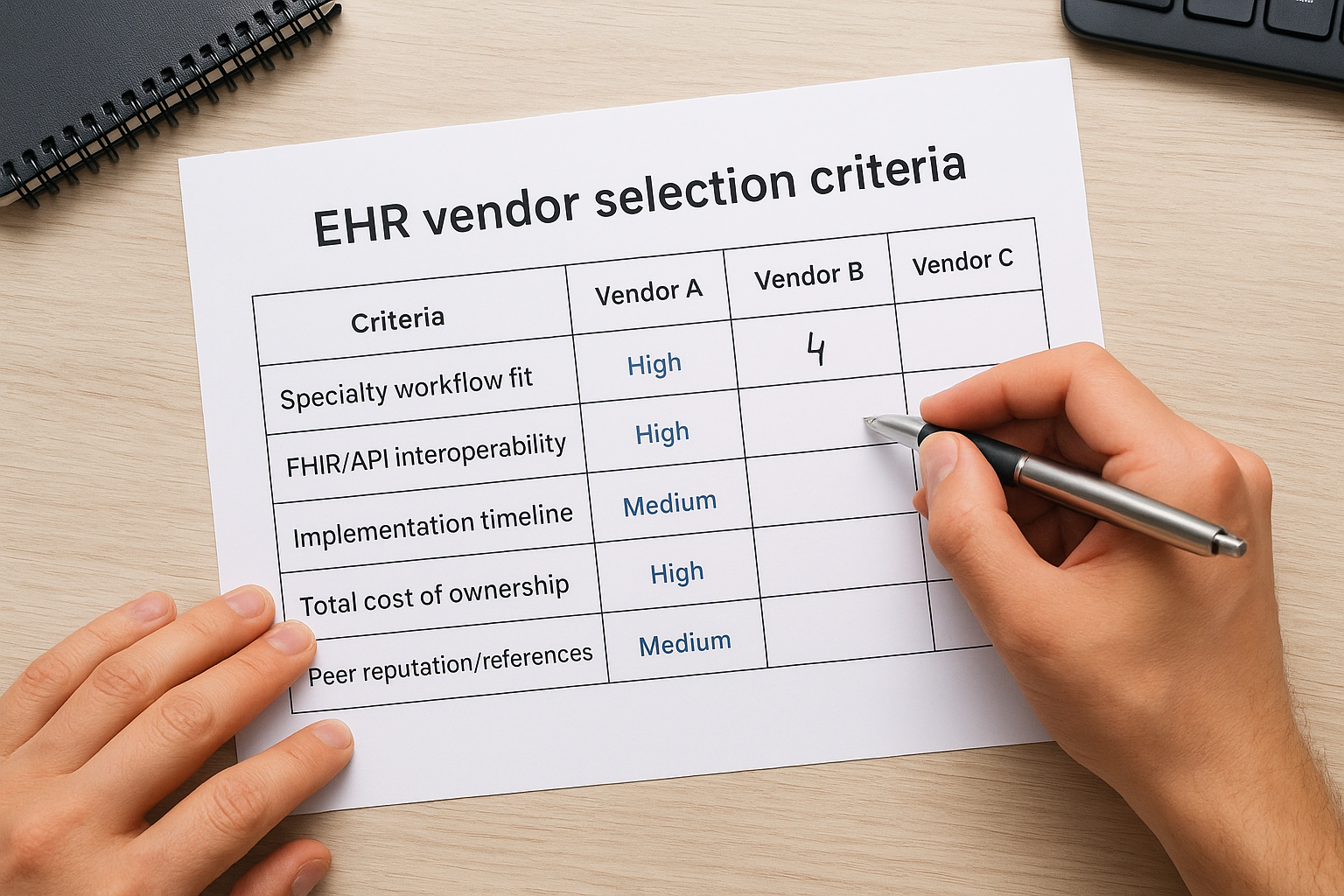
| Criteria | Weight | Vendor A | Vendor B | Vendor C |
|---|---|---|---|---|
| Specialty workflow fit | High | |||
| FHIR/API interoperability | High | |||
| Implementation timeline | Medium | |||
| Total cost of ownership | High | |||
| Peer reputation/references | Medium |
Rank vendors by weighted score, then move your top four to six candidates into the demo stage. Anyone scoring poorly on a must-have requirement gets cut here, not after a two-hour sales pitch has warmed up your team's opinion of them.
Step 4. Evaluate demos, references, and compliance
Once your shortlist is set, move into the stage where vendors actually prove their claims. Running structured demos matters more than most buyers realize, because a generic sales presentation tells you almost nothing about how the system performs in your specific workflows. Insist that every vendor demo your real use cases, not their polished default script.
Script the demo around your own workflows
Send each vendor a written scenario before the meeting: a new patient intake, a specialty-specific documentation flow, a referral to an outside provider. Ask them to complete these tasks live, in front of your clinical staff, using your data fields where possible. This single change exposes gaps that a canned demo hides.
- Require live task completion, not slides
- Include front-desk and billing staff in at least one session
- Time how long common tasks take inside the system
- Ask specifically how the system handles the app launch sequence inside the EHR and third-party data sharing
A vendor that can't complete your real workflow live on a call probably can't support it in production either.
Call references who match your organization
Ask each vendor for three references from organizations similar in size, specialty, and EHR use case to yours, not their flagship success story. Checking vendor references properly means asking pointed questions: How long did implementation actually take versus what was promised? What surprised them after go-live? How responsive is support when something breaks at 2 a.m.? A reference call that only surfaces praise usually means you didn't ask hard enough questions.
Verify compliance and security claims independently
Don't take a vendor's claims about HIPAA privacy and security requirements at face value. Ask for their most recent SOC 2 report, request documentation of their Business Associate Agreement terms, and confirm their ONC certification status directly through the ONC Certified Health IT Product List. This step protects your organization from discovering a compliance gap after you've signed a multi-year contract. If your evaluation includes third-party apps that will connect through the EHR, confirm that those integrations also carry proper HIPAA safeguards and BAAs, since the responsibility doesn't disappear just because the connection runs through your core system.
Step 5. Compare contracts and make your final decision
Narrow your list to two or three finalists and put their contracts side by side before anyone signs anything. Comparing vendor contracts line by line matters more at this stage than any remaining feature comparison, because the contract terms determine what happens when things go wrong, not just what the system does when everything works.
Read the contract for what it doesn't say
Look past the licensing fee and study the fine print on auto-renewal clauses, data ownership after termination, and what happens to your patient records if you switch vendors in five years. Ask specifically who owns your data during and after the contract term, and get written confirmation of exit costs and data export formats. Vendors rarely volunteer this information, so your finance and compliance representatives need to request it directly.
A contract you haven't stress-tested for the exit scenario isn't finished, no matter how good the pricing looks today.
Negotiate before you sign, not after
Every term in a vendor's first draft is a starting point, not a final offer. Push back on the items that carry the most long-term risk:
- Cap annual price increases at a fixed percentage instead of leaving them open-ended
- Negotiate service-level agreements with specific uptime and support response guarantees
- Request a data migration credit or reduced implementation fee if you're switching from a legacy system
- Clarify costs for third-party API access and FHIR API integration support upfront, not as a future add-on
- Confirm BAA terms cover every subcontractor who touches patient data
Score your finalists one more time
Run your top contenders through one final weighted comparison before your team votes:
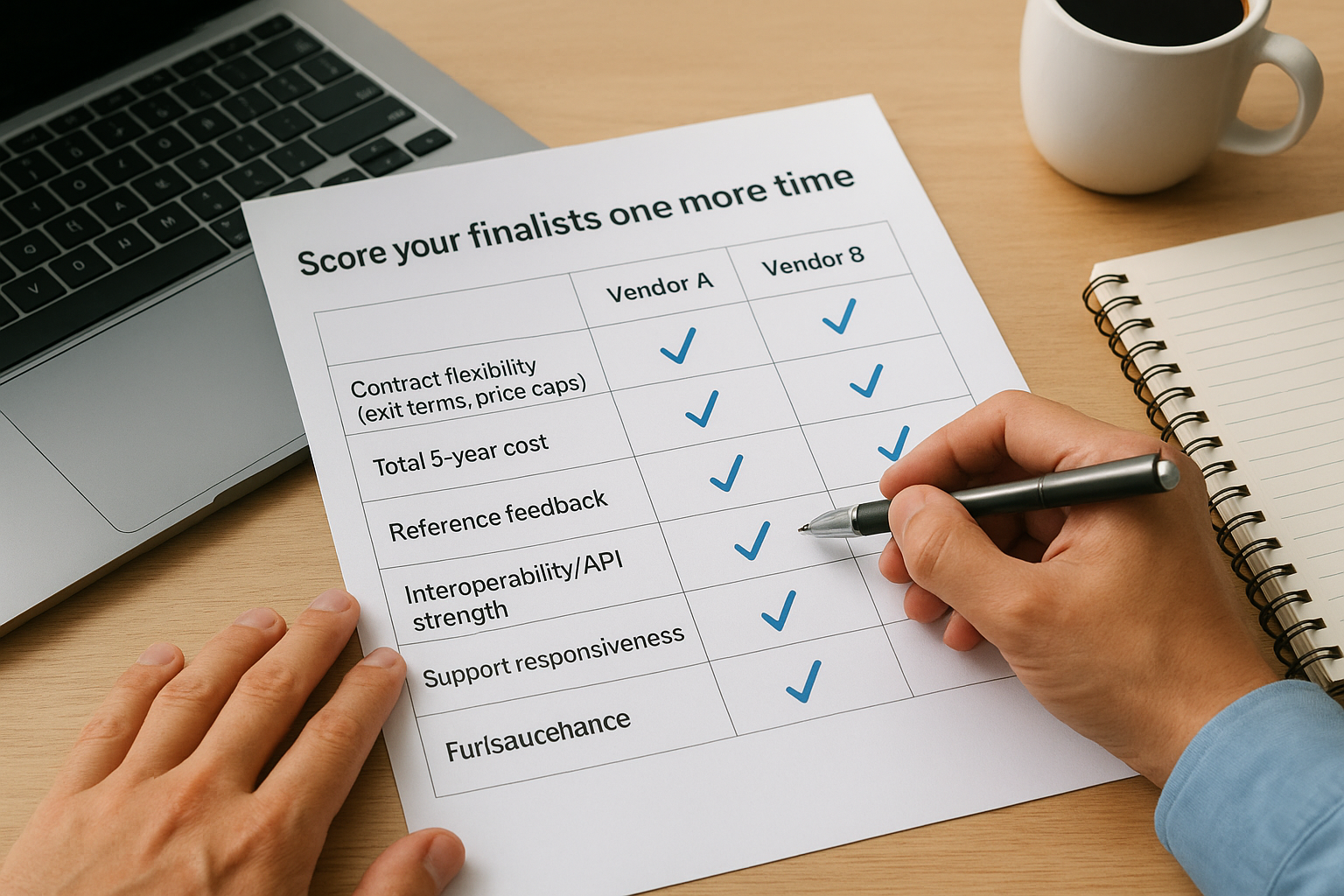
| Factor | Vendor A | Vendor B |
|---|---|---|
| Contract flexibility (exit terms, price caps) | ||
| Total 5-year cost | ||
| Reference feedback | ||
| Interoperability/API strength | ||
| Support responsiveness |
Bring this final scorecard back to your full selection team, not just the executive sponsor. Everyone who sat through demos and reference calls should have visibility into why one vendor won over another, since that shared understanding makes the rollout smoother once training starts. Once you've made the call, get sign-off in writing from clinical, IT, finance, and compliance leads before the contract goes to signature.
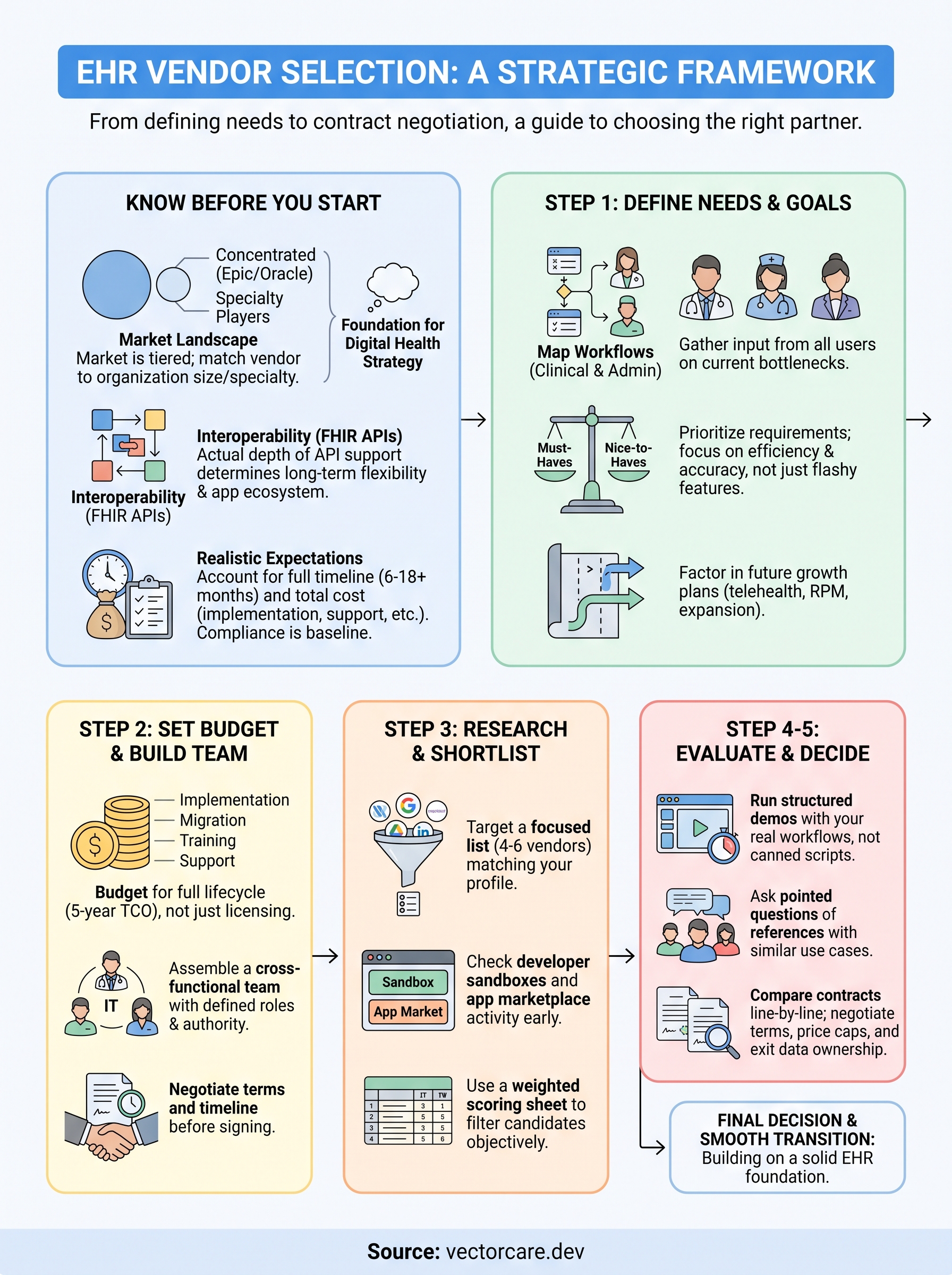
Turning your EHR decision into a smooth transition
Selecting an EHR vendor is never just a procurement task, it's a multi-year commitment that shapes how your clinical teams work and how easily your organization connects to the broader digital health ecosystem. Following a structured process, from defining needs through contract negotiation, protects you from the expensive mistakes that come with rushed decisions or gut-feel vendor picks. The framework in this guide won't guarantee a perfect outcome, but it stacks the odds heavily in your favor.
Once your EHR is locked in, the real work of building on that foundation begins. If your organization or a vendor partner needs to build and deploy a SMART on FHIR app that plugs directly into Epic without a 12-18 month engineering slog, that's exactly the gap VectorCare's no-code platform was built to close, turning months of integration work into weeks.
The Future of Patient Logistics
Exploring the future of all things related to patient logistics, technology and how AI is going to re-shape the way we deliver care.
Thank you! Your submission has been received!
Oops! Something went wrong while submitting the form.