HIPAA Compliant Hosting Pricing: What You'll Actually Pay

You've gotten quotes for HIPAA compliant hosting and the numbers are all over the place. One vendor quotes $200 a month, another wants $5,000, and a third won't give you a number until you sit through a sales call. HIPAA compliant hosting pricing varies this much because you're rarely paying for the same thing twice, even when the marketing pages look identical, and because HIPAA compliant cloud hosting bundles requirements, BAAs, and costs differently from vendor to vendor.
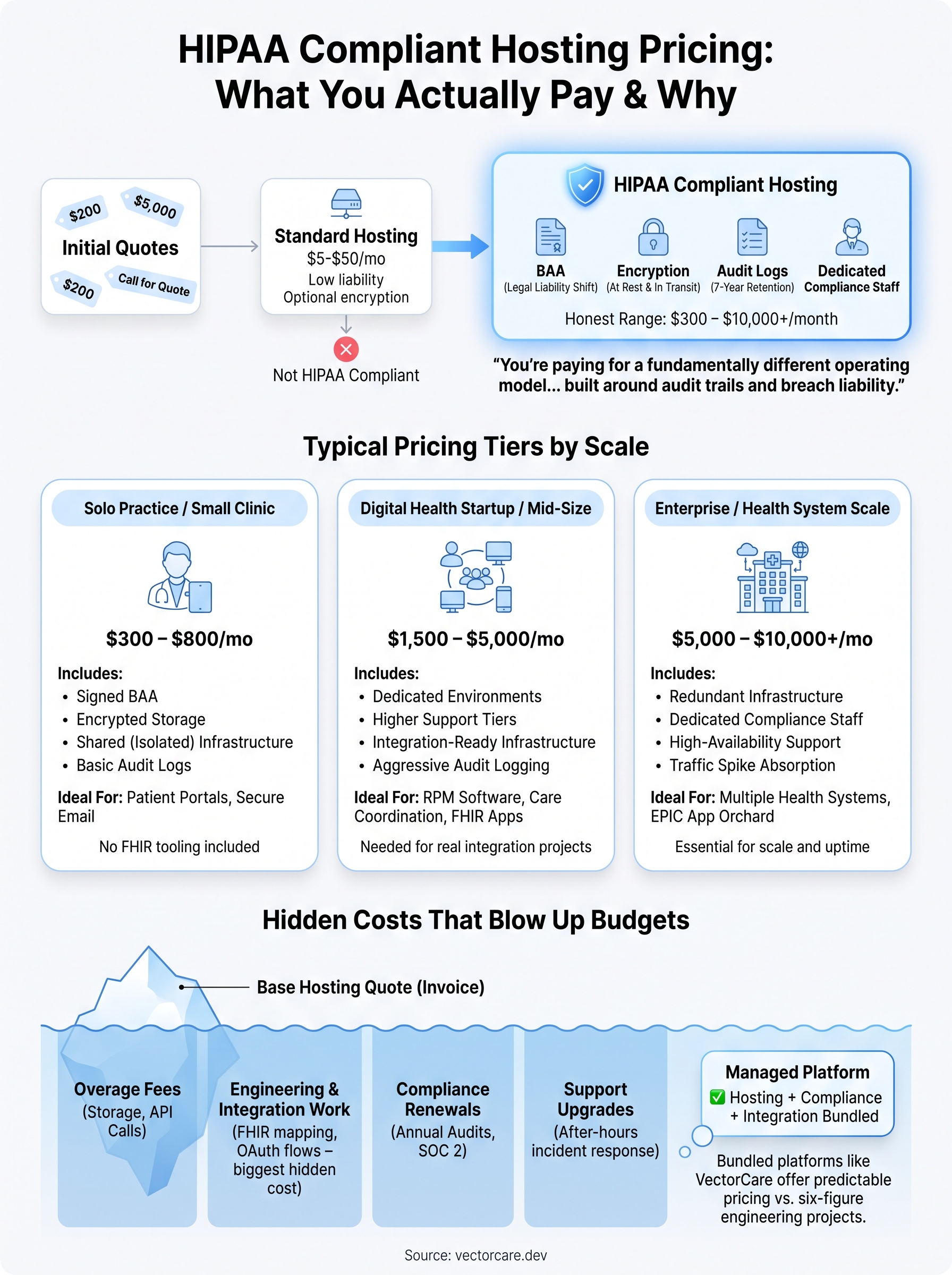
The honest answer is that most healthcare vendors pay somewhere between $300 and $10,000 a month, depending on infrastructure, the strength of your Business Associate Agreement, and whether compliance is bolted on or built in. The bigger cost driver isn't the hosting line item at all: it's what you still have to build and maintain around it, like FHIR integrations, audit logging, and EHR connectivity, which is where budgets actually blow up.
This article breaks down what you should expect to pay at each tier, the hidden costs that don't show up on a pricing page, and how managed platforms like VectorCare change the math by bundling hosting, compliance, and EPIC integration into one predictable monthly rate instead of a six-figure engineering project.
Why HIPAA compliant hosting costs more than standard hosting
Standard shared hosting runs $5 to $20 a month because the provider assumes almost no liability for what you put on the server. HIPAA compliant hosting requirements push the price to 15 to 20 times that because the provider is now contractually and legally on the hook for how patient data gets stored, transmitted, and accessed. You're not paying more for the same servers with a compliance sticker slapped on. You're paying for a fundamentally different operating model, one built around audit trails, breach liability, and infrastructure that can survive an OCR investigation.

Encryption, access controls, and audit logging aren't optional add-ons
Every HIPAA compliant environment needs encryption at rest and in transit, role-based access controls, and audit logs that capture who touched what data and when. None of that is free to build or maintain. A standard host doesn't need to log every database query for seven years or generate tamper-evident audit trails, so it doesn't. A compliant host does, and that logging infrastructure alone can add real overhead in storage, processing, and engineering time.
The price difference between standard and HIPAA compliant hosting is really the price of provable accountability.
Business Associate Agreements shift liability, and liability costs money
A signed Business Associate Agreement under HIPAA means the hosting provider is legally accepting shared responsibility for a HIPAA breach involving your data. That's not a formality. The HHS Office for Civil Rights can and does fine business associates directly, and settlements have run into the millions for entities that mishandled protected health information. Providers price their BAAs based on the risk they're taking on, which is why a bare-metal box with a BAA costs more than the identical box without one, even though the hardware hasn't changed at all.
Redundant infrastructure and dedicated environments
HIPAA doesn't require dedicated servers by name, but most compliant hosts build toward it anyway because shared multi-tenant environments make access control and audit isolation harder to prove. That means:
- Dedicated or logically isolated environments instead of shared tenancy
- Redundant backups with tested disaster recovery, not just automated snapshots
- Intrusion detection and continuous monitoring rather than periodic scans
- Documented incident response plans that get tested, not just written
Each of these adds fixed cost regardless of how much traffic your app actually gets, which is why small healthcare vendors often feel like they're overpaying relative to their usage. You partly are, but the alternative, building this yourself, costs far more.
The compliance staff you're paying for, even if you never see them
Someone has to run risk assessments, keep policies current, train staff on PHI handling, and manage the vendor relationships that come with a healthcare-focused hosting stack. Reputable providers employ compliance officers and security engineers whose entire job is keeping the infrastructure audit-ready. You never see these people on a sales call, but their salaries are baked into your monthly rate. Cheap providers advertising HIPAA compliance at standard-hosting prices are usually skipping this staffing layer entirely, which is a fair warning sign when a quote looks too good.
Feature comparison at a glance
| Feature | Standard hosting | HIPAA compliant hosting |
|---|---|---|
| Typical monthly cost | $5–$50 | $300–$10,000+ |
| Business Associate Agreement | Not offered | Included or required |
| Encryption at rest/in transit | Optional | Mandatory |
| Audit logging retention | Days to weeks | Years, per policy |
| Dedicated compliance staff | Rare | Standard |
| Breach liability | Provider disclaims | Shared under BAA |
Once you see the table side by side, the price gap stops looking arbitrary. You're not buying bandwidth and uptime anymore. You're buying a legal and operational shield around every patient record that touches your app, and vendors like VectorCare build that shield into the platform itself so you're not pricing out each piece separately.
How to compare pricing across HIPAA hosting providers
Comparing quotes side by side is harder than it sounds because providers structure their pricing differently on purpose. One vendor bundles the Business Associate Agreement into the base rate, another charges an extra $200 a month for it, so it helps to know exactly what a BAA covers in healthcare before comparing line items. Getting an apples-to-apples comparison means asking the same five questions of every provider before you look at the dollar figure at all.
Ask what's actually included in the base rate
Request an itemized breakdown, not just a headline number. HIPAA compliant hosting cost comparisons fall apart when one quote includes managed backups and 24/7 support and another treats those as add-ons. Ask specifically about:
- Storage limits and what happens past the cap
- Number of included environments (staging vs. production)
- Support response times, and whether that includes security incidents
- Whether the BAA is standard or negotiated separately
- Backup frequency and retention period
Getting these answers in writing before you sign anything saves you from a surprise invoice in month two.
Watch how providers price scale
Some hosts charge a flat rate regardless of traffic. Others meter you by API calls, storage volume, or number of connected users, which can turn a $500 quote into $3,000 once you're live with real patients. Ask for a projected cost at your expected six-month volume, not just your launch-day traffic. A provider that won't model this for you is one that either doesn't understand your use case or doesn't want you to see the real number yet.
If a provider can't tell you what you'll pay at 10x your current volume, they can't tell you what HIPAA compliant hosting actually costs you.
Compare compliance depth, not just compliance claims
Almost every hosting page says "HIPAA compliant" somewhere. Few explain what that means operationally. Ask providers directly whether they've completed a third-party HIPAA audit, whether they carry SOC 2 Type II certification (and what a SOC 2 Type II audit costs to maintain), and whether they can produce documentation during your own vendor risk assessment. The HHS Office for Civil Rights publishes guidance on what a compliant BAA and risk analysis should cover, and it's worth holding every quote against that standard rather than trusting a badge on a website.
Factor in what you'd have to build yourself
Raw hosting pricing tells you almost nothing if you're a healthcare vendor building toward EPIC integration. A $500-a-month HIPAA compliant server with no FHIR tooling, no SMART on FHIR framework, and no EPIC Showroom pathway still leaves you facing months of engineering work on top of the hosting bill. When you compare quotes, ask whether the price includes integration tooling or just infrastructure. That distinction is usually where the real cost difference between providers hides.
What typical plans cost, from solo practice to enterprise
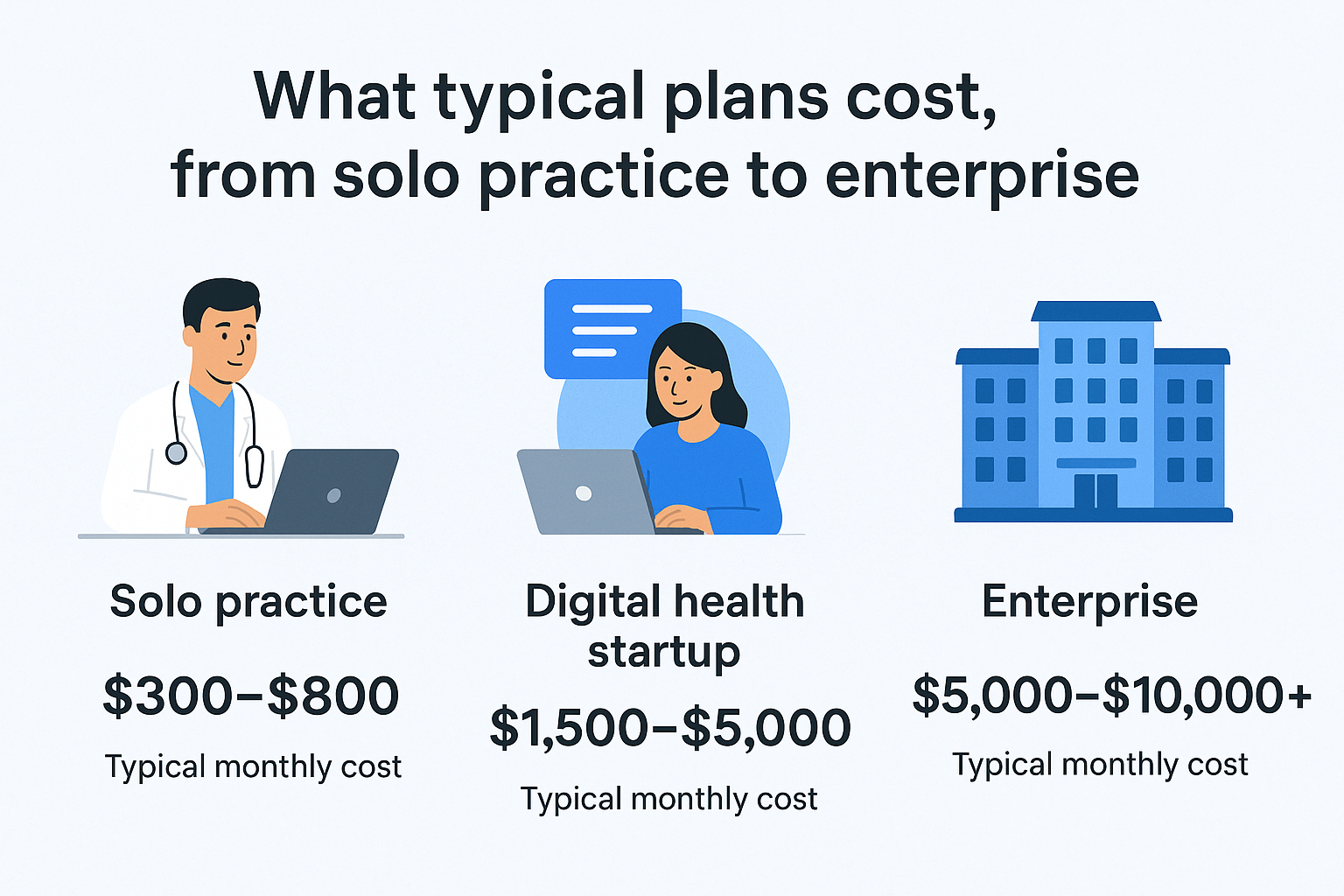
Pricing tiers in HIPAA compliant hosting roughly track the size and complexity of what you're running, but not in a straight line. A solo practice hosting a patient portal pays a fraction of what a digital health startup pays for FHIR-connected infrastructure, and both pay a fraction of what an enterprise vendor pays once EPIC connectivity, redundancy, and dedicated support enter the picture. Knowing where you land on this scale before you start shopping keeps you from either overpaying for headroom you don't need or underbuying infrastructure that can't handle your actual patient volume.
Solo practice and small clinic pricing
Basic HIPAA compliant hosting for a solo practice or small clinic, think a patient portal, secure email, or a simple scheduling app, typically runs $300 to $800 a month. This tier usually includes a signed BAA, encrypted storage, and shared but isolated infrastructure. What it doesn't include is FHIR tooling or EHR integration of any kind, so if your roadmap involves connecting to a hospital's EPIC instance, budget separately for FHIR certification cost and treat this tier as a starting point, not a destination.
Digital health startup and mid-size vendor pricing
Once you're building an actual application, remote patient monitoring software, clinical decision support, care coordination, costs jump to $1,500 to $5,000 a month. This range accounts for dedicated environments, more aggressive audit logging, and higher support tiers. It's also where the gap between raw hosting and a managed platform starts to matter most, because a vendor at this stage usually needs FHIR connectivity and SMART on FHIR compliance, not just a compliant server.
The jump from solo-practice pricing to startup pricing isn't about more storage, it's about the infrastructure needed to survive a real integration project.
Enterprise and health-system-scale pricing
Enterprise vendors serving multiple health systems, or building toward EPIC Showroom listings across dozens of hospitals, land in the $5,000 to $10,000-plus range, on top of Epic App Orchard fees and tiers. At this scale you're paying for redundant environments, dedicated compliance staff, and infrastructure that can absorb traffic spikes without downtime during a shift change or a mass patient influx.
| Tier | Typical monthly cost | Includes |
|---|---|---|
| Solo practice / small clinic | $300–$800 | BAA, encrypted storage, basic audit logs |
| Digital health startup / mid-size vendor | $1,500–$5,000 | Dedicated environments, higher support tier, integration-ready infrastructure |
| Enterprise / health-system-scale | $5,000–$10,000+ | Redundant infrastructure, dedicated compliance staff, high-availability support |
Growing into the next tier isn't optional if you're aiming for EPIC integration. Vendors who try to run FHIR connectivity on solo-practice-tier hosting usually hit a wall around month three, when audit logging or uptime requirements from a health system's security team exceed what the base plan supports, which is worth reading about before you decide where to host a SMART on FHIR app.
Hidden costs that change your real monthly bill
The number on a pricing page rarely matches what lands on your invoice six months later. HIPAA compliant hosting pricing almost always understates the real cost because providers quote a base tier and let overages, upgrades, and unbilled engineering work pile up separately. Before you sign a contract, walk through the line items below, because these are the ones that turn a $1,500 quote into a $4,000 monthly bill without anyone technically lying to you.
Overage fees that only show up after launch
Storage caps, API call limits, and bandwidth thresholds look generous on a sales call and tight once real patients start using your app. A provider quoting $2,000 a month for "unlimited" API calls often means unlimited within a soft cap, with steep per-call fees kicking in above it. Ask for the overage rate in dollars, not percentages, and model it against your projected six-month volume before you sign.
Integration and engineering work the quote doesn't cover
Most hosting quotes price the server, not the work required to connect it to anything useful. If your goal is EHR integration and how it actually works, specifically EPIC connectivity, you're likely staring at months of engineering for FHIR mapping, OAuth flows, and SMART on FHIR compliance that no hosting invoice mentions. This is the single biggest hidden cost in the entire category, and once you walk through the real steps, APIs, and timing involved in integrating with Epic EHR, it's clear why raw hosting comparisons miss the point for healthcare vendors building toward a health system contract.
The real cost of HIPAA compliant hosting usually isn't on the invoice, it's in the engineering hours nobody quoted you.
Compliance renewals and audit fees
SOC 2 Type II certification and third-party HIPAA audits aren't one-time events. Providers renew them annually, and some pass that cost through as a line item you won't see until renewal season. Ask upfront whether audit and certification costs are baked into your monthly rate or billed separately when they come due.
Support tier upgrades you'll eventually need
Basic support plans often exclude after-hours incident response, which matters a lot the first time your app goes down during a hospital's night shift. Common hidden costs to check for before signing include:
- Per-incident fees for after-hours support
- Charges for additional staging or test environments
- Fees for exporting or migrating data if you switch providers
- Costs for custom BAAs beyond the provider's standard template
- Charges for penetration testing reports required by a health system's security review
Running through this list with every quote you collect turns a vague dollar figure into a real number you can budget against, and it's usually where vendors realize a managed platform with a flat, all-in rate is worth more than it first appears.
Matching the price to your compliance needs
Pricing HIPAA compliant hosting isn't about finding the cheapest quote, it's about matching spend to what you actually need to defend during an audit or a health system's vendor review. A solo practice overpays by chasing enterprise-grade redundancy it'll never use, while a startup building toward EPIC connectivity underpays by treating a bare compliant server as a finished integration strategy. The real number you should budget for includes the hosting line item plus the FHIR mapping, OAuth work, and ongoing compliance renewals that rarely show up on the initial quote.
Once you add up hosting, engineering time, and the months spent building EPIC integration from scratch, the math tilts hard toward a managed platform that bundles all three into one predictable rate. If you're a healthcare vendor trying to launch inside EPIC without a six-figure build, see how VectorCare lets you build and deploy your SMART on FHIR app in days before you sign another hosting contract.
The Future of Patient Logistics
Exploring the future of all things related to patient logistics, technology and how AI is going to re-shape the way we deliver care.
Thank you! Your submission has been received!
Oops! Something went wrong while submitting the form.