7 Care Management Software Demos Worth Requesting in 2026

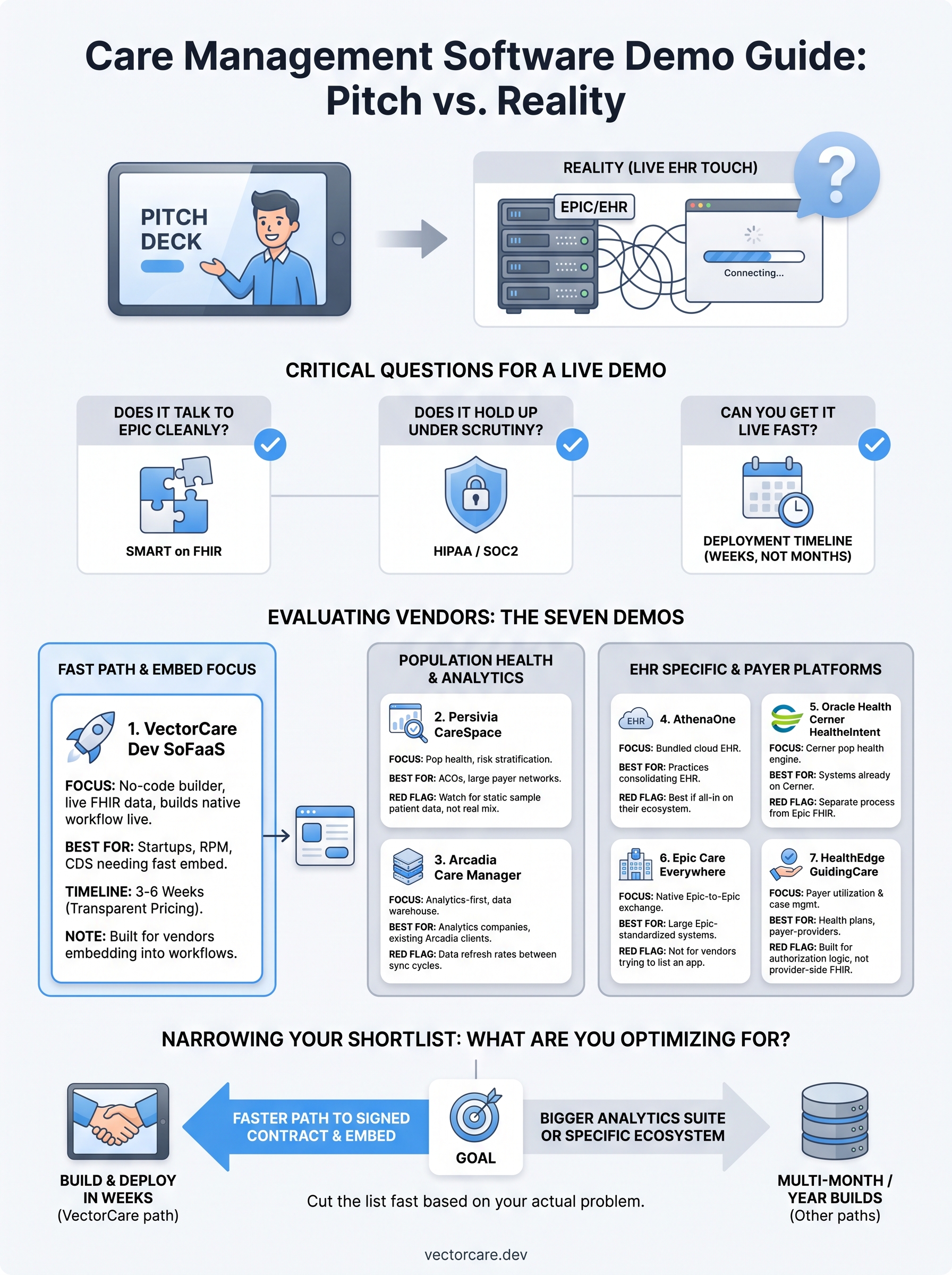
If you are booking a care management software demo, you already know the pitch decks rarely match what happens once the platform touches a real EHR. Vendors love to show polished dashboards, but the questions that matter for a health system contract are narrower: does it talk to EPIC cleanly, does it hold up under HIPAA and SOC2 scrutiny, and can your team actually get it live before the next budget cycle closes.
This list answers that directly. Instead of generic feature tours, you get seven demos worth your calendar time in 2026, chosen because each one shows how the vendor handles SMART on FHIR integration, workflow configuration, and support once you are past the sales call and into implementation. We built this from the perspective of vendors evaluating platforms to embed into clinical workflows, not hospital IT teams shopping for internal tools.
You will find what to ask during each live demo request, red flags that signal a slow or costly EPIC integration down the road, and how to compare deployment timelines across vendors so you are not stuck in a 12-month build when a 6-week path exists, starting with what actually drags an Epic build out.
1. VectorCare Dev SoFaaS
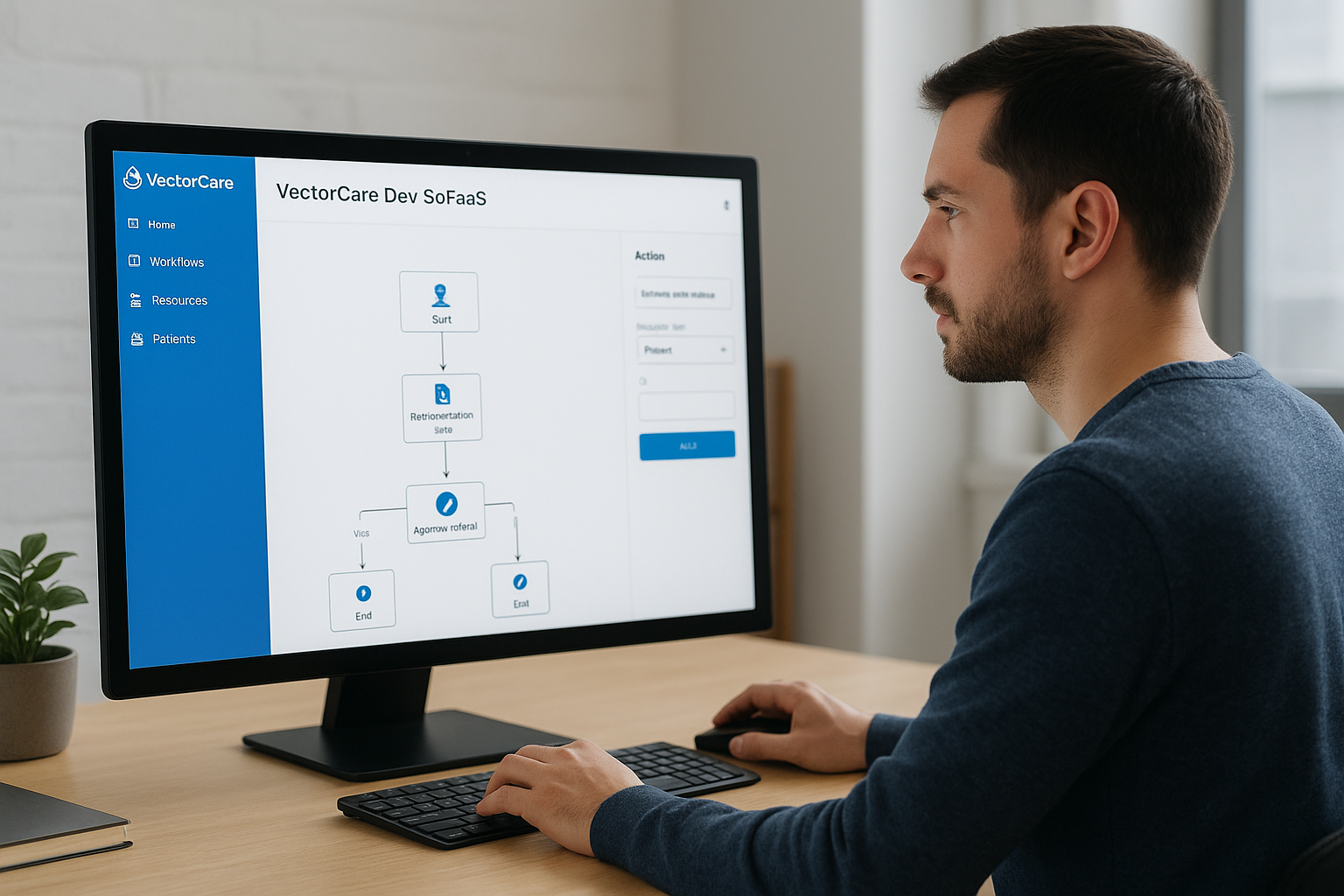
Unlike most vendors on this list, VectorCare isn't selling you a finished care management app. It's selling you the fastest path to building one that runs natively inside EPIC. When you request a VectorCare demo, expect to spend most of the call watching the no-code workflow builder configure a real intake or referral flow live, pulling actual FHIR resources instead of mock data. That distinction matters if your last EPIC integration attempt stalled in a 12-month engineering queue.
What the demo shows
A good VectorCare walkthrough starts with the visual FHIR configuration screen, showing pre-built actions that pull patient data through Epic's FHIR API without writing a single API call. From there, the team typically builds a sample decision tree or approval flow in real time, then shows how that workflow renders as an in-EPIC UI using ready-made templates for intake, orders, or assessments. Ask them to show the App Orchard submission dashboard too, since that's the step most vendors underestimate.
The real test of any EPIC integration demo isn't the dashboard, it's whether you can rebuild that workflow yourself the next day.
Who it's best for
This platform fits digital health startups, remote patient monitoring companies, and clinical decision support vendors that need EPIC embedded fast but don't have a dedicated FHIR engineering team. It's less useful if you're a hospital IT department managing an internal EHR instance rather than a vendor trying to get listed and adopted across multiple health systems.
Key features to evaluate
- Drag-and-drop workflow logic for routing, notifications, and approvals
- HIPAA and SOC2 compliance handled through signed BAAs
- EPIC Showroom listing management included in onboarding
- Connections beyond EPIC, including transportation, DME, and home health vendors for post-acute placement workflows
Pricing and implementation
VectorCare runs on a transparent pricing model: $500 per month plus $3,000 per month per live instance, compared to the $500K-plus custom builds most vendors quote. Implementation typically lands in 3 to 6 weeks, with the App Orchard listing fees included, versus the 12 to 18 months a from-scratch integration usually takes.
2. Persivia CareSpace
Persivia CareSpace targets population health teams that need one platform for care coordination and risk stratification across multiple payer contracts. If your organization runs value-based care programs alongside fee-for-service work, this demo is worth booking to see how it unifies those data streams.
What the demo shows
Most demos open with the population health dashboard, showing risk scores pulled from claims and clinical data side by side. The sales team then walks through a care plan build, showing how tasks route to case managers based on risk tier. Push them to show real EPIC data flowing in live, not a static screenshot, since some Persivia demos lean heavily on curated sample patients.
A demo that only shows sample patients tells you nothing about how the platform handles your actual patient mix.
Who it's best for
This platform suits accountable care organizations and large payer-provider networks managing thousands of attributed lives. Smaller vendors without an existing population health contract will likely find it overbuilt for their needs.
Key features to evaluate
- Risk stratification models tied to claims and clinical data
- Care plan templates configurable by condition or program
- Reporting built for value-based contract requirements
- Integration options across multiple EHR vendors, not EPIC alone
Pricing and implementation
Persivia doesn't publish pricing publicly. Expect a custom quote based on covered lives, and budget several months for implementation given the data integration scope involved.
3. Arcadia Care Manager
Arcadia Care Manager pitches itself as the analytics-first option, built for organizations that already lean on Arcadia's population health data warehouse. Requesting this demo makes sense if your team wants care management workflows tied directly to the same analytics engine driving your quality reporting, rather than bolted on as a separate system.
What the demo shows
Expect the walkthrough to open with Arcadia's data aggregation layer, pulling clinical, claims, and SDOH data into a single patient record before ever touching a care plan. The team then demonstrates task assignment and care plan documentation layered on top of that record. Ask specifically how the platform handles EPIC data refresh rates, since some demos gloss over how current the aggregated record actually stays between sync cycles.
An analytics platform is only as useful as the freshness of the data feeding it.
Who it's best for
This tool suits healthcare analytics companies and larger provider groups already running Arcadia's population health suite. Vendors without an existing Arcadia contract will find the onboarding heavier than a standalone care management tool.
Key features to evaluate
- Unified patient record combining clinical, claims, and social data
- Task and care plan tools tied to risk scoring
- Reporting built for quality measure tracking
- EPIC connectivity through standard interface engines
Pricing and implementation
Arcadia requires a custom enterprise quote, and implementation typically runs several months given the data warehouse setup involved.
4. AthenaOne by Athenahealth
AthenaOne bundles care management into a broader cloud-based EHR platform, which makes it a fit for organizations that want one vendor for scheduling, billing, and clinical workflows instead of stitching a separate care management tool onto an existing EHR. Booking this demo makes sense if you're already running athenahealth or considering a full platform switch rather than a point solution.
What the demo shows
Sales teams typically start with the patient engagement dashboard, showing outreach tasks and care gaps flagged automatically from claims and clinical data. From there, expect a walkthrough of care plan documentation embedded directly in the same chart a provider uses for visits. Push for a live look at how the platform handles EPIC data when a patient's record lives across two systems, since athenahealth's interoperability story works best when your organization is fully on their EHR.
A bundled platform only saves you time if you're ready to live inside its entire ecosystem, not just its care management module.
Who it's best for
AthenaOne suits ambulatory practices and mid-size health systems willing to consolidate their EHR and care management under one vendor. It's a poor fit for vendors needing to embed a standalone tool inside a health system that already runs EPIC.
Key features to evaluate
- Automated care gap identification tied to claims data
- Patient outreach and engagement task queues
- Care plan documentation inside the same clinical chart
- Interoperability tools for data exchange with outside EHRs
Pricing and implementation
Athenahealth prices per provider per month, with care management typically bundled into broader EHR contracts. Implementation runs several months and depends heavily on how much of the platform you're adopting beyond care management alone.
5. Oracle Health Cerner HealtheIntent
HealtheIntent is Oracle Health's population health engine, built on the old Cerner infrastructure and still the go-to choice for health systems running Cerner as their primary EHR. Requesting this demo makes sense if your target hospitals sit on Cerner rather than EPIC, since the two platforms don't share a submission process or a common FHIR configuration approach, and listing on Cerner means going through the Oracle Health Developer Program.
What the demo shows
Expect the session to open with the data aggregation platform, pulling clinical, claims, and device data into a longitudinal patient record. From there, the team demonstrates care plan creation and task assignment layered on top of that record, plus dashboards for identifying gaps in care across a population. Ask directly how the platform handles cross-EHR data when a patient touches both Cerner and EPIC systems, since that scenario trips up a lot of vendors mid-implementation.
A platform built for one EHR ecosystem rarely bridges cleanly into another without real engineering work.
Who it's best for
HealtheIntent suits health systems and vendors already committed to the Cerner ecosystem, particularly those managing value-based contracts across Cerner-based hospitals. Vendors targeting EPIC-dominant markets should look elsewhere.
Key features to evaluate
- Longitudinal patient record across Cerner and connected sources
- Population-level gap-in-care identification
- Care plan and task management tools
- Interoperability options for non-Cerner data sources
Pricing and implementation
Oracle Health negotiates enterprise contracts case by case, and implementation typically spans many months given the data warehouse and integration scope involved.
6. Epic Care Everywhere
Care Everywhere is Epic's own interoperability network, built to let providers exchange records across health systems that all run Epic. Booking this demo makes sense if you're evaluating whether native EPIC integration through Epic's own tools beats a third-party build, especially if your target hospitals already lean on Care Everywhere for referrals and transitions of care.

What the demo shows
Expect the walkthrough to center on cross-organization record exchange, showing how a patient's history pulls in automatically when they show up at a different Epic-based facility. The team then demonstrates how care team members see shared care plans and alerts across those organizations. Ask how the platform handles non-Epic systems in the mix, since Care Everywhere works best when everyone involved runs Epic.
Epic's own tools solve interoperability inside its ecosystem, but they don't solve the problem of getting your app listed and adopted there.
Who it's best for
This fits large health systems and integrated delivery networks already standardized on Epic across multiple facilities. Vendors trying to embed a standalone service into Epic won't find a path here at all, so start instead with the route vendors take to ship an app inside Epic.
Key features to evaluate
- Automatic record retrieval across Epic organizations
- Shared care plan visibility for referring providers
- Alerts for care transitions and admissions
- Limited support for non-Epic data sources
Pricing and implementation
Care Everywhere ships as part of an existing Epic license, with no separate published price and implementation tied to your organization's broader Epic build.
7. HealthEdge GuidingCare
GuidingCare is HealthEdge's care management platform built for payers running utilization management, case management, and disease management programs under one roof. Health plans and risk-bearing provider groups request this demo when they need utilization management workflows tied directly to authorization and claims data instead of a bolt-on tool.
What the demo shows
Expect the session to open with authorization workflow automation, showing how a request moves from intake through clinical review to approval or denial with audit trails built in, much like electronic prior authorization inside Epic. The team then walks through case management queues, showing how care managers get assigned members based on risk or program eligibility. Ask how the platform pulls clinical data from EPIC-based providers, since GuidingCare's strength is payer workflows, not provider-side FHIR integration.
A platform built around authorization logic solves a different problem than one built to embed inside a clinical workflow.
Who it's best for
GuidingCare suits health plans and payer-provider hybrids running utilization management and disease management programs at scale. Vendors trying to embed a service directly into a hospital's EPIC workflow won't find that path here.
Key features to evaluate
- Utilization management and prior authorization workflows
- Case and disease management task queues
- Appeals and grievance tracking
- Reporting built for payer compliance requirements
Pricing and implementation
HealthEdge quotes custom payer contracts, with implementation typically running six months or longer depending on how many modules you adopt.
Narrowing down your shortlist
Seven demos is a lot of calendar time, so cut the list fast. If your target hospitals run Cerner, skip straight to HealtheIntent. If you're a payer running utilization management, GuidingCare earns the call. But if you're a vendor trying to get a service embedded inside EPIC, running live in weeks instead of quarters, most of this list works against you rather than for you.
Oracle Health, Epic's own tools, and the payer platforms all solve problems adjacent to yours, not the actual one: getting your app built, compliant, and listed in the App Orchard without a 12-month engineering sprint. That gap is exactly why VectorCare exists on this list at all.
Before you book another demo, ask yourself what you're actually optimizing for: a bigger analytics suite, or a faster path to a signed health system contract. If it's the second one, see how VectorCare lets you build and deploy your SMART on FHIR app in days, and what a 3 to 6 week build actually looks like.
The Future of Patient Logistics
Exploring the future of all things related to patient logistics, technology and how AI is going to re-shape the way we deliver care.
Thank you! Your submission has been received!
Oops! Something went wrong while submitting the form.