Home Health Software Pricing: What You'll Actually Pay

If you sell home health software, you already know home health software pricing varies wildly depending on who you ask. One vendor quotes a flat monthly fee, another charges per patient census, and a third won't give you a number until you sit through a 45-minute demo. That inconsistency makes it hard to budget, compare vendors, or explain your own pricing to prospective health system clients.
This article breaks down what agencies and vendors actually pay, from base licensing fees that start around $300 to $500 per month for small agencies up to enterprise contracts running $50,000 or more annually. You'll see how per-patient, per-user, and tiered pricing models stack up, plus what typically gets bundled versus billed as an add-on.
We also cover the cost most pricing pages skip entirely: EPIC integration. If your platform needs to connect with EPIC EHR systems to win health system contracts, that line item can add hundreds of thousands of dollars and over a year to your timeline unless you know where those costs actually come from and how to avoid them with a faster integration path.
Why home health software pricing varies so much
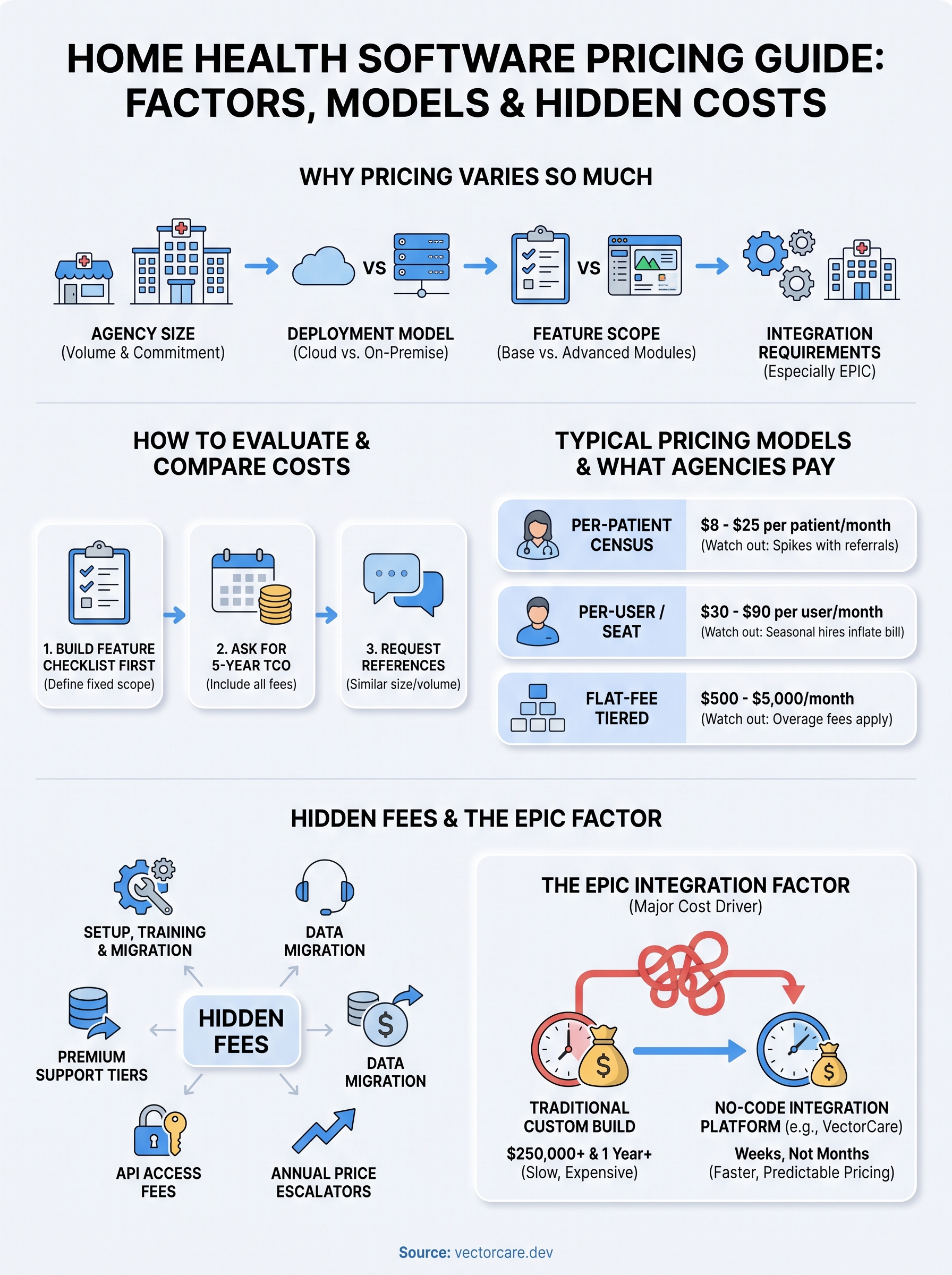
Agency size sits at the top of the list. A five-clinician home health startup and a 200-location enterprise agency are not buying the same product, even when both vendors call it "home health software." Small agencies pay flat monthly fees because vendors want predictable revenue from a low-volume account. Enterprise buyers negotiate custom contracts because they bring enough patient volume and multi-year commitment to justify a dedicated implementation team, custom reporting, and a named account manager. The sticker price you see on a vendor's website almost never reflects what a mid-size or large agency actually pays after negotiation.

Deployment model changes the math just as much. Cloud-based subscriptions bill monthly or annually and roll maintenance, hosting, and updates into the price. On-premise licenses, still common among agencies with older EHR systems, front-load a large purchase price and then charge separate annual maintenance fees, often 18-22% of the license cost every year. That means a system that looked cheaper upfront can cost more over a five-year period once you add maintenance, server hardware, and the IT staff needed to keep it running.
Feature scope is the third variable, and it's the one vendors are least transparent about. A base license usually covers scheduling, basic clinical documentation, and billing. Everything past that, telehealth modules, remote patient monitoring integrations, advanced analytics dashboards, or state-specific compliance reporting, gets priced separately. Two vendors quoting "$400 per month" might be describing completely different feature sets, which is why side-by-side price comparisons without a feature checklist are close to meaningless.
| Agency Profile | Typical Deployment | Monthly Cost Range | What Drives the Price |
|---|---|---|---|
| Solo or small agency (1-3 branches) | Cloud subscription | $300 - $800 | Per-user or flat licensing fee |
| Mid-size regional agency (4-15 branches) | Cloud subscription | $1,500 - $6,000 | Per-patient census plus add-on modules |
| Enterprise agency (16+ branches) | Cloud or hybrid | $8,000 - $50,000+ | Custom contract, dedicated support, integrations |
Integration requirements push costs even higher
Once a vendor needs to connect its software to a hospital's or health system's EHR, the pricing conversation changes entirely. EPIC integration in particular introduces engineering costs that dwarf the base software license: FHIR API development, OAuth 2.0 authentication, ongoing App Orchard fees and maintenance, and compliance work for HIPAA and SOC2. Vendors who build this in-house commonly report spending $250,000 or more in engineering time before their app ever reaches a health system's live environment, and the reasons those builds drag on compound fast if the integration touches multiple EPIC modules.
The biggest swing in home health software pricing rarely comes from the base license. It comes from what it costs to connect that software to a hospital's EHR.
That single fact explains why two vendors selling nearly identical home health platforms can post wildly different total costs to a health system client. One vendor absorbed a year of custom EPIC development; the other used a no-code integration platform like VectorCare's SMART on FHIR builder to reach the EPIC Showroom in weeks instead of months. Both are technically "home health software," but only one carries the hidden weight of a six-figure integration project baked into its pricing.
Understanding which of these four factors, agency size, deployment model, feature scope, or integration requirements, is driving a specific quote is the first step toward comparing vendors honestly instead of comparing marketing pages.
How to evaluate and compare software costs
Getting an apples-to-apples comparison starts with defining exactly what you're comparing before you ask a single vendor for a number. Most buyers request a quote first and try to reverse-engineer the feature list later, which is backwards. Instead, build a feature checklist that lists every capability your agency actually needs, then send that same checklist to every vendor you're evaluating. This forces vendors to price against a fixed scope instead of steering you toward whatever bundle makes their number look best.
A vendor's quote only means something once you know exactly what it does and doesn't include.
Build a feature checklist before you call any vendor
Specific line items matter more than vague categories like "clinical documentation." A useful checklist typically covers:
- Scheduling and visit routing for field clinicians
- OASIS documentation and clinical charting
- Billing, claims submission, and revenue cycle tools
- Telehealth or remote patient monitoring modules
- State-specific compliance and reporting requirements
- EHR integration or EPIC integration capability, if you plan to sell into health systems
- Data migration support from your current system
Without this list in hand, you'll compare a $400/month quote against a $1,200/month quote with no idea why they differ, and vendors know that ambiguity works in their favor.
Ask for total cost of ownership, not just the quote
Quotes almost never reflect what you'll pay in year two. Ask every vendor for a five-year total cost of ownership figure that includes implementation fees, training, support tiers, and any planned price increases tied to patient volume growth. On-premise systems in particular hide costs in annual maintenance contracts that can run 20% of the original license fee, so a system that looks $10,000 cheaper upfront can end up costing more by year three.
Requesting references from agencies of a similar size closes the loop. Vendors will show you their best-case customers by default, so ask specifically for a reference agency with your patient volume and branch count. That conversation usually surfaces the add-on fees and support gaps that never make it into a sales deck, and it's the fastest way to find out whether a quoted price is realistic or a starting offer designed to be negotiated up later.
Typical pricing models and what agencies pay
Most home health platforms fall into one of three billing structures, and each one rewards a different kind of buyer. Per-patient census pricing charges based on the number of active patients in your system each month, which scales naturally with a growing agency but can spike unpredictably during a seasonal surge in referrals. Per-user or per-seat pricing charges for every clinician, scheduler, or biller who logs in, which works well for agencies with a stable staff count but penalizes seasonal hiring. Flat-fee tiers bundle a set number of users or patients into a fixed monthly price and charge overage fees once you cross the threshold, splitting the difference between the two.

Comparing the three models side by side
No model is objectively cheaper. The right fit depends on how your patient volume moves month to month.
| Pricing Model | Best For | Typical Range | Watch Out For |
|---|---|---|---|
| Per-patient census | Growing agencies with steady referral flow | $8 - $25 per patient/month | Costs spike during referral surges |
| Per-user/seat | Agencies with stable staffing | $30 - $90 per user/month | Seasonal hires inflate the bill fast |
| Flat-fee tiered | Predictable, budget-conscious buyers | $500 - $5,000/month | Overage fees once you exceed the tier |
Overage clauses deserve a closer look before you sign anything. Several vendors advertise a low flat-fee entry point, then quietly charge $15 to $40 per additional patient once you exceed the tier's cap, which erases the savings within two or three months of steady growth.
The cheapest quote on paper is rarely the cheapest bill twelve months later.
Questions worth asking every vendor before you commit include:
- What happens to my price if patient census doubles next quarter?
- Are implementation and training billed separately from the monthly fee?
- Is EPIC or other EHR integration priced as a bundled feature or a separate contract?
Regional market position also affects what agencies pay for otherwise similar software. Vendors selling into competitive metro markets tend to price aggressively to win volume, while those serving rural or underserved regions charge a premium tied to limited local competition. Understanding which model your vendor uses, and where the overage triggers sit, is the difference between a monthly bill you can forecast and one that surprises your finance team every quarter.
Hidden fees that can inflate your bill
Even a carefully negotiated quote can balloon once the invoices start arriving. Vendors rarely lie about their base price, but they also rarely volunteer the list of add-on charges that show up after implementation. If you're building your own home health software pricing page for a health system audience, knowing where these fees hide helps you price honestly instead of shocking a client three months into a contract.
Setup, training, and data migration charges
Before your first invoice reflects the advertised monthly rate, most agencies pay a one-time implementation fee that can run anywhere from $2,000 to $25,000 depending on how much of your existing data needs to migrate. Training is often billed separately too, either as a per-session fee or a per-seat charge for every clinician who needs onboarding. Data migration from a legacy EHR is the line item that surprises buyers most, since vendors frequently quote it as "custom pricing" rather than including a number up front.
Support tiers and integration surcharges
Basic email support usually comes bundled with the license, but phone support, a dedicated account manager, or guaranteed response times under four hours typically sit in a paid tier above it. Watch for these common add-ons before you sign:
- Priority or 24/7 support tiers, often $200-$1,000/month extra
- API access fees for connecting to third-party billing, analytics, or HIPAA compliance software tools
- Per-integration surcharges for each additional EHR or payer connection
- Annual price escalators tied to patient volume growth, sometimes 5-8% per year
The quote you sign is rarely the number you pay by year two.
EPIC connectivity deserves its own line in this conversation. Sold as a custom project, an EPIC integration alone can add $250,000 or more in engineering costs on top of every fee above, which is exactly why platforms like VectorCare exist to fold that cost into a flat $500/month plus $3,000/month per instance instead of a six-figure surprise. Reading every fee schedule line by line, and asking directly what happens to pricing as your patient census or integration count grows, is the only reliable way to keep a competitive quote from turning into an unaffordable one.
Finding the right fit for your budget
Pricing a home health platform honestly means separating the base license from the two costs that actually move the total: feature scope and EHR integration. Agencies can compare monthly rates all day, but the number that determines whether your software wins or loses a health system contract almost always comes down to how fast and how affordably you can connect to EPIC. Build that checklist, request total cost of ownership, and push every vendor to itemize their integration surcharges before you sign anything.
Getting the EPIC piece right is where most vendors overspend, either in cash or in time. Instead of budgeting $250,000 and a year for custom development, you can price a SMART on FHIR build the way it should be priced: flat, predictable, and fast. See how VectorCare lets you build and deploy your SMART on FHIR app in days, and get a real EPIC integration number before you write your next quote.
The Future of Patient Logistics
Exploring the future of all things related to patient logistics, technology and how AI is going to re-shape the way we deliver care.
Thank you! Your submission has been received!
Oops! Something went wrong while submitting the form.