Who Needs SOC 2 Compliance, and Is It Mandatory?

Every health system RFP you've seen probably asks the same question: are you SOC 2 compliant? If you're not sure whether that applies to you, or whether it's a nice-to-have versus a dealbreaker, you're not alone. Who needs SOC 2 compliance comes up constantly among founders trying to figure out what they actually have to build before they can sign a contract, and the answer isn't the same for every company.
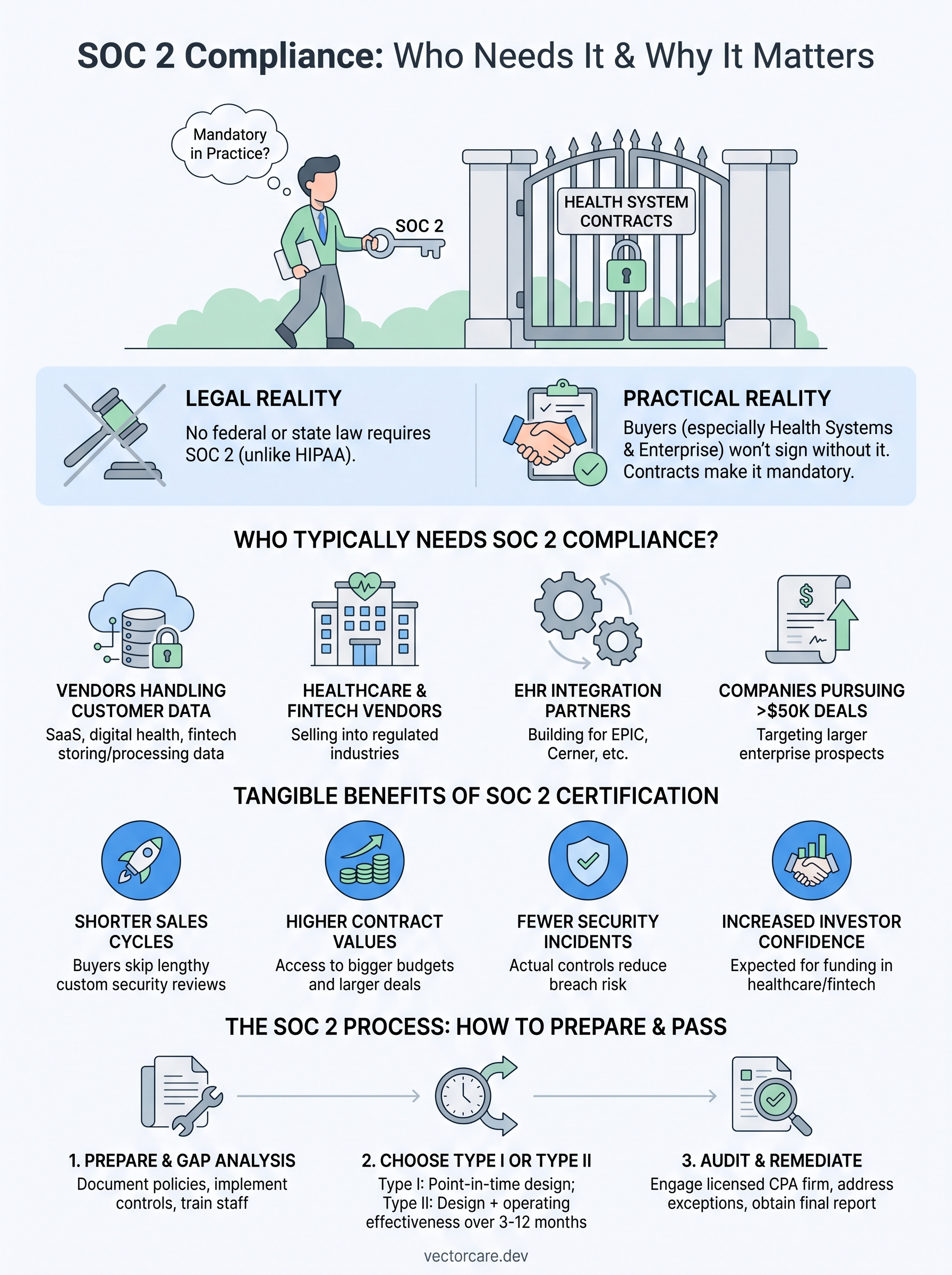
Here's the short version: SOC 2 isn't a legal requirement like HIPAA, but for most B2B software vendors handling customer data, especially in healthcare, fintech, or any SaaS selling into regulated industries, it's mandatory in practice. Health systems and enterprise buyers won't sign without it. So while no law forces you to get certified, your sales pipeline often will.
This article breaks down exactly who needs it, why it matters even when it's technically optional, and what the certification process involves, starting from what SOC 2 compliance actually covers. We work with digital health vendors building EPIC integrations every day, and SOC 2 questions come up in nearly every deal, so we'll walk through what you need to know before your next contract negotiation stalls over compliance.
Why SOC 2 compliance matters for your business
SOC 2 answers the question every buyer is really asking
When a health system's procurement team asks about your compliance posture, they're not testing your paperwork. They're asking a simpler question: can we trust you with patient data? SOC 2 gives them a standardized answer instead of a sales pitch. It's an independent audit, performed by a licensed CPA firm, that verifies your security controls actually work the way you say they do. That's why SOC 2 compliance is important in practice, even though it isn't a government mandate: it replaces months of back-and-forth security questionnaires with one document a buyer's legal and IT teams already know how to evaluate.
A SOC 2 report doesn't just describe your security controls, it proves someone independent checked them.
The five trust service criteria buyers care about
SOC 2 reports are built around five trust service criteria, and most companies only need to address the first one plus whichever others match their business model. Understanding these categories helps you see exactly what a buyer is checking for when they request your report.

| Trust Service Criteria | What it covers | Who typically needs it |
|---|---|---|
| Security | Access controls, encryption, incident response | Every company pursuing SOC 2 |
| Availability | Uptime commitments, disaster recovery | SaaS platforms with SLAs |
| Processing Integrity | Data accuracy and completeness | Billing, claims, or transaction platforms |
| Confidentiality | Protection of sensitive business data | Vendors handling proprietary health system data |
| Privacy | Collection, use, and disposal of personal data | Companies processing PHI or PII directly |
Most digital health vendors end up scoping their audit around Security, Availability, and Confidentiality, since those map directly to what a hospital IT security team wants to see before granting API access to their EHR.
What happens when you skip it
Skipping SOC 2 doesn't get you arrested, but it does get your deal stuck. Enterprise procurement cycles routinely stall for weeks while a vendor scrambles to answer a 200-question security assessment they could have shortcut with an existing report. Health systems in particular are risk-averse after years of high-profile breaches, and they've learned to treat SOC 2 as a baseline filter, not a bonus. Vendors without it often get quietly moved to the bottom of the vendor shortlist, not because their product is worse, but because their compliance story takes longer to verify. If you're building anything that touches an EPIC instance, this filtering happens before you ever get a demo.
The tangible benefits of SOC 2 certification
Beyond unblocking sales conversations, there are concrete benefits of getting SOC 2 certified that compound over time:
- Shorter sales cycles: buyers skip lengthy custom security reviews when you hand them an existing report.
- Higher contract values: enterprise and health system deals often require SOC 2 as a floor, so you gain access to bigger budgets.
- Fewer security incidents: the controls you build to pass the audit (access logging, encryption, vendor management) reduce your actual breach risk, not just your paperwork risk.
- Investor confidence: many venture and growth-stage investors now expect SOC 2 as part of standard diligence for healthcare and fintech startups.
- Internal clarity: the audit forces you to document processes that founders often carry around only in their heads, which matters as your team scales.
Taken together, these reasons explain why companies get SOC 2 certification even when no regulator requires it. It's less about compliance for its own sake and more about removing friction from every deal that involves sensitive data. If you're building a SMART on FHIR app for EPIC integration, VectorCare's platform bakes SOC 2-aligned controls into deployment from day one, so this isn't a separate project you have to staff and manage on top of your integration work.
How to know if your company needs SOC 2 compliance
Signals you're already a candidate
Ask yourself one question first: does your product touch, store, or process data that belongs to someone else's customers or patients? If yes, you're already in the pool of companies that typically need SOC 2. Digital health startups, remote patient monitoring vendors, clinical decision support tools, and healthcare analytics platforms almost always qualify, because they sit between a health system's data and the outside world. The same goes for fintech tools handling account data and any SaaS product that plugs into a larger enterprise's systems. Who needs SOC 2 certification really comes down to one thing: whether a bigger, more risk-averse organization has to trust you with something they can't easily verify themselves.
If a buyer's IT security team has to approve your access before you go live, you probably need SOC 2.
A quick self-check
Before you invest months into an audit, run through this checklist. The more boxes you check, the stronger the case that SOC 2 isn't optional for your growth plans:
- You store, process, or transmit protected health information (PHI) or personally identifiable information (PII)
- Your product integrates with an EHR system like EPIC, Cerner, or Athenahealth
- Enterprise or health system prospects have asked for a security questionnaire, SOC 2 report, or "proof of compliance" during sales
- You've lost or stalled a deal because of unanswered security concerns
- Your investors or board have flagged compliance as a growth blocker
- You're targeting contracts above $50K annually with regulated industries
Companies that check two or more of these usually can't avoid the conversation for long. It tends to surface the moment you move from pilot customers to real procurement processes.
Company stage matters more than company size
Founders often assume SOC 2 is only for large, established companies, but that's backwards. Early-stage vendors selling into health systems face the same audit requirements as a 200-person company, because the health system's compliance team doesn't scale its requirements down for smaller vendors. A five-person startup building a SMART on FHIR app for EPIC faces the identical bar as an established analytics platform. What changes with size isn't whether you need it, it's how painful the process is without the right infrastructure already in place.
When you can reasonably wait
Not every company needs SOC 2 on day one. If you're pre-revenue, still validating product-market fit with a handful of design partners under signed data processing agreements, and nowhere near a health system contract, you can defer the audit without real risk. The moment that changes is the moment a prospect's procurement team sends you a security questionnaire longer than your product roadmap. That's your signal to start the clock, because the audit itself takes months, not weeks.
Is SOC 2 compliance actually mandatory?
No federal or state law requires it
Legally, nothing forces you to get SOC 2 certified. There's no statute like HIPAA that says "you must complete a SOC 2 audit before selling software." Is SOC 2 compliance mandatory in a legal sense? No. The American Institute of CPAs (AICPA) developed the framework as a voluntary reporting standard, and no regulator enforces it the way the HHS Office for Civil Rights enforces HIPAA. You could, in theory, run a healthcare SaaS company for years without ever completing an audit and never face a fine or legal penalty for skipping it.
SOC 2 isn't a law you can break, it's a contract you can't win without.
Contracts turn it into a practical requirement
Once you look past the legal question, the picture changes fast. Health systems, hospital IT departments, and enterprise procurement teams routinely write SOC 2 into vendor requirements before they'll sign a contract or grant EHR access. Their own compliance policies, cyber insurance terms, and board-level risk frameworks often require them to only work with vendors who carry a current report. So the mandate doesn't come from Washington, it comes from your buyer's legal department. If your growth plan depends on selling into hospitals, payers, or large enterprises, treat SOC 2 as a hard requirement even though no statute names it.
How SOC 2 differs from actual legal obligations
This distinction matters because founders sometimes confuse SOC 2 with regulations they can't opt out of. Comparing the two side by side makes the difference clear:
| Requirement | Legally mandated? | Enforced by |
|---|---|---|
| HIPAA | Yes | HHS Office for Civil Rights |
| State breach notification laws | Yes | State attorneys general |
| SOC 2 | No | Contracts, procurement teams, investors |
| HITRUST | No | Contracts, procurement teams |
Even though SOC 2 sits in the "not legally mandated" column, it often functions as the gatekeeper that determines whether you get the chance to demonstrate you meet HIPAA compliance requirements in the first place. Buyers use it as a proxy for trustworthiness before they'll even review your Business Associate Agreement.
The bottom line for vendors weighing the decision
Given that reality, most vendors selling into healthcare or other regulated industries stop asking whether SOC 2 is legally required and start asking whether they can afford to lose deals without it. Skipping the audit doesn't expose you to fines, but it does expose you to a sales pipeline that stalls at the security review stage, over and over, deal after deal. For companies with health system customers on their roadmap, that's a cost far higher than the audit itself.
How to prepare for and pass a SOC 2 audit
Getting ready for a SOC 2 audit is less about scrambling before a deadline and more about building habits your team can sustain. Preparing for SOC 2 usually starts months before an auditor ever looks at your systems, with a gap analysis that compares your current controls against the trust service criteria you're scoping. Most vendors hire a readiness consultant or use compliance software to run this first pass, since finding gaps yourself after the audit starts is far more expensive than finding them before.
Type I versus Type II: pick the right starting point
Before you prepare anything, decide whether you're pursuing a Type I or Type II report. A Type I report checks whether your controls are designed correctly at a single point in time. A Type II report checks whether those controls actually operated effectively over a period, usually three to twelve months. Health systems increasingly ask for Type II specifically, because it proves your controls hold up over time, not just on paper.
| Report type | What it proves | Typical timeline | Buyer perception | |---|---|---| | Type I | Controls are designed properly | Weeks after readiness | Acceptable starting point | | Type II | Controls worked consistently over time | 3-12 month observation period | Preferred by enterprise buyers |
A Type I report shows you built the right locks. A Type II report shows you actually kept them locked.
The core steps to get audit-ready
Most successful audits follow a similar audit checklist, regardless of company size:
- Run a gap analysis against your chosen trust service criteria
- Document policies for access control, incident response, and vendor management
- Implement technical controls: encryption, logging, multi-factor authentication
- Train employees on security policies and keep records of that training
- Choose a licensed CPA firm to perform the actual audit
- Complete the observation period (Type II) or point-in-time review (Type I)
- Remediate any exceptions the auditor flags before the final report ships
Skipping documentation is the most common reason companies fail their first attempt. Auditors don't just check whether you have a firewall, they check whether you can prove who approved the firewall rules and when.
Where teams get stuck without infrastructure
Narrowing down where audits stall reveals a pattern: teams without existing infrastructure spend most of their time building basic security plumbing instead of preparing evidence. Why get SOC 2 certification becomes a much easier question to answer once you realize the actual bottleneck isn't the audit itself, it's the six months of engineering work most companies do beforehand to even qualify for one. Platforms that bake compliant controls into deployment from the start, rather than bolting them on after the product ships, cut that runway dramatically. For vendors building EPIC integrations specifically, that difference often determines whether you make a hospital's procurement deadline or miss the contract cycle entirely.
SOC 2 compliance for healthcare and EPIC integration vendors
Why EPIC integrations raise the bar even higher
Building a SMART on FHIR app that touches an EPIC instance puts you in a category where SOC 2 stops being a nice-to-have and becomes table stakes. EPIC integration vendors sit closer to the patient record than almost any other type of health tech vendor, since your app is pulling live clinical data through an authenticated connection into a hospital's core system. Health system security teams know this, so they scrutinize EPIC-connected vendors harder than a typical SaaS purchase. If you're wondering who needs SOC 2 certification most urgently in digital health, it's exactly this group: companies whose product literally lives inside the EHR workflow.
What EPIC's App Orchard reviewers actually check
Getting listed on EPIC's App Orchard, now the Showroom, involves its own technical and security review, separate from whatever a specific hospital's IT team requires. A current SOC 2 report smooths that review considerably, because it answers many of the same questions EPIC's team would otherwise ask you individually. Vendors preparing for listing typically need to show:

- Documented access controls over who can view or modify patient data
- Encryption in transit and at rest for any FHIR resources you handle
- A named security contact and incident response process
- Evidence of ongoing monitoring, not just a one-time security review
- A signed Business Associate Agreement template ready for health system partners
Without SOC 2, you're answering EPIC's security questions from scratch; with it, you're handing over proof someone already verified the answers.
HIPAA, SMART on FHIR, and SOC 2 working together
None of these frameworks replace each other, and health systems expect vendors to satisfy all three simultaneously. HIPAA governs how you handle protected health information legally. SMART on FHIR governs how your app authenticates and exchanges data with EPIC technically. SOC 2 governs whether an independent auditor has verified your security controls actually work. A vendor missing any one of these three typically stalls somewhere in procurement, even if the other two are solid. Compliance requirements for EPIC vendors aren't a checklist you complete once, they're an overlapping set of standards you maintain continuously as your app scales across new health systems.
Why most vendors don't build this alone
Stitching together SOC 2-aligned infrastructure, SMART on FHIR compliance, and an App Orchard submission from scratch is exactly why Epic integration drags on for months and stalls smaller vendor teams. VectorCare's no-code platform builds SOC 2-aligned controls, HIPAA-ready hosting, and SMART on FHIR compliance directly into every app it deploys, and it manages the entire Showroom submission process as part of the build. Instead of staffing a compliance project alongside your integration work, you launch with the controls already in place, which is how vendors using the platform get from concept to a live EPIC listing in weeks instead of the year-plus timeline custom development usually requires.
Making sense of your SOC 2 decision
SOC 2 isn't a law, but for most vendors selling into health systems, fintech, or any enterprise buyer, it functions like one. No regulator requires it, yet almost no serious procurement team will sign a contract without it. If your product touches patient data, plugs into an EHR, or sells to risk-averse buyers, the question isn't whether you need it, it's how fast you can get there without stalling your pipeline for months.
That's the real cost of skipping it: not fines, but deals that never close. Building SOC 2-aligned controls into your product from day one, rather than retrofitting them after a lost contract, is what separates vendors who hit their sales targets from those still answering security questionnaires a year later.
If you're building a SMART on FHIR app for EPIC, don't staff a separate compliance project. Build and deploy your SMART on FHIR app in days, with SOC 2-aligned controls already in place.
The Future of Patient Logistics
Exploring the future of all things related to patient logistics, technology and how AI is going to re-shape the way we deliver care.
Thank you! Your submission has been received!
Oops! Something went wrong while submitting the form.