SSAE 16 SOC 2 Compliance: What It Is and How It Works

If you're vetting a vendor or getting ready for a health system contract, you've probably seen ssae 16 soc 2 compliance listed as a requirement and wondered if it's one standard or two. It's a common mix-up, and getting it wrong on a security questionnaire can stall a deal for weeks. The terms get used interchangeably so often that most people assume they're the same thing.
They're not. SSAE 16 is an auditing standard that expired years ago, replaced by SSAE 18, while SOC 2 is the actual report your auditor produces under that standard. Understanding ssae 16 soc 2 certification means knowing which term describes the audit process and which describes the deliverable you hand to a prospect or partner. This distinction matters most when you're comparing an ssae 16 soc 2 type 2 certification against a Type 1, since one proves your controls exist and the other proves they actually worked over time.
This article breaks down what each term means, how they connect, and what a service organization actually needs to do to get compliant, so you can answer questions confidently instead of guessing at acronyms during a sales call or vendor review.
Why SSAE 16 SOC 2 compliance matters for healthcare vendors
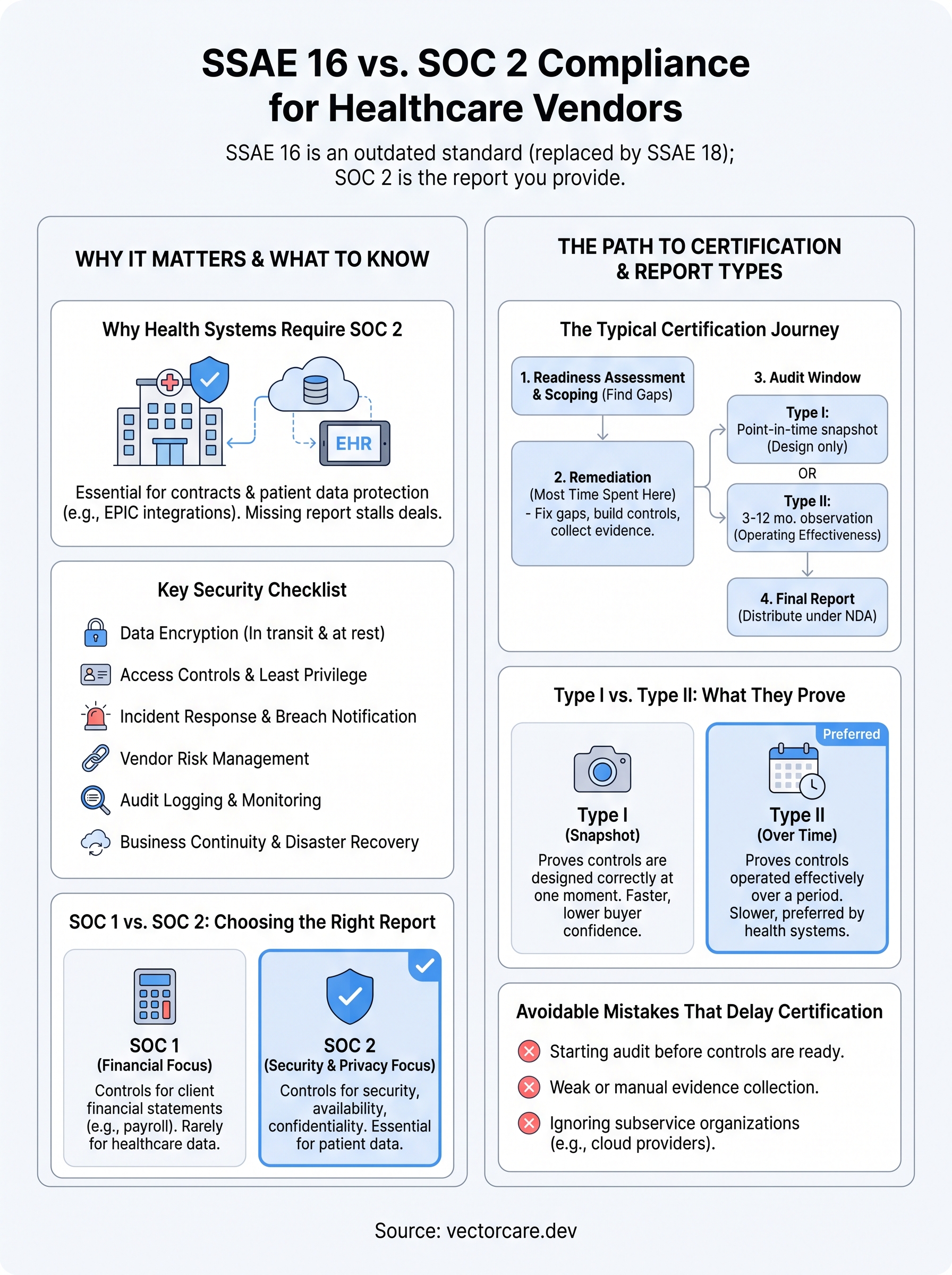
Health systems don't sign vendor contracts without proof that your organization protects patient data properly. When you're building an integration that touches protected health information inside an EPIC instance, a hospital's security team will ask for your SOC 2 report before they'll even schedule a technical review. Skip this step and your deal stalls in procurement, no matter how good your product is. For digital health vendors and RPM platforms writing observations into the chart, SOC 2 compliance isn't a nice-to-have credential, it's the entry ticket to the conversation.

What health systems actually check for
Every health system security review follows a similar pattern, even when the questionnaire looks different from one hospital to the next. Reviewers want proof that you've addressed the same handful of risk areas auditors evaluate under the AICPA's trust services criteria, and they're not interested in taking your word for it. Here's what typically shows up on a vendor security checklist:
- Data encryption in transit and at rest
- Access controls and least-privilege permissions
- Incident response and breach notification procedures
- Vendor risk management for your own subcontractors and cloud providers
- Audit logging and monitoring of PHI access
- Business continuity and disaster recovery plans
Miss even one of these and you'll get sent back for clarification, adding weeks to a process that's already slow.
The cost of failing a security review
Losing a contract over a missing compliance document is one of the more avoidable ways to burn a sales cycle. A typical health system procurement cycle already runs three to six months; a failed or incomplete security review can tack on another 60 to 90 days, or kill the deal outright if a rival vendor already has their SOC 2 report ready to hand over. Clinical decision support platforms shipping into hospitals and medical device companies competing for the same hospital contracts often lose not because their product is worse, but because their compliance paperwork wasn't ready when procurement asked for it.
A missing SOC 2 report doesn't just slow down a deal, it hands the contract to whichever competitor already has theirs.
SOC 2 and EPIC App Orchard submissions
Submitting an app to EPIC's App Orchard or Showroom raises the bar even further, since EPIC expects vendors to demonstrate HIPAA safeguards and a signed Business Associate Agreement before listing goes live. A current SOC 2 report backs up those claims with independent, third-party verification instead of a self-attestation nobody can check. Platforms like VectorCare build this expectation into the deployment process itself, bundling HIPAA and SOC 2 compliance work with the technical build so vendors aren't scrambling to produce an audit report after they've already committed to a launch timeline with a health system.
How to achieve SSAE 16 SOC 2 compliance
Getting to SSAE 16 SOC 2 compliance, step by step isn't a single certificate you apply for. It's a process where an independent CPA firm examines your controls against the AICPA's trust services criteria and issues a report on what they found. Before an auditor ever shows up, you need documented policies, working technical controls, and evidence that both have been in place long enough to test. Most service organizations underestimate how much groundwork happens before the audit clock even starts.
The typical path to certification
Here's the sequence most healthcare vendors follow when preparing for their first audit:
- Scope the audit by choosing which of the five trust services criteria apply (security is mandatory, availability and confidentiality usually follow for healthcare data).
- Run a readiness assessment to find gaps between your current controls and what the criteria require.
- Remediate gaps in access management, encryption, logging, and vendor oversight.
- Select a licensed CPA firm to perform the formal examination.
- Complete the audit window, which spans a point in time for Type 1 or three to twelve months of observation for Type 2.
- Receive your report and distribute it under NDA to prospects and health system procurement teams.
You can't shortcut the observation period. A Type 2 report only proves controls worked, and that takes months of evidence, not a weekend of paperwork.
Where most of the work actually happens
Remediation eats most of the timeline, not the audit itself. Teams without dedicated compliance staff often spend three to four months just building the access reviews, encryption standards, and incident response documentation an auditor expects to see. Software platforms built for SOC 2 compliance automation can cut that down by continuously monitoring controls instead of scrambling to produce evidence right before the audit window opens.
Skipping the readiness assessment is the mistake that costs vendors the most time. Vendors that jump straight to hiring an auditor without first mapping their control gaps usually get a report full of exceptions, which defeats the purpose of getting certified in the first place. Fixing gaps mid-audit is slower and more expensive than fixing them before the auditor arrives.
SOC 1 vs SOC 2: choosing the right report
Confusing these two reports is almost as common as confusing SSAE 16 with SOC 2 itself. SOC 1 Type 2 reports cover controls relevant to a client's financial statements, think payroll processors, billing platforms, or payment gateways. SOC 2 reports cover controls relevant to security, availability, processing integrity, confidentiality, and privacy, which is exactly what a hospital's security team cares about when your app touches patient data. If your product doesn't process financial transactions on behalf of clients, SOC 1 isn't the report you need, no matter what a generic compliance checklist tells you.
Healthcare vendors almost always need SOC 2, not SOC 1, because health systems evaluate data protection, not accounting controls. A remote patient monitoring company transmitting vitals data, or a clinical decision support tool pulling records through EPIC, has zero financial reporting exposure that would trigger a SOC 1 requirement. What they do have is protected health information flowing through their systems, which puts them squarely in SOC 2 territory under the security and confidentiality criteria.
If your app touches patient data instead of client financial statements, SOC 2 is the only report worth pursuing.
Quick comparison
| Factor | SOC 1 | SOC 2 |
|---|---|---|
| Focus | Financial reporting controls | Security, availability, confidentiality, privacy |
| Typical audience | Auditors of client financials | Health systems, enterprise security teams |
| Common users | Payroll, billing, payment processors | Digital health, SaaS, cloud vendors |
| Relevant to healthcare vendors | Rarely | Almost always |
Running both audits when only one applies wastes budget and stretches an already tight timeline. Some vendors assume more paperwork signals more trust, but a health system reviewer will simply ask why you're handing them a report that doesn't answer their actual security questions. Sticking to the report that matches your business model saves months of unnecessary audit work and gets a relevant document in front of procurement faster.
Type I vs Type II: what SOC 2 certification requires
Once you've settled on SOC 2 over SOC 1, the next decision is which type of report to pursue. Type I evaluates whether your controls are designed properly at a single point in time, like a snapshot of your security posture on the day the auditor looks, and the differences, timelines, and costs between the two types follow from that.name Type II goes further, testing whether those same controls actually operated effectively over an extended window, usually three to twelve months. A health system reviewer treats these very differently: Type I tells them you built the right locks, Type II tells them you actually kept using them.
A Type I report proves your controls exist. A Type II report proves they worked.
Why most healthcare vendors skip straight to Type II
Sophisticated buyers, and hospital procurement teams count as sophisticated buyers, usually ask for a SOC 2 Type II report outright. An ssae 16 soc 2 type 2 certification, which is technically an attestation rather than a certification, carries more weight because it demonstrates sustained compliance, not a one-time effort staged for an auditor's visit. Some vendors start with Type I to get a report in hand faster, then follow up with Type II once they have enough operating history. That's a reasonable bridge strategy if you're racing to close a deal, but plan on the Type II audit starting almost immediately after, since most contracts eventually require it anyway.
Comparing the two report types
| Factor | Type I | Type II |
|---|---|---|
| What it proves | Controls are designed correctly | Controls operated effectively over time |
| Audit window | Single point in time | 3 to 12 months of observation |
| Time to first report | Faster, often 6 to 8 weeks | Slower, tied to the observation period |
| Buyer confidence | Lower, seen as a starting point | Higher, expected by most health systems |
| Typical use case | Early-stage vendors needing something quickly | Vendors closing enterprise or hospital contracts |
Waiting for a full Type II report before signing your first customer isn't always realistic, especially for a startup racing a runway clock. Vendors under time pressure sometimes negotiate a shorter observation window, like three months instead of twelve, to get a valid Type II report faster without sacrificing the credibility a Type I alone can't provide.
Common mistakes that delay SOC 2 certification
Most delays in the SOC 2 audit timeline trace back to a handful of avoidable errors, not to the audit itself. Poor preparation and rushed scoping account for the majority of extended audit windows, and both are entirely within a vendor's control. Catching these mistakes before the auditor gets involved saves months, not weeks.
Starting the audit before controls are ready
Vendors under contract pressure sometimes hire an auditor before finishing remediation, hoping the audit process itself will force the missing controls into place. It doesn't work that way. Auditors document exceptions, not fix them, so a rushed start usually produces a report riddled with gaps that spooks a health system reviewer more than having no report at all.
Hiring an auditor before your controls are ready doesn't speed up certification, it just documents your gaps for prospects to see.
Weak evidence collection
Every control needs proof, not a policy document sitting in a shared drive nobody follows. Manual evidence gathering falls apart fast once an audit spans several months, because someone has to remember to screenshot access reviews, export logs, and track ticket closures every single cycle. Common gaps that show up during evidence review include:
- Access reviews that happened once but were never repeated on schedule
- Incident response plans that exist on paper but were never tested
- Encryption policies that don't match what's actually configured in production
- Vendor risk assessments that stopped after the initial onboarding
Ignoring subservice organizations
Many healthcare vendors run on top of cloud infrastructure, EHR middleware, or third-party APIs, and those subservice organizations carry their own control responsibilities. Skipping a review of how those partners handle security often surfaces mid-audit as a carve-out issue, forcing last-minute scrambling to document what the vendor assumed was someone else's problem. Confirming your key vendors already hold current SOC 2 reports before your audit starts avoids this entirely, and it's one reason working with a platform that already carries its own compliance work, rather than building integrations from scratch, removes an entire category of risk from your own certification timeline.
Staying audit-ready as standards evolve
Standards keep shifting, and SSAE 16 becoming SSAE 18 is proof that today's terminology won't stay fixed forever. Treat SOC 2 compliance as an ongoing discipline rather than a box you check once and forget. Auditors update trust services criteria, health systems tighten their vendor questionnaires, and the vendors who stay ready are the ones who keep evidence collection running year-round instead of scrambling before renewal.
Getting your SSAE 16 SOC 2 certification in place, and keeping it current, is what turns a promising product into a signable contract. If you're building a SMART on FHIR app for EPIC and don't want compliance work competing with your launch timeline, build and deploy your SMART on FHIR app in days and let the platform carry the HIPAA and SOC 2 groundwork while you focus on the integration itself.
The Future of Patient Logistics
Exploring the future of all things related to patient logistics, technology and how AI is going to re-shape the way we deliver care.
Thank you! Your submission has been received!
Oops! Something went wrong while submitting the form.