SOC 2 Compliance Training: What It Covers and Who Needs It

If you're building a digital health product that touches patient data, someone on your team eventually asks: do we need SOC 2 compliance training, and who actually has to sit through it? That question usually shows up right before a health system's security review, when it's already late to figure out the answer.
SOC 2 compliance training teaches your team the specific controls auditors check during a SOC 2 compliance audit: access management, change control, incident response, vendor risk, and how to document all of it consistently. It's not a single class. It ranges from short awareness sessions for general staff to deep technical training for engineers who own the systems under audit, and separate coaching for the people who'll sit in front of an auditor and explain your controls.
This article breaks down what SOC 2 training actually covers, which roles need which level of training, and how to build a program that gets your team audit-ready without wasting months on generic content. We'll also touch on where HIPAA and SOC2 compliance overlap, since most healthcare vendors need to satisfy both, and where a managed platform can shrink the compliance workload before you ever start building EPIC integrations.
Why SOC 2 compliance training matters for your business
Auditors don't take your word for it. During a SOC 2 audit, the auditor pulls a sample of employees and asks them to explain, in their own words, how access requests get approved or what happens when a laptop goes missing. If the answer doesn't match your written policy, that's a finding. SOC 2 compliance training exists to close that gap between what your SOC 2 policies and procedures say and what your staff actually does day to day. Skip it, and you're gambling that everyone on payroll happens to already understand SOC 2's Trust Services Criteria without ever being taught them.
Auditors test knowledge, not just documentation
Control walkthroughs are interviews, and interviews expose whoever wasn't trained. A developer who can't describe your change management process, or a support rep who doesn't know how to report a suspected breach, turns a routine control test into an exception on your report. Exceptions don't automatically fail an audit, but they slow it down, invite follow-up questions, and make health system security teams nervous when they review your SOC 2 report before signing a contract. For a healthcare vendor selling into hospitals, that hesitation can stall a deal for months.
A SOC 2 report only holds up if the people behind it can explain the controls it describes.
The real cost of skipping it
Untrained staff cause the kind of small, avoidable mistakes that snowball into audit exceptions or actual security incidents. The pattern shows up the same way across most companies that treat training as optional:
- Access reviews slip because nobody assigned the task or explained why it matters.
- Incidents go unreported because staff don't recognize what counts as a reportable event.
- Vendor risk gets ignored when engineers spin up a new SaaS tool without checking it against your third-party risk process.
- Onboarding and offboarding drift when new hires get system access before training and departing employees keep it after.
Each of these is a finding waiting to happen, and each one is preventable with a SOC 2 audit training program that actually reaches the people doing the work, not just the compliance team writing the policies.
Healthcare vendors carry extra weight
If your product touches patient data, your training obligations don't stop at SOC 2. Most digital health vendors need HIPAA and SOC2 compliance running side by side, since HIPAA's own requirements govern how you handle protected health information and SOC 2 governs the broader security posture health systems demand before they'll integrate with you. Training that only covers SOC 2 controls and ignores the HIPAA administrative safeguards, minimum necessary standard, or breach notification rules leaves a real gap, especially once you're pushing data through an EPIC integration where a health system's own security team will ask pointed questions about both frameworks. VectorCare builds HIPAA and SOC 2 compliance directly into the platform, including signed BAAs, so your team spends less time proving control knowledge from scratch and more time building the actual product.
Getting this right upfront also protects your sales pipeline. Health systems increasingly ask vendors for evidence of an active training program, not just a completed SOC 2 report, before they'll move forward with a security review. A stale training deck from two years ago won't satisfy that ask. Building a program that stays current, and that you can point to when a prospect's security team comes asking, is what the rest of this article covers.
How to build a SOC 2 training program that satisfies auditors
Building a program that survives an audit takes more than assigning a generic security awareness course once a year. Auditors want to see SOC 2 audit training mapped to your actual controls, delivered to the right people, and tracked with dates and completion records, the same way the rest of your SOC 2 audit checklist gets handled. Here's how to structure it so it holds up, the same discipline you'd use to prepare for a SOC 2 audit overall.
Start with your control list, not a course catalog
Grab your SOC 2 controls checklist before you shop for training content. Every control that names a human action, like approving access requests or reviewing vendor contracts, needs a matching piece of training that teaches someone how to perform it. Working backward from a generic curriculum instead leaves gaps auditors will find during control testing.
Training that doesn't trace back to a specific control won't survive a walkthrough.
Segment training by role, not by department
Junior engineers and your VP of engineering don't need the same session. Split content by what someone actually touches:
- General staff: security awareness, phishing recognition, incident reporting basics.
- Engineers and IT: access control, change management, encryption standards, secure development practices.
- Managers: approval workflows, offboarding responsibilities, vendor risk sign-off.
- Executives and control owners: policy ownership, audit interview prep, risk acceptance decisions.
Running everyone through identical content wastes time for advanced staff and overwhelms newer hires with details they don't need yet.
Set a cadence and stick to it
One-time training doesn't cut it for a SOC 2 compliance training program that needs to show continuity across an audit period, which typically runs six or twelve months. Most companies land on this rhythm:
| Training type | Frequency | Audience |
|---|---|---|
| Security awareness refresher | Annually | All staff |
| Role-specific control training | Annually or at role change | Control owners |
| New hire onboarding | Within first 2 weeks | New employees |
| Incident response tabletop | Annually | Engineering, IT, leadership |
Missing a cycle creates a visible gap in your training log, and auditors notice gaps immediately.
Track everything you'll need to prove it happened
Evidence beats intention every time. Keep a simple log with employee name, training module, completion date, and a quiz score or acknowledgment signature. Auditors will pull this log directly and cross-reference it against your HR records for new hires and terminations. Storing it in a spreadsheet works fine at a small company, but as headcount grows, a lightweight learning management system saves you from scrambling to reconstruct records the week before fieldwork starts.
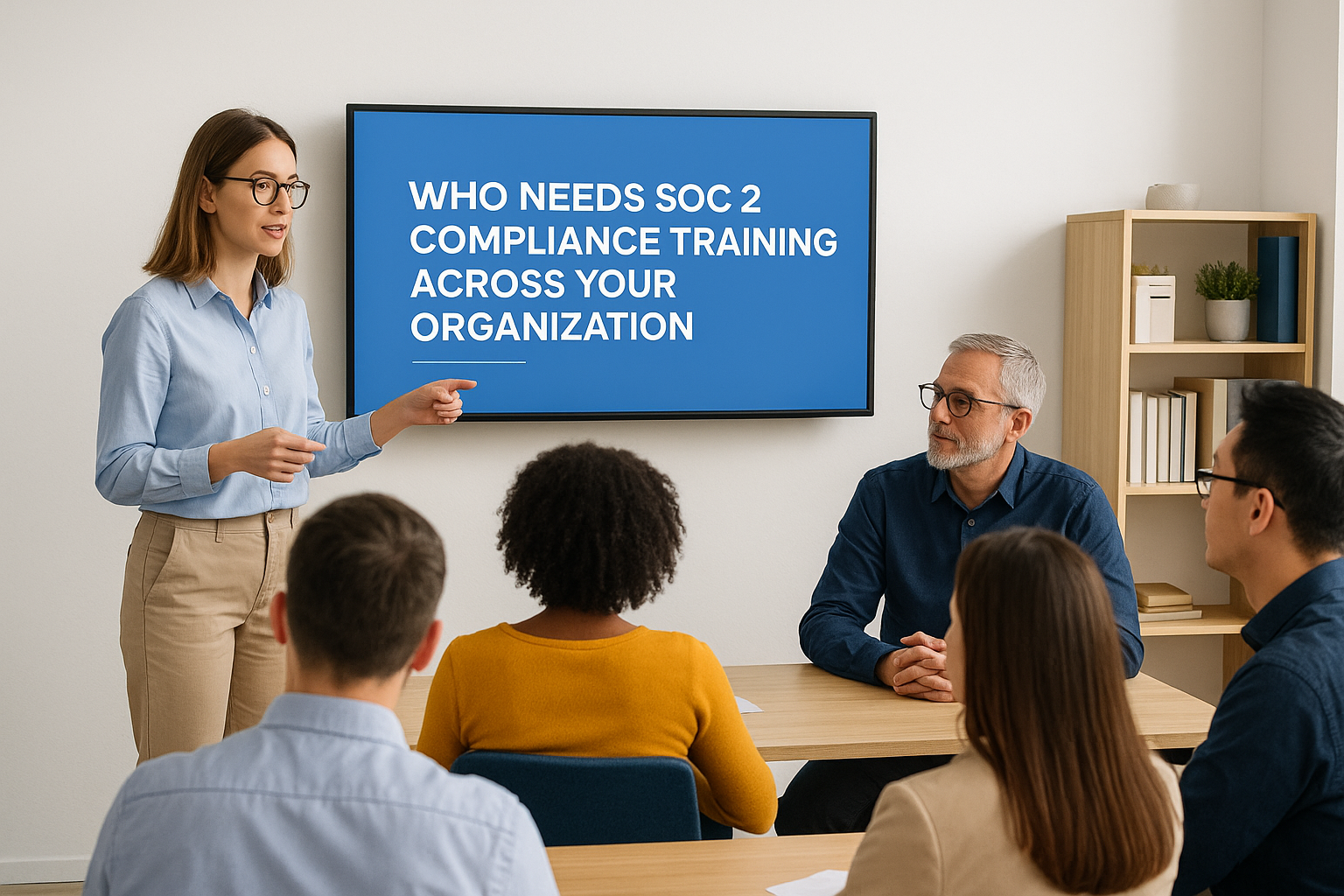
Who needs SOC 2 compliance training across your organization
Every employee touches a control somewhere, even if they don't realize it. The person who provisions a new laptop, the sales rep who signs a new marketing tool without checking its data handling, the support agent who resets a customer's password over the phone: all of them interact with something an auditor will test. SOC 2 compliance training has to reach further than the engineering team, because the Trust Services Criteria cover the whole company, not just the people who write code.
Map roles to the controls they actually touch
Start by matching job functions to the parts of your control matrix they influence. This keeps training relevant instead of generic:
| Role | Primary training focus |
|---|---|
| Engineers and DevOps | Change management, access control, secure coding, encryption |
| IT and security staff | Vendor risk review, monitoring, incident response ownership |
| Customer support | Data handling, breach recognition, escalation procedures |
| HR | Onboarding and offboarding timelines, background checks |
| Sales and marketing | Vendor tool approval, data collected on prospects |
| Executives | Risk acceptance, policy sign-off, audit interview readiness |
If a role touches customer data or company systems, it belongs in your training plan, no exceptions.
Gaps in this mapping are exactly where audit exceptions come from. An auditor who samples five random employees and finds one who never took SOC 2 audit training doesn't care that the person works in marketing instead of engineering. The control still applies to them if they had system access during the audit period.
Contractors and part-time staff count too
Healthcare vendors lean heavily on contractors for engineering sprints, QA, and customer success, and it's tempting to skip training for anyone not on full-time payroll. Don't. If a contractor has access to production systems, patient data, or your codebase, they're in scope for the same training your employees complete. Auditors specifically ask about contractor onboarding, since it's a common blind spot companies overlook until it shows up as a finding.
New hires need training before access, not after
Order matters here. Give someone system credentials before they've completed security awareness training and you've created a control gap the moment they log in. Structure onboarding so training happens in the first days, tied directly to when access gets provisioned, and log the completion date alongside the access grant date. That pairing is one of the first things auditors cross-reference when they test your onboarding control.
What a strong SOC 2 training curriculum should cover
Content matters as much as reach. A SOC 2 compliance training program that covers the right topics in enough depth prevents the kind of vague, half-remembered answers that turn a control walkthrough into an exception. The curriculum needs to map to the five Trust Services Criteria auditors actually test against: security, availability, processing integrity, confidentiality, and privacy, though most companies scope their audit to security plus one or two others relevant to their product.
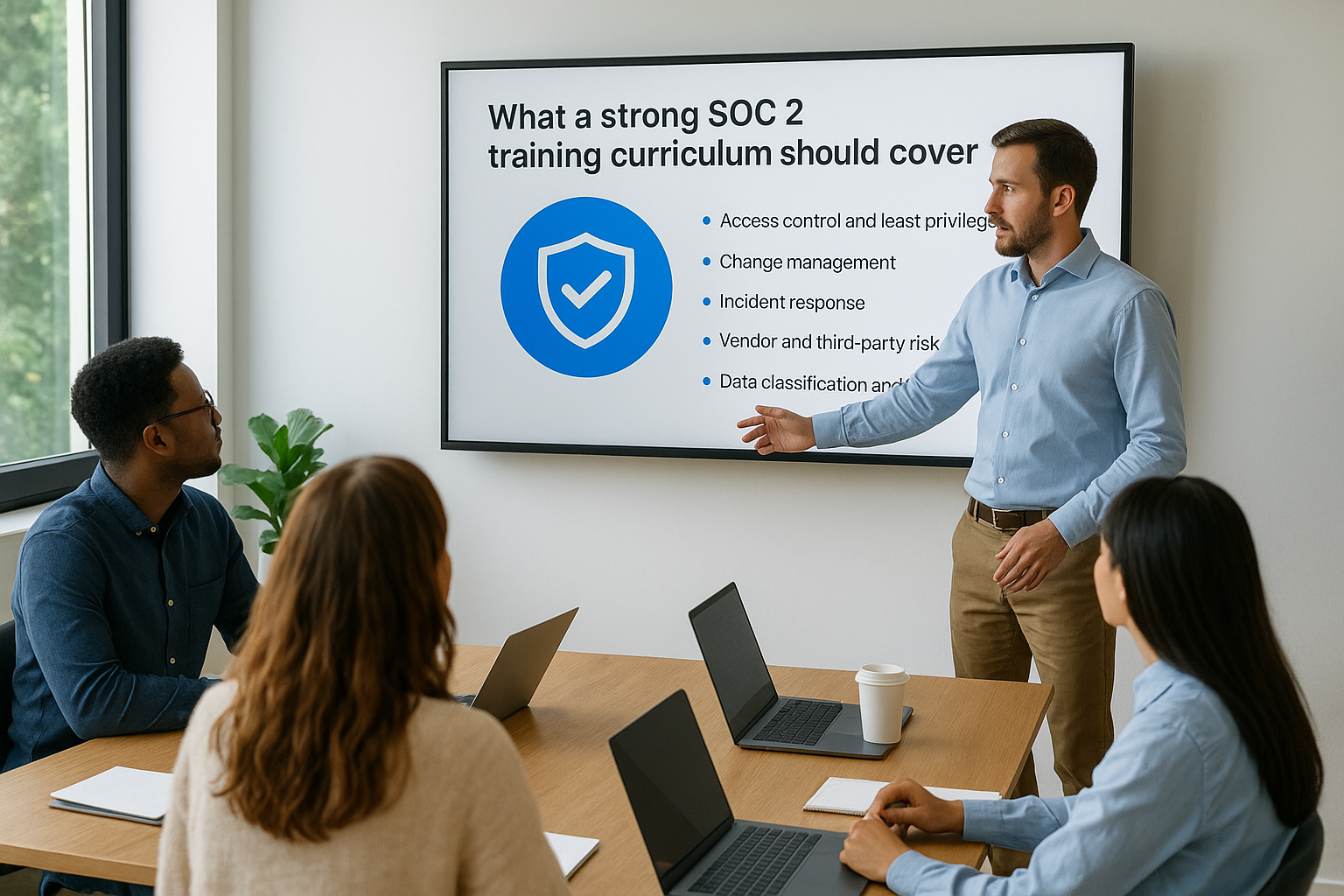
Core topics every module should include
Every SOC 2 training curriculum needs to walk through the mechanics of your specific controls, not generic security theory. At minimum, build modules around:
- Access control and least privilege: how requests get submitted, approved, and reviewed, and why nobody gets standing admin access by default.
- Change management: the approval and testing steps required before code or infrastructure changes reach production.
- Incident response: what counts as a reportable incident, who to notify, and how fast.
- Vendor and third-party risk: why new tools go through a review before anyone signs a contract or connects an API.
- Data classification and handling: what counts as sensitive data at your company and how it moves, stores, and gets deleted.
A training module that doesn't answer "what do I actually do differently" isn't training, it's a slide deck.
Make it specific to your environment
Generic vendor content covers the concepts, but it won't mention your ticketing system, your access approval tool, or your actual incident escalation path. Layer company-specific screenshots and workflows on top of any off-the-shelf course so staff walk away knowing exactly which button to click and who to message, not just the theory behind why the control exists. This is where most SOC 2 audit training programs fall short: they teach the framework and skip the part where an employee actually needs to act.
Build in a way to check understanding
Finishing a video isn't the same as understanding a control. Add a short quiz or scenario question after each module, something like "a laptop with patient data access just got reported stolen, what do you do in the next 15 minutes." Scenario-based questions catch the gap between passive viewing and real comprehension, and they give you a defensible completion record beyond a simple checkbox, which matters when an auditor asks how you know training actually worked.
Employee training versus SOC 2 auditor certification
Confusion between these two things trips up a lot of teams. SOC 2 compliance training for your staff teaches people how to follow controls they already have to follow. SOC 2 auditor certification is a professional credential that qualifies someone to actually issue a SOC 2 report, which is an attestation rather than a certification, and it belongs to accountants, not your engineering team. Mixing the two up leads companies to either overinvest in credentials nobody needs or underinvest in the awareness training an audit actually requires.
Your staff needs to know what to do. Your auditor needs a license that says they're allowed to judge whether you did it.
What separates the two tracks
The gap comes down to purpose, audience, and who issues the credential. A quick side-by-side makes the distinction clear:
| Employee training | Auditor certification | |
|---|---|---|
| Purpose | Teach staff to follow controls | Qualify someone to audit and opine on controls |
| Audience | All employees and contractors | CPAs and audit firm staff |
| Issued by | Internal program or vendor course | AICPA and licensed CPA boards |
| Typical length | Hours per year | Years of accounting education plus exams |
| Proof required | Completion log, quiz score | CPA license, firm affiliation |
Only a licensed CPA firm can issue an actual SOC 2 report, a requirement set by the AICPA, the body that governs the SOC 2 framework itself. No amount of internal employee training changes that. Your staff training exists to make sure the controls hold up when that CPA firm shows up to test them, not to qualify anyone on your team to perform the audit.
Why this distinction matters for budgeting and hiring
Spending money sending your compliance manager through a CPA-track audit certification doesn't move the needle on your actual audit readiness, unless that person plans to become an auditor themselves. Put the budget instead toward company-wide SOC 2 audit training that reaches every role touching a control, and reserve professional certifications for the specific people who benefit from deeper framework knowledge, like a compliance lead who wants a recognized credential to strengthen their resume or negotiate with audit firms. Those roles do exist and they're worth discussing next, since a few respected certifications can genuinely sharpen how your internal team manages the audit relationship, even without anyone becoming a licensed CPA.
Certification options for SOC 2 professionals
Once you've drawn the line between staff awareness training and CPA-level auditor certification, a middle tier still deserves attention: credentials built for compliance leads, GRC analysts, and security managers who own the SOC 2 relationship without personally signing the report. These certifications don't qualify anyone to issue an opinion, but they build the kind of depth that makes internal audit prep faster and negotiations with your audit firm more productive. SOC 2 compliance training at the awareness level teaches your whole company; these credentials sharpen the one or two people running the program.
Credentials worth considering
A handful of established certifications show up repeatedly among compliance professionals working on SOC 2 programs:
| Certification | Issued by | Best fit |
|---|---|---|
| CISA (Certified Information Systems Auditor) | ISACA | Compliance leads who manage audit relationships |
| CISSP (Certified Information Systems Security Professional) | ISC2 | Security managers overseeing technical controls |
| CCSK (Certificate of Cloud Security Knowledge) | Cloud Security Alliance | Teams running SOC 2 on cloud infrastructure |
| GRC Professional (GRCP) | OCEG | Staff building out risk and compliance programs broadly |
None of these replace CPA licensure for issuing a report, but each one signals to prospects and auditors alike that the person running your program understands the framework beyond a checklist.
A certification on your compliance lead's resume tells a health system's security team someone competent is steering the program, not that the program itself is airtight.
Weigh the cost against the actual need
Before approving budget for any of these, ask whether the certification solves a real gap or just looks good on a LinkedIn profile. Companies running a lean SOC 2 program with a strong external audit firm often get more value from investing that money in better internal SOC 2 audit training content than in sending one employee through a months-long certification track. Reserve the investment for someone who negotiates directly with auditors, manages a growing GRC function, or plans to make compliance a long-term career, since that's where the depth actually pays off. For most healthcare vendors moving fast toward an EPIC EHR integration, the bigger return usually comes from tightening the training and evidence process covered earlier, not from stacking credentials nobody outside the compliance team will ever ask about.
Choosing the right SOC 2 training provider
Buying an off-the-shelf course saves time, but not every vendor built their content for a real audit. Some SOC 2 training providers sell generic security awareness slides repackaged with a SOC 2 label slapped on top, and an auditor spots the difference fast when your staff can't connect the content to your actual controls. Picking the right provider, like vetting any of the SOC 2 compliance companies you'd hire for readiness work, means checking whether their material maps to the Trust Services Criteria specifically, not just general cybersecurity hygiene.
What to look for before you sign a contract
Vet any provider against a short list before committing budget:
- Content mapped to Trust Services Criteria, not repurposed generic security awareness training.
- Role-based tracks for engineers, managers, and general staff, instead of one video for everyone.
- Completion tracking and reporting you can hand directly to an auditor without reformatting.
- Regular content updates that reflect changes to the framework or your audit scope.
- Scenario-based assessments, not just a "mark as complete" button.
A course an auditor has never heard of isn't automatically wrong, but a course with no way to prove completion is always a problem.
Red flags that signal a bad fit
Watch for providers who can't answer basic questions about how their content ties back to actual controls. If a sales rep can't explain how their SOC 2 audit training maps to access control or change management specifically, walk away. Similarly, be wary of platforms that only offer a single one-size-fits-all course with no way to segment content by role, since you'll end up building a workaround anyway once your auditor asks why engineers and sales reps got identical training.
Build versus buy for healthcare vendors
Healthcare vendors juggling both HIPAA and SOC 2 face a harder version of this decision, since generic providers rarely cover both frameworks with the depth a health system's security review expects. Weighing a standalone training platform against a compliance partner that already builds these requirements into your infrastructure often makes more sense than stitching together separate vendors for training content, hosting, and audit prep. VectorCare's approach folds compliance groundwork into the EPIC integration platform itself, so your team spends less energy sourcing and vetting training vendors and more energy shipping the actual product. Whatever you choose, the provider's real job is making sure your staff can answer an auditor's questions accurately, not just checking a training box.
Turning training into audit-ready evidence
Completing a training module means nothing to an auditor unless you can produce proof of it on demand. Audit-ready evidence turns your training program from a good intention into something a CPA firm can actually test, and that means treating every session, quiz, and acknowledgment as a document you'll need to hand over later, not just a box to check internally. Teams that treat evidence collection as an afterthought end up scrambling through email threads and Slack messages the week before fieldwork, trying to reconstruct who trained on what and when.

What auditors actually ask for
During fieldwork, an auditor typically requests a full training log covering the audit period, then samples a handful of employees and cross-references their completion dates against system access logs and HR records. They're checking for three things specifically:
- Timing: did training happen before or after access was granted?
- Coverage: did every in-scope employee and contractor complete it?
- Content match: does the training actually address the control being tested?
A gap in any of these three turns a routine sample into a documented exception on your report.
Evidence that exists only in someone's memory doesn't exist as far as an auditor is concerned.
Build a repeatable evidence trail
Don't wait until an auditor asks to start organizing records. Set up a standing process that captures evidence as training happens, not after the fact:
- Log completion dates automatically through whatever platform delivers the training.
- Store quiz scores or scenario responses alongside the completion record, not in a separate system.
- Tag each record to the specific control it supports, so you can pull evidence by control instead of searching through a spreadsheet.
- Export a clean report before every audit cycle and run your own SOC 2 gap analysis on it first.
Following this order catches missing records while there's still time to fix them, instead of discovering the gap during fieldwork when it's too late to backfill.
Close the loop with corrective action
When you find a gap, whether it's a contractor who never completed onboarding training or a manager who missed the annual refresher, document what you did to fix it, not just that you noticed the problem. Auditors respond better to a documented correction than to a silent gap they discover themselves, since it shows your SOC 2 compliance training program actually functions as a control rather than a checkbox exercise nobody monitors.
Putting training into practice
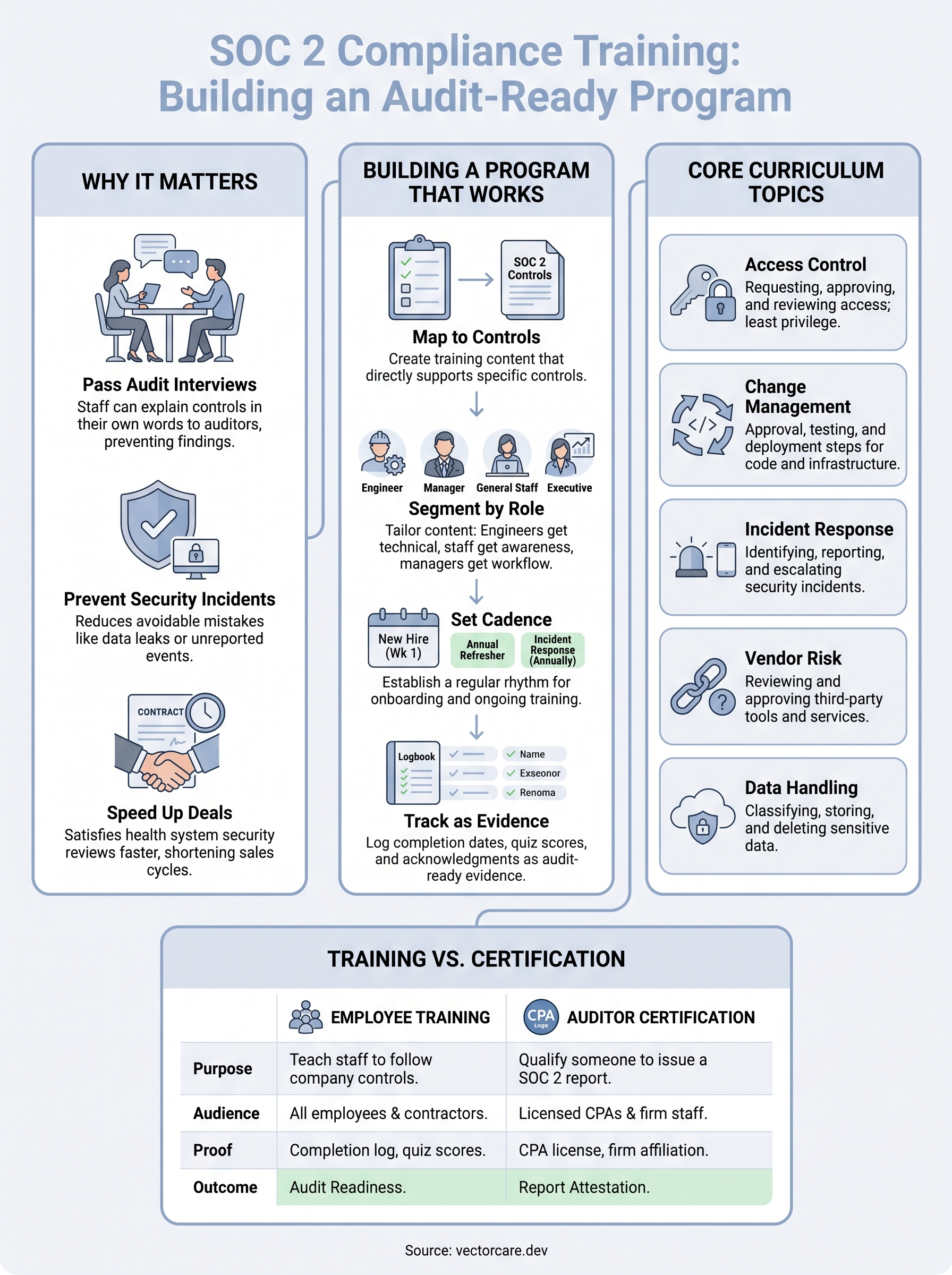
Good SOC 2 compliance training isn't a compliance-team side project. It's what makes the rest of your controls hold up when an auditor starts asking real people real questions. Map training to your control matrix, split content by role, track completions like evidence because they are evidence, and you'll walk into fieldwork without dreading the sample interviews.
For healthcare vendors, the stakes double. You're not just proving SOC 2 knowledge, you're proving HIPAA and SOC2 compliance together, right as health systems scrutinize both before signing off on an EPIC integration. Building that program from scratch alongside the integration itself eats months you don't have.
VectorCare handles the compliance groundwork so your team can focus on the product. Build and deploy your SMART on FHIR app in days instead of spending that time proving controls you haven't automated yet.
The Future of Patient Logistics
Exploring the future of all things related to patient logistics, technology and how AI is going to re-shape the way we deliver care.
Thank you! Your submission has been received!
Oops! Something went wrong while submitting the form.