SOC 2 Compliance Consultant: What They Do and Why You Need One

If you're building a digital health product and a hospital system just asked for your SOC 2 report before signing, you're not alone. Most health systems won't touch a vendor without proof that patient data is locked down, which is exactly why so many startups end up searching for a soc 2 compliance consultant the moment a big contract is on the line. The right consultant turns a vague compliance requirement into a clear, auditable process instead of a scramble in the weeks before a deal closes.
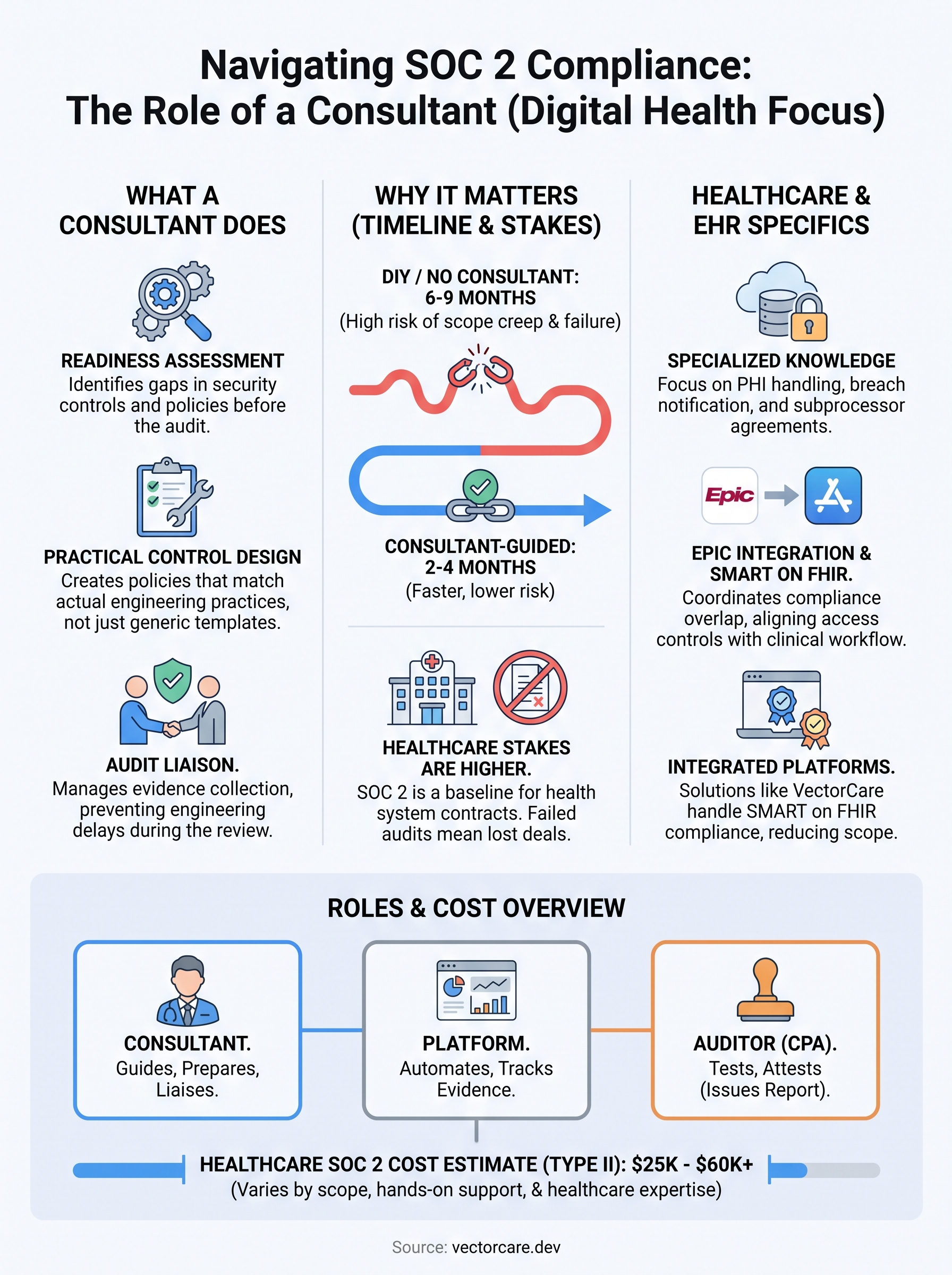
A good SOC 2 consultant does more than hand you a checklist. They run your readiness assessment, identify gaps in your security controls, help you write policies that actually match how your team works, and prepare you to face an independent auditor without surprises. Some also act as your audit liaison, managing evidence collection so engineering doesn't grind to a halt during the review window.
This article breaks down exactly what these consultants do, when to bring one in, and how to pick between a boutique firm and a bigger compliance platform. If you're a healthcare vendor eyeing EPIC integration, this matters even more: SOC 2 is table stakes, and platforms like VectorCare handle the SMART on FHIR compliance layer so you're not fighting two audits at once.
Why hiring a SOC 2 compliance consultant matters
Most founders assume SOC 2 is a paperwork exercise they can knock out with a template pack and a few weekends. That assumption costs companies months. A SOC 2 audit examines your actual security practices: how a SOC 2 audit works comes down to access controls, encryption, incident response, vendor management, and whether your policies match what your engineers actually do day to day. Auditors don't grade effort, they grade evidence. Without someone who has been through dozens of these audits, teams routinely misjudge scope, pick the wrong trust service criteria, or build controls that look fine on paper but fall apart the moment an auditor asks for a log file.
The real cost of getting a first audit wrong
Getting your first SOC 2 attempt wrong doesn't just waste time, it can tank a deal. A failed or delayed audit means you tell a health system procurement team "not yet" right when they were ready to sign. Soc 2 certification consultants exist specifically to prevent that scenario. They've seen which controls auditors flag most often, which policies get rejected for being too generic, and which evidence formats speed up review instead of triggering follow-up questions. That pattern recognition is the entire value proposition. You're not paying for someone to write a security policy, you're paying for someone who already knows which fifteen things will actually get scrutinized.
A consultant's real job isn't writing policies, it's knowing exactly what an auditor will ask before they ask it.
Consider the timeline problem
Here's a table showing how the SOC 2 audit timeline typically differs between DIY and guided efforts, based on patterns common among early-stage vendors:

| Approach | Typical timeline to audit-ready | Common failure point |
|---|---|---|
| DIY, no consultant | 6-9 months | Scope creep, missing evidence trail |
| Compliance platform only | 3-5 months | Controls exist but aren't operationalized |
| Consultant-guided | 2-4 months | Rare, mostly vendor-side delays |
DIY teams almost always underestimate how long evidence collection takes. Someone has to pull access logs, screenshot configurations, and document change management for every sprint during the audit period, and if that process isn't set up correctly from day one, you end up scrambling to reconstruct months of history right before the audit window closes.
Why in-house teams struggle without outside help
Engineering leaders often try to own SOC 2 internally, and it's an understandable instinct since they know the systems best. But internal ownership creates a conflict of priorities. The engineer who understands your infrastructure is also the person you need shipping product features, and SOC 2 prep competes directly with your roadmap for their time. A consultant absorbs that burden. They translate auditor-speak into concrete engineering tasks, run the gap analysis, and keep the project moving without pulling your best people off customer-facing work for months at a stretch.
The stakes are higher in healthcare
For healthcare vendors specifically, the stakes are higher than for a typical SaaS company. Health system procurement teams treat SOC 2 as a baseline filter, not a nice-to-have. If your report has gaps, or if you're still "working toward" certification when a contract is on the table, you lose leverage in the negotiation and sometimes lose the deal outright. A consultant who has specifically worked with digital health, remote monitoring, or clinical decision support vendors understands which controls hospital security teams scrutinize hardest, like data retention, breach notification timelines, and subprocessor management, and builds your audit around those pressure points instead of a generic framework.
What a consultant actually protects
Good consultants also protect you from a subtler risk: scope mismatch. Plenty of companies pursue a SOC 2 Type II report covering all five trust services criteria when their actual customer requirements only demand security and availability. That mismatch adds months and cost for zero commercial benefit. An experienced consultant scopes the audit to match what your prospects and contracts actually require, which keeps the process lean and the invoice smaller. That single decision, made correctly in week one, often saves more time than any other part of the engagement.
How a SOC 2 compliance consultant guides your audit
Engaging a soc 2 compliance consultant usually starts long before an auditor ever looks at your systems. The consultant's job is to walk you through a structured process, from the first SOC 2 gap analysis to the final report, so nothing gets discovered for the first time during the actual audit. Think of it less like hiring an inspector and more like hiring a coach who has run this exact race dozens of times and knows where people trip.
Readiness assessment comes first
Before anything else, a consultant runs a SOC 2 readiness assessment. This means reviewing your current security posture against the trust service criteria you're pursuing, usually security at minimum, sometimes availability and confidentiality depending on what your customers demand. They interview your team, review existing policies, and check whether your infrastructure actually enforces what your documentation claims. This step surfaces the gaps that would otherwise show up as findings during the real audit, when fixing them costs far more time.
The whole point of a readiness assessment is to fail privately, on your own schedule, instead of failing publicly in front of an auditor.
Building controls that match reality
Once gaps are identified, the consultant works with your team to close them. This typically covers:
- Access control policies tied to actual role-based permissions in your systems
- Encryption standards for data at rest and in transit
- Incident response plans with named owners and defined escalation steps
- Vendor and subprocessor management, especially relevant if you're integrating with EHR platforms
- Change management processes that log every production deployment
A consultant pushes back on generic templates when drafting the SOC 2 policies and procedures you actually need. Auditors can tell when a policy was copied from a boilerplate kit and never touched again, and that mismatch between paper and practice is exactly what triggers exceptions in a final report.
Running point during the audit window
During the actual audit, the consultant often becomes your audit liaison, coordinating between your engineering team and the independent CPA firm performing the review. They organize evidence requests, translate what auditors are asking for into specific screenshots or logs, and keep the process from stalling because nobody knew which system owned a given piece of documentation. For a Type II audit, which observes controls operating over a period of months rather than a single point in time, this coordination matters even more since evidence has to be collected consistently across the entire window.
Deciding between Type I and Type II
One decision consultants routinely help clients get right is whether to start with a Type I report or go straight to Type II, since Type I only confirms controls are designed properly at a single point in time. Startups under pressure from a health system contract sometimes need the faster Type I first, then follow with Type II once controls have run long enough to prove they work. Getting that sequencing wrong wastes months, and it's exactly the kind of decision where outside experience pays for itself.
What to look for when choosing a SOC 2 consultant
Not every consultant fits every company, and picking the wrong one wastes the exact time and money you hired them to save. Before signing a contract, dig into their track record with companies your size, in your industry, pursuing the same trust service criteria you need. A generalist who mostly works with fintech clients may not know the specific pressure points health system security reviewers care about, like PHI handling or subprocessor agreements with EHR vendors.
Industry experience beats generic credentials
Ask any candidate consultant for client references in digital health or a closely adjacent regulated industry. A consultant who has guided remote monitoring companies, clinical decision support vendors, or EHR-adjacent startups through SOC 2 already knows which controls hospital procurement teams scrutinize hardest. That experience shows up in the questions they ask during your first call. If they're asking about your data retention policy and breach notification timeline before you even mention it, that's a good sign.
The best signal a consultant knows your industry is that they ask about your risks before you bring them up.
Check how they actually work, not just what they promise
Some firms hand you a portal and disappear until the audit date. Others sit in your Slack, review pull requests for control implications, and join calls with your auditor directly. Decide up front which model your team needs. A lean startup pursuing SOC 2 compliance with no dedicated compliance hire usually needs the hands-on version, even if it costs more, because nobody internally has bandwidth to chase down evidence requests alone.
When vetting soc 2 certification consultants and the best SOC 2 compliance companies, run through this checklist:
- Do they have direct experience with healthcare or EHR-adjacent clients?
- Will they name the specific CPA firm they typically work with for the actual audit?
- Do they provide a fixed scope and timeline, or open-ended hourly billing?
- Will one named person manage your engagement, or does it rotate between staff?
- Can they show a sample readiness assessment report, not just a sales deck?
Watch for scope inflation and vague pricing
Be wary of any consultant who pushes you toward a broader scope than your contracts actually require. Some firms profit from longer engagements, so they recommend all five trust service criteria when your customers only ask for security and availability. A trustworthy consultant scopes down when the evidence supports it, not up. Similarly, pin down pricing before you sign. Vague hourly estimates without a cap have a way of ballooning once the engagement starts, especially during the evidence-collection crunch before an audit deadline.
Fit matters as much as expertise
Finally, trust your gut on communication style. You'll be working closely with this person or team for months, sometimes through stressful stretches right before a contract deadline. If a consultant is slow to respond during the sales process, expect the same during crunch time. Pick someone whose pace matches the urgency of your health system deal.
Consultant vs. auditor vs. compliance platform
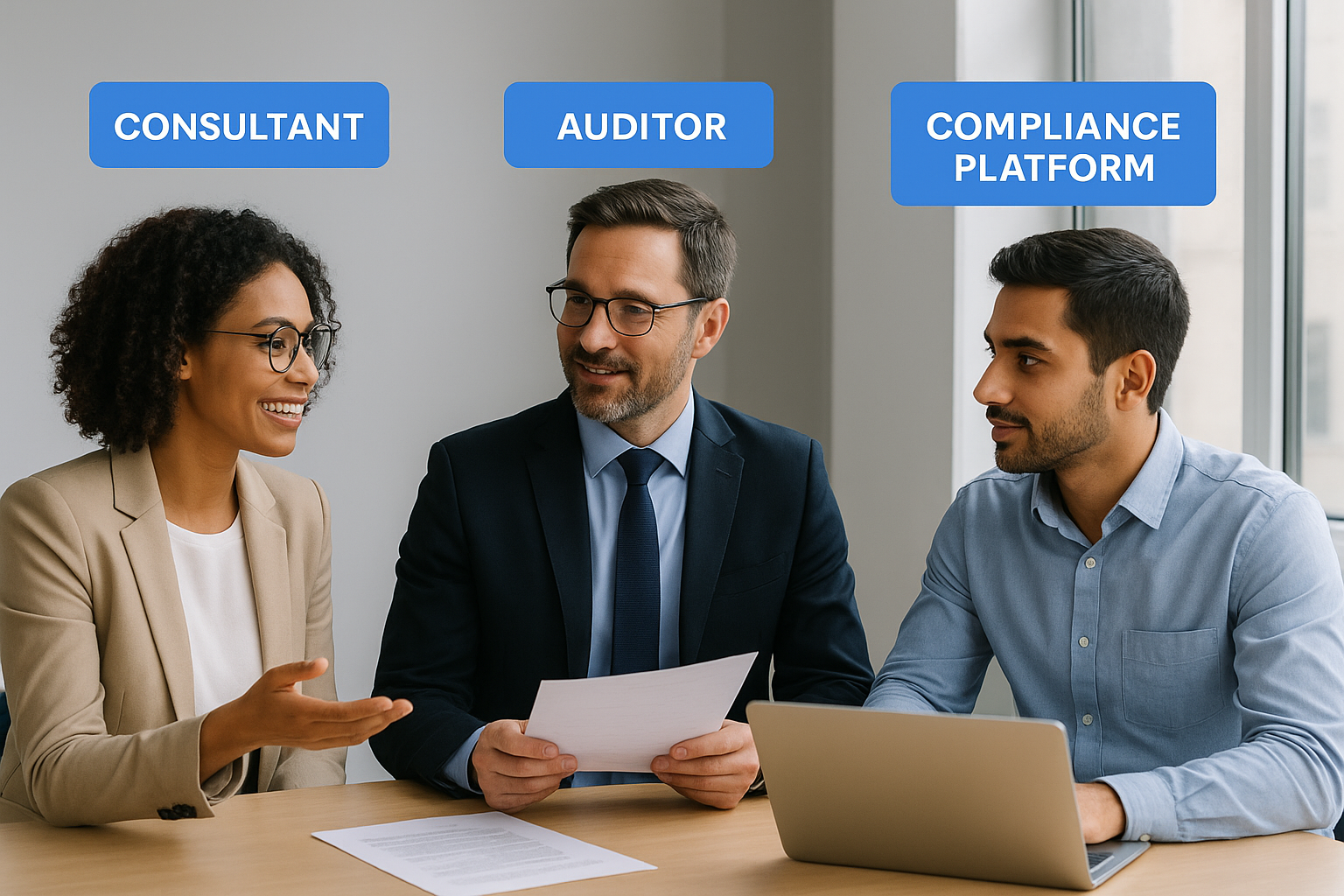
People mix these three up constantly, and the confusion causes real problems when a company hires the wrong one for the job. A SOC 2 consultant advises you and does the prep work. An independent auditor is the CPA firm that actually issues the report, which is technically an attestation rather than a certification, and by rule they can't also be your consultant on the same engagement, since that would compromise their independence. A compliance platform is software that automates evidence collection and control monitoring, but it doesn't replace human judgment about scope, policy language, or how to handle a tricky auditor question. Treating any one of these as a full substitute for the other two is the fastest way to stall your audit.
What each role actually does
Grasping the boundaries between these roles saves you from paying for overlap or missing coverage entirely. Here's how the three break down in practice:
| Role | What they do | What they can't do |
|---|---|---|
| Consultant | Runs gap analysis, writes policies, coaches your team, liaises with the auditor | Issue the actual SOC 2 report |
| Auditor (CPA firm) | Independently tests controls and issues the attestation report | Advise you on how to fix gaps they'll later test |
| Compliance platform | Automates evidence pulls, tracks control status, flags drift | Interpret ambiguous requirements or negotiate scope with an auditor |
A consultant prepares you, a platform tracks you, but only an independent auditor can actually certify you.
Why you often need all three
Rarely does a growing healthcare vendor get away with just one of these. Most companies pursuing SOC 2 for the first time end up using compliance software tools like Vanta or Drata to automate evidence collection, a consultant to interpret what that evidence means and close real gaps, and an independent CPA firm to run the actual audit. Skipping the consultant and going straight from platform to auditor is where most first-timers get burned, because the platform will happily show you a dashboard full of green checkmarks while your actual policies still don't match your infrastructure. The platform tells you what's tracked. It doesn't tell you what's wrong.
Where healthcare vendors run into trouble
Digital health startups face an extra wrinkle here, since the trust service criteria that matter most for hospital contracts, like confidentiality and processing integrity around patient data, aren't always the default settings in a generic compliance platform template. Vendors also need to think about how SOC 2 sits alongside EPIC integration requirements, since a hospital's security review often touches both at once. A consultant who understands that overlap keeps you from treating SOC 2 and your EHR integration work as two unrelated projects that happen to share a deadline.
How much does a SOC 2 compliance consultant cost
Pricing for a soc 2 compliance consultant varies more than most first-time buyers expect, and like the broader SOC 2 audit cost, the range depends heavily on scope, industry, and how hands-on you need them to be. A narrow security-only engagement for a five-person startup might run $8,000 to $15,000 total, while a healthcare vendor facing Type II audit pricing across multiple trust service criteria, with PHI handling and EHR integration in scope, can easily land between $25,000 and $60,000. Fixed-fee engagements are the norm among reputable firms, though some still bill hourly, which is where budgets get out of hand fast.
Engagement structure drives most of the cost swing. A one-time readiness assessment with a written gap report costs far less than a full-service engagement where the consultant stays on through evidence collection and audit liaison duties. Here's roughly how the market breaks down:
| Engagement type | Typical cost range | What's included |
|---|---|---|
| Readiness assessment only | $5,000 - $10,000 | Gap analysis, findings report |
| Guided prep, Type I | $10,000 - $25,000 | Policy drafting, control implementation, coaching |
| Full-service, Type II | $25,000 - $60,000+ | Ongoing liaison, evidence management, healthcare-specific controls |
The cheapest quote almost never wins, because a consultant who underprices readiness prep usually underdelivers on the parts that actually prevent audit findings.
Separately, you'll still pay the independent auditor for the actual attestation, typically $10,000 to $30,000 depending on scope and criteria count, and you'll likely license a compliance platform like Vanta or Drata for $7,000 to $20,000 a year. Add those three line items together, and a first-year SOC 2 program for a mid-size health tech vendor often lands somewhere between $50,000 and $100,000 all in. That's real money, but it's a fraction of what a single lost health system contract costs, and procurement teams won't wait around while you figure out compliance from scratch.
Factors that push cost up beyond the baseline include:
- Pursuing all five trust service criteria instead of the two or three your contracts actually require
- Starting from near-zero security infrastructure rather than existing controls
- Needing a consultant with specific healthcare or EHR integration experience, which commands a premium
- Requiring hands-on evidence collection support because your team has no dedicated compliance owner
- Running Type II over a nine to twelve month observation window instead of a shorter six month period
Vendors building on top of an EPIC integration, in particular, should factor in whether their integration platform already handles pieces of the compliance burden. VectorCare's SMART on FHIR compliance layer, for example, comes with HIPAA and SOC2-aligned infrastructure baked into the deployment, which narrows what a consultant needs to build from scratch and can meaningfully shrink the scope, and therefore the invoice, of your SOC 2 engagement.
SOC 2 compliance for healthcare and EHR software vendors
Healthcare vendors face a compliance stack that most SaaS companies never touch. EHR integration work, especially anything connecting to EPIC, layers SMART on FHIR requirements, HIPAA obligations, and hospital-specific security reviews on top of a standard SOC 2 audit. A consultant who only knows generic SaaS controls will miss the parts of your architecture that matter most to a hospital security team, like how patient data flows through your app during an EPIC session and what happens to that data once the session ends.

Why EHR integration raises the compliance bar
Connecting to EPIC means your app touches protected health information the moment a clinician launches it from inside the EHR. That single fact changes what auditors and hospital reviewers expect. Access controls now need to account for clinical context, meaning your app should only surface data relevant to the patient a clinician has open, and your audit trail needs to prove that boundary holds. Hospitals also expect clear answers on data residency, subprocessor agreements, and how quickly you'd notify them of a breach involving PHI pulled through the integration.
A SOC 2 report that ignores your EHR integration architecture answers the wrong questions for a hospital security reviewer.
The overlap between SOC 2 and SMART on FHIR
SOC 2 and SMART on FHIR compliance aren't the same requirement, but they overlap enough that treating them separately wastes effort. Both demand documented access control, both care about how OAuth tokens are scoped and rotated, and both get scrutinized during the same hospital procurement review. A healthcare-focused consultant builds your SOC 2 controls with the FHIR integration layer in mind from the start, instead of bolting on integration-specific controls after the audit scope is already locked.
Practical steps for EPIC-focused vendors
Vendors pursuing EPIC integration alongside SOC 2 should:
- Map exactly which FHIR resources your app pulls and confirm each has a documented business justification
- Confirm OAuth token scopes match the minimum data access your workflow actually needs
- Document subprocessor relationships for any hosting, analytics, or downstream integration partners
- Align breach notification timelines with what hospital contracts typically require, not just HIPAA's baseline
Where a managed platform changes the math
Building all of this from scratch, on top of your own custom EPIC build, is where most engineering timelines blow up. VectorCare's no-code platform for EPIC integration ships with HIPAA and SOC2-aligned infrastructure already built into deployment, so a soc 2 compliance consultant isn't starting from zero on the integration side of your audit. That head start shrinks both the audit scope and the months of engineering time a custom build would otherwise demand, which matters most when a health system contract is waiting on your report.
Finding the right compliance partner for your team
Hiring a soc 2 compliance consultant isn't about outsourcing responsibility, it's about buying speed and avoiding the mistakes that stall a health system deal. The right consultant scopes your audit correctly, closes real gaps instead of paperwork gaps, and keeps your engineers focused on product instead of evidence screenshots. Skip that guidance, and you risk months of delay right when a contract is ready to sign.
Healthcare vendors carry an extra layer most SaaS companies never face: EPIC integration, SMART on FHIR requirements, and hospital security reviews that don't wait for you to catch up. Choosing soc 2 certification consultants who understand that overlap, paired with infrastructure that's already built for it, cuts months off your timeline rather than adding them.
If you're building toward EPIC and want that head start baked in from day one, see how you can build and deploy your SMART on FHIR app in days with the compliance groundwork already handled before your consultant even starts.
The Future of Patient Logistics
Exploring the future of all things related to patient logistics, technology and how AI is going to re-shape the way we deliver care.
Thank you! Your submission has been received!
Oops! Something went wrong while submitting the form.