Health Information Exchange: What It Is And How It Works

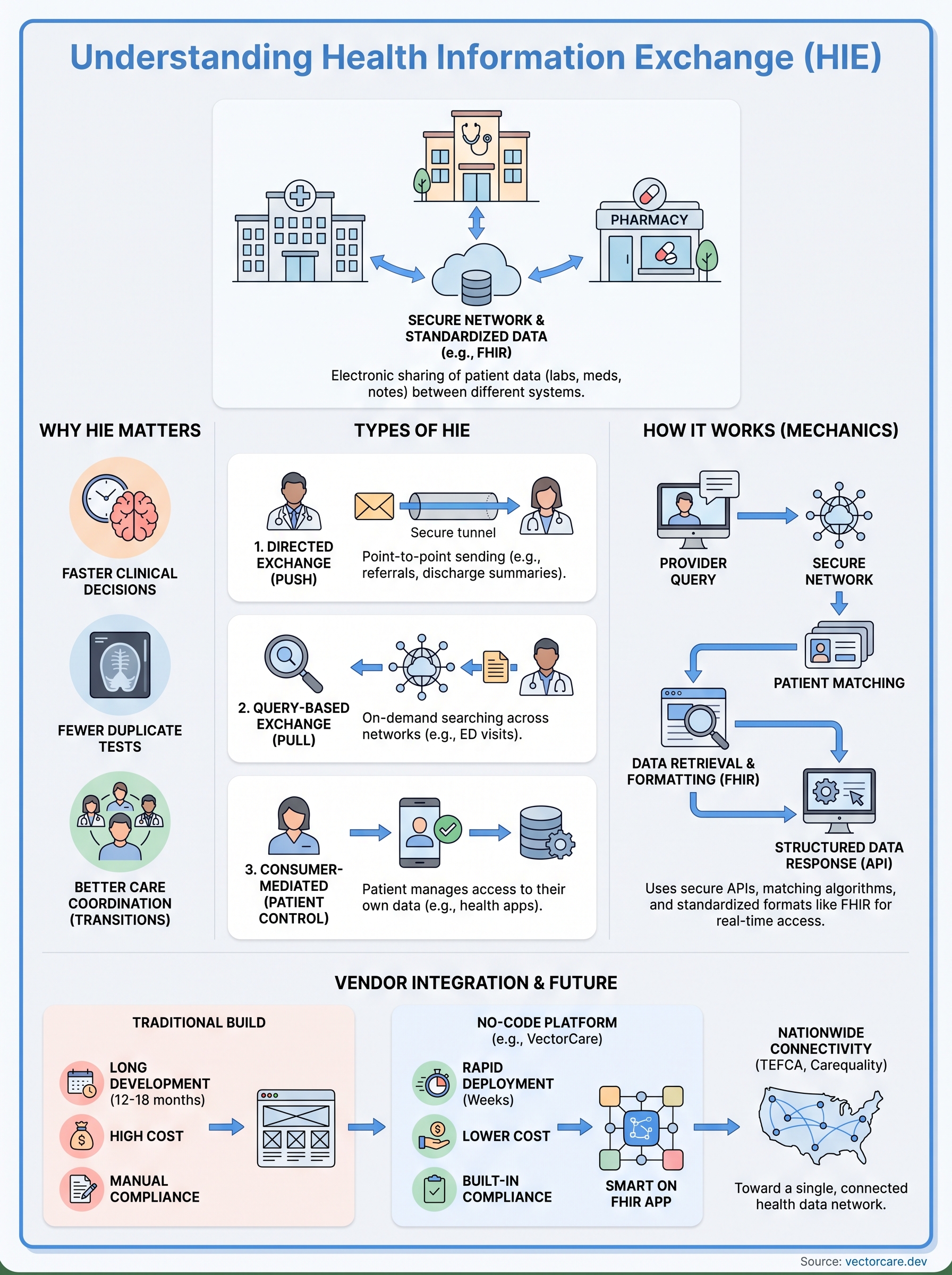
If you've ever wondered why a patient's records don't just follow them from one clinic to the next, you've bumped into the exact problem health information exchange solves. What is health information exchange? It's the electronic sharing of patient data, lab results, medication lists, imaging, and clinical notes, between hospitals, clinics, pharmacies, and payers that otherwise run on different systems and can't talk to each other natively.
At its core, HIE works through standardized data formats and secure networks that let a provider in one system pull up records created in a completely different EHR, often EPIC, without faxing, scanning, or phone calls. That means faster clinical decisions, fewer duplicate tests, and better care coordination, especially for patients seeing multiple specialists or moving between facilities.
This article breaks down the three main types of HIE, walks through how the exchange actually happens behind the scenes, and explains why this infrastructure matters so much for health systems and the digital health vendors trying to plug into it. If you're building a product that needs to move patient data securely into clinical workflows, understanding HIE is the first step toward getting that integration right.
Why health information exchange matters in healthcare
Health information exchange exists because patient data, left alone, stays trapped inside whatever system created it. A cardiologist's notes live in one EHR, a primary care visit lives in another, and a hospital discharge summary might sit in a third. Without a way to move that information electronically, providers rely on faxes, phone calls, or patients trying to remember their own medication list from memory. Fragmented records cost time, money, and sometimes patient safety, which is exactly the gap HIE closes.

The cost of fragmented patient records
When a patient shows up at an emergency department without a visible history, the clinical team is working blind. They don't know about allergies, recent imaging, or medications already tried and failed. The Office of the National Coordinator for Health IT has tracked this problem for years and points to HIE as core infrastructure for reducing exactly this kind of blind-spot care. Redundant testing is one of the most measurable consequences: a patient gets a CT scan at one facility, then gets the same scan again three days later at another facility because nobody could pull the first result. That's wasted radiation exposure, wasted time, and an unnecessary bill.
Fewer duplicate tests, faster diagnoses
When exchange works the way it's supposed to, a provider searching a patient's history finds the lab result or imaging study that already exists instead of ordering it again. This isn't a marginal efficiency gain, it changes clinical decisions in real time. A physician deciding whether to admit a patient, order a scan, or start a new medication is making a better call when they can see what happened at the urgent care visit last week or the specialist appointment last month.
Health information exchange turns scattered patient history into a single, searchable record at the point of care.
That single sentence captures why HIE isn't just an IT project, it's a patient safety tool. Clinical decision speed improves because the provider isn't waiting on a records request that might take days to process through a medical records department.
Coordinating care across providers and settings
Care coordination breaks down most often at transitions, when a patient moves from hospital to skilled nursing facility, from specialist back to primary care, or from one health system to another after switching insurance. HIE gives every party in that transition a shared source of truth. Consider what this typically prevents:
- Medication conflicts from a new prescriber not seeing the full current medication list
- Missed follow-up on abnormal lab results that never got forwarded to the primary care provider
- Repeated intake paperwork and history-taking that frustrates patients and wastes staff time
- Delayed diagnoses when imaging or specialist notes sit in a system nobody on the new care team can access
Each of these failure points has a real cost, whether that's a readmission, a malpractice exposure, or simply a patient who gives up and stops seeking care. Care transitions are where HIE earns its keep, because they're also where communication traditionally falls apart the most.
Why it matters to digital health vendors, not just hospitals
Hospitals and health systems aren't the only ones who need this infrastructure to work. Remote patient monitoring companies, clinical decision support vendors, and analytics platforms all depend on getting data into and out of the EHR reliably. A health system evaluating a new vendor almost always asks how that vendor's product will exchange data with EPIC, and a weak answer kills the deal before it starts. Vendors who understand HIE and can demonstrate a real integration path close contracts faster than competitors who treat data exchange as an afterthought.
Every layer of this, faster diagnoses, safer transitions, and vendor credibility, comes back to the same underlying question: how does the data actually move from one system to another? That's the mechanics worth understanding next.
How health information exchange works
Underneath the concept of HIE sits a fairly mechanical process: a query goes out, a matching record comes back, and both systems agree on a format they can both read. Data exchange doesn't happen by magic or by two EHR vendors deciding to be friendly. It happens because of standardized protocols, patient matching logic, and secure network connections that were built specifically to let unrelated systems talk without a human retyping anything.
The request and response cycle
Picture a provider at Hospital B who needs records from Hospital A, where the patient was treated last month. The provider's EHR sends an electronic query across the exchange network, asking whether any records exist for that patient. The network checks patient identifiers, name, date of birth, sometimes an insurance ID, to confirm it has found the same person and not just someone with a similar name. Once matched, Hospital A's system responds with the relevant clinical data, formatted in a structure Hospital B's EHR can actually parse and display. This whole exchange typically takes seconds, not the days a records request by fax or mail would take.
The value of HIE isn't the data itself, it's the speed and accuracy of the match-and-retrieve process happening behind the screen.
Patient matching is the hard part
Getting the query right sounds simple until you consider how many ways a name can be spelled, how often addresses change, or how many patients share a birthday in a large health system's database. Patient matching errors cause either false negatives, where a real record exists but never surfaces, or false positives, where the wrong patient's data gets pulled up. Most HIE networks solve this with probabilistic matching algorithms that weigh multiple identifiers together rather than requiring an exact match on any single field, which is why the underlying data quality at each connected system matters as much as the network itself.
The role of APIs and secure connections
Modern exchange increasingly runs through APIs rather than older document-based methods. A SMART on FHIR app, for example, authenticates through OAuth 2.0, requests specific FHIR resources like a patient's medication list or lab results, and receives a structured JSON response back from the EHR:
GET /Patient/12345/MedicationRequest
Authorization: Bearer <access_token>
Accept: application/fhir+json
That single request-response pattern replaces what used to be a phone call to a records department followed by a fax. The security model matters just as much as the data format. Every exchange runs over encrypted connections, with audit logs tracking who accessed what and when, which is a requirement under HIPAA and something health systems check carefully before connecting any outside application to their EHR.
Speed, accuracy, and security are the three things every HIE transaction has to get right simultaneously. Miss any one of them and the exchange either fails outright or creates a compliance problem nobody wants to explain to a health system's privacy office. That balancing act looks a little different depending on which type of exchange model is doing the work, which is worth breaking down next.
Types of health information exchange
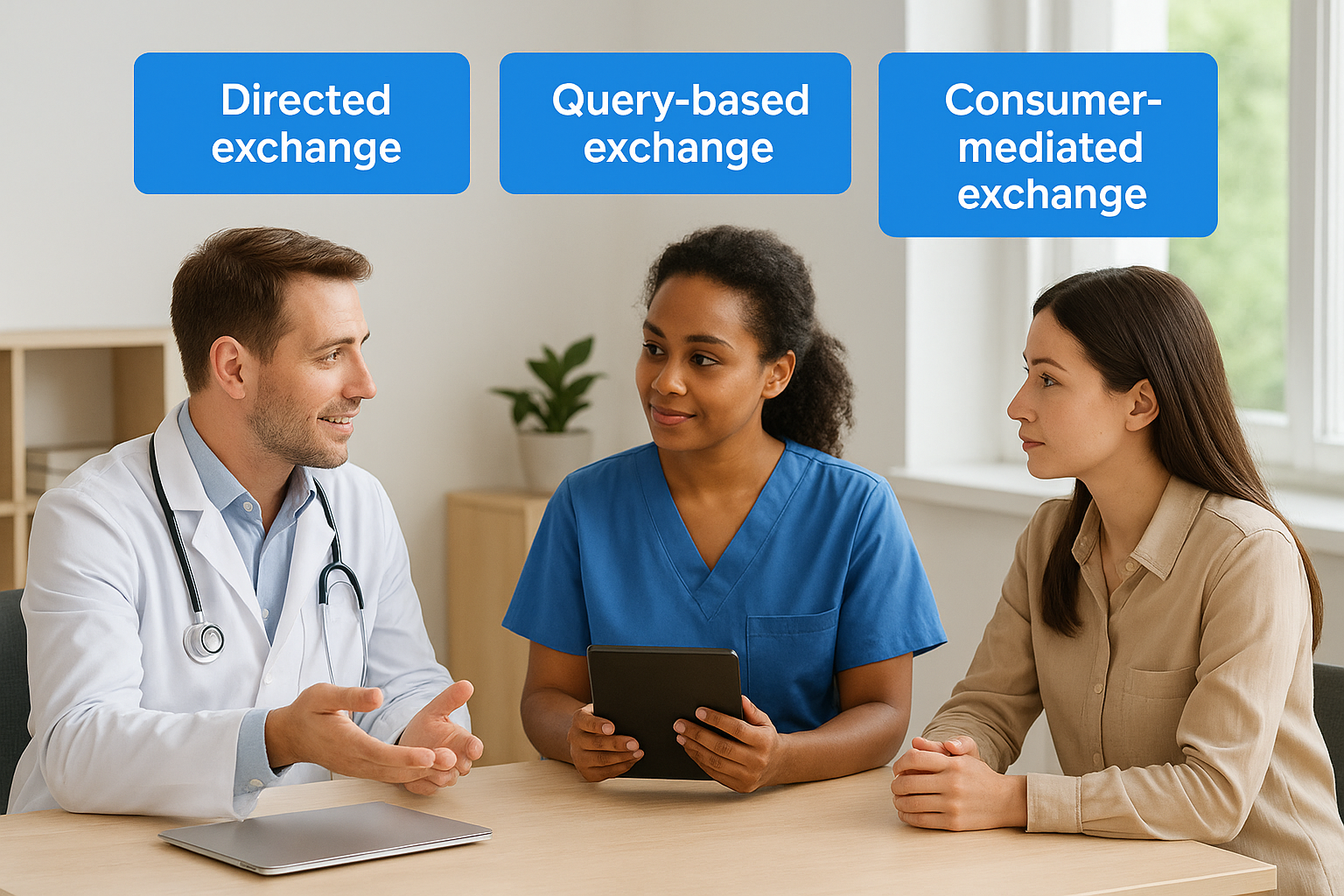
HIE isn't a single technology, it's three distinct models that solve different problems. The Office of the National Coordinator for Health IT groups these into directed exchange, query-based exchange, and consumer-mediated exchange, and most health systems run some combination of all three depending on the use case. Knowing which model applies to a given workflow matters because the technical requirements, and the vendor's integration path, look completely different for each one.
Directed exchange: sending records point to point
Directed exchange is the electronic version of a referral letter. A primary care provider sends a patient's summary directly to a specialist ahead of an appointment, or a hospital pushes a discharge summary to the skilled nursing facility receiving the patient. Point-to-point transfer happens through secure, encrypted messaging protocols, often built on the Direct Trust network, and it requires both parties to know exactly who they're sending to and receiving from. This model works well for scheduled handoffs but does nothing for a provider who doesn't already know where a patient's prior records live.
Query-based exchange: pulling records on demand
Query-based exchange flips the model. Instead of pushing data to a known recipient, a provider searches across a network to find whatever records exist for a patient, regardless of which facility created them. This is the model behind the emergency department scenario from earlier, where a clinician needs history from a patient who's never been seen at that hospital before. On-demand retrieval depends on strong patient matching and a broad network of participating organizations, which is why regional and statewide HIEs invest so heavily in matching algorithms and data-sharing agreements between competing health systems.
Consumer-mediated exchange: the patient holds the data
Consumer-mediated exchange puts the patient in control of their own information rather than routing everything through provider-to-provider agreements. A patient portal, a personal health app, or an EPIC MyChart account that lets someone download their own records and hand them to a new provider all fall into this category. Patient-controlled access has grown fast alongside SMART on FHIR apps, since patients can now authorize a third-party app to pull their data directly from the EHR without a staff member in the middle.
Directed exchange sends, query-based exchange searches, and consumer-mediated exchange puts the patient in the driver's seat.
| Exchange Type | How It Moves Data | Typical Use Case |
|---|---|---|
| Directed | Push, point-to-point | Referrals, discharge summaries |
| Query-based | Pull, search across network | ED visits, unknown patient history |
| Consumer-mediated | Patient-authorized pull | Personal health apps, portals |
Most real-world systems blend these three depending on the scenario, and a vendor building a connected application needs to know which one their use case actually maps to. A remote monitoring company pulling vitals into EPIC is leaning on query-based and API-driven access, while a referral tool sending a summary to a specialist looks a lot more like directed exchange. Getting that distinction wrong early in a build often means rearchitecting the integration later, which is a costly mistake to catch after development is already underway.
Key benefits of health information exchange
Once the mechanics and models are clear, the real question is what HIE actually buys a health system or a vendor building on top of it. Measurable outcomes show up in fewer readmissions, shorter emergency visits, and lower administrative overhead, not just abstract talk about "connected care." Here's what changes when exchange actually works.
Reduced duplicate testing and imaging
Already covered from the patient safety angle, duplicate testing also has a direct financial cost that hospital finance teams track closely. A health system with reliable query-based exchange sees fewer repeat CT scans, redundant bloodwork, and unnecessary imaging orders because clinicians can pull existing results instead of reordering out of caution. Lower imaging costs translate into real savings at scale, and payers increasingly expect this kind of efficiency when negotiating value-based contracts with health systems.
Faster care transitions and fewer readmissions
Moving a patient from hospital to home health, or from ED to primary care follow-up, works better when the receiving provider already has the discharge summary, medication changes, and follow-up instructions in hand. Readmission reduction is one of the most cited benefits in ONC's own research, since a patient who leaves the hospital with a clear, electronically shared care plan is less likely to bounce back within 30 days. Skilled nursing facilities, home health agencies, and specialists all benefit from the same mechanism: less time spent chasing down records, more time acting on them.
Better data for population health and analytics
Aggregated, standardized data flowing through an HIE network gives health systems visibility they can't get from a single EHR alone. Population health insight depends on seeing patterns across facilities, not just within one hospital's four walls, which is why analytics vendors and public health agencies rely heavily on HIE infrastructure for tracking chronic disease management, immunization rates, and outbreak response.
The real payoff of health information exchange is fewer repeated mistakes and faster right decisions, at scale, across an entire care network.
A faster path to market for connected apps
For vendors, the benefit looks a little different but matters just as much. A remote patient monitoring company, a clinical decision support tool, or a referral platform that can plug into existing exchange infrastructure doesn't need to build point-to-point integrations with every health system it wants to sell into. Vendor integration speed improves dramatically when the underlying exchange standards are already in place, since the heavy lifting of patient matching, security, and data formatting is handled by the network rather than custom-built from scratch for each new client.
Here's a quick summary of who benefits and how:
| Beneficiary | Primary Benefit |
|---|---|
| Hospitals | Fewer duplicate tests, lower imaging costs |
| Skilled nursing/home health | Smoother transitions, fewer readmissions |
| Public health agencies | Population-level visibility, outbreak tracking |
| Digital health vendors | Faster, cheaper path into clinical workflows |
These gains aren't automatic, though. They depend on data quality, network participation, and technical readiness, all of which come with their own friction, which is exactly where the next set of challenges comes in.
Common challenges and limitations of HIE
No infrastructure this complex works perfectly, and HIE has real friction points that slow adoption even among organizations that want to participate. Technical debt at individual health systems, inconsistent data quality, and a patchwork of state and regional networks all mean that exchange rarely works as smoothly in practice as it does in a vendor's pitch deck. Understanding these limitations matters just as much as understanding the benefits, especially if you're building something that depends on this infrastructure working reliably.
Data quality problems undercut the whole system
Garbage in, garbage out applies directly here. If one EHR records a patient's name slightly differently than another, or a date of birth gets entered wrong at intake, the matching algorithm either misses the record entirely or, worse, merges two different patients into one chart. Duplicate patient records inside a single health system are common enough on their own, and once you're matching across multiple organizations with different intake processes, the error rate climbs. No amount of network sophistication fixes bad source data.
An HIE network is only as trustworthy as the data quality of the systems feeding into it.
Cost and technical burden for smaller organizations
Small clinics, rural hospitals, and independent practices often lack the IT staff to maintain a full connection to a regional or statewide exchange. Integration overhead for a smaller organization can mean choosing between joining a network that requires ongoing technical maintenance or simply opting out and continuing to rely on faxes. This creates uneven participation, where the sickest, most resource-strapped patients are often served by the facilities least equipped to exchange their data electronically.
Privacy, consent, and information blocking rules
Patients have a right to control who sees their records, and consent rules vary by state, by data type, and sometimes by the sensitivity of the information involved. Behavioral health and substance use records, for example, carry extra federal protections that don't apply to a routine lab result. Consent management across a network with dozens of participating organizations, each with slightly different policies, is genuinely hard to get right. The ONC's information blocking rule now requires most providers and vendors to share data on request unless a specific exception applies, which has pushed adoption forward but hasn't eliminated the underlying complexity of managing consent at scale.
Inconsistent adoption across networks
Several states run mature, well-funded HIE networks, while others have fragmented or underfunded efforts that cover only a fraction of local providers. This means a patient's data might exchange seamlessly in one region and hit a dead end the moment they cross a state line. Common gaps include:
- Behavioral health records often excluded from standard exchange due to added consent requirements
- Rural and critical access hospitals with limited connectivity or staff to maintain integrations
- Cross-state care where the receiving network has no data-sharing agreement with the originating one
- Legacy EHR systems that predate modern API standards and require costly custom work to connect
These gaps are exactly why standards matter so much, and why the next section on interoperability standards is the piece that ties the whole system together.
Interoperability standards behind health information exchange
Standards are the reason two unrelated EHR vendors can exchange a lab result without a developer on either side writing custom code for that specific connection. Interoperability standards define the data format, the vocabulary, and the transport method so that a message sent from one system arrives readable on the other end. Without this shared rulebook, every health information exchange connection would be a one-off project, which is exactly the world hospitals lived in before these standards matured.

HL7 and FHIR set the common language
Health Level Seven International built the earlier HL7 v2 and CDA standards that still power a lot of legacy hospital messaging, but FHIR (Fast Healthcare Interoperability Resources) is what modern exchange runs on now. FHIR breaks clinical data into discrete, reusable resources, a Patient resource, a MedicationRequest resource, an Observation resource, each with a consistent structure that any compliant system can parse. You can review the resource model directly through HL7's FHIR specification, which is the same reference EPIC and most major EHRs build their APIs against.
FHIR didn't just speed up health information exchange, it made it possible for systems that were never designed to talk to each other.
USCDI defines what data must actually move
Knowing the format isn't enough if every system decides on its own what data to include. The United States Core Data for Interoperability (USCDI) solves that by specifying a required minimum data set that certified health IT must be able to exchange. That set covers:
- Patient demographics and identifiers
- Problem lists and diagnoses
- Medications and allergies
- Lab results and vital signs
- Clinical notes and care team information
Every certified EHR, EPIC included, has to support exchanging this baseline set, which is why a vendor building against USCDI-aligned data can count on a consistent minimum across health systems.
OAuth 2.0 and SMART on FHIR secure the pipe
Getting the data format right doesn't matter if the connection itself isn't secure. SMART on FHIR layers OAuth 2.0 authentication on top of the FHIR standard, so an app has to be explicitly authorized, by the patient, the provider, or the health system, before it can request any resource. This is the same authentication flow behind the API request shown earlier in this article, and it's the reason EPIC requires every third-party app in its ecosystem to demonstrate SMART on FHIR compliance before going live.
TEFCA is pushing toward one nationwide network
The Trusted Exchange Framework and Common Agreement (TEFCA), run through ONC, aims to connect regional and state HIE networks into a single nationwide exchange, using Qualified Health Information Networks (QHINs) as the connective layer. It's not fully mature yet, but it points toward a future where a single connection gets a vendor access to patient data across the whole country, not just one region.
Real-world examples of health information exchange
Theory only goes so far. Look at how exchange actually runs today and the picture gets a lot more concrete. Care Everywhere, Carequality, CommonWell, and dozens of regional and statewide HIEs already move millions of patient records every day, and each one solves a slightly different version of the same problem: getting the right record to the right provider without a fax machine in the middle.

EPIC's Care Everywhere network
Care Everywhere is EPIC's built-in exchange network, and it's probably the single largest example of query-based exchange running in production today. A hospital on EPIC can query another EPIC site, or a non-EPIC site connected through Carequality, and pull a patient's history directly into the chart during a visit. Cross-system record pulls happen without the provider ever leaving their normal workflow, which is exactly the kind of frictionless exchange the ONC has pushed vendors toward for over a decade.
Regional and statewide HIE networks
Before national frameworks matured, states built their own infrastructure, and many of these regional networks are still the backbone of local exchange. Indiana's health information network, one of the oldest in the country, connects hospitals, labs, and public health agencies across the state and has served as a model other regions copied. Statewide HIE adoption varies widely though, and a network that covers 90 percent of hospitals in one state might barely reach rural facilities in a neighboring one.
A patient's data moves as far as the network reaches, and no further.
Carequality and CommonWell as national frameworks
Carequality and CommonWell Health Alliance both function as connective tissue between otherwise separate networks, letting a query from an EPIC hospital reach a Cerner hospital, or vice versa, without a direct point-to-point agreement between the two. National network interoperability through these frameworks is what makes it possible for a patient's records to follow them across state lines, even when the originating and receiving systems have never directly connected before.
Here's how a few of the major players stack up:
| Network | Model | Scope |
|---|---|---|
| Care Everywhere | Query-based | EPIC-to-EPIC and Carequality-connected sites |
| Carequality | Query-based framework | Cross-vendor, national |
| CommonWell | Query-based framework | Cross-vendor, national |
| State/regional HIEs | Mixed (directed and query) | Single state or region |
What these examples show vendors
Each of these networks proves the same point: exchange works best when a vendor doesn't have to rebuild the wiring for every new health system relationship. A remote monitoring company that connects once to Care Everywhere, through proper SMART on FHIR authorization, gains access to a network effect it could never replicate through custom integrations with each hospital individually. That's the practical lesson buried inside every one of these real-world networks, and it's exactly the problem worth solving before writing a single line of integration code.
How vendors connect their apps to HIE networks
Getting a product into a health system's clinical workflow means solving the same technical puzzle every EPIC hospital has already answered for itself: authentication, data mapping, and compliance. Vendor integration into an HIE network isn't optional if you want your app to sit inside a provider's normal workflow rather than living as a separate login they forget to check. The path to get there looks different depending on whether you build it yourself or use a platform designed for exactly this problem.
The traditional build-it-yourself path
Most vendors historically had to hire FHIR-literate engineers, register as an app in EPIC's developer sandbox, build OAuth 2.0 authentication from scratch, and pass a security review before ever touching a live patient record. That process typically runs 12 to 18 months and easily exceeds $250,000 in engineering cost before the app sees a single real patient. Along the way, a team has to handle:
- OAuth 2.0 and SMART on FHIR authentication setup
- FHIR resource mapping for every data field the app needs
- HIPAA and SOC2 compliance documentation, including BAAs
- EPIC App Orchard/Showroom submission and review
- Ongoing hosting, monitoring, and maintenance after launch
Every one of those steps has to work correctly before a health system will let an app anywhere near live patient data.
Submitting to the EPIC Showroom
Even after the technical build is done, Showroom listing is its own gate. EPIC reviews the app for security, data handling, and workflow fit before it becomes discoverable to health systems browsing for tools to add to their EHR. Skip or rush this step and the app either gets rejected or sits invisible to the exact buyers a vendor needs to reach, since most health systems start their vendor search directly inside the Showroom rather than through a Google search.
How a no-code platform changes the math
This is precisely where a platform like VectorCare changes the equation. Instead of hiring a FHIR team and spending over a year building authentication, data mapping, and compliance infrastructure from scratch, a vendor uses a visual workflow builder to configure the same connections, pulling patient data, building approval flows, adding referral or intake screens, without writing integration code. No-code EHR integration compresses that 12-to-18-month build into 3 to 6 weeks, and the cost drops from six figures upfront to roughly $500 a month plus $3,000 per instance, with hosting, HIPAA and SOC2 compliance, and the Showroom submission all handled as part of the platform rather than as separate projects a vendor manages alone.
Once the app is live, connecting beyond EPIC follows the same pattern: transportation, DME, home health, and analytics platforms plug into the same underlying exchange logic without a separate integration project for each one. That's the practical shortcut for any vendor who understands why HIE matters but doesn't want to spend a year and a quarter-million dollars proving it.
Where health data sharing goes from here
Health information exchange started as a way to stop faxing records back and forth, and it's turned into the infrastructure every clinical app now depends on. Nationwide connectivity through TEFCA and frameworks like Carequality keeps pushing toward a single connection point instead of dozens of one-off relationships, and that trend only favors vendors who build for interoperability now rather than later. The health systems you want as customers already expect a real integration story, not a promise to figure it out post-signature.
Understanding what HIE is and how it works gets you halfway there. Getting connected is the other half, and that's where most vendors lose months they don't have. If you're ready to skip the FHIR hiring cycle and the year-long build, build and deploy your SMART on FHIR app in days with VectorCare and get in front of health systems while the opportunity is still open.
The Future of Patient Logistics
Exploring the future of all things related to patient logistics, technology and how AI is going to re-shape the way we deliver care.
Thank you! Your submission has been received!
Oops! Something went wrong while submitting the form.