SOC 2 Certification: What It Is and How to Get Certified

If you sell software to health systems, someone on the security team will eventually ask for your SOC 2 certification. It happens right before a contract gets signed, and if you don't have an answer, the deal stalls while your prospect worries about where their patient data is going. That question alone has killed more healthcare vendor deals than any feature gap.
SOC 2 isn't a government license or a one-time exam. It's an independent audit report showing that your controls around security, availability, and confidentiality actually hold up in practice. Most vendors need SOC 2 Type 2 compliance, not just Type 1, because Type 2 proves those controls worked over months, not just on the day of the audit. That distinction matters a lot once you're negotiating with hospital IT.
This article breaks down what SOC 2 actually covers, how Type 1 differs from Type 2, and walks through the SOC 2 certification process step by step, from choosing a framework to picking an auditor to closing gaps before your audit window opens. If you're building healthcare software that needs to earn a health system's trust, this is the groundwork before you even think about EPIC integration.
Why SOC 2 certification matters for your business
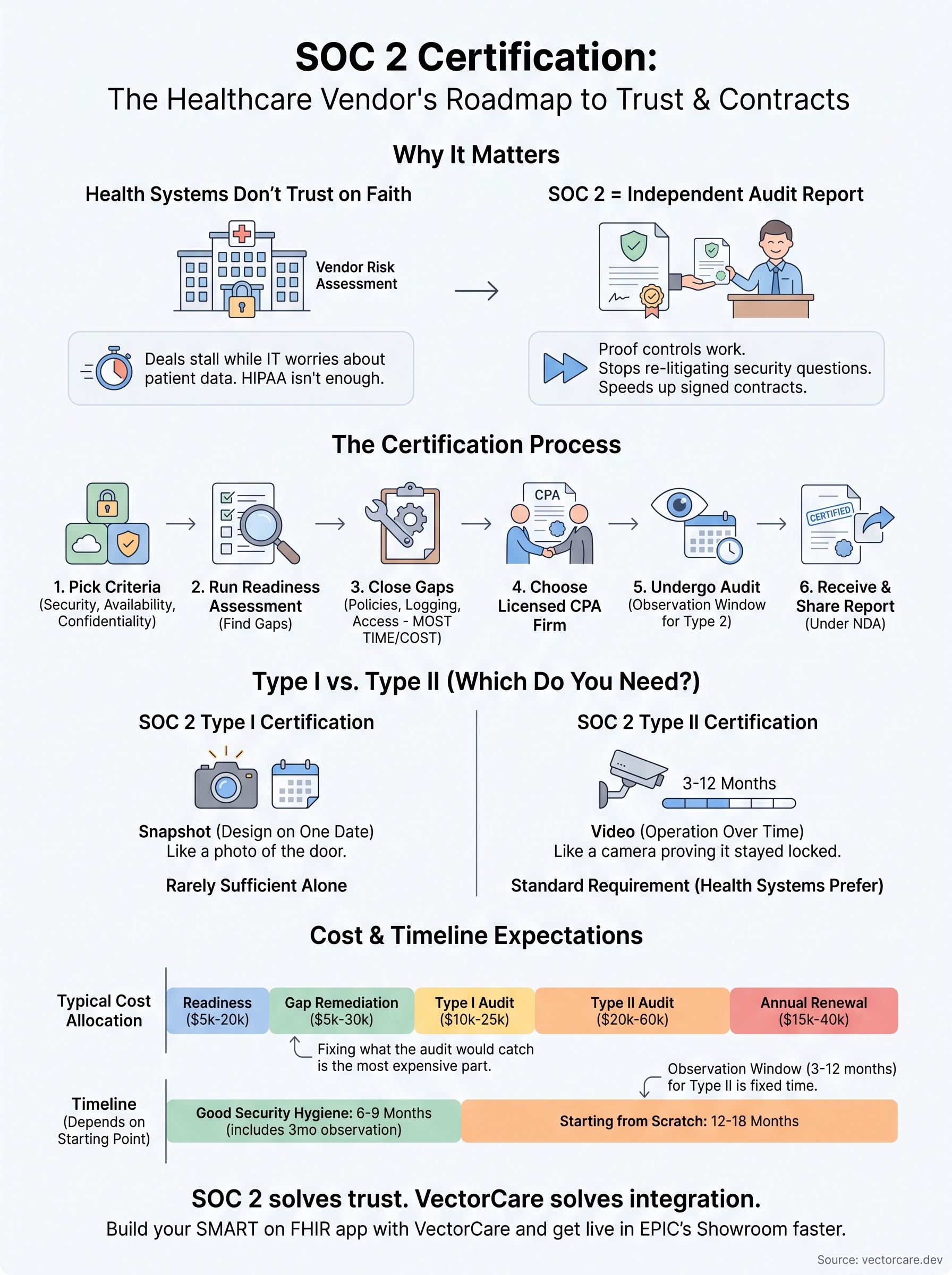
Health systems don't take vendor security claims on faith. Every hospital IT department runs a vendor risk assessment before letting your app touch patient data, and that assessment almost always starts with a request for your SOC 2 report. Skip this step and you're not competing on features anymore, you're stuck explaining why you don't have basic proof of security controls while a competitor hands over a clean audit report and moves straight to contract redlines.
If procurement can't verify your security controls, they can't approve your contract, no matter how good your product is.
HIPAA compliance alone doesn't cut it
Many healthcare vendors assume HIPAA compliance is enough to satisfy a health system's security team. It isn't. HIPAA is a legal requirement with broad standards, but it doesn't come with independent verification that your controls actually work day to day. SOC 2 fills that gap with a third-party audit conducted by a licensed CPA firm, giving hospital IT a document they can point to instead of taking your word for it. This is exactly why so many RFPs list both HIPAA compliance and SOC 2 certification as separate line items.
SOC 2 reports are built around five Trust Services Criteria, and most healthcare vendors need to demonstrate several of them:
- Security (required in every report)
- Availability (uptime and system resilience)
- Confidentiality (how sensitive data is protected)
- Processing integrity (accuracy of data handling)
- Privacy (how personal data is collected and used)
What it costs you to skip it
Deals stall without it. A sales cycle that should close in 60 days can drag past 180 days while your team scrambles to answer a 40-page security questionnaire manually, department by department. Worse, some health systems won't even start that questionnaire until you've supplied a SOC 2 report, so the delay happens before your sales team gets any real feedback on the deal.
Organizations that treat SOC 2 as a growth investment rather than a compliance checkbox tend to close larger contracts faster. Once you have the report, you stop re-litigating the same security questions with every new prospect and start pointing procurement to a document that already answers them. For a vendor trying to land health system contracts on top of building EPIC integrations, that time savings compounds fast, and it's often the difference between a signed contract this quarter and one that slips into next year.
How to get SOC 2 certified: the process step by step
Getting SOC 2 certified isn't a single event, it's a sequence of decisions that build on each other. Skip a step or rush the readiness work, and you'll find out during the audit, which is the most expensive place to find out. Here's how the SOC 2 certification process actually plays out for most healthcare vendors:
- Pick your Trust Services Criteria. Security is mandatory. Most healthcare vendors add Availability and Confidentiality, since those map directly to what hospital IT cares about.
- Run a readiness assessment. Either internally or with a consultant, map your existing controls against the criteria you picked. This is where you find the gaps before an auditor does.
- Close the gaps. Write missing policies, turn on logging, set up access reviews, document your incident response plan. This step usually takes longer than anyone expects.
- Choose a licensed CPA firm. Only a CPA firm can issue a SOC 2 report. Get quotes and check their healthcare experience specifically.
- Undergo the audit. For Type 2, the auditor observes your controls operating over a set window, typically three to twelve months.
- Receive your report and distribute it. Most vendors share it under NDA with prospects during procurement.
Management always assigns responsibility for the resulting controls, per the American Institute of Certified Public Accountants (AICPA), which owns the SOC 2 framework. You can read their official overview of SOC for Service Organizations if you want the source material straight from the standards body.
Readiness work, not the audit itself, is where most vendors either save months or lose them.
One detail trips up a lot of first-timers: how to get SOC 2 certification doesn't mean passing a test once. Type 2 requires your controls to run consistently across the entire observation window, so if you fix something in month four, the clock doesn't reset, but the auditor will note when the control became effective.
SOC 2 Type I vs Type II: which report do you need
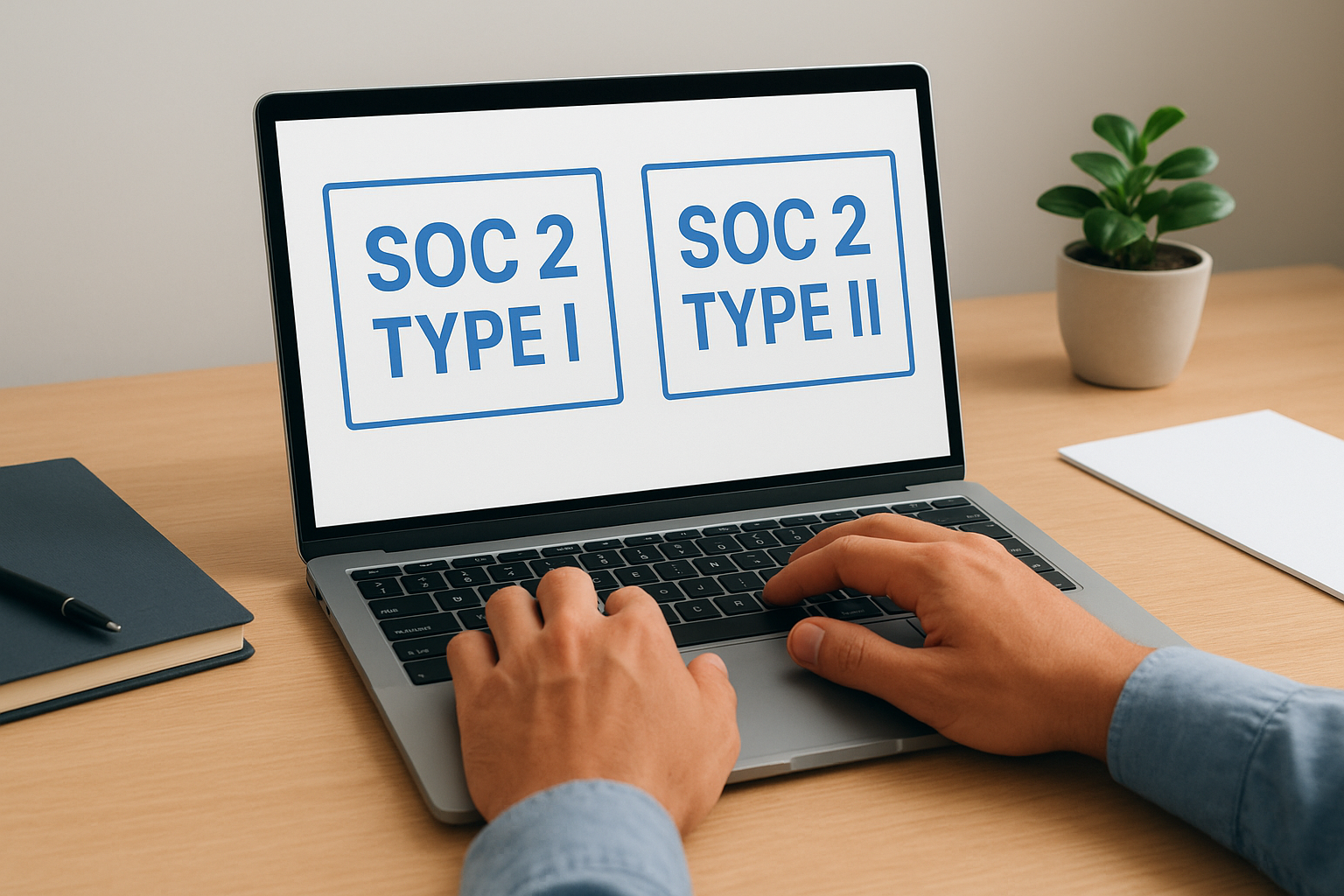
Both reports cover the same Trust Services Criteria, but they answer different questions. A SOC 2 Type I certification confirms that your controls are designed correctly on a single date, like a photograph of your security setup. A SOC 2 Type II certification confirms those same controls actually operated correctly over a period of months, more like a security camera than a photo. Health system procurement teams almost always want the camera, not the photo.
What each report actually proves
Understanding the gap matters before you commit budget to either one. Type I is faster and cheaper, so some vendors use it as a stepping stone to show early progress to a specific prospect. Type II takes longer because the auditor has to watch your controls run for an observation window, typically three to twelve months, before signing off.
| Type I | Type II | |
|---|---|---|
| What it proves | Controls designed properly on one date | Controls operated properly over time |
| Typical timeline | 4-8 weeks | 3-12 month observation, plus audit |
| Health system acceptance | Rarely sufficient alone | Standard requirement |
| Best use case | Bridge report while Type II is underway | Long-term proof for contracts |
A Type I report shows you built the door. A Type II report shows it stayed locked.
Why healthcare vendors skip straight to Type II
Once you understand what hospital IT actually asks for, the choice gets easier. Is SOC 2 Type 2 a certification health systems will accept on its own? Generally yes, and it's the version RFPs specify by name. Vendors who start with Type I often end up paying for both reports anyway, since prospects eventually ask for the Type II once the observation period closes. If you can afford the longer runway, go straight for Type II and skip the intermediate step entirely.
How much SOC 2 certification costs and how long it takes
Budget matters as much as timeline when you're deciding how to get SOC 2 certification. Costs vary based on company size, the number of Trust Services Criteria you include, and whether you hire a readiness consultant or handle gap remediation internally. Small vendors with lean infrastructure often spend less than sprawling organizations with multiple products and cloud environments, so don't anchor to a single number until you know where you fall on that spectrum.

What you'll actually pay
Expect these ranges for a typical healthcare software vendor pursuing SOC 2 compliance certification:
| Line item | Typical cost range |
|---|---|
| Readiness assessment / consultant | $5,000-$20,000 |
| Gap remediation (tools, policy work) | $5,000-$30,000 |
| Type I audit fee | $10,000-$25,000 |
| Type II audit fee | $20,000-$60,000 |
| Annual renewal audit | $15,000-$40,000 |
Most of that spending happens before the auditor ever shows up. Gap remediation eats the biggest chunk of budget for vendors who haven't built formal security programs yet, since you're paying for tooling, engineering time, and sometimes a fractional security hire to get controls in place.
The audit fee is rarely the expensive part. Fixing what the audit would catch is.
Why the timeline stretches longer than you expect
Timing depends on your starting point more than anything else. A vendor with decent security hygiene can reach a SOC 2 Type II certification in six to nine months total, factoring in a three-month observation window. A vendor starting from scratch, no access reviews, no logging, no documented incident response, should plan for twelve to eighteen months before the report lands in hand. Healthcare vendors chasing EPIC integration timelines need to start this process early, since a stalled SOC 2 report can hold up a signed contract just as easily as a missing FHIR endpoint.
Making SOC 2 work for your organization
SOC 2 certification isn't optional anymore for healthcare vendors chasing health system contracts. It's the document that lets procurement say yes without a six-month security review, and skipping it just pushes that review onto your sales team's calendar instead. Start the readiness work now, pick Type II if you can afford the runway, and treat the audit as the finish line rather than the starting point.
Getting your SOC 2 certification in hand solves the trust problem, but it doesn't build the FHIR integration a health system actually needs to use your product. That's a separate technical lift, one that traditionally costs $500K and takes over a year to build in-house. Once your compliance story is solid, build your SMART on FHIR app with VectorCare and get it live in EPIC's Showroom in weeks instead of months, so your security work and your integration work land on procurement's desk at the same time.
The Future of Patient Logistics
Exploring the future of all things related to patient logistics, technology and how AI is going to re-shape the way we deliver care.
Thank you! Your submission has been received!
Oops! Something went wrong while submitting the form.