SOC 1 Type 2 Certification: What It Is and How It Works

You're evaluating a vendor, or you're the vendor, and someone just asked for proof of a SOC 1 Type 2 certification. If you're not sure what separates that from a SOC 2 report or a Type 1 audit, you're not alone. Health systems and enterprise buyers throw these terms around as if they're interchangeable, and they aren't.
SOC 1 Type 2 is an auditor's opinion on whether your internal controls over financial reporting actually worked, consistently, over a period of months, not just on paper at a single point in time. That distinction matters because a Type 1 report only confirms your controls exist on a given day, while Type 2 proves they held up under real operating conditions. Understanding soc 1 and 2 certification differences helps you answer buyer questions correctly instead of guessing.
This article breaks down what SOC 1 Type 2 actually covers, how it differs from SOC 1 Type 1 and SOC 2 reports, and what the audit process looks like from scoping to final report. If your product touches EHR data or clinical workflows, knowing where soc 1 soc 2 certification fits into your compliance stack will save you time when health systems start asking for documentation.
Why SOC 1 Type 2 certification matters for healthcare vendors
Healthcare vendors that touch billing, claims adjudication, revenue cycle management, or any financial data flowing through a health system's books need SOC 1 Type 2 certification to close enterprise deals. Health system finance and compliance teams rely on your report to satisfy their own auditors, and a Type 1 snapshot won't cut it when their auditors need evidence spanning a full fiscal period. Skipping this step doesn't just slow procurement, it can kill a deal outright once legal or finance flags the gap.
Where SOC 1 fits alongside HIPAA and SOC 2
Digital health vendors often assume HIPAA compliance and a SOC 2 report cover everything a hospital system wants to see. HIPAA addresses patient privacy and security, and SOC 2 speaks to trust principles like availability and confidentiality. Neither one tells a health system's controller whether your platform's financial controls, like invoicing logic, payment reconciliation, or automated billing calculations, actually functioned correctly across the year. If your app calculates copays, processes claims, or feeds data into a revenue cycle system, expect finance stakeholders to ask for SOC 1 specifically, not a substitute.
A SOC 2 report proves your system is secure; a SOC 1 Type 2 report proves your financial controls actually worked, month after month.
What happens when you don't have it
Without a current report, you'll spend cycles answering one-off security questionnaires, drafting custom attestation letters, and waiting on legal review, all of which stretch a sales cycle that should take weeks into months. Procurement teams at large health systems increasingly treat soc 1 and 2 certification as a gate, not a nice-to-have, especially for vendors integrating with EPIC where financial and clinical workflows overlap.
Common triggers that push a health system to require SOC 1 Type 2:
- Your platform touches billing, claims, or payment data tied to patient encounters
- You process reimbursement calculations or fee schedules on their behalf
- Your app integrates with their revenue cycle or practice management systems
- Their internal audit team requires third-party assurance for any vendor touching financial reporting
Vendors who get ahead of this requirement, rather than scrambling once a deal stalls, tend to close larger contracts faster and skip the awkward mid-negotiation compliance fire drill.
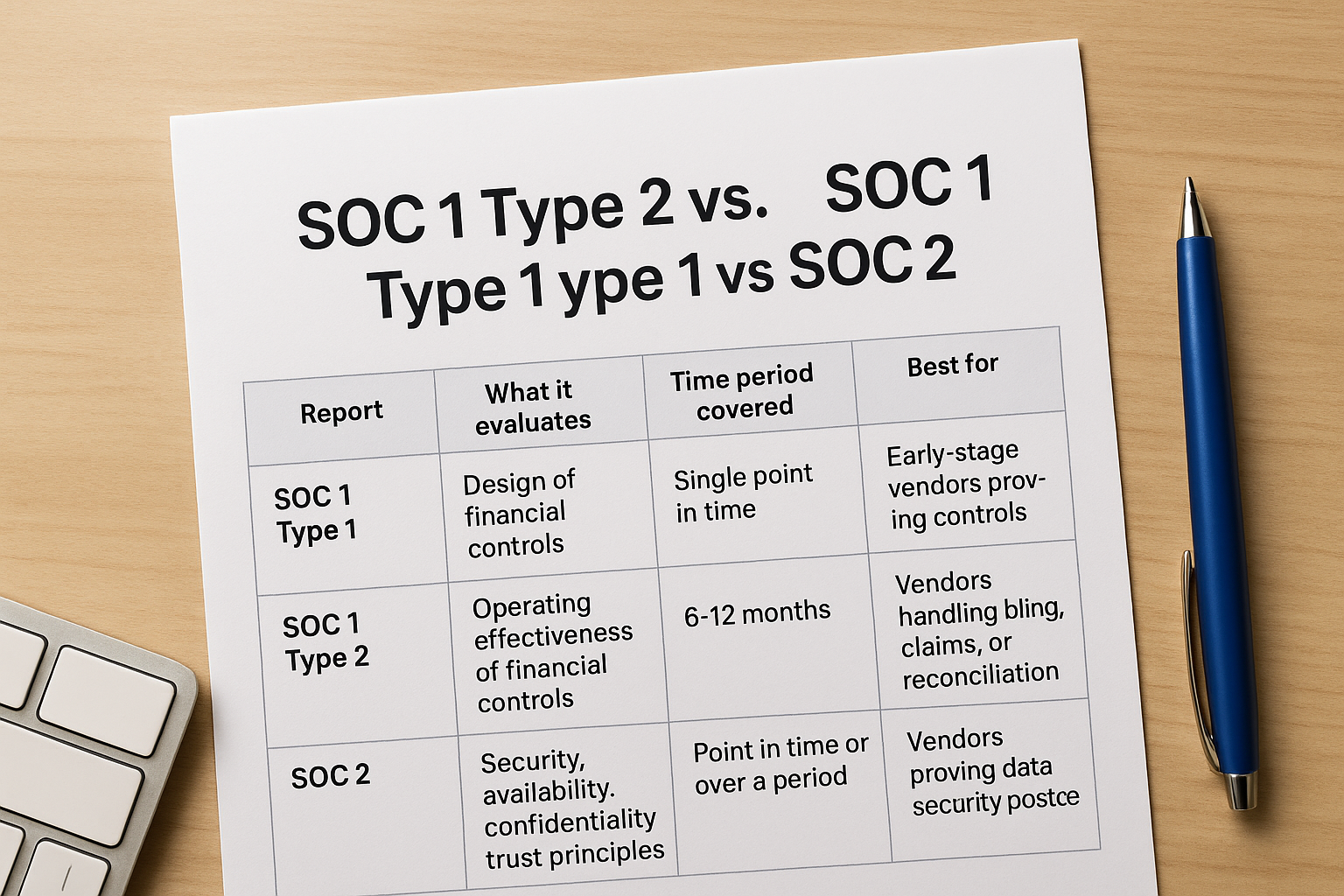
SOC 1 Type 2 vs. SOC 1 Type 1 vs. SOC 2
Confusing these three reports is the fastest way to send a health system the wrong document. Each one answers a different question, and mixing them up during a compliance review makes your team look unprepared. Here's the breakdown buyers actually care about.
| Report | What it evaluates | Time period covered | Best for |
|---|---|---|---|
| SOC 1 Type 1 | Design of financial controls | Single point in time | Early-stage vendors proving controls exist |
| SOC 1 Type 2 | Operating effectiveness of financial controls | 6-12 months | Vendors handling billing, claims, or reconciliation |
| SOC 2 | Security, availability, confidentiality trust principles | Point in time or over a period | Vendors proving data security posture |
Why the distinction trips people up
Many vendors assume SOC 2 automatically satisfies any compliance request, since it's the more commonly discussed report in tech circles. SOC 2 reports focus on the Trust Services Criteria, security, availability, processing integrity, confidentiality, and privacy, none of which speak to whether your invoicing math or payment reconciliation logic actually worked correctly. A SOC 1 Type 2 audit, by contrast, tests whether your financial control activities operated as designed across the audit window, with an auditor sampling transactions and reviewing evidence month by month.
If a health system's finance team is asking about your controls, they want SOC 1, not SOC 2, no matter how strong your security posture is.
Selecting between Type 1 and Type 2 usually comes down to timeline pressure versus buyer expectations. Type 1 reports work as a stopgap when a deal needs proof fast and you haven't accumulated enough operating history yet. Type 2 takes longer because auditors need real transaction data spanning multiple months, but it's the report most enterprise health systems will ultimately require before signing a contract that touches financial workflows.
How to prepare for and complete a SOC 1 Type 2 audit
Getting through a SOC 1 Type 2 audit takes real planning, not a last-minute scramble before a health system deadline. Most vendors underestimate the lead time because the audit itself only starts once you've already built and documented the controls the auditor will test. Budget at least two to three months for prep work before the observation period even begins.
Scoping and readiness assessment
Before hiring an auditor, map out which systems and processes touch financial reporting, invoicing, payment reconciliation, fee calculations, or anything feeding a health system's books. A readiness assessment, often run by the same firm that will later issue the report, flags gaps in your control design before the clock starts. Typical prep steps include:
- Document control owners and responsibilities for each financial process
- Write formal policies where informal practices currently exist
- Set up logging and evidence retention so auditors can verify activity later
- Run a mock walkthrough with your compliance lead or outside counsel
The observation period and evidence collection
Once scoping wraps, the observation period begins, typically six to twelve months during which the auditor samples transactions, interviews staff, and reviews system logs at intervals. This is where Type 2 diverges sharply from Type 1: you can't fake months of consistent operation, so any control that only works when someone's watching will surface as an exception.
A SOC 1 Type 2 audit rewards vendors who build controls into daily operations, not ones who scramble to look compliant right before the auditor calls.
Report delivery and remediation
Six to twelve weeks after the observation period closes, the auditor issues a draft report noting any exceptions found during testing. Vendors typically get a chance to respond with management commentary explaining remediation steps already underway, which health systems' finance teams will read closely before signing off.
What a SOC 1 Type 2 report covers, costs, and takes
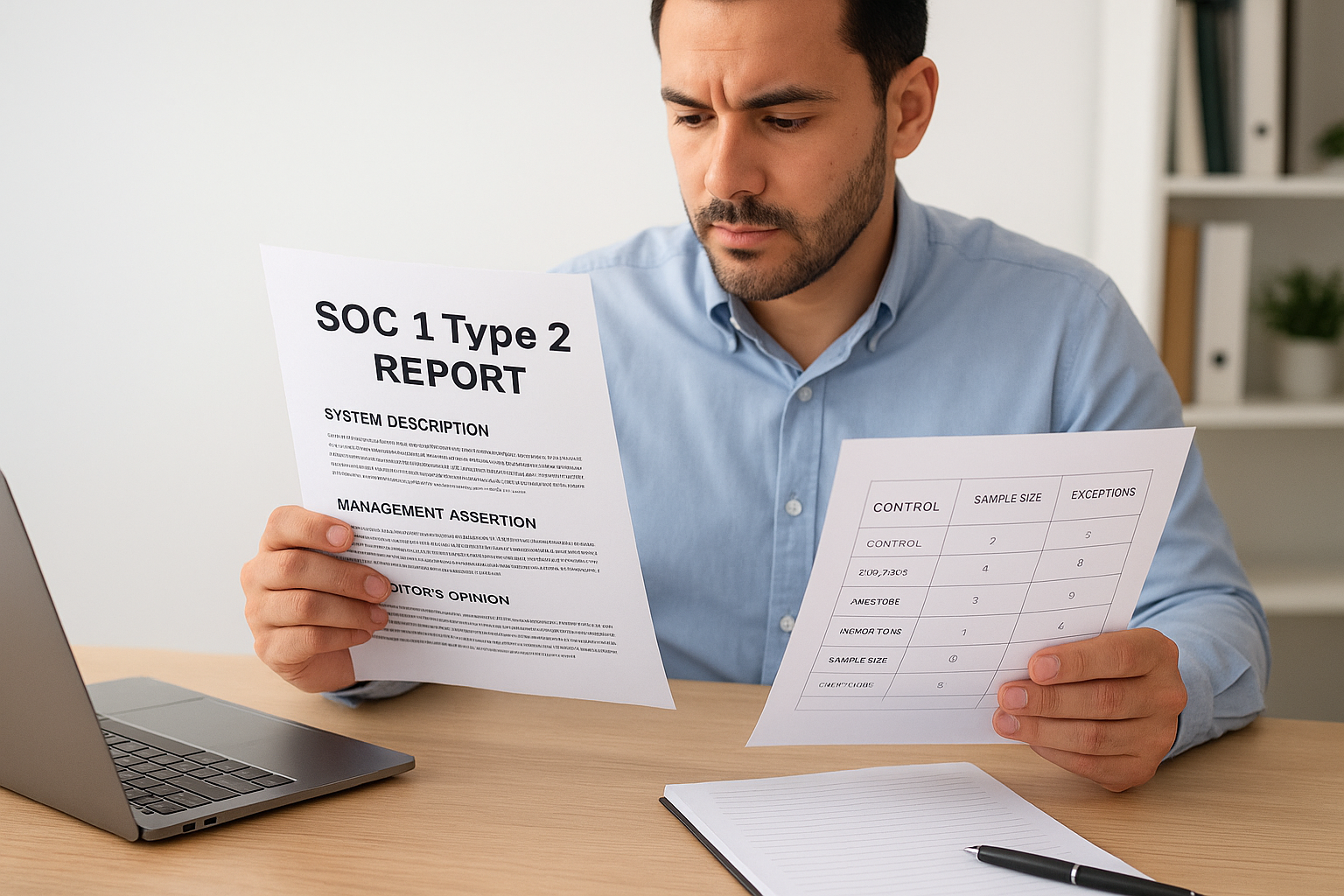
A finished SOC 1 Type 2 report contains four sections that health system auditors will actually read: a description of your system, management's assertion about control design, the auditor's opinion, and detailed testing results for each control tested. That last section is where the real value sits, since it lists every control, the sample size tested, and whether exceptions turned up. Buyers skip the boilerplate and go straight to the testing matrix, so incomplete or vague control descriptions raise red flags fast.
Typical costs and timeline
Costs vary by company size and control complexity, but most digital health vendors land in a predictable range. Budgeting accurately here prevents the scramble that hits teams who assumed a soc 1 type 2 certification would cost the same as a lighter SOC 2 Type 1 engagement.
| Line item | Typical range |
|---|---|
| Readiness assessment | $10,000 to $25,000 |
| Audit fees (Type 2) | $30,000 to $80,000 |
| Internal staff time | 100 to 300 hours |
| Observation period | 6 to 12 months |
| Report delivery after period ends | 6 to 12 weeks |
Why the investment pays off in contract velocity
Dollars spent on the audit itself are only part of the equation. Internal engineering, finance, and compliance hours often exceed the auditor's invoice, especially in the first year when policies and evidence trails don't exist yet.
The real cost of SOC 1 Type 2 isn't the audit fee, it's the months of internal discipline required before the observation period even starts.
Repeat audits in later years cost less and move faster, since evidence collection becomes routine rather than a first-time build. Vendors who treat the first cycle as infrastructure, not a one-off expense, see that payoff show up in shorter procurement timelines the second time around.
Who actually needs SOC 1 Type 2 certification
Not every digital health vendor needs a SOC 1 Type 2 report, and chasing one before it's relevant wastes money you could spend on product or sales. The report matters specifically for companies whose platform touches financial data flowing into a health system's books. If your app never calculates a charge, processes a claim, or reconciles a payment, a health system's finance team has no reason to ask for it, even if their security team still wants SOC 2.
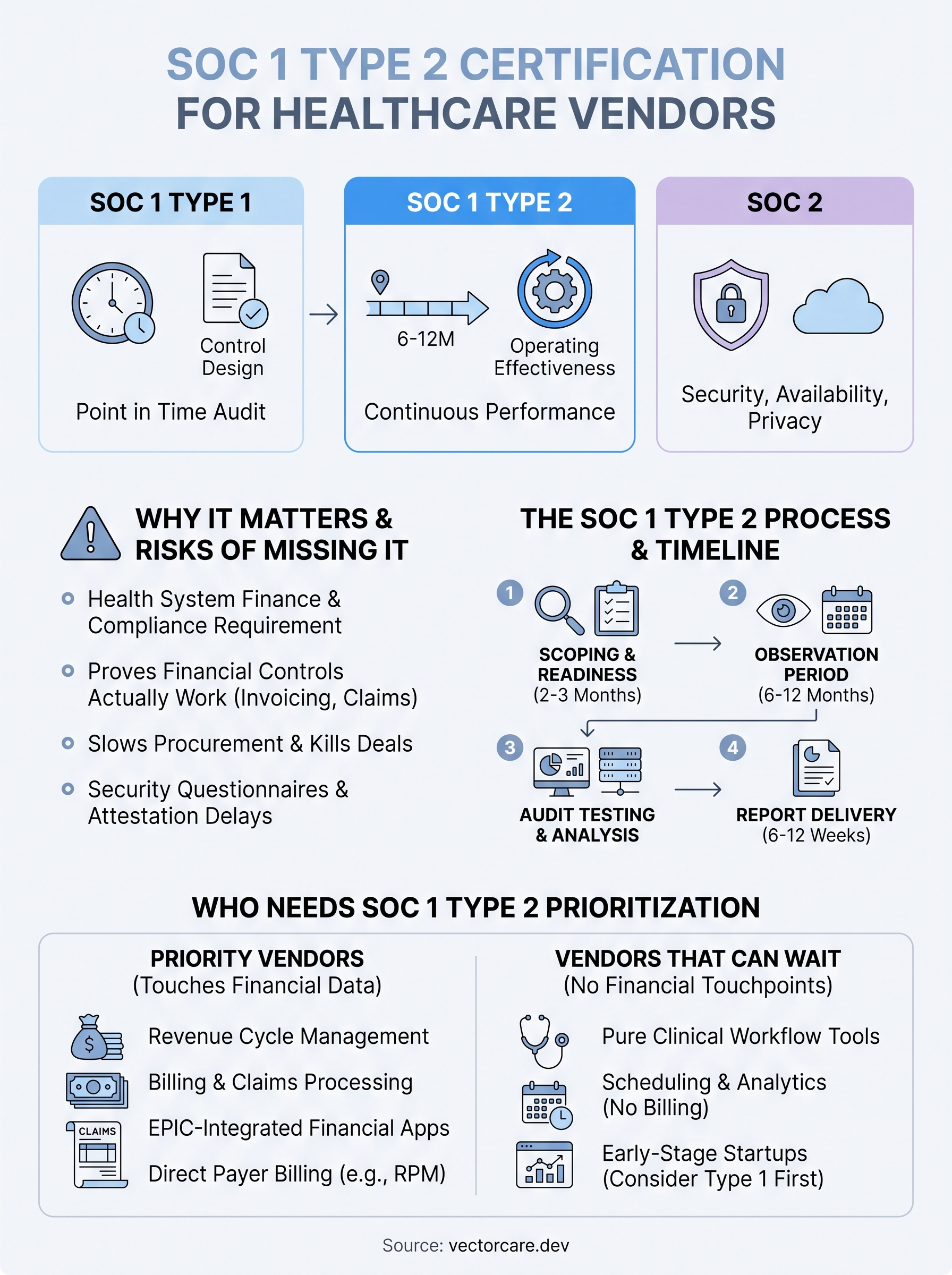
Vendors that should prioritize it
Certain business models trigger the requirement almost every time during procurement:
- Revenue cycle management platforms calculating reimbursement or fee schedules
- Billing and claims adjudication tools processing patient encounter data
- Remote patient monitoring companies that bill payers directly for services rendered
- Clinical decision support vendors whose recommendations feed into billable events
- Any EPIC-integrated app that touches payment reconciliation or invoicing logic
If your platform generates or influences a dollar figure that ends up on a health system's books, plan on SOC 1 Type 2.
Vendors that can usually wait
Companies building pure clinical workflow tools, scheduling apps, or analytics platforms with no billing component typically satisfy buyers with HIPAA compliance and a SOC 2 report alone. Startups early in their fundraising and contracting cycle sometimes start with a SOC 1 Type 1 to prove control design exists, then move to Type 2 once they've closed a few larger health system deals and have the operating history to show consistent performance. Skipping straight to Type 2 before you have real transaction volume just means paying an auditor to test controls that barely have a track record yet.
Putting SOC 1 Type 2 into perspective
SOC 1 Type 2 certification isn't a checkbox you tackle because a competitor has one. It's proof, tested over months, that your financial controls hold up under real transaction volume, and health systems handling billing or claims data will ask for exactly that proof before signing. Skip it when your app doesn't touch a dollar figure, pursue it early when it does, and don't confuse it with SOC 2 or lean on a Type 1 report longer than you need to.
Compliance is only half the battle for EPIC-integrated vendors, though. Even with a clean audit report in hand, you still need a working SMART on FHIR app that health systems can actually install, and building that from scratch eats the same months you just spent on the audit. If you'd rather skip the custom engineering and get a compliant app into EPIC's Showroom fast, build and deploy your SMART on FHIR app in days.
The Future of Patient Logistics
Exploring the future of all things related to patient logistics, technology and how AI is going to re-shape the way we deliver care.
Thank you! Your submission has been received!
Oops! Something went wrong while submitting the form.