SOC 2 Compliance AI: What It Is And How It Works

If you're building an AI-powered health tool and a hospital's security team just asked for your SOC 2 report, you're not alone. SOC 2 compliance AI sits at the intersection of two things health systems now demand before they'll sign a contract: proof that your controls are sound, and proof that your AI features don't create new risk. Auditors are asking sharper questions about model training data, access controls around inference, and how you monitor AI-driven decisions, and generic compliance checklists don't cover that anymore.
This article breaks down what AI SOC 2 compliance actually means in practice, not just the theory. You'll see how SOC 2's trust service criteria map onto AI-specific risks, and where automated evidence collection and continuous monitoring tools can cut months off your audit prep instead of relying on spreadsheets and manual screenshots.
We'll also cover why this matters more for vendors building on top of EHR data. If your product touches EPIC through SMART on FHIR, health systems will scrutinize your compliance posture and data handling practices before they let your app anywhere near a clinical workflow, so getting this right early saves you from stalled deals later.
Why SOC 2 compliance matters for AI companies
Health systems treat a SOC 2 report as a baseline requirement, not a nice-to-have. Before a hospital lets your application touch patient data or connect to EPIC, their security and compliance teams want documented proof that you control access, encrypt data in transit and at rest, and monitor your systems for incidents. Without that report, most procurement processes stop cold. Digital health vendors who show up with a completed SOC 2 Type II report routinely move through vendor review in weeks instead of months, because the report answers dozens of security questionnaire items in one shot.

Adding AI to your product changes what auditors expect from that report. A model that pulls patient history, flags risk scores, or recommends care pathways introduces failure modes a traditional SaaS tool never had to answer for. Auditors now ask how you version your training data, who can access model outputs, how you detect drift, and what happens when the model gets something wrong in a clinical context. AI SOC 2 compliance means extending your existing controls to cover these questions specifically, not treating your AI features as a black box sitting outside the audit scope.
A SOC 2 report without answers for your AI features is a report health systems will send back with more questions.
Skipping this work doesn't just delay a deal, it can kill it outright. Health system security teams have gotten more sophisticated about AI risk in the last two years, partly because regulators and their own legal counsel are pushing them to. A few of the questions that now show up in vendor security reviews for AI-enabled health tools:
- How is patient data used to train or fine-tune your models, and can it be excluded on request?
- Who has access to model inputs and outputs, and is that access logged?
- What monitoring do you have for anomalous or biased model behavior?
- Can you explain a specific model decision if a clinician or patient disputes it?
- Do you have a documented incident response process specific to AI failures?
Matters here go beyond just closing one contract. Compliance posture becomes a competitive signal in healthcare sales cycles. Vendors who can hand over a current SOC 2 report with an AI-aware scope close deals faster and get referred to other health systems by satisfied security teams. Vendors who can't end up stuck answering the same custom questionnaire every time, burning weeks of sales cycle on paperwork instead of product. If you're building on top of EHR data, that difference compounds, because every health system you approach runs the same playbook, and a strong SOC 2 report becomes the fastest way through it.
How SOC 2 compliance works for AI platforms
SOC 2 is an audit standard set by the American Institute of CPAs, and it evaluates whether your controls actually protect data the way you say they do. An independent auditor examines your policies, your infrastructure, and your evidence, then issues a report scoped to one or more of the five trust services criteria: security, availability, processing integrity, confidentiality, and privacy. SOC 2 compliance AI work starts with the same audit mechanics, but the auditor now digs into how your models handle data alongside how your servers do.
Type I versus Type II
Most health systems won't accept a Type I report on its own, because it only confirms your controls exist on a single date. They want Type II, which tests whether those controls held up over a review period, usually six to twelve months.
| Report type | What it proves | Typical review period |
|---|---|---|
| Type I | Controls are designed correctly | Point in time |
| Type II | Controls actually operated as designed | 6 to 12 months |
A Type I report tells a health system your controls exist. A Type II report tells them your controls worked.
Where AI fits into audit scope
Getting to a clean Type II report means defining your audit scope before the auditor shows up, and for AI platforms that scope now has to explicitly include model training pipelines, inference environments, and any third-party AI APIs you call. Leaving those out doesn't make the audit easier, it just means your report won't answer the questions health system reviewers are actually going to ask. Vendors who scope their AI features in from day one avoid the awkward follow-up audit six months later when a customer's security team notices the gap.
How AI changes the five trust services criteria
Each of the five trust services criteria still applies to an AI-enabled platform, but auditors interpret them differently once a model is making decisions or touching patient data. SOC 2 compliance AI work means mapping each criterion to a specific AI risk instead of assuming your existing controls already cover it.
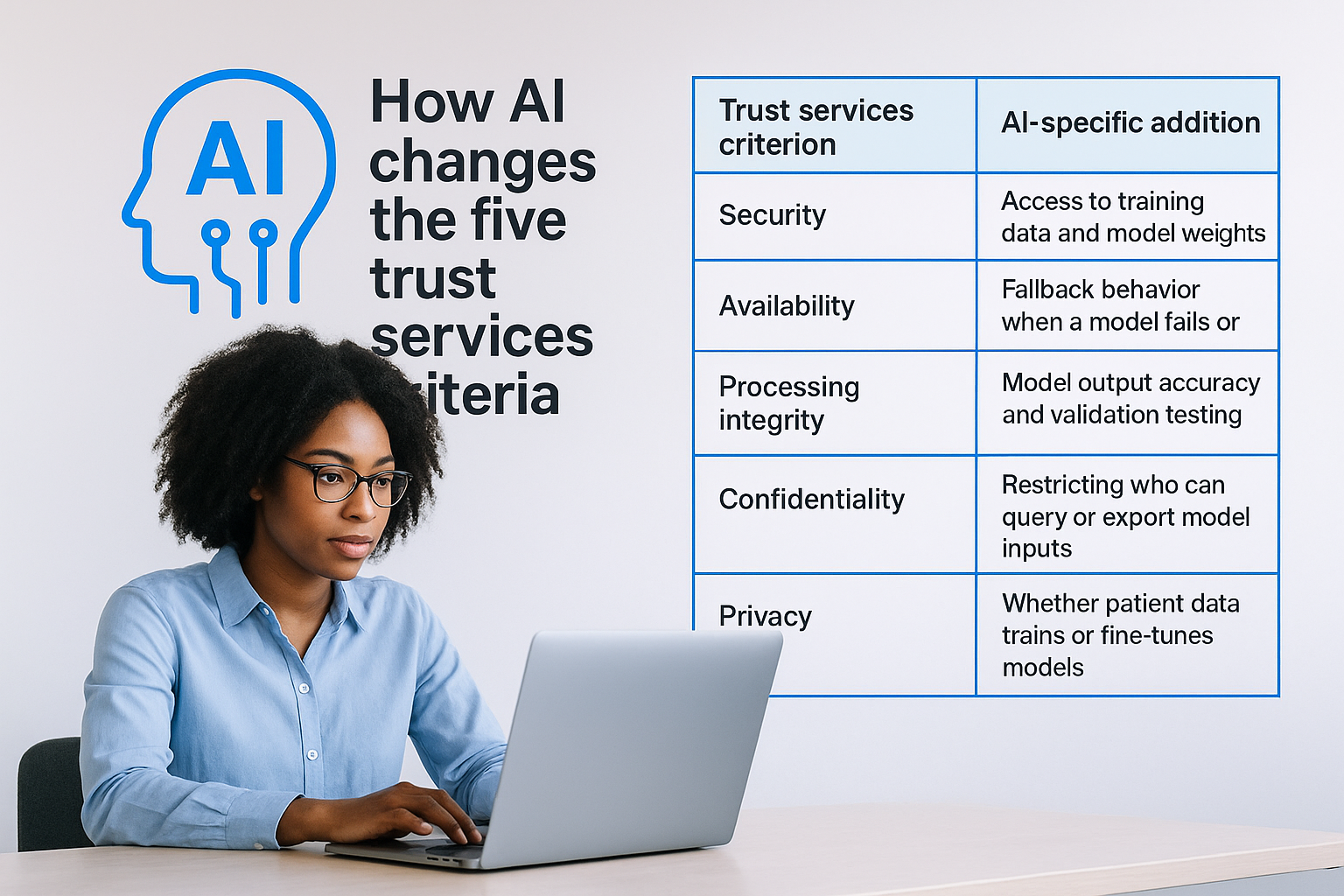
| Trust services criterion | Traditional focus | AI-specific addition |
|---|---|---|
| Security | Access controls, encryption | Access to training data and model weights |
| Availability | Uptime, disaster recovery | Fallback behavior when a model fails or drifts |
| Processing integrity | Accurate data processing | Model output accuracy and validation testing |
| Confidentiality | Data classification | Restricting who can query or export model inputs |
| Privacy | Consent, data minimization | Whether patient data trains or fine-tunes models |
Privacy and confidentiality carry the most AI risk
Getting these two criteria right matters more for AI vendors than the other three combined, because health system reviewers assume your servers are secure and instead focus on what happens to patient data once it enters a model. AI-driven decisions built on protected health information raise questions your legacy SaaS controls never addressed, like whether a patient can opt out of having their data used for model training.
The trust services criteria haven't changed, but for AI platforms, privacy and confidentiality now carry most of the weight.
Processing integrity gets a new definition
Here's where auditors dig deepest for clinical AI tools. Processing integrity used to mean your system processed data without corruption. Now it also means your model produces outputs a clinician can trust, which requires documented validation testing and a way to flag low-confidence predictions before they reach a workflow.
How to use AI tools to streamline SOC 2 compliance
Manual SOC 2 prep used to mean screenshots, spreadsheets, and someone spending a week chasing down access logs before an audit window closed. AI SOC 2 compliance tooling flips that model by pulling evidence continuously from your cloud infrastructure, identity provider, and code repositories instead of waiting for a compliance manager to gather it by hand. Vendors building on top of EPIC and other EHR systems benefit most here, because the volume of access logs and data-handling events an AI feature generates would overwhelm a manual process anyway.
Automated evidence collection
Platforms built for this job connect directly to your AWS or Azure environment, your HR system, and your ticketing tool, then map what they find to specific trust services criteria automatically. That means an auditor sees a live trail of access reviews, encryption settings, and incident tickets instead of a folder of exported PDFs assembled the week before the audit. Automated evidence collection typically covers:
- Access control logs tied to individual employees and service accounts
- Encryption configuration checks across data at rest and in transit
- Vendor risk assessments for any third-party AI API you call
- Incident response tickets and resolution timestamps
The vendors who pass SOC 2 audits fastest aren't the ones with perfect controls, they're the ones who can prove those controls worked without weeks of manual digging.
Continuous monitoring instead of point-in-time checks
Continuous monitoring tools flag control failures the moment they happen, not months later when an auditor samples a random date and finds a gap. For an AI platform, that includes watching for unauthorized access to training data, unexpected changes to model permissions, or a service account picking up access it shouldn't have. Running this kind of monitoring year-round turns your Type II audit into a formality that confirms what you already know, rather than a scramble to reconstruct six months of history from memory and disconnected logs.
Common SOC 2 compliance challenges for healthcare AI vendors
Healthcare AI vendors run into a specific set of obstacles that generic software companies rarely face. Ai soc 2 compliance work gets harder the moment your product touches EPIC data, because you're now accountable for controls across your own infrastructure and every third-party model API, hosting provider, or data pipeline you rely on. Small teams building SMART on FHIR apps often discover their compliance gaps only after a health system's security review surfaces them, which is the worst possible time to find out.
Shared responsibility with third-party AI vendors
Most healthcare AI tools call at least one external model API for inference or fine-tuning, and that creates a shared responsibility problem auditors expect you to have already solved. You need documented vendor risk assessments, a data processing agreement, and proof that patient data sent to that API doesn't get retained or used for someone else's training run. Skipping this step is the single most common gap the National Institute of Standards and Technology flags in its AI risk management framework, and it's exactly the kind of gap a health system's security team will catch.
The weakest link in most healthcare AI compliance programs isn't your own infrastructure, it's the vendor you forgot to vet.
Explaining model decisions to non-technical auditors
Explaining a model's behavior in plain language to an auditor who isn't a data scientist trips up even experienced teams. You need documentation that a compliance reviewer, not an engineer, can read and verify against evidence.
- A written explanation of what data trains or fine-tunes your model
- A log showing who accessed model outputs and when
- A record of validation testing before each model update ships
Getting these three items in order before your audit window opens saves weeks of back-and-forth once the auditor starts asking questions.

Bringing it all together
SOC 2 compliance AI work isn't a separate audit track from your existing security program, it's an extension of it. The same five trust services criteria apply, but you now have to document what your models train on, who touches their outputs, and how you catch failures before they reach a clinical workflow. Health systems have gotten sharper about asking these questions, and vendors who can't answer them lose deals to ones who can.
Getting this right matters even more once you're touching EPIC data through SMART on FHIR, where security review is the gate standing between your product and a signed contract. Automated evidence collection and continuous monitoring turn that gate from a months-long scramble into routine paperwork.
If you're already dealing with the EPIC integration side of that equation, build your SMART on FHIR app with VectorCare and skip the months of engineering work standing between you and your next health system contract.
The Future of Patient Logistics
Exploring the future of all things related to patient logistics, technology and how AI is going to re-shape the way we deliver care.
Thank you! Your submission has been received!
Oops! Something went wrong while submitting the form.