What Is a BAA in Healthcare? Business Associate Agreements Explained

If you're building software that touches patient data, someone on your legal or compliance team has probably asked you about a BAA. What is a BAA in healthcare, and why does every hospital, EHR vendor, and digital health partner seem to require one before they'll even look at your product? A Business Associate Agreement under HIPAA is a legally binding contract required whenever a vendor creates, receives, maintains, or transmits protected health information (PHI) on behalf of a covered entity like a hospital or health system.
This article breaks down exactly what a BAA covers, who's legally required to sign one, and what happens if you skip it. You'll learn the specific obligations it places on both parties and why health systems won't move forward without one signed and filed.
We wrote this for digital health vendors heading toward an EPIC integration, because a BAA is usually the first compliance hurdle you hit before a health system will even discuss connecting to their EHR. Understanding it now saves you from delays later, especially once your app needs to pass HIPAA and SOC 2 compliance requirements for startups to reach clinical workflows.
Why business associate agreements matter in healthcare
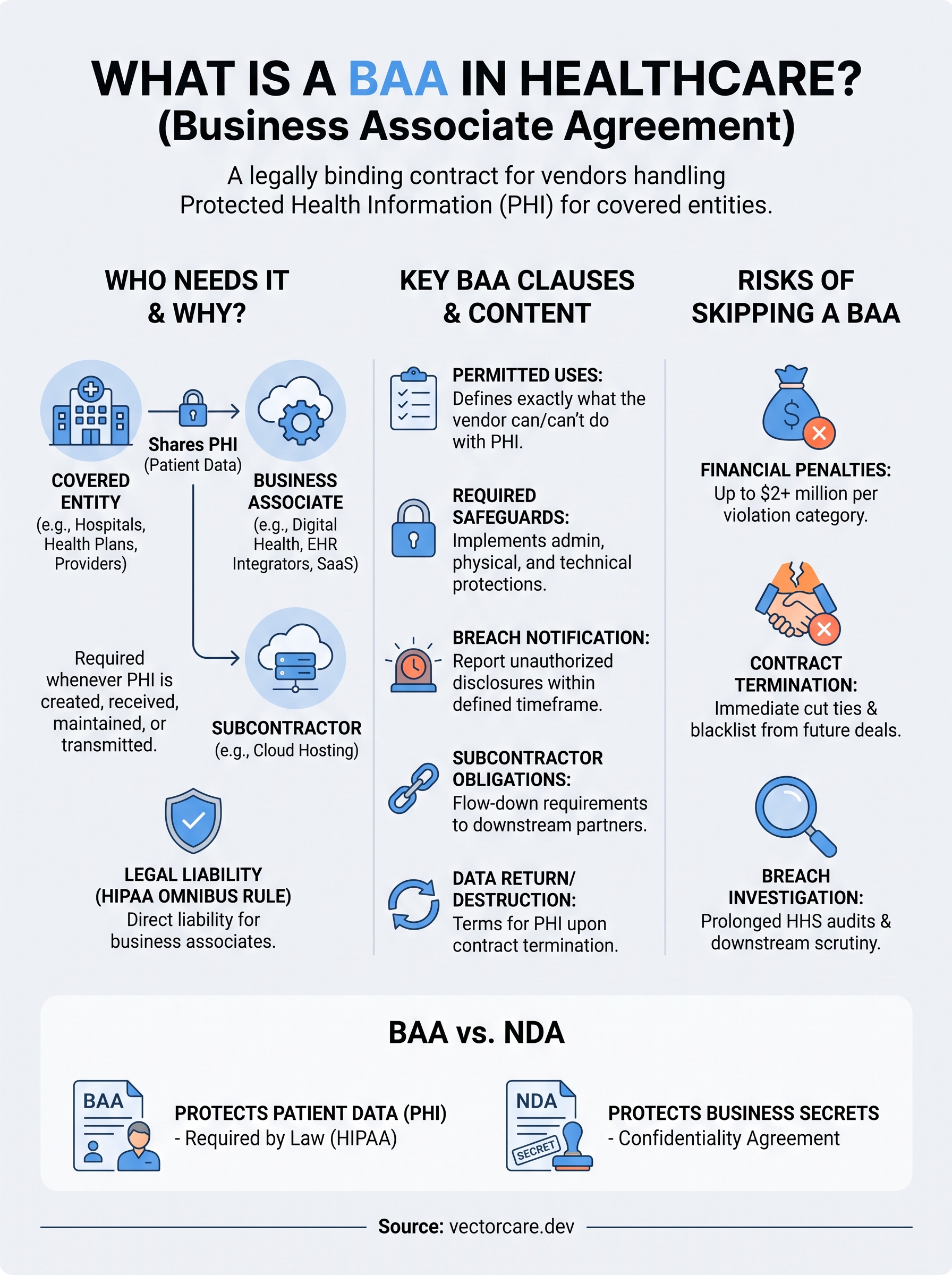
A BAA isn't a formality you sign and forget. It's the legal mechanism that lets HIPAA's privacy and security rules extend beyond hospitals and insurers to every vendor that touches patient data on their behalf. Congress wrote HIPAA to regulate covered entities, not the software companies, billing services, and cloud platforms that support them. Without the BAA requirement, a hospital could outsource data processing to a vendor with zero privacy obligations, and PHI would leak through a gap the original law never closed. The Department of Health and Human Services closed that gap by requiring a signed contract before any protected health information changes hands.
The legal foundation under HIPAA
Health systems don't ask for a BAA out of caution. They ask because federal law makes them personally liable for what their vendors do with patient data. The HIPAA Omnibus Rule of 2013 extended direct liability to business associates themselves, meaning your company can now be fined directly by HHS's Office for Civil Rights, not just sued by the hospital that hired you. That changed the incentive structure completely. Before 2013, a covered entity might get away with a vague contract. Now both sides face exposure, so legal teams on both ends scrutinize every clause before anyone connects to a live EHR feed.
A BAA exists because HIPAA can't regulate a vendor it never signed a contract with.
What's actually at stake without one
Skipping a BAA isn't a paperwork oversight, it's a compliance failure that carries real financial and reputational weight. HHS enforcement actions routinely cite missing or defective BAAs as the root cause of a breach penalty, and the fines scale with negligence. A single unresolved BAA gap can trigger a breach investigation that spans years and drags in every downstream partner who touched the same data. For a digital health vendor trying to land a health system contract, the absence of a BAA is often the single fastest way to get disqualified from a vendor review, long before anyone evaluates your product's clinical value.
Here's what's typically on the line when a BAA is missing or incomplete:
- Civil penalties ranging from $137 to over $2 million per violation category, adjusted annually by HHS
- Contract termination rights that let the covered entity cut ties immediately if a vendor mishandles PHI
- Breach notification obligations that fall on both parties, often triggering state-level reporting requirements too
- Loss of trust with the health system, which can blacklist a vendor from future procurement even after the issue is fixed
How BAAs protect both sides
Done right, a BAA isn't just a liability shield, it's a working document that spells out exactly what a vendor can and can't do with patient data. It defines permitted uses, requires the vendor to implement appropriate safeguards, and obligates prompt breach notification if something goes wrong. Covered entities rely on it to prove, during an audit, that they exercised due diligence before sharing PHI. Vendors rely on it to know precisely where their responsibilities start and stop, which matters enormously when you're integrating with a system as tightly governed as EPIC.
Organizations that treat the BAA as a checkbox usually end up rewriting it later, once a health system's legal team flags gaps during procurement. That rework costs weeks you don't have when you're racing toward a go-live date. Vendors who build compliance into their process from day one, rather than bolting it on after a health system asks, tend to close deals faster and avoid the back-and-forth that stalls EPIC integrations. That's part of why platforms built for SMART on FHIR development bake BAA-ready compliance into the deployment process itself, rather than leaving vendors to negotiate one from scratch with every new health system partner.
Who needs a BAA: covered entities and business associates
Not every organization that touches patient data needs a BAA, but the two categories that do cover a huge slice of healthcare, and the definitions carry real legal weight. HIPAA splits the healthcare world into covered entities and business associates, and figuring out which organizations need a BAA determines whether you're required to sign one before touching any PHI. Get this wrong, and you either sign contracts you don't need or skip one you legally must have, both of which slow down a health system's procurement process.

Covered entities: who HIPAA regulates directly
Covered entities are the organizations HIPAA was written to regulate in the first place: health plans, healthcare clearinghouses, and any healthcare provider that transmits health information electronically in connection with a covered transaction. Think hospitals, physician practices, pharmacies, and health insurers. These organizations carry the primary legal obligation to protect PHI, and they're the ones who initiate a BAA whenever they hire an outside vendor to handle any part of that data. If you're building a digital health product, the health system or clinic you're integrating with is almost always the covered entity in the relationship.
Business associates: the vendors HIPAA reaches indirectly
Business associates are everyone else who creates, receives, maintains, or transmits PHI on behalf of a covered entity, and this is where most digital health vendors land. That includes SaaS platforms, billing companies, cloud hosting providers, EHR integration vendors, and analytics firms, essentially any company performing a function that requires touching patient data even if patient care isn't your core business. The scope is broad on purpose, and HHS has repeatedly expanded it through guidance to close loopholes.
If your software ever sees a patient's name next to their diagnosis, you're probably a business associate.
Subcontractors extend the chain further
Subcontractors, meaning any vendor that a business associate hires to help perform its function, also need a BAA, this time signed directly with the business associate rather than the covered entity. HIPAA calls this a downstream requirement, and it means the obligation doesn't stop at the first vendor in line.
| Role | Example | Signs BAA With |
|---|---|---|
| Covered entity | Hospital, health plan | Originates the BAA |
| Business associate | RPM vendor, EHR integrator | Covered entity |
| Subcontractor | Cloud hosting provider | Business associate |
Every link in that chain needs its own signed agreement, and missing one anywhere breaks the compliance trail a health system's auditors will eventually check when they're deciding when a business associate agreement is required for your product.
How to create a HIPAA-compliant business associate agreement
Building a compliant BAA from scratch isn't something you draft over a weekend and hope holds up. Most vendors either start from a template published by HHS, adapt language from a covered entity's existing agreement, or work from HIPAA policy and procedure templates, then adjust it to reflect the specific data flows your product actually touches. Getting the process right matters just as much as getting the wording right, because a health system's legal team will scrutinize both before they let your app anywhere near live patient data.
Start with a template, then customize for your data flows
HHS publishes sample BAA provisions that cover the baseline requirements, and most vendors use that as a starting skeleton rather than a finished document. Generic language works for the boilerplate sections, but you still need to spell out exactly what PHI your product touches, how long you retain it, and which subcontractors (HIPAA compliant cloud hosting providers, analytics tools, notification services) also need their own downstream agreements. Skipping this customization is how vendors end up with a signed BAA that doesn't actually match what their software does, which becomes a problem the moment an auditor compares the contract to your architecture diagram.
Route it through legal review on both sides
Once the draft reflects your real data flows, it goes through legal review from both the covered entity and your own counsel. This is where most delays happen, because health system legal teams often push back on liability caps, indemnification language, or breach notification timelines. Build extra time into your project timeline for this back-and-forth rather than assuming a template signs itself.
A BAA that doesn't match your actual data flows is worse than no BAA at all, because it hides the gap instead of closing it.
Get signatures and file it before any data moves
Here's the sequence that keeps a health system integration on schedule:
- Draft the BAA using an HHS-aligned template as your baseline
- Map every PHI touchpoint in your product against the contract language
- List every subcontractor that also needs a downstream agreement
- Route the draft through both legal teams for redlines
- Get signatures from authorized representatives on both sides
- File the signed copy before a single API call touches PHI
Answering what is a BAA in healthcare from a process standpoint usually comes down to this: it's a negotiated contract, not a boilerplate form, and treating it that way from the start avoids the rewrite cycle that stalls so many EPIC integrations. Vendors using VectorCare's HIPAA and SOC2 compliant platform skip most of this negotiation entirely, since the compliance groundwork is already built into the deployment process.
Key clauses every BAA must include
HIPAA doesn't leave the contents of a BAA to guesswork. The Privacy Rule at 45 CFR 164.504(e) spells out specific provisions that must appear in the agreement, and a health system's legal team will check for every one of them before signing off on a new digital health vendor. Missing even one clause can send the contract back for another round of redlines, which is exactly the kind of delay that pushes an EPIC go-live date further out.

Permitted uses and required safeguards
Every compliant BAA has to define exactly what the vendor is allowed to do with PHI and nothing beyond that scope. This clause names the specific purpose (claims processing, remote monitoring, care coordination) and prohibits any use outside it, including internal analytics projects that weren't part of the original agreement. Alongside that, the safeguards clause requires the vendor to implement administrative, physical, and technical protections that meet the HIPAA Security Rule requirements, not just promise to "keep data secure" in vague terms.
A BAA that doesn't name the exact permitted use is really just a promise, not a compliance document.
Breach notification and subcontractor obligations
The agreement must also require the vendor to report any breach or unauthorized disclosure to the covered entity within a defined timeframe, often 24 to 72 hours depending on the contract. This breach notification clause starts the clock on the covered entity's own reporting obligations under the HIPAA Breach Notification Rule and its 60-day timeline, so vague or delayed language here creates real downstream liability. A separate subcontractor clause obligates the vendor to get a matching BAA signed with any downstream partner, cloud host, or analytics tool that also touches the same PHI.
Access, termination, and data return
Finally, every BAA needs language covering three closing scenarios: giving patients access to their own records upon request, making PHI available to HHS during an audit, and returning or destroying all PHI when the relationship ends. That last piece, sometimes called the termination clause, matters more than vendors expect, since it defines what happens to years of stored patient data the moment a contract lapses.
Here's the full business associate agreement checklist a compliant BAA needs to satisfy:
- Defined permitted uses and disclosures of PHI
- Required administrative, physical, and technical safeguards
- Breach notification timeline and process
- Subcontractor flow-down requirement
- Patient access and amendment rights
- HHS audit access provision
- Data return or destruction terms at termination
- Termination rights for material breach
Organizations using VectorCare don't draft this checklist from scratch each time, since the platform's compliance framework already maps to every required clause before a health system ever sees the contract.
BAA vs NDA: how these agreements differ
Vendors new to healthcare deals often assume an NDA covers them once a hospital starts sharing data, but that assumption can sink a deal before it starts. A non-disclosure agreement protects confidential business information, trade secrets, pricing, product roadmaps, from competitors and outsiders. A Business Associate Agreement protects patient data specifically, and it exists because a federal law says so, not because two companies decided confidentiality mattered. Confusing the two is one of the fastest ways to get flagged during a health system's vendor review, because legal teams check for a BAA by name, not a generic confidentiality clause buried in a master services agreement.
Why an NDA can't substitute for a BAA
Signing only an NDA when you're handling PHI leaves both parties exposed, because an NDA has no teeth under HIPAA. It doesn't require breach notification within a set timeframe, doesn't obligate specific safeguards like encryption or access controls, and doesn't give HHS any enforcement hook if something goes wrong. A hospital's compliance officer knows this, which is exactly why they'll reject a contract package that substitutes an NDA for the real thing. Signing an NDA feels like progress, but it does nothing to satisfy the legal requirement a covered entity actually needs before sharing patient records.
An NDA protects secrets. A BAA protects patients. Confusing one for the other is how vendors fail compliance review.
What each agreement actually protects
The two documents solve different problems, and a side-by-side comparison makes the gap obvious:
| Aspect | NDA | BAA |
|---|---|---|
| Legal basis | Contract law | HIPAA (45 CFR 164.504) |
| Protects | Trade secrets, business info | Protected health information |
| Required by law | No | Yes, when PHI is involved |
| Breach notification | Rarely specified | Mandatory, with strict timelines |
| Federal enforcement | None | HHS Office for Civil Rights |
| Survives termination | Sometimes | Always includes data return/destruction terms |
When you need both
Many vendor relationships legitimately require both documents at once, and that's not redundant, it's thorough. Suppose you're negotiating pricing and integration architecture with a health system before any live PHI exchange begins. An NDA covers those early conversations about roadmap and contract terms. Once the relationship moves toward actual data flow, connecting to a live EHR feed, pulling patient records, transmitting lab results, the BAA becomes mandatory on top of whatever NDA already exists. Treat them as sequential layers rather than interchangeable options: the NDA guards the business conversation, the BAA guards the patient data once that conversation turns into a technical integration.
Common BAA compliance mistakes to avoid
Most BAA failures don't come from ignoring the requirement entirely, they come from signing one and then treating it as finished business. Vendors chasing an EPIC integration tend to make the same handful of errors, and each one surfaces at the worst possible time, usually during a health system's procurement review or, worse, an actual breach investigation. Knowing these patterns ahead of time is the fastest way to avoid the delays they cause.
Treating the BAA as a one-time signature
Signing the agreement and filing it away is the single most common mistake vendors make. A Business Associate Agreement isn't a document you sign once and forget, it's a living contract that needs updating whenever your product's data flows change, whenever you add a new subcontractor, or whenever your architecture shifts to touch PHI in a way the original agreement never anticipated. Vendors who skip these updates end up with a signed BAA that doesn't match what their software actually does, and that gap is exactly what an auditor flags first.
A signed BAA that no longer matches your product is a liability disguised as a compliance win.
Forgetting downstream subcontractor agreements
Business associates frequently forget that their own vendors, cloud hosts, analytics platforms, notification services, need matching agreements too. HIPAA's downstream requirement doesn't stop at the first signature, and a health system's legal team will ask for proof that every subcontractor touching PHI has one in place. Missing even a single link in that chain breaks the compliance trail the moment anyone traces the data flow back.
Letting compliance lag behind development
Development teams often build first and loop in legal later, which means the BAA gets negotiated after the integration is already technically finished. That sequencing backfires almost every time, because legal review surfaces gaps that require rework, pushing the go-live date weeks past what engineering promised. Here's the pattern that actually holds up:
- Map PHI touchpoints before writing a line of integration code
- Loop in legal during the design phase, not after deployment
- Update the BAA any time a new data flow or subcontractor gets added
- Re-check the agreement before every major product release that touches PHI
Questions about what is a BAA in healthcare often surface only after one of these mistakes has already caused a delay, which is backwards. Vendors deploying through VectorCare's platform avoid most of this because compliance is mapped into the workflow builder itself, so the agreement stays aligned with the actual data flow instead of drifting away from it release after release.
Examples of business associates in digital health
Abstract definitions only go so far, so it helps to see where the business associate line actually falls in practice. Nearly every digital health company that connects to a hospital's systems ends up classified as a business associate the moment its software touches patient data, even if the company thinks of itself as a technology vendor rather than a healthcare organization. The categories below cover the vendor types that most often need a BAA in healthcare before a health system will let them anywhere near live PHI.

Clinical and monitoring vendors
Remote patient monitoring platforms collect vitals, glucose readings, or cardiac data that flows straight into a patient's chart, which makes them a textbook business associate. Clinical decision support platforms fall into the same bucket, since their algorithms ingest lab results and diagnosis codes to generate recommendations inside the clinical workflow. Even a company that only displays data, without storing it long-term, still counts as a business associate the moment PHI passes through its systems.
If patient data flows through your product at any point, you're a business associate, regardless of how you describe your company.
Operational and logistics vendors
Business associate status extends well past clinical software. Transportation and DME (durable medical equipment) coordinators who receive discharge orders tied to a patient's name and diagnosis need a signed agreement, as do care coordination and post-acute placement platforms scheduling visits based on care plans pulled from the EHR. Billing services, medical coding vendors, and healthcare analytics firms that aggregate claims data all fall under the same requirement, since HIPAA doesn't carve out an exception for vendors who never interact with a patient directly.
| Vendor Type | PHI Touchpoint | BAA Required |
|---|---|---|
| Remote patient monitoring | Vitals, device readings | Yes |
| Clinical decision support | Diagnoses, lab results | Yes |
| Home health / DME | Discharge orders, care plans | Yes |
| Billing and coding | Claims data | Yes |
| Analytics platform | Aggregated patient records | Yes |
| Cloud hosting provider | Stored PHI | Yes, as subcontractor |
EPIC integration vendors
Every vendor integrating with Epic EHR to pull patient records with a SMART on FHIR app lands squarely in this category, since the entire purpose of the integration is moving PHI between systems. That includes intake tools, referral platforms, and assessment apps built through a no-code workflow builder like VectorCare's, where the underlying compliance obligation is identical to a custom-built integration even though the development process looks nothing alike. Skipping the BAA doesn't change the classification, it just means the health system won't let the connection go live until one is signed.
What happens if you skip a BAA
Skipping a BAA doesn't mean nothing happens until someone notices. It means every downstream consequence, financial, legal, and reputational, becomes active the moment PHI moves without a signed agreement in place. Health systems know this, which is why procurement teams flag a missing BAA before anyone even reviews your product's clinical value. Understanding the real cost of skipping one is the fastest way to convince a founder or product team that this isn't optional paperwork.
Financial penalties escalate fast
HHS treats a missing BAA as a compliance failure, not a technicality, and the penalty structure reflects that. Fines are tiered by the level of negligence involved, and a missing agreement almost always lands in the higher tiers because it shows the vendor never established a legal basis for handling PHI in the first place.
| Violation Tier | Penalty Range (per violation) | Annual Cap |
|---|---|---|
| Unknowing | $137 to $68,928 | $2,067,813 |
| Reasonable cause | $1,379 to $68,928 | $2,067,813 |
| Willful neglect, corrected | $13,785 to $68,928 | $2,067,813 |
| Willful neglect, uncorrected | $68,928 minimum | $2,067,813 |
These figures come directly from HHS's civil monetary penalty guidance, and they apply per violation category, not per incident, so a single gap can multiply quickly across affected patient records.
Losing the health system relationship entirely
Beyond the fines, skipping a BAA usually ends the business relationship before it starts. A health system's legal team treats a missing agreement as disqualifying, not negotiable, and vendors who try to move forward without one often get removed from a vendor shortlist permanently. Reapplying later doesn't erase the flag, either, since procurement teams track which vendors failed compliance review the first time around.
Skipping a BAA doesn't save time, it just moves the delay to a worse point in the deal.
The breach investigation nobody wants
If a breach happens without a BAA in place, the investigation becomes far harder to contain. Neither party can point to a contract defining who was responsible for what safeguard, which means HHS investigators dig into both organizations' practices from scratch. That kind of scrutiny stretches breach investigations from months into years, and it drags in every partner who touched the same data along the way. Vendors building toward an EPIC integration rarely get a second chance after a finding like that follows their name into the next health system's due diligence process.
Making BAA compliance part of your routine
A BAA isn't a hurdle to clear once and forget. It's a living contract that has to track your product's actual data flows, every subcontractor, every new integration, every release that touches PHI in a new way. Vendors who treat it that way close health system deals faster and never get stuck rewriting a contract mid-procurement. The ones who don't end up relearning what is a BAA in healthcare the hard way, usually during an audit or a stalled EPIC review.
If you're building toward an EPIC integration, don't let compliance paperwork become the bottleneck between you and a signed contract. VectorCare bakes HIPAA and SOC2 compliance, BAA-ready agreements, and SMART on FHIR deployment into one no-code platform, so you spend your time on your product instead of redlining contracts. Build and deploy your SMART on FHIR app in days instead of months.
The Future of Patient Logistics
Exploring the future of all things related to patient logistics, technology and how AI is going to re-shape the way we deliver care.
Thank you! Your submission has been received!
Oops! Something went wrong while submitting the form.