Sprinto SOC 2: Features, Pricing, Process & Reviews (2026)

Sprinto SOC 2: Features, Pricing, Process & Reviews (2026)
SOC 2 compliance drains months from your roadmap and tens of thousands from your budget. You need control mapping, policy documentation, continuous evidence collection, and an audit that spans 3 to 12 months. Enterprise buyers expect the certification, but building it from scratch forces your team to choose between product development and compliance overhead.
Sprinto positions itself as the automation layer that handles SOC 2 preparation, evidence gathering, and audit coordination. The platform connects to your cloud infrastructure, maps controls automatically, and maintains audit readiness through continuous monitoring. It promises to cut manual effort by up to 90% while reducing total compliance costs.
This guide walks through what Sprinto actually delivers for SOC 2, how its pricing model works in practice, and what implementation looks like from day one to certification. You will see real user feedback, cost breakdowns, feature comparisons, and a clear process for deciding if Sprinto fits your compliance strategy. Whether you are evaluating automation platforms or preparing for your first audit, you will leave with actionable insights on making Sprinto work for your timeline and budget.
What Sprinto SOC 2 actually offers
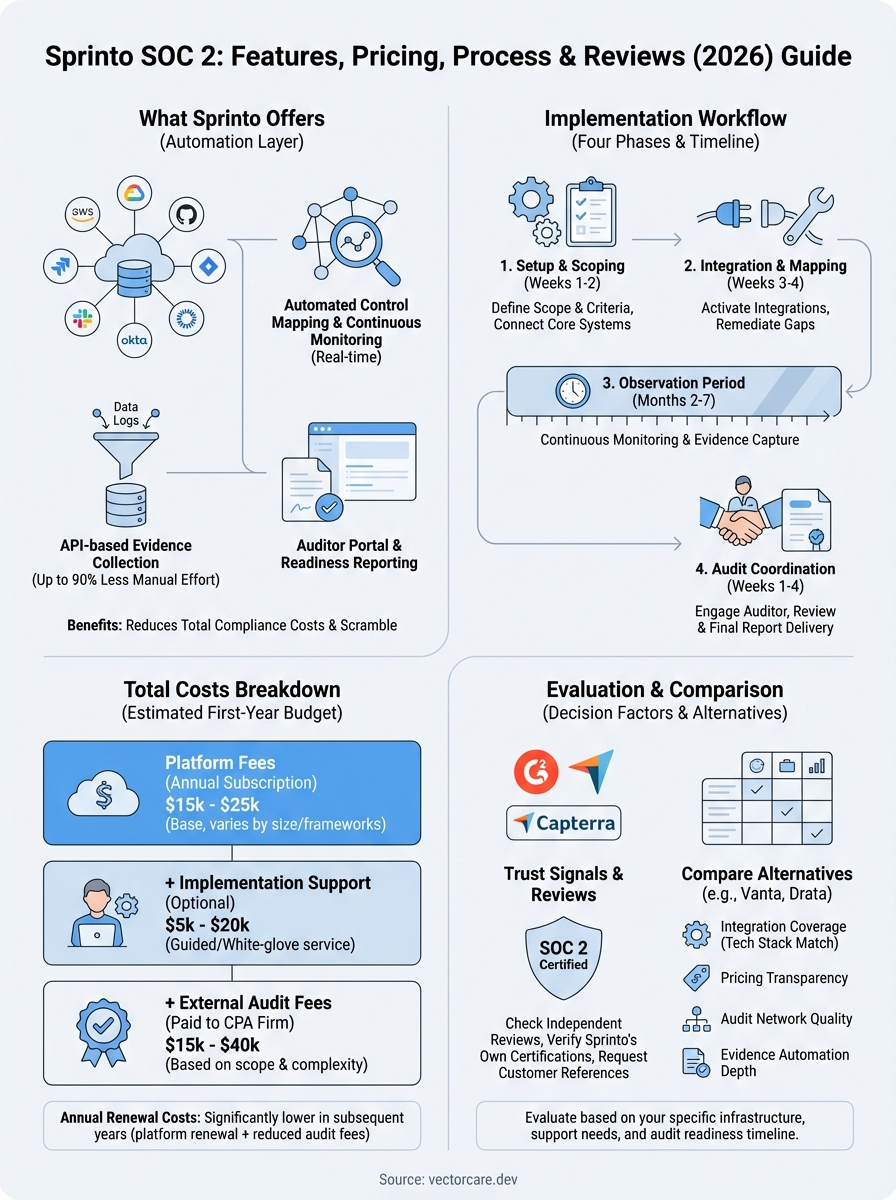
Sprinto delivers a compliance automation platform that connects directly to your infrastructure through native integrations. The core system pulls data from your cloud environments, HR systems, and development tools to track control effectiveness in real time. Your team gets a centralized dashboard that displays compliance status, identifies gaps, and generates audit-ready evidence without manual screenshot collection or document chasing.
Core automation capabilities
The platform maintains over 200 pre-built integrations with services like AWS, Google Cloud, GitHub, Jira, Slack, and Okta. These connections enable automatic monitoring of security controls such as multi-factor authentication enforcement, encryption status, access permissions, and change management workflows. Sprinto runs continuous compliance checks against your infrastructure and flags deviations immediately, allowing you to remediate issues before they become audit findings.

Integration setup requires API keys or OAuth connections that you configure through the platform interface. Once connected, Sprinto begins polling your systems on a schedule that ranges from hourly to daily, depending on the control type. Critical security settings receive more frequent checks, while policy-related controls may run weekly assessments. The system stores timestamped evidence of each check, creating an auditable trail that spans your entire observation period.
Evidence collection and control mapping
Sprinto automatically maps your technical controls to SOC 2 Trust Service Criteria across Security, Availability, Confidentiality, Processing Integrity, and Privacy. The platform includes templates for required policies such as information security, incident response, access control, and business continuity. You customize these templates to match your environment, and Sprinto tracks policy acknowledgment from your team members.
Evidence collection happens through direct API pulls rather than manual uploads. The platform captures logs, configuration states, user access records, and system changes as they occur. Your audit package builds incrementally throughout the observation window, reducing the scramble that typically happens during audit preparation. Sprinto presents this evidence in a format that auditors can review directly through a shared portal.
"The system stores evidence with tamper-proof timestamps that satisfy auditor requirements for control operating effectiveness over time."
Audit coordination features
The platform includes a dedicated auditor dashboard that allows your CPA firm to access evidence, request additional documentation, and track testing progress without email threads or file transfers. Sprinto supports both Type 1 and Type 2 audits, with Type 2 requiring the full observation period before audit fieldwork begins.
Your implementation includes access to Sprinto's network of pre-vetted audit firms that understand the platform's evidence structure. This familiarity accelerates fieldwork because auditors spend less time learning your documentation format and more time testing controls. The platform also generates reports showing control coverage, identifies missing evidence, and highlights areas where you need manual documentation to supplement automated collection.
Step 1. Define your SOC 2 goals and timeline
Your first move determines everything that follows. You need to clarify why you are pursuing SOC 2 and when you must complete certification before you evaluate any platform. These two variables dictate your scope, budget allocation, and whether Sprinto SOC 2 automation makes sense for your situation. Most teams skip this step and rush into vendor selection, then discover midway through implementation that their timeline was unrealistic or their scope was wrong.
Identify your compliance drivers
Start by documenting what triggers this compliance requirement. Enterprise buyers may demand SOC 2 as a contract condition with a hard deadline tied to your deal closing. Your board might require certification before a Series B funding round. Industry partnerships could mandate it as an entry requirement. Each driver carries different urgency levels and defines whether you need Type 1 (point-in-time assessment) or Type 2 (operational effectiveness over 3 to 12 months).
List every stakeholder who requested SOC 2 and their specific requirements. Some customers accept Type 1 reports for initial contracts, while others require Type 2 with a full 12-month observation period. Healthcare integrators often need additional Privacy criteria beyond the mandatory Security baseline. Financial services buyers may demand Confidentiality and Processing Integrity attestations. Your scope selection depends entirely on these external requirements, not on what seems easiest to implement.
Set your observation period
Type 2 reports require continuous operation of your controls throughout the observation window. Your first audit typically uses a 6-month period, though you can choose 3, 9, or 12 months. The window starts when your controls become fully operational, not when you begin planning. Factor in 4 to 6 weeks for readiness work before the observation period begins, then another 2 to 4 weeks for auditor fieldwork after it ends.
"Your audit timeline extends at least 7 to 8 months from kickoff to final report delivery, assuming no major remediation delays."
Map milestones to your sales cycle
Build a reverse timeline from your certification deadline. If you need a signed SOC 2 report by Q3 2026 for a major contract renewal, your observation period must end by mid-May 2026 to allow fieldwork time. That means controls must be operational by November 2025 for a 6-month window, which requires starting implementation in September 2025. Add buffer weeks for unexpected remediation work, vendor onboarding delays, and auditor scheduling constraints. Most teams underestimate this timeline by 30 to 40 percent.
Step 2. Match Sprinto features to your requirements
Your SOC 2 scope dictates which Sprinto capabilities you actually need. The platform offers comprehensive automation, but not every feature matters for your specific Trust Service Criteria selection or infrastructure stack. You need to verify that Sprinto covers your control requirements completely before committing to the platform, especially for the Security criterion that every audit mandates.
Map your control needs to platform capabilities
Start by listing every control objective your auditor will test. The Security TSC includes 33 individual criteria covering logical access, system operations, change management, and risk mitigation. If you selected Availability, add 5 criteria for system uptime and disaster recovery. Confidentiality brings 2 criteria, Processing Integrity adds 5, and Privacy contributes 9. Your complete control list determines which Sprinto modules you activate.
Review Sprinto's control library against your list to identify gaps where manual processes remain necessary. The platform automates infrastructure controls through API integrations but relies on your team for administrative tasks like policy acknowledgment workflows or vendor risk assessments. Document every control that requires human intervention so you can assign owners and build execution timelines. Physical security controls for office spaces fall outside Sprinto's automation scope and demand separate evidence collection.
Validate integration coverage
Check whether Sprinto maintains native connections to your entire technology stack. The platform supports major cloud providers, identity systems, and development tools, but your environment may include niche services that lack pre-built integrations. Log into Sprinto's integration marketplace and search for each service you use for customer data processing, employee access management, or infrastructure hosting.
Missing integrations force you into manual evidence collection mode for those systems. If your team uses a proprietary HR system without an API connector, you will upload access review exports manually each quarter. Custom-built applications require you to implement logging and monitoring controls independently, then provide evidence through screen captures and configuration exports. Calculate the manual effort percentage before assuming Sprinto eliminates all compliance overhead.
"Platforms automate only what they can connect to. Your manual workload scales with the number of unsupported tools in your production environment."
Assess policy template fit
Sprinto includes pre-written policy documents covering information security, incident response, data classification, and change management. Download the templates during your trial period and evaluate whether they match your operational reality. Generic policies fail audits when auditors compare documented procedures against your actual workflows and discover mismatches.
Customize every template to reflect your specific technology choices and team structure. If Sprinto's incident response policy references a security team you do not have, revise it to assign responsibilities to your engineering lead. Update data classification schemes to match your customer data types. Replace vendor management procedures with your actual procurement workflow. Policy accuracy matters more than policy completeness because auditors test whether you follow what you document.
Step 3. Break down Sprinto pricing and total costs
Sprinto pricing operates on a subscription model that scales with your company size and selected compliance frameworks. The platform does not publish rates publicly, forcing you to request a custom quote through their sales team. However, you can estimate total costs by breaking down the three major expense categories: platform fees, implementation support, and external audit charges. Your first-year SOC 2 budget typically lands between $30,000 and $80,000 depending on team size and audit scope.

Calculate base platform fees
Sprinto charges annual subscription fees that vary based on employee headcount and the number of frameworks you pursue simultaneously. Companies with 50 to 100 employees typically pay $15,000 to $25,000 per year for SOC 2 access alone. Adding ISO 27001 or HIPAA increases the fee by 20 to 40 percent because each framework requires additional control monitoring and evidence collection. Request quotes for single-framework and multi-framework scenarios to understand the marginal cost of expanding compliance scope.
The platform bills annually in advance, though some contracts allow quarterly payments with a 10 to 15 percent premium. Your subscription includes unlimited user accounts for your team, access to all integrations, policy templates, and the auditor portal. Storage for evidence and historical compliance data does not incur additional charges regardless of volume. Renewal pricing remains flat unless you substantially increase headcount or add new frameworks during the contract term.
Add implementation and audit costs
Implementation support from Sprinto varies by engagement model. The self-service tier includes platform access and email support but requires your team to configure integrations and map controls independently. Guided implementation adds dedicated success manager time, regular check-ins, and hands-on configuration assistance for $5,000 to $15,000 extra. White-glove service with project management and remediation planning pushes that figure to $20,000 or higher for complex environments.
External audit fees operate independently of Sprinto subscription costs. Licensed CPA firms charge based on observation period length and scope complexity. A Type 2 audit with Security only typically costs $15,000 to $25,000 for first-time certification. Adding Availability, Confidentiality, or Privacy increases audit time and pushes fees toward $30,000 to $40,000. Sprinto's partner auditor network may offer preferential rates, but you retain full freedom to select any qualified firm.
| Cost component | Typical range | Payment timing |
|---|---|---|
| Sprinto platform (annual) | $15,000 to $25,000 | Upfront or quarterly |
| Implementation support | $5,000 to $20,000 | One-time at start |
| External SOC 2 audit | $15,000 to $40,000 | Due at audit completion |
Account for ongoing annual expenses
Your second-year costs drop significantly because implementation work does not repeat. Plan for annual Sprinto renewal at the same subscription rate plus inflation adjustments. External audits recur yearly to maintain valid SOC 2 status, though subsequent audits often cost 10 to 20 percent less than initial certification because auditors already understand your environment. Budget $12,000 to $30,000 for annual audit renewals depending on your scope.
"Continuous compliance automation justifies its cost by eliminating the 150+ staff hours typically consumed by manual evidence collection during each audit cycle."
Factor in potential increases if you expand team size beyond your initial contract tier. Crossing headcount thresholds triggers subscription upgrades that add $3,000 to $8,000 annually. Adding new frameworks after your first year costs less than bundling them initially because your control foundation already exists. Track these variables in your multi-year compliance budget to avoid surprises during renewal periods.
Step 4. Understand the Sprinto SOC 2 implementation workflow
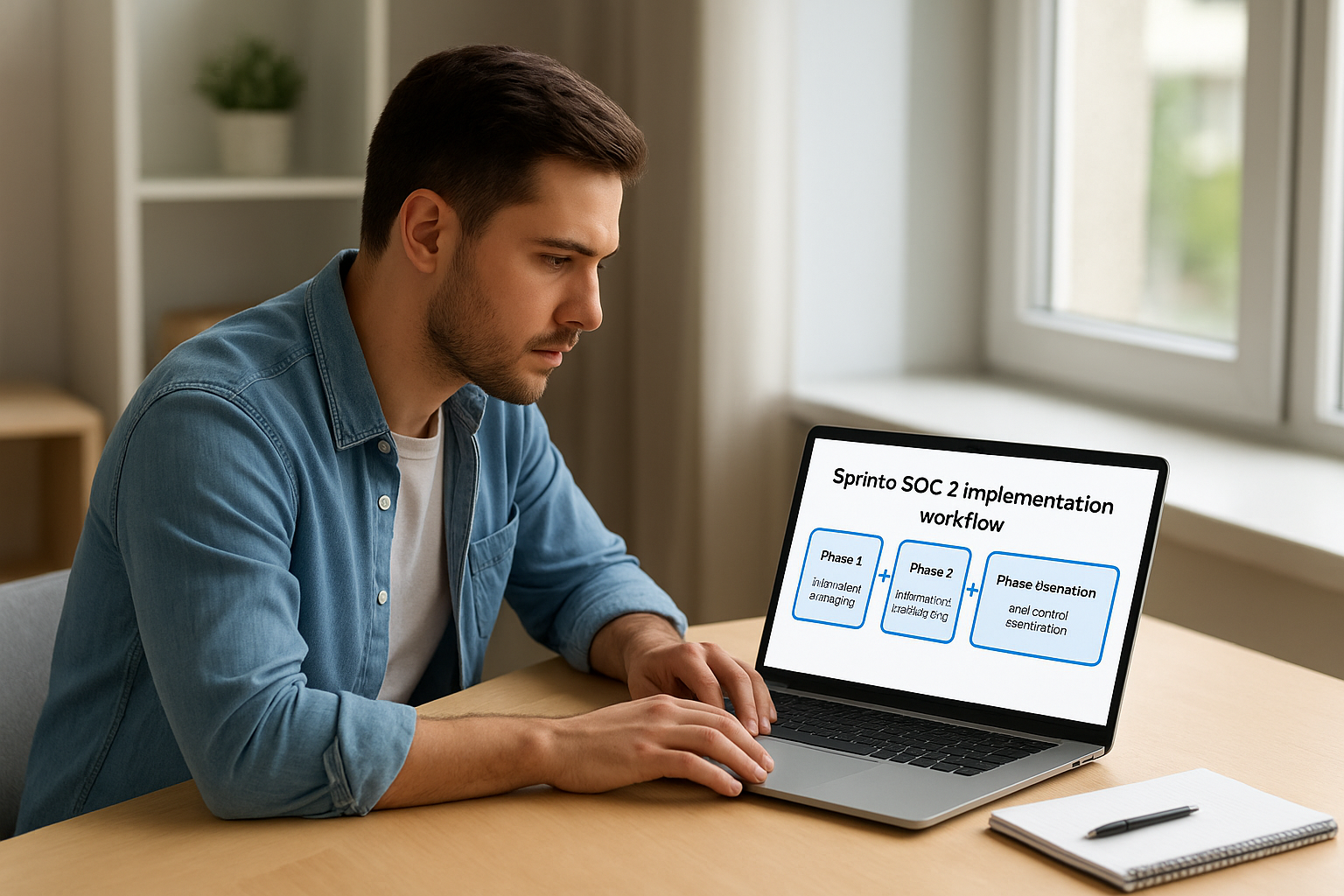
Your implementation follows a four-phase timeline that spans readiness work through final audit delivery. The exact duration varies based on your control maturity and chosen observation period, but most teams complete Sprinto SOC 2 setup within 8 to 10 weeks before starting their Type 2 observation window. Understanding each phase helps you allocate resources correctly and set realistic milestones with your stakeholders.
Phase 1: Initial setup and scoping (weeks 1-2)
You begin by connecting your Sprinto account and defining your audit scope parameters. Log into the platform and navigate to the scoping wizard, where you select which Trust Service Criteria your audit will cover. Enter your company details, employee count, and primary infrastructure providers to generate your initial control framework. The system automatically creates a compliance project with all required controls pre-mapped to your selected criteria.
Complete these specific tasks during setup:
- Connect your primary cloud provider (AWS, GCP, or Azure) using API credentials
- Import your employee directory through your HRIS integration (BambooHR, Workday, or similar)
- Link your identity provider (Okta, Google Workspace, or Azure AD) for access monitoring
- Upload existing security policies or customize Sprinto's templates to match your operations
- Assign control owners from your team for areas like incident response, change management, and vendor oversight
Phase 2: Integration and control mapping (weeks 3-4)
Platform configuration accelerates once your core systems connect. You activate remaining integrations for development tools, ticketing systems, and communication platforms that support your control environment. Sprinto begins pulling data immediately and runs its first compliance assessment against your infrastructure. The dashboard displays your readiness percentage and highlights controls that need attention.
Address flagged items by enabling missing security settings in your source systems. If multi-factor authentication enforcement shows as non-compliant, configure MFA requirements in your identity provider and wait for Sprinto to verify the change on its next polling cycle. For policy-based controls, distribute documents to your team through Sprinto's acknowledgment workflow and track completion rates in the platform. Your remediation sprint typically requires 2 to 3 weeks depending on how many gaps the initial assessment reveals.
"Control readiness must reach 95% or higher before starting your observation period, or auditors will identify systematic deficiencies during fieldwork."
Phase 3: Observation period execution (months 2-7)
Your observation window starts when all critical controls operate consistently. Sprinto runs continuous monitoring checks throughout this period and captures timestamped evidence for every control test. You receive alerts when controls drift out of compliance, such as when an employee's device encryption gets disabled or an access review deadline passes. Respond to alerts within 24 to 48 hours to maintain your compliance posture.
Schedule quarterly check-ins to review accumulated evidence and address any trending issues. Export compliance reports from Sprinto to share status updates with your leadership team. Maintain your control discipline by processing offboarding tickets promptly, completing scheduled vulnerability scans, and documenting incident response activities through your integrated ticketing system.
Phase 4: Audit coordination and completion (weeks 1-4)
Once your observation period closes, you engage your auditor through Sprinto's partner network or your chosen CPA firm. Grant the auditor access to your Sprinto auditor portal, where they review your evidence package and submit documentation requests. Respond to auditor queries by providing additional context, uploading supplemental files, or clarifying control implementation details through the platform's messaging system. Most auditors complete fieldwork within 2 to 3 weeks when evidence is well-organized, then deliver your draft report for management response before issuing the final signed document.
Step 5. Evaluate Sprinto reviews and trust signals
Your vendor selection depends on verifiable proof that the platform delivers what it promises. You need to examine independent reviews, security certifications, and customer references before committing to a multi-year compliance automation contract. Sprinto markets itself as the faster path to SOC 2, but your due diligence requires evidence that other companies achieved certification using their platform within the advertised timelines and budgets.
Check third-party review platforms
Start your research on G2 and Capterra, where users post detailed reviews about implementation experiences, customer support quality, and actual time-to-certification results. Filter reviews by company size and industry to find feedback from organizations similar to yours. Pay specific attention to comments about hidden costs, integration reliability, and how well Sprinto handled audit preparation compared to initial promises.
Look for patterns in negative reviews that indicate systemic issues. Multiple complaints about poor customer support response times or integration failures with specific platforms suggest problems you will likely encounter. Positive reviews should mention concrete outcomes like reduced audit preparation time or successful first-time certification rather than vague statements about ease of use. Verify review authenticity by checking reviewer profiles for detail level and engagement history.
Verify security certifications and compliance
Sprinto must maintain its own SOC 2 Type 2 certification if it expects to help you achieve yours. Request a copy of their current report during your evaluation and verify the issue date falls within the past 12 months. Review their Trust Service Criteria coverage to confirm they meet the same standards they help you implement. Check whether they hold additional certifications like ISO 27001 or maintain compliance with GDPR for customer data protection.
"A compliance automation vendor without current SOC 2 certification creates immediate credibility problems with your auditors and customers."
Request customer references
Ask Sprinto for contact information for three to five customers who completed certification within the past year. Prepare specific questions about implementation timeline accuracy, hidden costs that emerged mid-project, and whether the platform actually reduced manual effort as advertised. Contact references directly through LinkedIn if Sprinto provides only email addresses to ensure you reach real users rather than scripted testimonials.
Step 6. Compare Sprinto with SOC 2 alternatives
Your evaluation requires a structured comparison framework that tests multiple platforms against your specific requirements rather than accepting vendor claims at face value. You need to assess how Sprinto SOC 2 automation stacks up against competing platforms like Vanta, Drata, and Secureframe across five critical dimensions: integration coverage, pricing transparency, audit network quality, implementation support, and evidence automation depth. Each platform excels in different areas, so your choice depends on which capabilities matter most for your infrastructure and timeline.
Build a comparison matrix
Create a spreadsheet that lists your top three to five vendor candidates across the rows and your evaluation criteria across the columns. Score each platform on a 1 to 5 scale for categories like number of native integrations matching your tech stack, average customer rating on G2, quoted pricing per employee, and estimated time to audit readiness based on customer case studies. Add columns for decision factors unique to your situation such as support for your specific cloud provider, availability of preferred audit partners, or expertise with your industry vertical.

Request product demonstrations from each vendor where you share your actual system architecture and ask them to walk through how their platform would automate your specific controls. Take notes on which manual processes remain after automation and how each platform handles evidence collection for controls outside their integration catalog. Compare how vendors propose handling your custom-built applications versus commercial software in your stack.
| Evaluation criteria | Weight (%) | Scoring method |
|---|---|---|
| Tech stack integration match | 30 | Count of native integrations / total tools used |
| Total first-year cost | 25 | Platform + implementation + audit fees |
| Time to audit readiness | 20 | Average from customer references |
| Customer support quality | 15 | G2 rating + reference feedback |
| Multi-framework capability | 10 | Number of frameworks supported natively |
Evaluate platform depth versus speed
Sprinto emphasizes rapid deployment and continuous monitoring through extensive API integrations but may require more manual work for administrative controls compared to competitors. Vanta offers deeper policy workflow automation and employee onboarding sequences but charges premium pricing that exceeds Sprinto by 20 to 40 percent. Drata provides strong evidence collection but receives mixed reviews about customer support responsiveness during critical audit windows.
"The fastest platform to implement rarely becomes the fastest platform to certification if it lacks controls automation for your specific infrastructure choices."
Test each platform's trial period by connecting your production systems and running initial compliance assessments. Compare which platform flags the fewest false positives and provides the most actionable remediation guidance. Request sample audit packages from each vendor to evaluate evidence format, completeness, and whether your preferred auditors accept their documentation structure without extensive reformatting.
Consider hybrid approaches
Your optimal solution might combine platform automation with targeted consulting support rather than relying exclusively on software. Some teams use Sprinto for infrastructure control monitoring while hiring specialist consultants to handle policy development, risk assessments, and vendor management workflows. This hybrid model costs $10,000 to $20,000 extra upfront but accelerates certification when your team lacks compliance expertise.
Alternatively, evaluate whether your existing security information and event management (SIEM) tools already collect sufficient evidence for infrastructure controls. Platforms like Splunk or Datadog capture detailed logs that satisfy auditor requirements if properly configured. You might implement Sprinto solely for policy workflows and audit coordination while maintaining your current monitoring stack, reducing total platform costs by focusing the subscription on areas where manual processes currently dominate.
Bringing it all together
Your Sprinto SOC 2 evaluation now includes every factor that determines whether the platform fits your compliance timeline and budget. You have examined feature coverage, pricing structures, implementation workflows, customer reviews, and competitive alternatives. The platform delivers the strongest value when your infrastructure runs on supported cloud services and you need continuous compliance monitoring rather than point-in-time certification.
Healthcare vendors face additional pressure because enterprise buyers demand SOC 2 certification before approving integrations with clinical systems. Your compliance readiness directly impacts contract velocity and revenue recognition. If you are building EPIC integrations alongside your SOC 2 preparation, consider platforms that handle both technical deployment and compliance requirements simultaneously. VectorCare enables healthcare vendors to launch SMART on FHIR applications with built-in HIPAA and SOC 2 compliance, eliminating separate certification timelines that delay market entry.
The Future of Patient Logistics
Exploring the future of all things related to patient logistics, technology and how AI is going to re-shape the way we deliver care.
Thank you! Your submission has been received!
Oops! Something went wrong while submitting the form.