SOC 2 and HIPAA Compliance: What's the Difference?

You're building a healthcare product and someone just asked whether you're SOC 2 certified, HIPAA compliant, or both. If you paused before answering, you're not alone. SOC 2 HIPAA compliance gets treated as one bundled requirement in sales calls and security reviews, but they're separate frameworks built for different purposes, and mixing them up can stall a health system contract or a due diligence review.
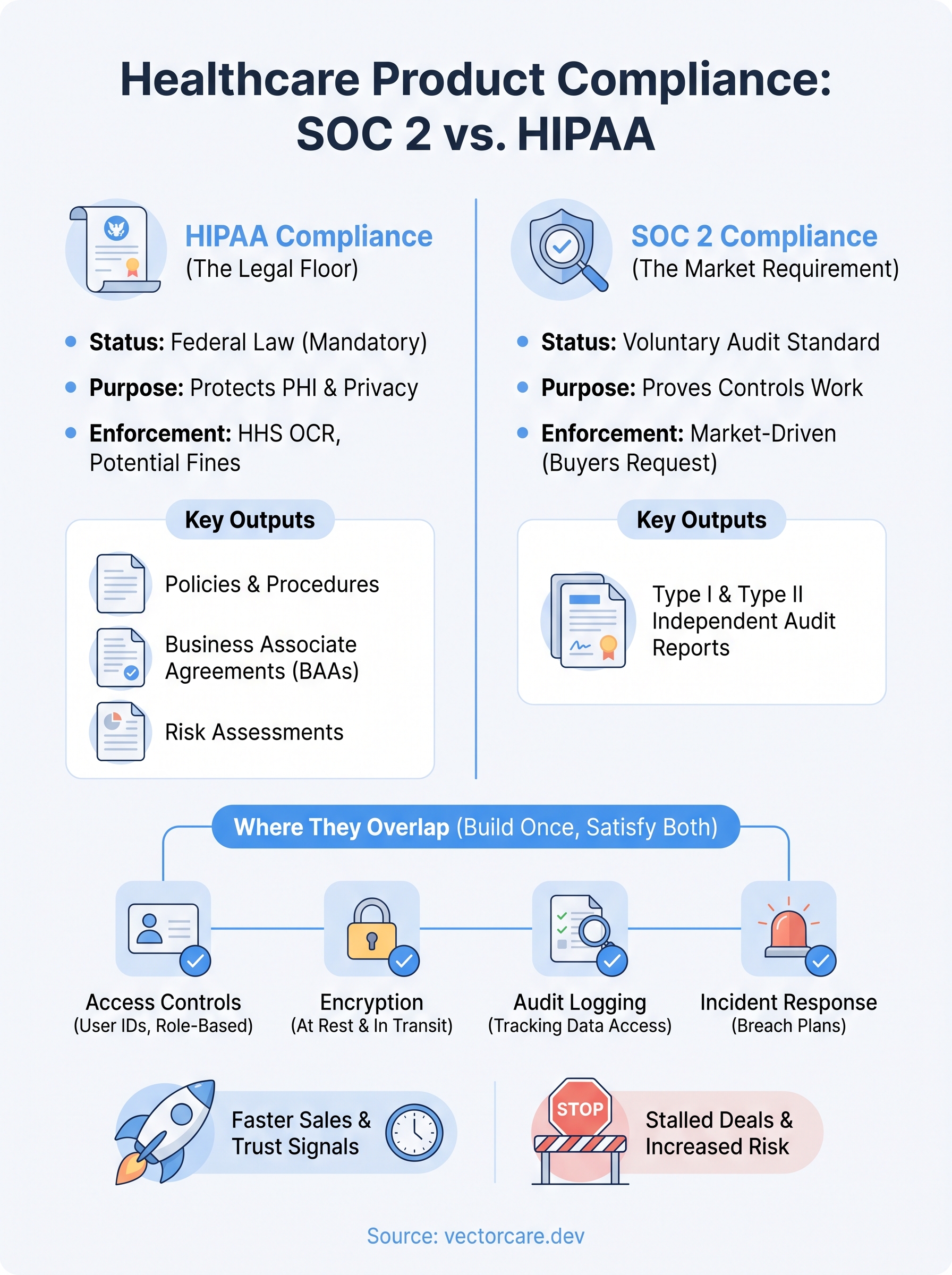
Here's the short answer: HIPAA is a federal law that governs how you handle protected health information, while SOC 2 is a voluntary audit standard that proves your internal controls around security and data handling actually work. Most digital health vendors selling into hospitals need elements of both, and understanding hipaa and soc 2 compliance together, rather than as competing checkboxes, is what actually satisfies enterprise security teams.
In this article, we'll break down what each framework actually covers, where they overlap, where they diverge, and how vendors integrating with systems like EPIC typically approach both. If you're trying to figure out which certifications your team needs before you can close your next health system deal, this will give you a clear starting point.
Why SOC 2 and HIPAA compliance matter for your business
Health systems won't sign a contract based on a promise. Their security and compliance teams ask for documentation, and if you can't produce it, your deal stalls in legal review while a competitor with the right paperwork moves ahead. SOC 2 HIPAA compliance has become table stakes for any vendor touching patient data, whether you're building a remote monitoring app, a clinical decision support tool, or a scheduling platform that connects to an EHR. Hospitals have been burned by vendor breaches before, so their procurement teams now treat compliance verification as a gate, not a formality.

Beyond the sale, there's real financial exposure if you skip this work. HIPAA violations carry civil penalties that range from $137 to over $2 million per violation category per year, depending on the level of negligence involved, according to the U.S. Department of Health and Human Services. A single breach involving unsecured patient records can trigger mandatory notification to affected individuals, state attorneys general, and sometimes the media, on top of the fines themselves, which is why preventing healthcare data breaches belongs in your compliance plan from the start. SOC 2 doesn't carry legal penalties in the same way, but failing to have it often means losing the deal before the fine ever becomes relevant.
If you can't hand a health system's security team a HIPAA attestation and a SOC 2 report on request, you're not ready to sell into that market.
Trust signals that shorten your sales cycle
Vendors who walk into a security review with both frameworks in place close faster. Instead of spending weeks answering a 200-question security questionnaire from scratch, you point to your SOC 2 Type II report and your HIPAA policies, and most of the back-and-forth disappears. This matters even more for companies integrating with Epic EHR, since health systems already have a baseline expectation that any app in the EPIC Showroom has cleared a security bar. Compliance stops being a cost center and starts functioning as a sales asset once you have it documented properly.
The cost of getting caught without it
Skipping compliance rarely saves money in the long run. Digital health companies that get flagged mid-deal for missing a Business Associate Agreement or lacking basic access controls often lose months rebuilding trust, and some lose the deal outright. The table below shows what's typically at stake when compliance gaps surface late in a sales cycle:
| Gap discovered | Typical consequence |
|---|---|
| No signed BAA with subcontractors | Deal paused pending legal review |
| No SOC 2 report available | Extended security questionnaire, added weeks to close |
| No access logging or audit trail | Security team requests remediation plan before signing |
| No breach notification policy | Contract terms shift to include stricter liability clauses |
Ongoing operations depend on this groundwork too. Once you're live inside a hospital's workflow, you'll face annual re-attestations, periodic audits, and sometimes surprise security reviews triggered by a breach elsewhere in the industry. Platforms like VectorCare build HIPAA and SOC 2 requirements into the app development process itself, so vendors aren't scrambling to retrofit compliance after a health system already asks for proof. Waiting until a prospect asks for your compliance documentation is the wrong time to start building it, because both frameworks take real time to implement properly, and rushing them tends to produce gaps that show up during an audit rather than before one.
How to decide whether you need SOC 2, HIPAA, or both
Not every healthcare vendor needs both frameworks on day one, and figuring out which one applies starts with a simple question: who touches the data, and who's asking for proof? HIPAA compliance is legally required the moment you create, receive, store, or transmit protected health information on behalf of a covered entity or as a business associate. There's no opt-out. SOC 2, on the other hand, is a business decision, and whether SOC 2 is mandatory for your company depends entirely on who you sell to. Nobody forces you to get a SOC 2 report, but enterprise buyers increasingly won't sign without one, so it becomes mandatory in practice even though it's voluntary on paper.
When HIPAA alone might cover you
Smaller vendors selling directly to individual clinicians, or companies that never touch identifiable patient data, sometimes get by with HIPAA policies alone for a while. If your app processes de-identified data only, or if you're still in an early pilot with a single small practice, a full SOC 2 audit might be premature. That said, this window closes fast. The moment you try to sell to a hospital system or a larger health network, their procurement team will ask for a SOC 2 report as a matter of course.
When you need both
Most companies integrating with EPIC or any major EHR fall into this category. You're handling protected health information, which triggers HIPAA obligations, and you're selling to enterprise health systems, which triggers SOC 2 expectations. Ask yourself these questions to confirm where you land:
- Do you store, process, or transmit PHI in any form? If yes, HIPAA applies to you now.
- Are you selling to hospitals, health systems, or payers with formal security review processes? If yes, expect a SOC 2 request.
- Do you rely on subcontractors or cloud vendors who touch patient data? If yes, you need signed BAAs regardless of SOC 2 status, so check when a business associate agreement is required.
- Is your growth strategy dependent on enterprise contracts rather than individual practices? If yes, build toward SOC 2 Type II now instead of later.
If your roadmap includes selling to a hospital system, plan for both frameworks from the start rather than treating SOC 2 as optional.
Getting this sequencing wrong costs time you don't have. Waiting until a deal is on the table to start a SOC 2 audit means a six to twelve month delay right when you need to close fastest, since auditors typically require months of evidence collection before they'll issue a Type II report.
Key differences between SOC 2 and HIPAA compliance
Once you've decided you need both, it helps to understand exactly where these two frameworks diverge, because treating them as interchangeable leads to gaps in your compliance program. SOC 2 HIPAA compliance sounds like a single requirement, but the two frameworks answer different questions: HIPAA asks whether you're legally allowed to handle protected health information, and SOC 2 asks whether an independent auditor can verify your controls actually work as claimed. Confusing the two often means a vendor builds strong HIPAA policies but has nothing an auditor can independently test, or vice versa.
Legal mandate versus voluntary audit
HIPAA is federal law, enforced by the Department of Health and Human Services' Office for Civil Rights, with real penalties attached. SOC 2 is a reporting framework created by the American Institute of Certified Public Accountants, and no government agency requires it. Nobody fines you for skipping SOC 2, but enterprise buyers treat it as a prerequisite anyway.
HIPAA tells you what you're legally required to do with patient data; SOC 2 proves to a buyer that you actually do it.
Scope, structure, and who reviews it
Graded audits versus fixed rules make up the other major split. HIPAA gives you a rulebook, the Privacy Rule, Security Rule, and Breach Notification Rule, and you self-attest to compliance unless the government investigates you. SOC 2 hires an independent CPA firm to test your controls against five Trust Services Criteria and issues a report you hand to customers directly.
| Factor | HIPAA | SOC 2 |
|---|---|---|
| Legal status | Federal law | Voluntary industry standard |
| Enforced by | HHS Office for Civil Rights | No government body; market-driven |
| Applies to | PHI specifically | Any sensitive customer data |
| Verification | Self-attestation, government audits if flagged | Independent CPA firm audit |
| Output | Policies and BAAs | Type I or Type II report |
| Renewal | Ongoing, no fixed certificate | Annual re-audit typical |
Rather than picking a winner between the two, most vendors need to treat this table as a checklist of gaps to close on both sides. Structurally, HIPAA compliance lives in your policies, training records, and signed BAAs, while SOC 2 compliance lives in a formal report you can hand a prospect's security team. Vendors chasing hipaa and soc 2 compliance at the same time often discover their HIPAA documentation feeds directly into their SOC 2 evidence collection, since access controls, encryption, and incident response procedures satisfy both frameworks at once.
Where SOC 2 and HIPAA compliance overlap
Despite their different legal status, HIPAA and SOC 2 lean on nearly identical technical foundations. Both frameworks care about who can access sensitive data, how that access gets logged, and what happens when something goes wrong. Vendors who build one set of controls to satisfy both requirements avoid duplicating work, and this is exactly where soc 2 hipaa compliance stops being two separate projects and becomes one coordinated effort.

Shared controls that satisfy both frameworks
Auditors and regulators ask about the same underlying safeguards, even though they phrase the requirements differently. The overlap shows up most clearly in these areas:
- Access controls: role-based permissions and unique user IDs satisfy HIPAA's Security Rule and SOC 2's Common Criteria at the same time.
- Encryption: data encrypted at rest and in transit checks a box under both frameworks without extra configuration, though it helps to know what auditors expect from encryption.
- Audit logging: tracking who accessed what and when supports HIPAA's accounting-of-disclosures requirement and SOC 2's monitoring criteria.
- Incident response: a documented breach response plan feeds HIPAA's Breach Notification Rule and SOC 2's availability and security criteria.
- Vendor management: reviewing subcontractors for security posture supports HIPAA's business associate requirements and SOC 2's third-party risk expectations.
Build your access controls, encryption, and logging once, and you've done most of the heavy lifting for both frameworks.
Where the paperwork still diverges
Even with shared controls, the two frameworks want different evidence packages. HIPAA expects signed Business Associate Agreements, a documented risk assessment, and workforce training records. SOC 2 expects an independent auditor's report covering a defined observation period, usually six to twelve months for a Type II report. Neither framework substitutes for the other's paperwork, even when the underlying control is identical.
Getting hipaa and soc 2 compliance aligned means mapping your controls once and then producing two different documentation trails from that same foundation. Teams that skip this mapping step often duplicate effort, writing separate policies for each framework when a single, well-documented control set would satisfy both auditors and regulators. The National Institute of Standards and Technology publishes control frameworks that many organizations use as a bridge between HIPAA's requirements and SOC 2's Trust Services Criteria, since both ultimately trace back to similar security principles even though the compliance vehicles differ.
How to build a compliance program for both frameworks
Building a compliance program that covers soc 2 hipaa compliance from the start saves you from redoing work six months later. Start with a gap analysis: document every place PHI enters, moves through, and leaves your system, then compare that map against both HIPAA's Security Rule requirements and SOC 2's Trust Services Criteria. This single exercise usually reveals that most of the technical controls you need overlap, which means your engineering team builds the control once and your compliance team documents it twice.
Treat the gap assessment as your blueprint, not a checkbox, and the rest of the program falls into place faster.
Sequence the work in the right order
Order matters more than most teams expect. Jumping straight into a SOC 2 audit before your HIPAA policies exist leaves the auditor with nothing to test your controls against. Follow this rough sequence:
- Complete a HIPAA risk assessment, using a HIPAA risk assessment checklist to set scope, and document your findings.
- Write and implement your Security Rule safeguards and standards (access control, encryption, logging, incident response).
- Sign Business Associate Agreements with every subcontractor and cloud vendor touching PHI.
- Select your SOC 2 Trust Services Criteria (Security is mandatory; add Availability and Confidentiality if relevant to your product).
- Run a SOC 2 Type I audit first to confirm your controls are designed correctly.
- Move to a SOC 2 Type II audit once you've operated those controls for six to twelve months.
Working through this order means your HIPAA evidence becomes the raw material your SOC 2 auditor reviews, instead of running two disconnected projects that compete for the same engineering time.
Bring in the right people and tools early
Nobody builds this alone, and most teams lean on HIPAA compliance software alongside outside expertise. You need a compliance lead who owns policy documentation, a security engineer who implements the technical controls, and eventually an independent CPA firm to conduct the SOC 2 audit itself. Smaller teams often underestimate how much engineering time this pulls away from product work, especially once hipaa and soc 2 compliance requirements touch every part of the stack that handles patient data. Platforms built specifically for healthcare integrations, like VectorCare's no-code workflow builder, bake HIPAA and SOC 2 controls into the deployment process itself, so vendors integrating with EPIC don't have to assemble this program from raw infrastructure on their own.
Common questions about SOC 2 and HIPAA compliance
Vendors working through soc 2 hipaa compliance for the first time tend to ask the same handful of questions, so it's worth answering them directly instead of leaving them buried in a policy document nobody reads.
Is SOC 2 required by law like HIPAA?
No. HIPAA is federal law, so if you handle protected health information, compliance isn't optional. SOC 2 is a voluntary audit standard created by the AICPA, and no regulator requires it. That said, enterprise health systems treat SOC 2 as a purchasing requirement, which makes it functionally mandatory even though it carries no legal penalty on its own.
Can you be HIPAA compliant without SOC 2?
Yes, and plenty of small vendors operate this way early on. If you're not yet selling to hospitals or large health networks, HIPAA policies alone might satisfy your current customers. The moment a health system's procurement team enters the picture, expect a SOC 2 request to follow shortly after.
Does SOC 2 replace the need for a Business Associate Agreement?
No. A SOC 2 report tells a customer your controls work, but it doesn't create the legal relationship HIPAA requires between a covered entity and a business associate. You still need a signed BAA with every partner or subcontractor who touches PHI, regardless of what your SOC 2 report says.
A SOC 2 report proves your controls work; it never substitutes for a signed BAA.
How long does it take to get both in place?
HIPAA policies can be documented in a few weeks if you already have the technical controls built. SOC 2 takes longer: a Type I audit can happen relatively quickly, but a Type II report requires an observation period of six to twelve months before an auditor issues it. Plan for a realistic timeline using the table below.
| Milestone | Typical timeframe |
|---|---|
| HIPAA risk assessment and policies | 4-8 weeks |
| BAAs signed with all subcontractors | 2-4 weeks, parallel to policy work |
| SOC 2 Type I audit | 1-3 months after controls are implemented |
| SOC 2 Type II audit | 6-12 months of evidence collection, plus audit time |
Does one certification cover multiple products?
Usually not automatically. If you run separate applications or environments, your SOC 2 scope needs to name each system explicitly, and your HIPAA risk assessment should cover every place PHI flows, product by product. Assuming one audit covers everything you build is a common and costly mistake.
Where to go from here
HIPAA and SOC 2 answer different questions, but both show up on the same checklist once you're selling into health systems. HIPAA is the legal floor you can't skip if you touch protected health information. SOC 2 compliance is the proof enterprise buyers demand before they'll sign, even though no regulator requires it. Treating soc 2 hipaa compliance as one coordinated program, rather than two separate scrambles, is what actually gets you through procurement without losing months to security review.
If you're integrating with EPIC and don't want to build this compliance groundwork from scratch while also writing FHIR code, that's exactly the gap VectorCare fills. The platform bakes HIPAA and SOC 2 controls into the deployment process itself, so you're not retrofitting compliance after a hospital already asked for proof. Build and deploy your SMART on FHIR app in days instead of spending the next year assembling a compliance program on your own.
The Future of Patient Logistics
Exploring the future of all things related to patient logistics, technology and how AI is going to re-shape the way we deliver care.
Thank you! Your submission has been received!
Oops! Something went wrong while submitting the form.