EHR Vendor Selection Criteria: A Framework for Choosing Right

Picking an EHR vendor is one of the highest-stakes decisions a healthcare organization makes. Get it wrong and you're stuck with a five-to-ten-year contract, staff who hate the interface, and integrations that never quite work. That's why ehr vendor selection criteria need to go beyond a glossy demo and a sales pitch. You need a repeatable evaluation process that catches problems before signatures, not after go-live.
This guide gives you exactly that: a structured evaluation framework covering clinical workflow fit, interoperability, security compliance, total cost of ownership, and vendor support quality. Instead of vague checklists, you'll get specific questions to ask during vendor demos and red flags that signal trouble down the road, especially around data exchange and third-party app compatibility.
We also address a piece most guides skip: how well a vendor's platform, particularly a dominant player like Epic, supports third-party integrations and SMART on FHIR apps. If your organization plans to connect remote monitoring tools, decision support software, or analytics platforms, that integration readiness, and a clear understanding of how EHR integration actually works, belongs in your scoring matrix from day one, not as an afterthought discovered mid-implementation.
Why EHR vendor selection criteria matter
A rushed EHR purchase doesn't just cost money upfront. It costs years of workarounds, staff turnover from clinicians who refuse to fight a bad interface, and lost contracts when the platform can't talk to the tools your patients and partners already use. Selection mistakes compound because EHR contracts run long and switching costs are brutal. A 2021 KLAS Research report found that organizations who replace their EHR within five years cite workflow mismatch and poor interoperability as the top two reasons, not price. That's the pattern this article's framework is built to prevent.
The hidden price of getting it wrong
Most buyers focus on license fees and implementation timelines, but the real damage shows up later: in support tickets, in nurses charting on paper because the mobile app freezes, in a compliance officer scrambling because the vendor's audit logs don't meet the HIPAA technical safeguards their organization is held to. The Office of the National Coordinator for Health IT has documented how poor EHR usability directly correlates with clinician burnout and documentation errors. None of that shows up in a sales deck.
The cheapest EHR on paper is often the most expensive one three years into a contract you can't easily exit.
Interoperability is no longer optional
Health systems today aren't buying a closed system. They're buying a hub that needs to exchange data with remote patient monitoring devices, clinical decision support tools, referral networks, and analytics platforms. If your EHR vendor selection criteria don't explicitly test how well a platform supports third-party app integration, you'll discover the gap only after you've signed a multi-year deal and a partner vendor tells you their app
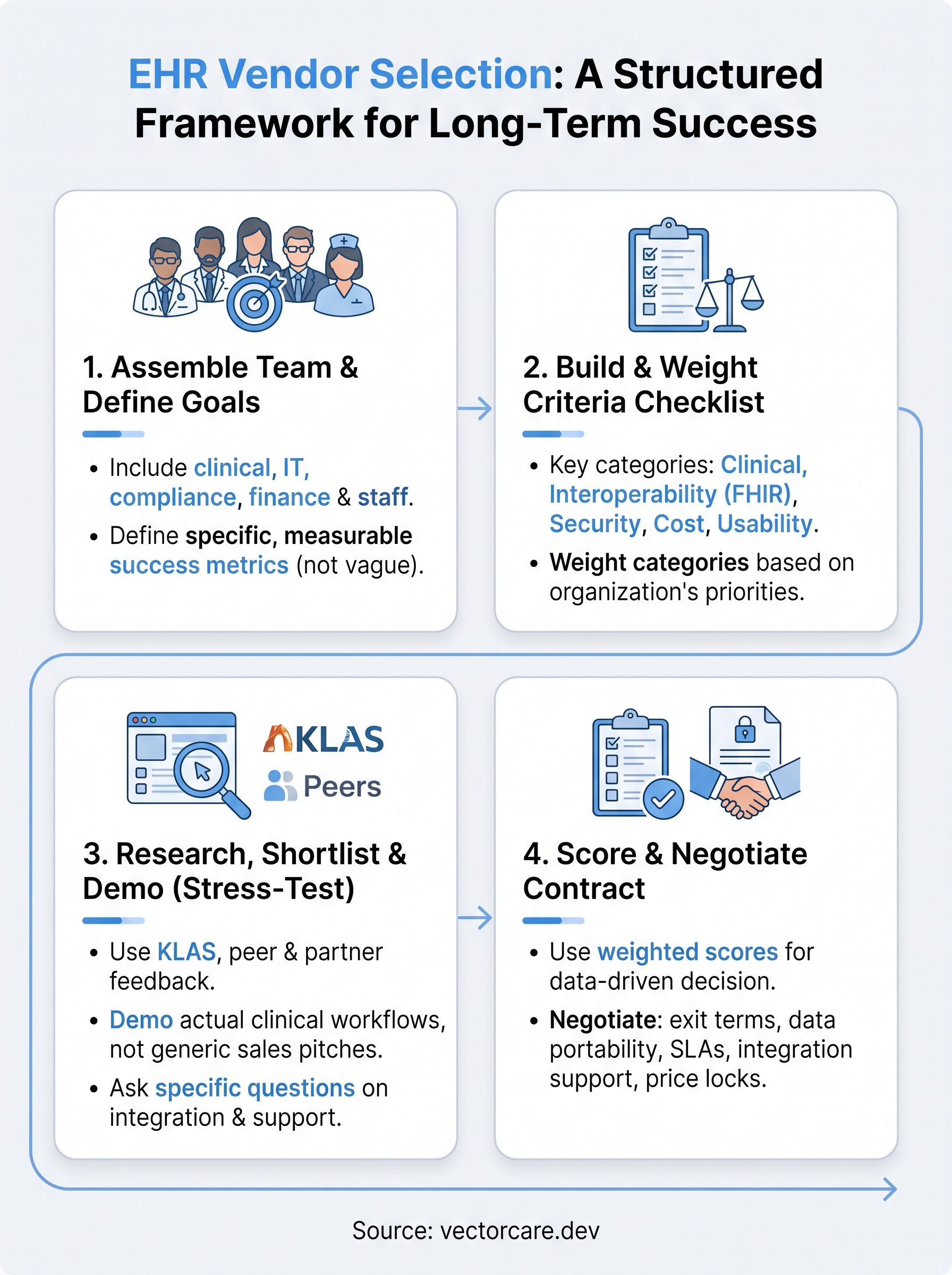
Step 1. Assemble your selection team and define your goals
Before you look at a single vendor website, pull together the people who will actually live with this system. A selection committee stacked with only IT and finance staff will miss the clinical friction points that surface six months into implementation. Bring in a floor nurse, a billing specialist, a physician who's fought with a bad EHR before, and someone from compliance. Each of them will flag risks the others miss, and that cross-functional input is one of the most reliable ehr vendor selection criteria in itself: does the vendor's demo team answer questions from every seat at your table, not just the executives?
Who needs a seat at the table
Keep the group small enough to move fast but broad enough to catch blind spots. A workable committee usually looks like this:
- Clinical lead (physician or nurse manager) to judge workflow fit and charting speed
- IT/security lead to vet interoperability, SMART on FHIR support, and data architecture
- Compliance officer to confirm HIPAA compliance requirements, SOC 2, and audit-log expectations
- Finance lead to model total cost of ownership across the contract term
- Front-line staff rep to flag usability issues before go-live, not after
Define what success looks like before you shop
Once the team exists, write down what a win actually looks like, in specific and measurable terms. Vague goals like
Step 2. Build your EHR evaluation criteria checklist
With your team and goals locked in, translate them into a written checklist you can score every vendor against. Skip this step and you'll end up comparing vendors on whatever each sales rep chose to demo, which is exactly how weak systems win deals. A solid evaluation criteria checklist turns fuzzy impressions into numbers you can defend to your board.

Core categories every checklist needs
Group your criteria into categories so nothing slips through, especially the technical items clinical staff wouldn't think to ask about. Here's a starting structure most healthcare organizations should adapt:
| Category | What to evaluate | Who scores it |
|---|---|---|
| Clinical workflow fit | Charting speed, order entry, specialty templates | Clinical lead |
| Interoperability & FHIR support | SMART on FHIR readiness, API access, third-party app compatibility | IT/security lead |
| Security & compliance | HIPAA safeguards, SOC 2 status, BAA terms, audit logging | Compliance officer |
| Total cost of ownership | License fees, implementation, per-instance hosting, support add-ons | Finance lead |
| Usability & support | Mobile access, training resources, response time on tickets | Front-line staff rep |
Notice that interoperability gets its own row, not a footnote under IT. If your organization plans to connect remote monitoring devices, decision support tools, or referral platforms down the line, ask vendors directly how they handle third-party integrations with systems like Epic, and learn what integrating with Epic EHR actually involves before the conversation. Vague answers here predict painful implementations later.
A checklist that treats interoperability as an afterthought will cost you a partner integration you haven't even signed yet.
Weight what matters to your organization
Not every category deserves equal weight. A rural clinic replacing a paper-based system might weight usability heavier than a hospital system already running mature IT infrastructure. Assign a percentage to each category that adds up to 100, then multiply each vendor's raw score by that weight to get a final ranking. This keeps the process from turning into whichever demo had the flashiest screen.
Write your EHR evaluation criteria down before you contact a single vendor, then resist the urge to change the weighting mid-process just because a favorite vendor scores poorly on something you initially cared about. Consistency here is what makes the final decision defensible to leadership, and to the clinicians who'll live with it for years.
Step 3. Research, shortlist, and demo vendors
Now you turn the checklist into a working shortlist. Start broad, three to six vendors that plausibly fit your size and specialty, then narrow to two or three finalists before you schedule a single live demo. Casting too wide wastes your committee's time; casting too narrow means you never learn what you're missing. Pull your initial list from KLAS Research rankings, peer referrals at similar-sized organizations, and direct outreach to vendors whose marketing claims match your must-haves on interoperability and cost.

Where to find real vendor intel
Don't rely on vendor websites alone. Call two or three reference customers each vendor provides, but also ask your network for names the vendor didn't hand you, those unfiltered conversations surface the support delays and hidden fees a curated reference list won't mention. Useful sources include:
- KLAS Research reports and peer-review scores for EHR usability and support
- Reference customers of similar size, specialty, and EHR footprint (ask for two beyond the vendor's list)
- State or regional hospital association vendor forums
- Existing technology partners who've already integrated with the platforms on your shortlist
Run demos that stress-test your actual workflows
A generic sales demo tells you nothing. Insist the vendor demo your actual clinical scenarios, a real order set, a real referral workflow, a real intake form, using your specialty's terminology. Require every finalist to answer a standard set of questions live, not in a follow-up email, so your committee can compare answers apples to apples:
1. Walk us through how a third-party app (like a remote monitoring or referral tool) connects via SMART on FHIR.
2. Show us the audit log for a sample patient record.
3. Demonstrate mobile charting speed for a routine visit.
4. What is the typical timeline for onboarding a new third-party integration post-go-live?
5. Show total cost, including hosting and support, for our projected patient volume.
If a vendor can't demo a live third-party integration on the spot, assume it doesn't exist yet.
Integration questions matter more than most committees realize. Vendors like VectorCare build SMART on FHIR apps specifically to plug into Epic's ecosystem, so ask any EHR finalist how a comparable third-party app would actually connect, and how long that connection typically takes to go live.
Step 4. Score vendors and negotiate the contract
After demos wrap, pull your committee together while the details are still fresh. Each member scores every finalist against the weighted checklist from Step 2, then you average the results into a single ranked list. This is where the earlier discipline pays off: because everyone scored the same evaluation criteria checklist, you can defend the winner to a skeptical board member or a clinician who liked a different vendor's screen better.
Turn committee scores into a decision
Don't let one loud voice override the math. If the numbers point to a vendor that didn't wow anyone in the room, dig into why before you override the process you built. Common tie-breakers include:
- Reference feedback on support response times during the first 90 days
- Integration track record with third-party apps similar to ones you'll add later
- Total cost of ownership over the full contract term, not just year one
- Implementation timeline commitments in writing, not verbal promises
A scoring matrix only protects you if you trust it more than the loudest opinion in the room.
Negotiate terms that protect you long-term
Once you've picked a finalist, negotiate before you sign anything, not after. Vendors expect this, and the request itself rarely damages the relationship. Focus your leverage on the clauses that matter most once you're locked in:
- Exit clause: cost and notice period to leave before contract end
- Data portability: format and timeline for exporting your data if you switch
- SLA terms: guaranteed uptime, support response times, penalties for misses
- Integration support: named contact and timeline for onboarding future third-party apps
- Price locks: cap on annual increases for licensing and hosting fees
Pay particular attention to the integration clause. If you plan to connect remote patient monitoring tools, referral platforms, or analytics dashboards down the road, get the vendor to commit in writing to a reasonable onboarding timeline for SMART on FHIR apps, not a vague "case by case" answer. That single clause has saved organizations months of delay when a partner vendor, including platforms like VectorCare, needs to go live on a tight timeline. Contract negotiation is your last real leverage point before you're locked into a multi-year relationship, so use it fully rather than rushing to sign because leadership wants the decision closed.
Choosing an EHR you can grow with
The right EHR vendor selection criteria protect you from a decision you can't undo for years. Build the committee, write the checklist, weight it honestly, then let the scores, not the loudest voice in the room, pick your finalist. That discipline is what separates organizations who love their EHR five years in from ones already planning their next replacement.
Remember that your EHR is the foundation for everything you connect to it later: remote monitoring, decision support, referral tools, analytics. Vendors change their integration roadmaps slower than your clinical needs evolve, so lock in integration commitments now while you still have leverage.
If you're on the other side of this equation, a healthcare vendor trying to get your app in front of health systems running Epic, don't wait 12-18 months to build that connection yourself. Build and deploy your SMART on FHIR app in days with VectorCare and skip the integration bottleneck your future EHR buyers will be scoring you on.
The Future of Patient Logistics
Exploring the future of all things related to patient logistics, technology and how AI is going to re-shape the way we deliver care.
Thank you! Your submission has been received!
Oops! Something went wrong while submitting the form.