HITRUST Certification vs SOC 2: Which Framework Fits?

If you're building a digital health product and a hospital's security team just asked for your compliance paperwork, you've probably hit the hitrust certification vs soc 2 question head on. Both show up in vendor security reviews, both get name-dropped in RFPs, and both take real time and money to pursue. Picking the wrong one first can cost you months on a deal that's already moving fast.
The short answer: SOC 2 is a flexible attestation rather than a certification built around your own control objectives, while HITRUST is a prescriptive certification mapped specifically to healthcare regulations like HIPAA. SOC 2 tends to be faster and cheaper to get, HITRUST carries more weight with large health systems and payers who want a standardized, auditable framework. Which one fits depends on your buyer, your timeline, and how deep into healthcare data you actually go.
Below, we break down what each framework actually certifies, how the audit processes differ, what they cost, and how to decide based on who's asking. If you're also working toward EPIC integration, we'll touch on where these frameworks intersect with what SMART on FHIR requires for secure EHR integration and what health systems expect to see before they'll trust your app with patient data.
Why the right framework matters for EPIC-focused vendors
Health systems set their own bar before EPIC gets involved
Getting listed in Epic's App Orchard, now called the Showroom, tells a health system your app is technically capable of connecting to their EHR. It says nothing about how you handle protected health information once that connection is live. Every hospital and health system runs its own vendor risk assessment on top of the Showroom listing, and that assessment almost always asks for a HITRUST certification or SOC 2 report before anyone in IT security signs off. Skip this step in your planning and you'll watch a signed letter of intent stall in procurement for months.
Why large health systems lean toward HITRUST
Large academic medical centers and multi-hospital systems tend to standardize their vendor security requirements around HITRUST, partly because the framework was built specifically for healthcare, and partly because a HITRUST CSF certification gives their risk team a single, auditable score instead of a narrative report they have to interpret line by line. Epic has partnered with HITRUST on assessment programs for connected apps, which signals how much weight the framework carries inside the EHR ecosystem specifically. If your target customers are large IDNs or regional hospital networks with dedicated compliance departments, expect HITRUST assessments to come up early in vendor diligence, sometimes as a hard requirement rather than a preference.
A HITRUST certification often opens doors that a SOC 2 report alone can't, especially with large hospital systems that treat it as a baseline requirement.
Why smaller systems and faster deals often accept SOC 2
Smaller hospitals, ambulatory groups, and health systems without a large dedicated security staff frequently accept a SOC 2 Type II report as sufficient proof of your controls, especially if you're early stage and trying to close your first few contracts. Digital health startups regularly use SOC 2 compliance for startups to get through procurement faster since the audit takes less time to complete and doesn't demand the same volume of control evidence HITRUST requires. Venture-backed teams under pressure to show revenue traction in a specific quarter often choose SOC 2 first for exactly this reason, then layer HITRUST on top once they've landed a few of the bigger accounts that ask for it by name.
What buyers actually expect, by type
Not every health system asks for the same paperwork, and knowing this ahead of time saves you from over-building or under-preparing your compliance program before you ever get to a security review.

| Buyer type | Typical framework expected | Why |
|---|---|---|
| Large IDN / academic medical center | HITRUST CSF certification | Standardized scoring, mapped directly to HIPAA and NIST controls |
| Regional hospital system | HITRUST or SOC 2 Type II | Depends on internal security team size and maturity |
| Community hospital / ambulatory group | SOC 2 Type II | Faster to review, sufficient for lower-volume vendor relationships |
| Payer or MSO | HITRUST, sometimes contractually required | Payers increasingly mandate HITRUST for data-sharing agreements |
Timing your certification against your sales pipeline
Matching matters because pursuing the wrong framework first doesn't just cost you money, it costs you deal velocity. Vendors integrating with Epic EHR who plan their compliance roadmap around their actual buyer list, rather than picking whichever framework sounds more impressive on a website, close faster and spend less on audits they didn't need yet. Waiting until a deal stalls in security review to start a HITRUST assessment is the most expensive way to learn this lesson, since a full validated assessment can take months longer than the sales cycle you're trying to protect.
How to decide between HITRUST and SOC 2 for your business
Deciding between these two frameworks isn't about which one looks more impressive on a compliance page. It comes down to three concrete questions: who's asking, how fast you need to close, and how much patient data actually flows through your application. Answer those honestly before you sign a contract with an assessor, because switching frameworks mid-engagement wastes both the money you already spent and the months you spent waiting on the first audit.
Start with your actual buyer list, not your roadmap
Pull up your current pipeline and your target account list, then sort them by the kind of vendor security review they're likely to run. If most of your near-term deals are with large IDNs or payers, HITRUST is probably non-negotiable and you should start the readiness assessment now, since a validated assessment can take nine months or longer from kickoff to certification. If your near-term deals are smaller hospitals or ambulatory groups moving fast, a report from a SOC 2 Type II versus Type I engagement gets you through procurement without the wait.
Choose the framework your next ten deals actually require, not the one that sounds more credible in a pitch deck.
Ask what your contracts already require
Existing contracts and business associate agreements sometimes spell out a specific framework requirement, and payer contracts increasingly name HITRUST explicitly rather than leaving it open to "an equivalent SOC 2 report." Read your current BAAs and any master service agreements before assuming you have flexibility, because a client that already committed you to HITRUST certification in writing removes the decision entirely.
Weigh your data footprint honestly
Consider how deep into protected health information your application actually reaches. An app that pulls read-only demographic data for a scheduling widget carries a different risk profile than one that writes orders, manages medication data, or stores clinical notes long-term. Heavier data handling tends to draw HITRUST requests even from smaller health systems, since their legal teams treat data depth as a risk multiplier regardless of vendor size.
A quick decision checklist
Run through this before committing budget to either framework:
- Buyer concentration: Are more than half your target accounts large IDNs, academic medical centers, or payers?
- Contract language: Do existing or pending BAAs name a specific framework?
- Data depth: Does your app write clinical data or just read limited data sets?
- Timeline pressure: Do you need a report in the next 60 to 90 days to close a deal?
- Runway: Can your budget absorb HITRUST's higher assessment fees without delaying other priorities?
Answering yes to the first three points toward HITRUST planning now. If timeline and runway dominate your answers instead, SOC 2 buys you time to grow into HITRUST later without blocking the deals in front of you.
Comparing cost, timeline, and effort for each framework
Once you know which framework your buyers actually want, the next question is what it will cost you in dollars, staff hours, and calendar time. The numbers aren't close. SOC 2 Type II audit pricing typically runs $20,000 to $60,000 depending on your auditor and the scope of your systems, while a first-year HITRUST validated assessment commonly lands between $60,000 and $150,000 once you count readiness consulting, the assessor's fees, and internal staff time pulled off other projects. Neither number includes the ongoing cost of maintaining controls year over year, which is real money whichever path you pick.
HITRUST costs two to three times more than SOC 2 in year one, and it demands a proportionally larger internal effort to match.
Timeline differences that affect your sales pipeline
Timeline gaps matter just as much as cost. A SOC 2 Type II report needs an observation period, usually three to six months of evidence collection, plus a few weeks for the auditor to issue the report, which is roughly the typical SOC 2 audit timeline from prep to report. HITRUST runs longer end to end: expect three to six months just for readiness work, then another two to four months for the validated assessment and HITRUST's own quality review before certification is issued. Vendors who start HITRUST cold, without a readiness assessment first, routinely see the full process stretch past nine months.
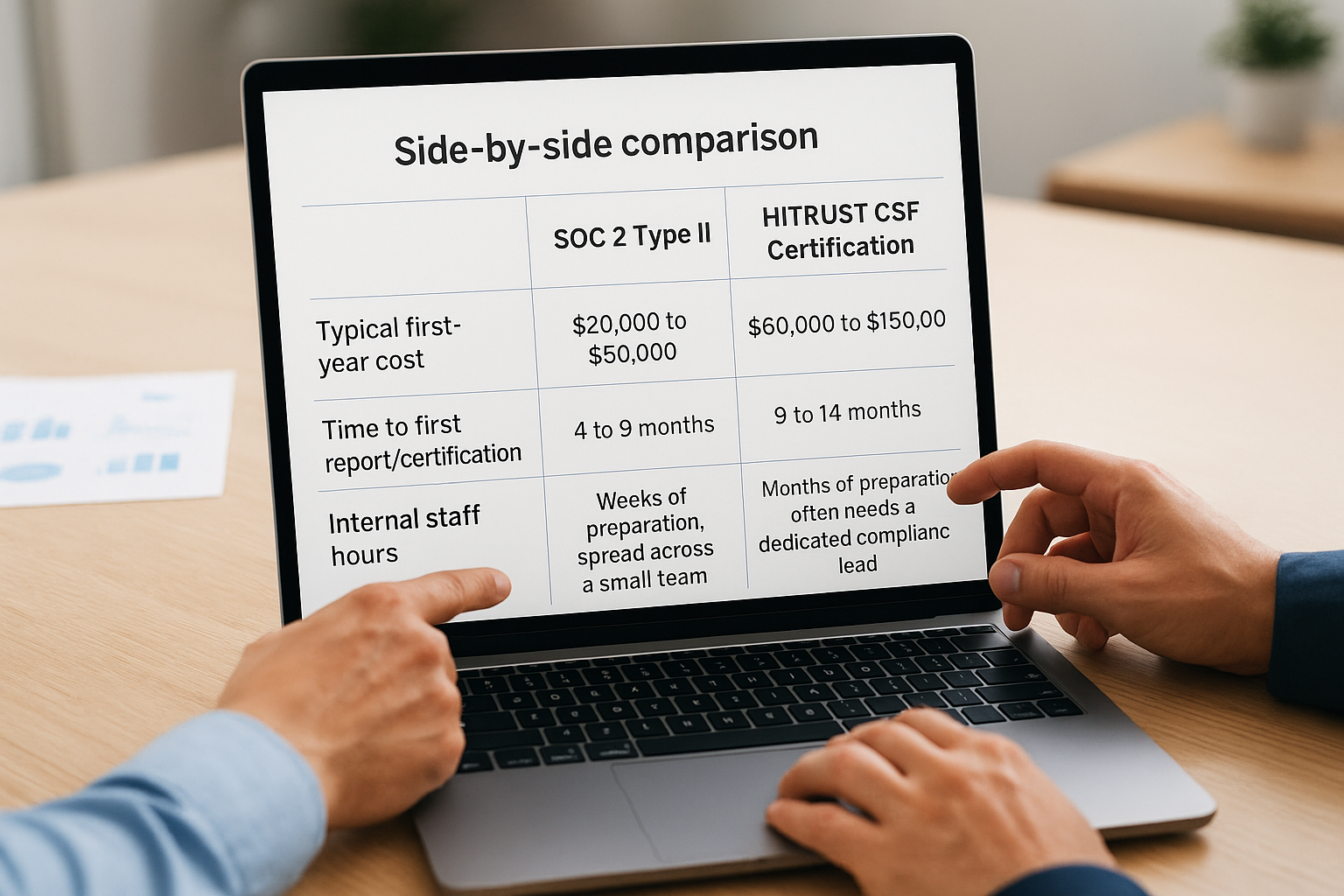
Side-by-side comparison
| Factor | SOC 2 Type II | HITRUST CSF Certification |
|---|---|---|
| Typical first-year cost | $20,000 to $60,000 | $60,000 to $150,000 |
| Time to first report/certification | 4 to 9 months | 9 to 14 months |
| Control evidence volume | Moderate, tied to your own control objectives | High, mapped to hundreds of prescriptive requirements |
| Internal staff hours | Weeks of preparation, spread across a small team | Months of preparation, often needs a dedicated compliance lead |
| Renewal cycle | Annual | Every 1 to 2 years depending on certification type |
Where the hidden effort actually lives
Cost estimates rarely capture the internal labor, and that's where teams get surprised. HITRUST's control set touches nearly every department, engineering, HR, facilities, vendor management, so you'll need people outside your security team pulling evidence, writing policies, and sitting in interviews with the assessor. Smaller companies without a dedicated compliance hire often underestimate this and end up delaying the assessment by a full quarter just to get documentation in order. SOC 2 asks for less breadth, since you define your own control objectives up front, but it still demands consistent evidence collection over the entire observation window, not just a point-in-time snapshot.
Given these gaps, budget and staffing capacity should factor into your decision as heavily as buyer demand does. A startup with two engineers handling security part-time has no realistic path to a HITRUST certification in the next two quarters, no matter how badly a target account wants one. Matching your framework choice to your actual team size and cash position keeps you from committing to a timeline you can't hit, which damages trust with the health system far more than simply telling them upfront which report you're pursuing and when.
Pursuing HITRUST and SOC 2 together as your program matures
Many vendors eventually need both frameworks, not because a single health system demands it, but because their buyer list splits between accounts that accept SOC 2 and accounts that require HITRUST outright. Growth changes the math. A company that closed its first ten deals on SOC 2 Type II alone often finds its eleventh prospect, usually a larger IDN or a payer, won't move forward without a HITRUST certification sitting next to it. At that point the question isn't which framework to pick, it's how to add the second one without blowing up your engineering roadmap or your compliance budget.
Sequence them instead of running both from scratch
Companies that pursue both frameworks well almost always sequence them rather than starting from zero on each. Build your SOC 2 controls first, since the audit is faster and gets you revenue sooner, then use that same control set as the foundation for a HITRUST readiness assessment. Roughly 40 percent of HITRUST's control requirements map cleanly onto the standard SOC 2 Trust Services Criteria categories around access management, change control, and incident response, so a mature SOC 2 program shortens your HITRUST readiness timeline meaningfully instead of doubling your work.
Build SOC 2 controls once, then extend them into HITRUST rather than building two separate compliance programs from the ground up.
Signs it's time to add the second framework
Watch for a few concrete signals rather than guessing at the right moment. Consider layering on HITRUST once you notice:

- Deal signals: More than two prospects in the last quarter asked specifically for HITRUST, not SOC 2 or "equivalent."
- Contract signals: A payer or IDN contract names HITRUST as a condition of the BAA.
- Team signals: You've hired or can hire a dedicated compliance lead to own the readiness process.
- Budget signals: You can absorb $60,000 or more in year-one HITRUST costs without cutting engineering spend.
Hitting two or more of these usually means the return on a HITRUST assessment now outweighs the cost of waiting.
Keep the frameworks in sync going forward
Once both certifications exist, treat them as one continuous compliance program rather than two separate audit cycles competing for the same staff time. Align your evidence collection calendar so SOC 2's observation period and HITRUST's assessment cycle overlap instead of running back to back, which cuts duplicate work for whoever owns compliance internally. Many EPIC-connected vendors settle into a rhythm where SOC 2 renews annually and HITRUST's certification, valid for one or two years depending on the assessment type, gets refreshed on its own schedule alongside it. Reaching this point signals a mature security program, and it's usually the moment vendors stop treating compliance as a sales blocker and start treating it as a genuine differentiator in EPIC-connected procurement conversations.
Common mistakes to avoid when choosing a framework
Vendors trip over the same handful of missteps when picking between HITRUST certification and SOC 2, and most of them come from optimizing for the wrong signal. Knowing these patterns ahead of time saves you a wasted audit cycle and a compliance budget you can't easily recover once it's spent.
Chasing prestige over buyer requirements
Teams sometimes pursue HITRUST because it sounds more rigorous, not because any account on their pipeline actually asked for it. That decision burns six figures and most of a year on a certification your buyers would have accepted a SOC 2 report for anyway. Pull your actual deal list before you sign an assessor contract, not after.
Never start a HITRUST assessment because it sounds impressive. Start it because a specific buyer on your pipeline requires it.
Starting HITRUST without a readiness assessment
Organizations that skip readiness work and jump straight into a validated assessment routinely blow past their target timeline by months. A readiness assessment exists specifically to catch gaps before the formal clock starts, and skipping it to save a few thousand dollars usually costs far more in delayed certification and re-testing fees.
Treating SOC 2 as a throwaway step
Some vendors dismiss SOC 2 as a lesser credential and skip it entirely on the assumption they'll go straight to HITRUST once they're ready. That thinking ignores how much of a mature SOC 2 control set carries over into HITRUST readiness. Skipping it doesn't save time, it just means you're rebuilding access management, change control, and incident response documentation from zero when HITRUST asks for it.
Underestimating internal staff time
Budgeting only for auditor fees and forgetting the internal labor is one of the most common gaps in a compliance roadmap. Engineering, HR, and vendor management teams all get pulled into collecting audit evidence, and companies that don't plan for that time often push their assessment back a full quarter just to catch up on documentation.
Ignoring the EPIC and SMART on FHIR angle
Vendors focused purely on the audit sometimes forget that a health system security review looks at your entire integration, not just your compliance report in isolation. A HITRUST or SOC 2 report paired with a properly built, SMART on FHIR compliant app moves through procurement faster than either piece alone. Platforms like VectorCare handle the SMART on FHIR and EPIC Showroom side of that equation, which lets your compliance investment actually translate into signed contracts instead of stalling in a security queue behind a technical review you weren't prepared for.
Waiting too long to start
Delaying either framework until a deal is already stuck in security review is the costliest mistake on this list, since neither audit moves faster just because your sales team needs it to.
Choosing the path that fits your growth
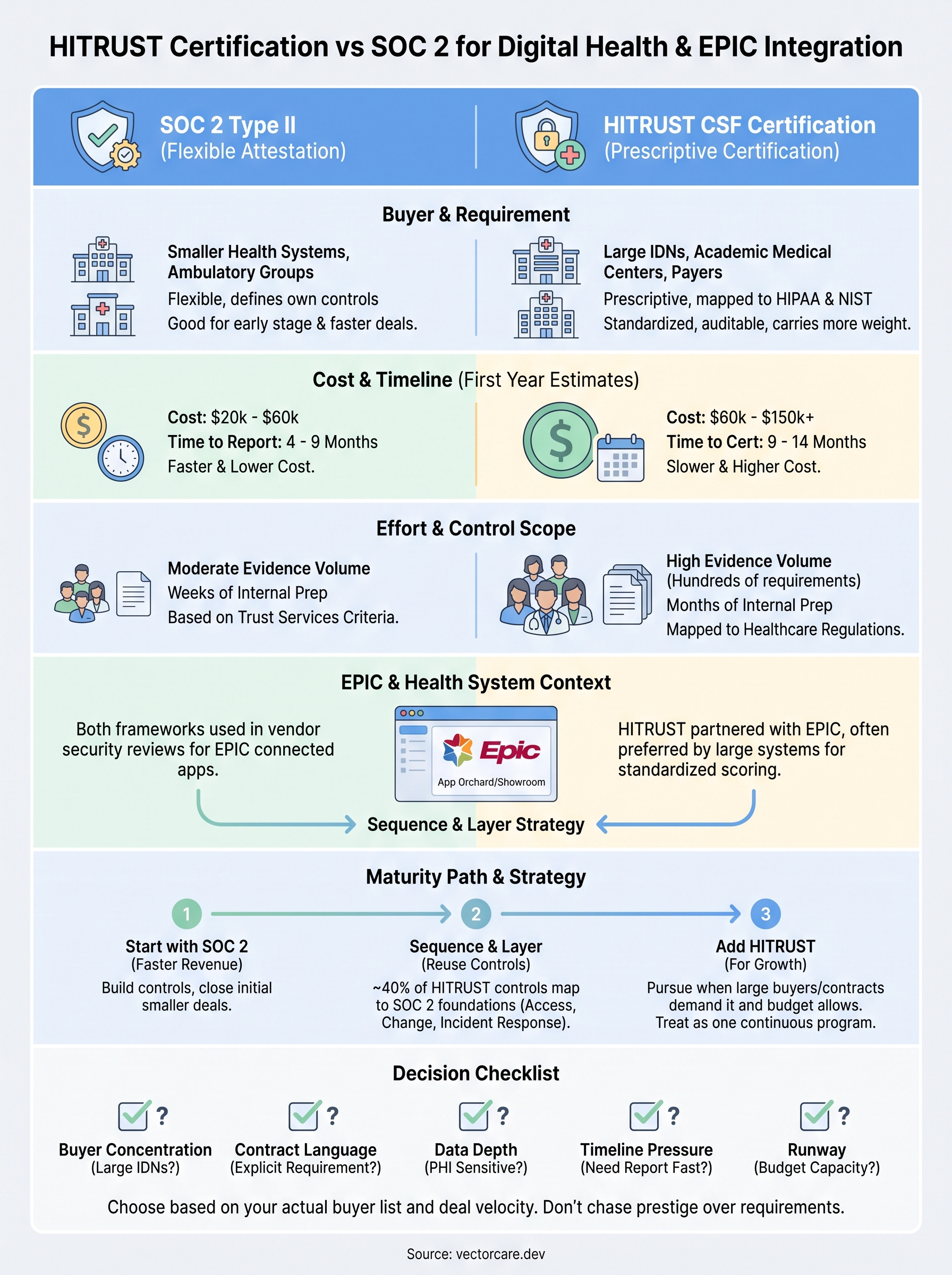
The hitrust certification vs soc 2 decision comes down to who's asking and how fast you need to move. SOC 2 gets you through procurement with smaller hospitals and ambulatory groups quickly and cheaply. HITRUST carries more weight with large IDNs and payers, but it costs more and takes longer, so start it only when your buyer list actually demands it. Neither choice fixes the technical side of getting your app in front of clinicians in the first place.
Once your compliance report is in hand, the fastest way to turn it into signed contracts is having a SMART on FHIR app already built and listed where health systems can find it. That's the piece vendors underestimate until a deal stalls waiting on integration work nobody budgeted for. Build and deploy your SMART on FHIR app in days and let your compliance work actually close deals instead of sitting in a security queue.
The Future of Patient Logistics
Exploring the future of all things related to patient logistics, technology and how AI is going to re-shape the way we deliver care.
Thank you! Your submission has been received!
Oops! Something went wrong while submitting the form.