Care Management Software Pricing: What You'll Actually Pay

If you've asked three vendors for a quote and gotten three wildly different answers, you're not imagining things. Care management software pricing ranges from a few hundred dollars a month to well over half a million dollars in upfront engineering costs, and the number you get depends heavily on what "integration" actually means for your product.
Here's the short answer: expect per-provider or per-seat licensing for standalone care management tools, and a completely different cost structure when EPIC EHR integration enters the picture. That second category is where most digital health vendors get blindsided, because custom FHIR integration work can quietly add $250K or more before you ever sign a health system contract.
This article breaks down what drives those numbers: licensing models, implementation fees, compliance overhead, and the hidden costs of building EPIC connectivity in-house versus using a managed platform. You'll walk away knowing what questions to ask vendors and what a realistic budget looks like for your stage.
Why care management software pricing varies so much
Ask five vendors for a quote and you'll get five different numbers, because care management software pricing isn't one market. You're actually comparing apples to spreadsheets: a standalone care coordination tool for a small clinic costs nothing like an EPIC-integrated platform serving a 500-bed health system. The vendor's answer depends on what you're building, who's using it, and how deep the integration needs to go.
Deployment model and integration depth
Standalone tools that live outside the EHR are cheap to price because they don't touch clinical workflows directly, which is the real dividing line in what EHR integration involves. Add EPIC or Cerner integration and the math changes completely. FHIR API development against Epic requires OAuth handling, data mapping, and ongoing maintenance as EPIC updates its endpoints, and that work alone can run into six figures if you're building it in-house. This is the single biggest reason two quotes for what sounds like
How to estimate your true software budget
Before you sign anything, build your own total cost of ownership model instead of trusting a single vendor quote. Most digital health teams anchor on the monthly subscription number and forget that implementation, compliance review, and staff training all show up as separate line items on the invoice. Start by mapping your actual usage: how many care coordinators need seats, how many patients flow through the system monthly, and whether you need one EPIC instance or connections across multiple health systems.
Map your usage before you shop
Gather these numbers before your first vendor call, because they change the quote more than any feature list:
- Active user seats (care coordinators, case managers, admins)
- Patient volume per month, since some vendors price on transaction count
- Number of EPIC instances you need to connect to (each health system counts separately)
- Compliance scope, including whether you need a signed BAA and SOC2 documentation (and what a SOC 2 audit costs if you're funding it yourself)
Compare the real cost buckets
Once you have those numbers, lay out the cost buckets side by side instead of comparing sticker prices in isolation.
| Cost Bucket | DIY Custom Build | Managed No-Code Platform |
|---|---|---|
| Upfront engineering | $250K–$500K+ | $0 |
| Monthly platform fee | Internal salary cost | ~$500/month |
| Per-instance EPIC fee | Varies, often untracked | ~$3K/month |
| Time to first health system live | 12–18 months | 3–6 weeks |
A quote is only useful once you've translated it into your own patient volume, seat count, and instance number.
Run this exercise against VectorCare's own pricing structure, alongside a realistic view of what it takes to integrate with Epic EHR, and you'll see exactly why the gap between DIY and managed care coordination platform cost is so wide.
Common pricing models you'll encounter
Vendors rarely use the same pricing logic, which is why comparing quotes feels like comparing currencies. Per-seat licensing charges you a flat fee for every care coordinator or case manager logged into the system, and it's common among standalone care management tools that never touch an EHR. Per-patient or per-encounter pricing scales with volume instead, so a small pilot program costs little while a full rollout across a health system can balloon fast if you didn't model usage first.
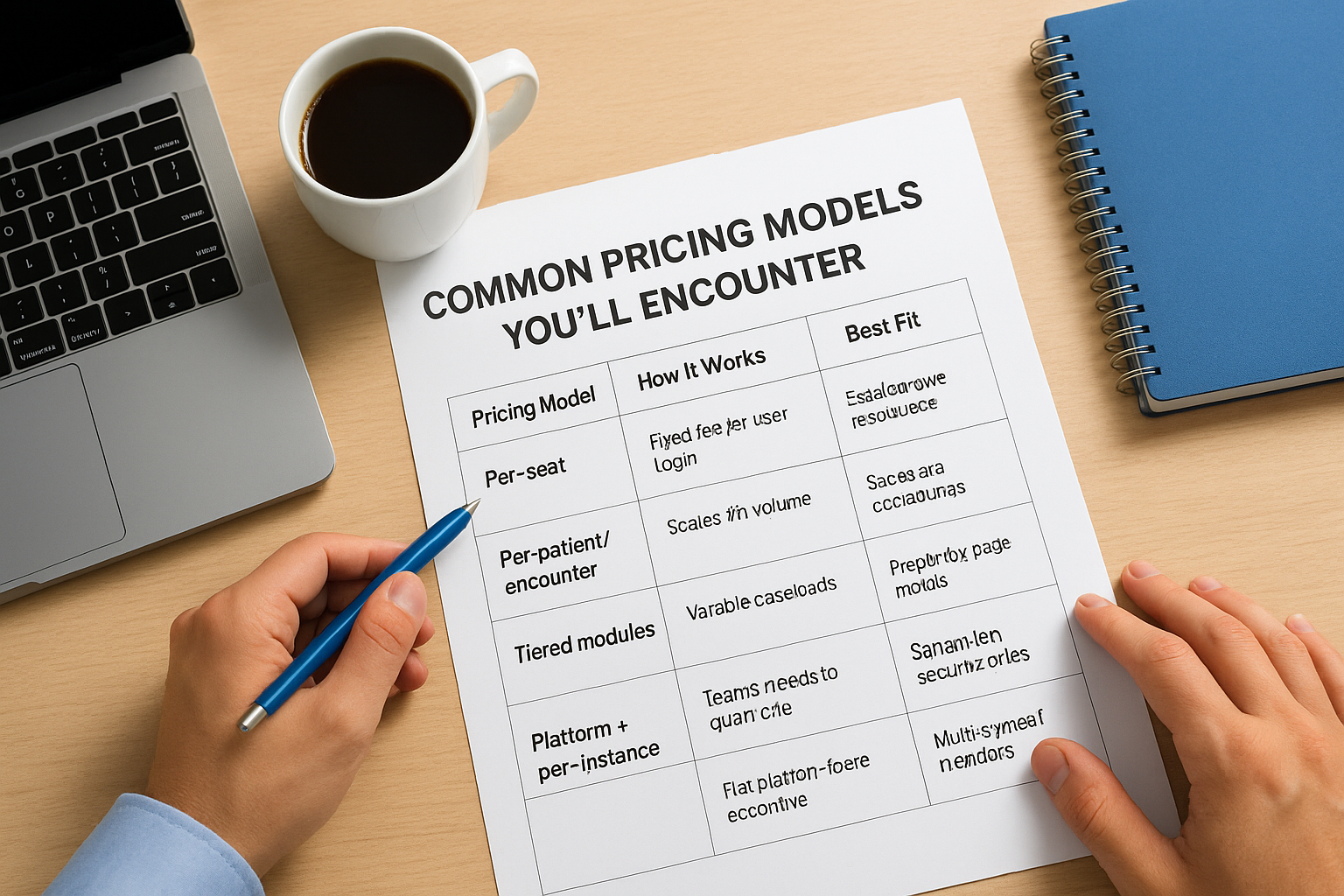
Modules and tiers complicate things further. Many platforms sell a base product, then charge extra for reporting dashboards, mobile access, or API connections. Watch for this especially when a vendor quotes a low base price but locks EPIC connectivity, SOC2 documentation, or a signed BAA behind a higher tier.
The lowest number on a pricing page rarely includes the features you actually need to go live.
Flat monthly platform fees plus a per-instance charge are the model you'll see most often once EPIC integration enters the conversation, because each health system connection carries its own maintenance burden, and that sits on top of Epic's own App Orchard fees and tiers.
| Pricing Model | How It Works | Best Fit |
|---|---|---|
| Per-seat | Fixed fee per user login | Small teams, internal tools |
| Per-patient/encounter | Scales with volume | Variable caseloads |
| Tiered modules | Base price plus add-ons | Teams needing specific features only |
| Platform + per-instance | Flat platform fee, per-EPIC-connection charge | Multi-health-system vendors |
Understanding which model you're being quoted matters more than the sticker price itself, since two vendors charging "$2,000 a month" can mean entirely different things depending on what triggers additional billing.
Hidden costs that can inflate your final bill
Most vendors quote you the sticker price and let you discover the rest on your own. Maintenance fees rarely show up in the initial pitch, but EPIC updates its FHIR endpoints multiple times a year, and every update means someone on your team has to test and patch the connection or risk a broken integration in production.

The invoice you sign is never the invoice you pay once maintenance, renewals, and scope changes enter the picture.
Compliance and renewal costs
SOC2 audits and BAA renewals aren't one-time events. Annual compliance overhead for a self-managed integration commonly runs $20K to $50K once you factor in audit prep, legal review, and documentation updates. Vendors who bundle this into a flat monthly fee save you from a surprise line item every renewal cycle.
Scope creep and support gaps
Watch for these charges specifically, since they rarely appear on the initial quote:
- Change request fees when your workflow logic needs updating after launch
- Support tier upgrades required once you exceed a ticket volume threshold
- Additional EPIC instance fees when a new health system signs on
- Data migration costs if you switch platforms later
Spotting these before you sign matters more than negotiating the base price. A platform like VectorCare, for example, folds ongoing HIPAA compliant hosting, monitoring, and EPIC endpoint maintenance into the flat per-instance fee, which is exactly the kind of bundling that keeps your care management software pricing predictable instead of creeping upward every quarter.
Questions to ask vendors before you sign
Getting a clean answer to a handful of questions upfront saves you from renegotiating your care management software pricing six months into a contract. Vendors won't volunteer the details that hurt their quote, so you have to ask directly and get answers in writing before you sign anything, the same discipline that applies when you're selecting an EHR vendor.
The checklist to bring to every sales call
Use this list on every vendor call, and don't accept a vague answer to any of them:
- What exactly triggers a per-instance fee, and does it apply per health system or per EPIC environment?
- Who owns FHIR endpoint maintenance when EPIC pushes an update, and is that included in the monthly price?
- Is the BAA and SOC2 documentation bundled into the base fee or billed as a separate compliance package?
- What's the cost and timeline for adding a second EPIC instance once you land another health system contract?
- Are workflow changes after launch billed as change requests, and if so, at what rate?
- What happens to your data and configuration if you switch platforms later?
If a vendor can't answer a pricing question in one sentence, that's the question that will cost you the most later.
Hold every answer against the total cost of ownership model you built earlier. Numbers that sound reasonable in isolation often reveal gaps once you compare them against your seat count, patient volume, and instance count side by side. Vendors who answer these questions cleanly, without redirecting you to a sales deck, are usually the ones whose pricing holds up once you're actually live.
Putting the numbers into perspective
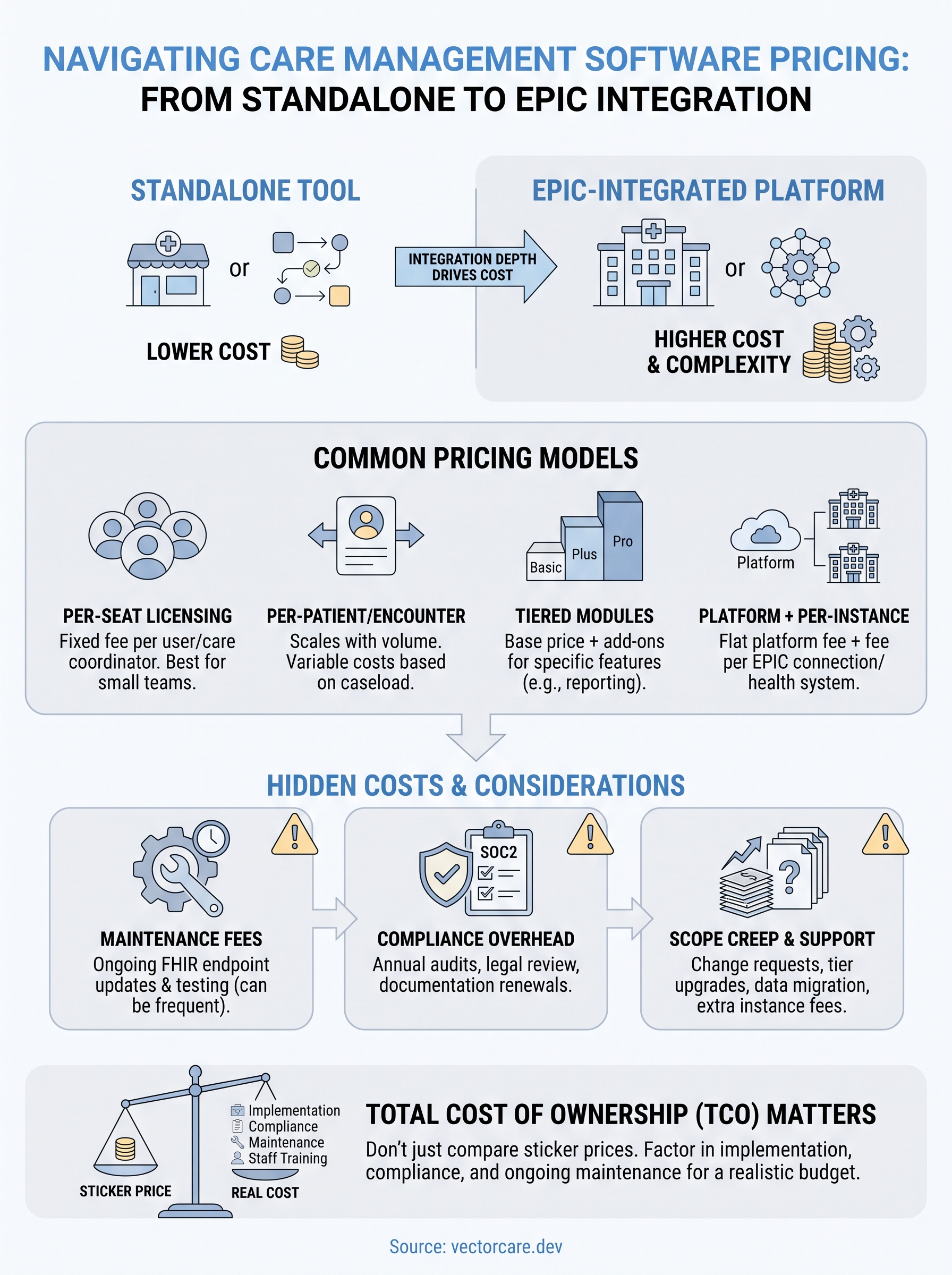
The sticker price on any quote tells you almost nothing until you run it through your own seat count, patient volume, and instance number. Care management software pricing spans from a few hundred dollars a month to half a million in upfront engineering, and the gap almost always comes down to whether EPIC integration is built custom or delivered through a managed platform. Once you factor in maintenance, compliance renewals, and per-instance fees, the DIY route rarely stays cheap for long.
Rather than spend months building FHIR connectivity in-house and absorbing every hidden cost along the way, most vendors are better served by a platform that bundles hosting, compliance, and EPIC maintenance into one predictable fee. If you want to see what that actually costs for your product, see how VectorCare lets you build and deploy your Smart on FHIR app in days before you sign anything else.
The Future of Patient Logistics
Exploring the future of all things related to patient logistics, technology and how AI is going to re-shape the way we deliver care.
Thank you! Your submission has been received!
Oops! Something went wrong while submitting the form.