SOC 2 Compliance Requirements: What They Are and Why

You searched for a soc 2 compliance requirements pdf because you need something concrete to hand your team, your investors, or your first health system prospect. A blog post that vaguely gestures at "security best practices" doesn't cut it when a hospital's procurement team is asking for evidence, not opinions.
Here's the direct answer: SOC 2 compliance rests on five trust service criteria, security, availability, processing integrity, confidentiality, and privacy, and your audit report proves you've built controls around whichever ones apply to your product. There's no universal checklist because SOC 2 isn't a fixed standard like a pass/fail exam. It's a framework your auditor tailors to your specific systems, which is exactly why a generic SOC 2 compliance checklist PDF often leaves founders more confused than when they started.
This article breaks down what each trust service criterion actually requires, how auditors evaluate your controls, and what documentation you need before you ever schedule a Type I or Type II audit. If you're a healthcare vendor building toward EPIC integration, understanding these compliance requirements early saves you from costly rework once real patient data and BAAs enter the picture.
Why SOC 2 compliance requirements matter
Health systems don't sign contracts with vendors who can't prove they protect patient data. SOC 2 compliance requirements exist because hospitals, insurers, and enterprise buyers need independent evidence, not a sales pitch, that your systems won't leak sensitive information. Without a report, you're stuck answering the same 40-question security questionnaire over and over, and every stalled answer pushes your deal further down the pipeline.
A missing SOC 2 report doesn't just slow a sale, it kills deals before procurement even reads your pitch.
The real cost of skipping compliance
Most founders underestimate how early buyers ask for this. A SOC 2 audit requirements conversation often shows up in the first vendor risk call, long before pricing negotiations start. Skip it, and you'll watch deals stall in legal review while competitors with a completed audit move straight to signature. The cost isn't just lost revenue either. Rebuilding infrastructure after the fact, once you've already onboarded customers on non-compliant systems, means retrofitting encryption, access controls, and logging into a live product. That's slower and riskier than building it in from day one.
Who actually asks for the report
Requests for your report come from predictable places, and knowing who needs SOC 2 compliance helps you prioritize which trust criteria matter first:
- Health system security teams evaluating any vendor touching patient data or EHR systems
- Enterprise procurement departments running standard vendor risk assessments
- Investors during due diligence, especially in Series A and later rounds
- Insurance underwriters setting your cyber liability premiums
- Existing customers renewing contracts that include security addendums
Each group cares about slightly different things. A hospital cares about confidentiality and privacy controls around PHI. An investor cares more about security and availability, since downtime and breaches hit revenue directly. Understanding your audience shapes which of the five criteria you scope into your first audit, and scoping wrong wastes months of preparation on controls nobody asked to see.
The five Trust Services Criteria explained
Every SOC 2 compliance requirements pdf you find online eventually points back to the same source: the AICPA's Trust Services Criteria. These five categories form the entire scope of any audit, and your auditor picks which ones apply based on what your product actually does with data.
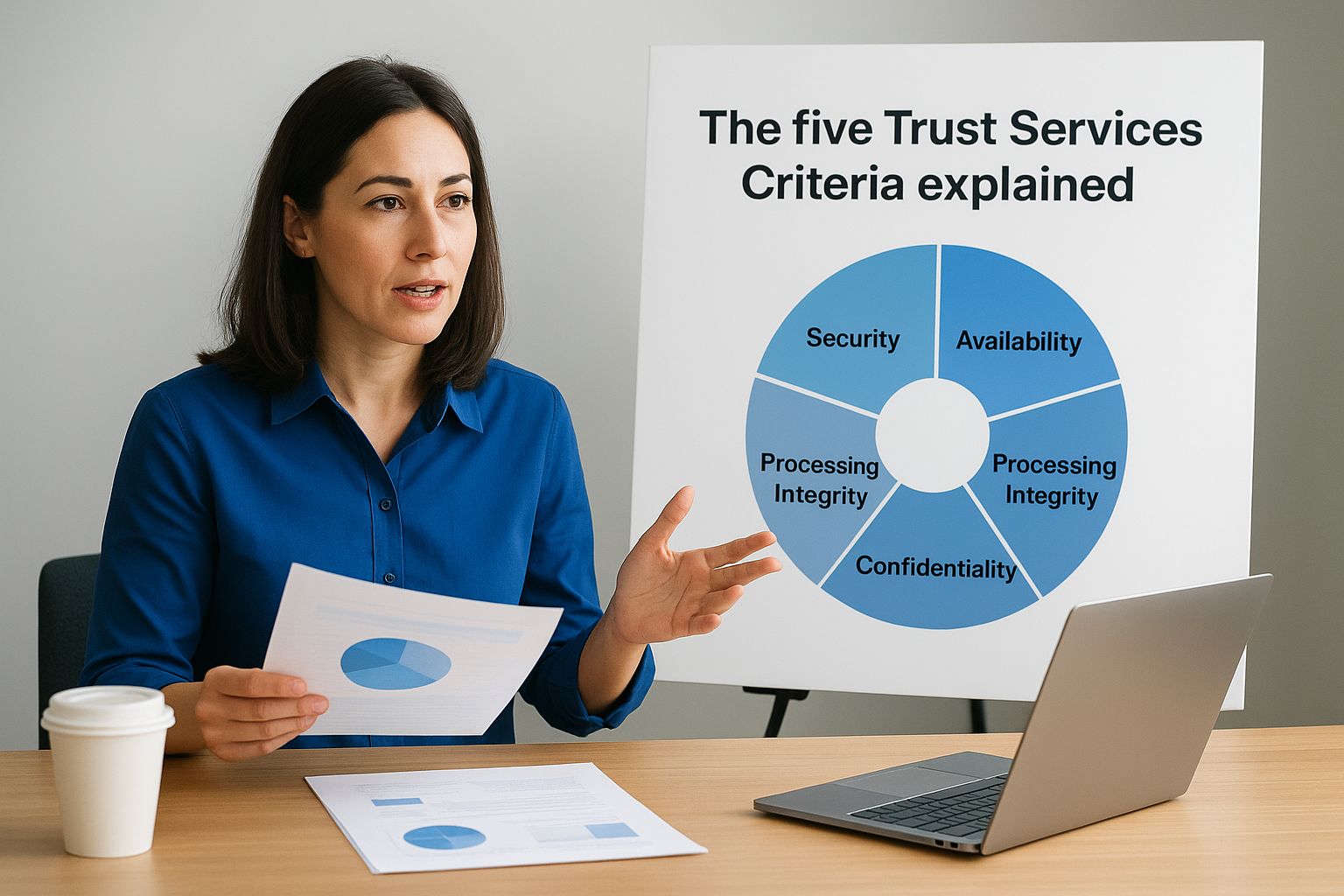
Security is the only mandatory criterion. The other four exist because your business needs them, not because SOC 2 demands them.
Security, often called the Common Criteria, covers access controls and system monitoring and applies to every single audit regardless of industry. Availability measures whether your systems stay operational and recover quickly from outages, which matters if a hospital depends on your app during a shift change. Processing integrity confirms your system delivers complete and accurate data without corruption, a big deal for anything touching clinical decision support. Confidentiality protects business and technical data marked as sensitive, while privacy specifically governs how you collect, use, and dispose of personal information like PHI.
| Criterion | What it protects | Common healthcare use case |
|---|---|---|
| Security | Unauthorized access | Required for all vendors |
| Availability | Uptime and recovery | Remote patient monitoring |
| Processing Integrity | Data accuracy | Clinical decision support tools |
| Confidentiality | Sensitive business data | Vendor contracts, IP |
| Privacy | Personal information handling | PHI collection and disposal |
Getting scope right up front saves you from testing controls nobody asked to see.
How to prepare for a SOC 2 audit
Preparation starts long before you contact an auditor. Most vendors underestimate the SOC 2 readiness assessment phase, treating it as a formality when it's actually where you catch gaps that would otherwise surface mid-audit and force you to restart evidence collection.
Choose Type I or Type II first
Deciding between report types shapes your entire timeline. A Type I audit versus a Type II audit comes down to this: Type I examines whether your controls are designed properly at a single point in time, while Type II tests whether those controls actually operated effectively over three to twelve months. Health systems increasingly want Type II reports because they prove sustained compliance, not a snapshot.
Auditors don't grade intentions. They grade evidence, so start collecting logs and screenshots the day you decide to pursue SOC 2.
Run a gap analysis before you scope
Here's the sequence that keeps preparation from dragging into a six-month project:
- Map every system that touches customer or patient data.
- Compare current controls against the trust criteria you've selected.
- Document gaps and assign owners with real deadlines.
- Remediate high-risk gaps first, especially access control weaknesses.
- Collect evidence continuously, not right before the audit window closes.
Remediation usually takes longer than founders expect. Skipping the gap analysis and jumping straight to an auditor almost always backfires, since you'll pay for audit hours spent identifying problems you could have found yourself for free.
Selecting the right auditor matters too. Look for firms with actual healthcare or SaaS experience, since generic auditors often misjudge which controls apply to your product.
Key controls to implement for each criteria
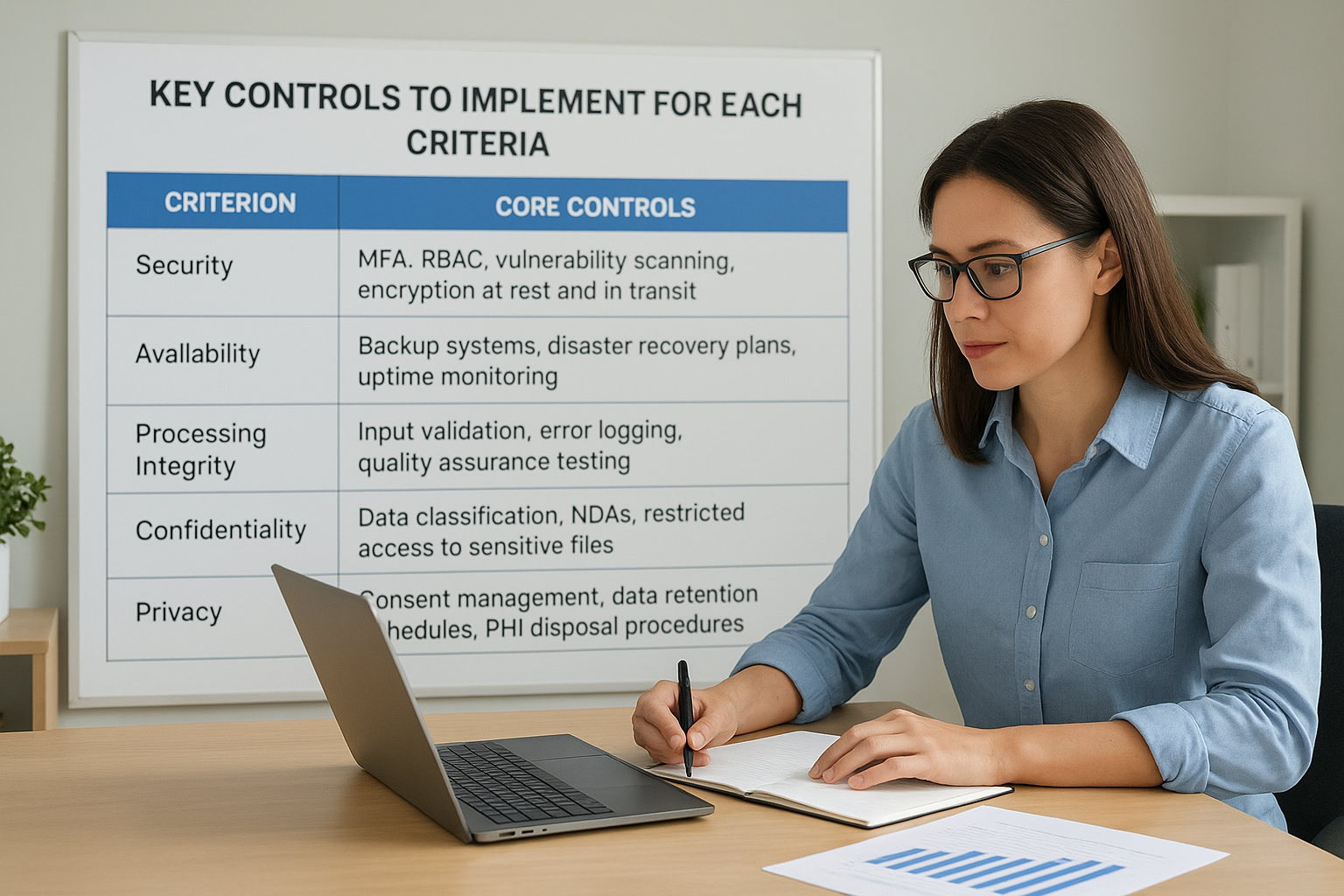
Each trust criterion maps to specific, testable SOC 2 controls, and auditors expect documented evidence for every one you claim to meet. Security controls typically include multi-factor authentication, role-based access, and continuous system monitoring, since this criterion applies to every audit regardless of scope. Availability controls center on redundancy, incident response plans, and documented recovery time objectives that prove you can restore service after an outage.
| Criterion | Core Controls |
|---|---|
| Security | MFA, RBAC, vulnerability scanning, encryption at rest and in transit |
| Availability | Backup systems, disaster recovery plans, uptime monitoring |
| Processing Integrity | Input validation, error logging, quality assurance testing |
| Confidentiality | Data classification, NDAs, restricted access to sensitive files |
| Privacy | Consent management, data retention schedules, PHI disposal procedures |
Processing integrity controls matter most for anything generating clinical outputs, since a miscalculated dosage recommendation or missed alert carries real consequences. Confidentiality and privacy controls overlap heavily in healthcare, which is why vendors handling PHI often build both simultaneously rather than treating them as separate projects.
Controls without documentation don't count. If you can't show the auditor a log, a policy, or a screenshot, the control doesn't exist as far as SOC 2 is concerned.
Setting up every one of these controls manually takes months, especially for a small engineering team already stretched thin. Managed platforms like VectorCare build encryption, access logging, and audit trails directly into the hosting layer, so you inherit compliant infrastructure instead of assembling it control by control.
SOC 2 compliance for healthcare and EPIC integrations
Healthcare vendors face a stricter version of SOC 2 than most SaaS companies, because EPIC integration means you're handling protected health information the moment your app touches the EHR. Epic's App Orchard review process expects proof of security controls before it even lists your app, and health systems layer their own vendor risk assessments on top. That's two separate compliance conversations happening at once, and skipping either one stalls your rollout.
A SOC 2 report gets you in the door. A BAA and HIPAA alignment keep you in the contract.
Because PHI sits at the center of nearly every workflow you build, confidentiality and privacy criteria carry more weight here than they would for a generic productivity tool. Auditors expect to see consent management, strict data retention schedules, and documented PHI disposal procedures, not just access logs. A HIPAA compliant SOC 2 report combines both frameworks, since HIPAA compliance requirements set the legal floor and SOC 2 proves you actually operate the controls that satisfy it.
Building this from scratch means standing up encryption, audit trails, BAAs, and FHIR-compliant data handling before you write a single line of clinical workflow logic. That's exactly the burden VectorCare's SMART on FHIR platform absorbs for you. Its managed hosting includes HIPAA and SOC2-ready infrastructure by default, so your app inherits compliant controls instead of your engineering team building them control by control while racing toward an EPIC Showroom listing.
Putting SOC 2 requirements into practice
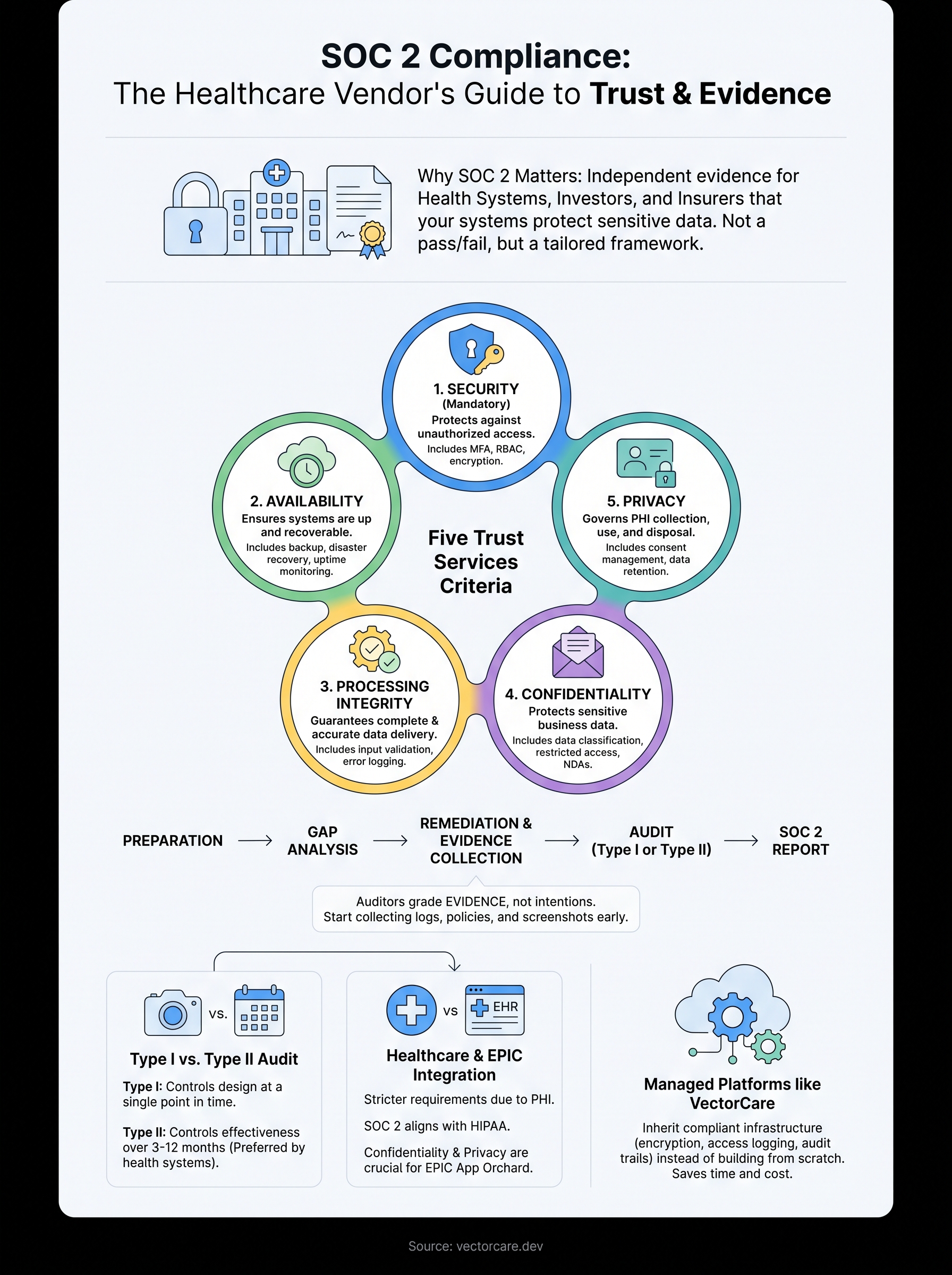
SOC 2 compliance requirements aren't a checkbox you tick once and forget. Trust service criteria shift as your product grows, and a Type II audit demands proof that your controls hold up over months, not just at launch. You now know the five criteria, how auditors weigh them, and what evidence actually counts as proof rather than intention.
Getting there alone means months of engineering time spent on encryption, logging, and access controls instead of your core product. Healthcare vendors racing toward an EPIC Showroom listing rarely have that runway to spare, especially when a health system's procurement team is waiting on your report before signing anything.
Skip the retrofit. Build and deploy your SMART on FHIR app in days on infrastructure that already carries HIPAA and SOC2-ready controls, and spend your engineering hours on the workflow logic that actually differentiates your product.
The Future of Patient Logistics
Exploring the future of all things related to patient logistics, technology and how AI is going to re-shape the way we deliver care.
Thank you! Your submission has been received!
Oops! Something went wrong while submitting the form.