8 Best SOC 2 Compliance Companies for Certification

If you're a digital health vendor trying to close deals with hospitals or health systems, someone on the buyer's side has already asked for your SOC 2 report. That single document can stall a contract for months if you don't know where to start. Searching for soc 2 compliance companies usually means you need an auditor or a compliance platform fast, and you need one that actually understands the pressure your sales team is under.
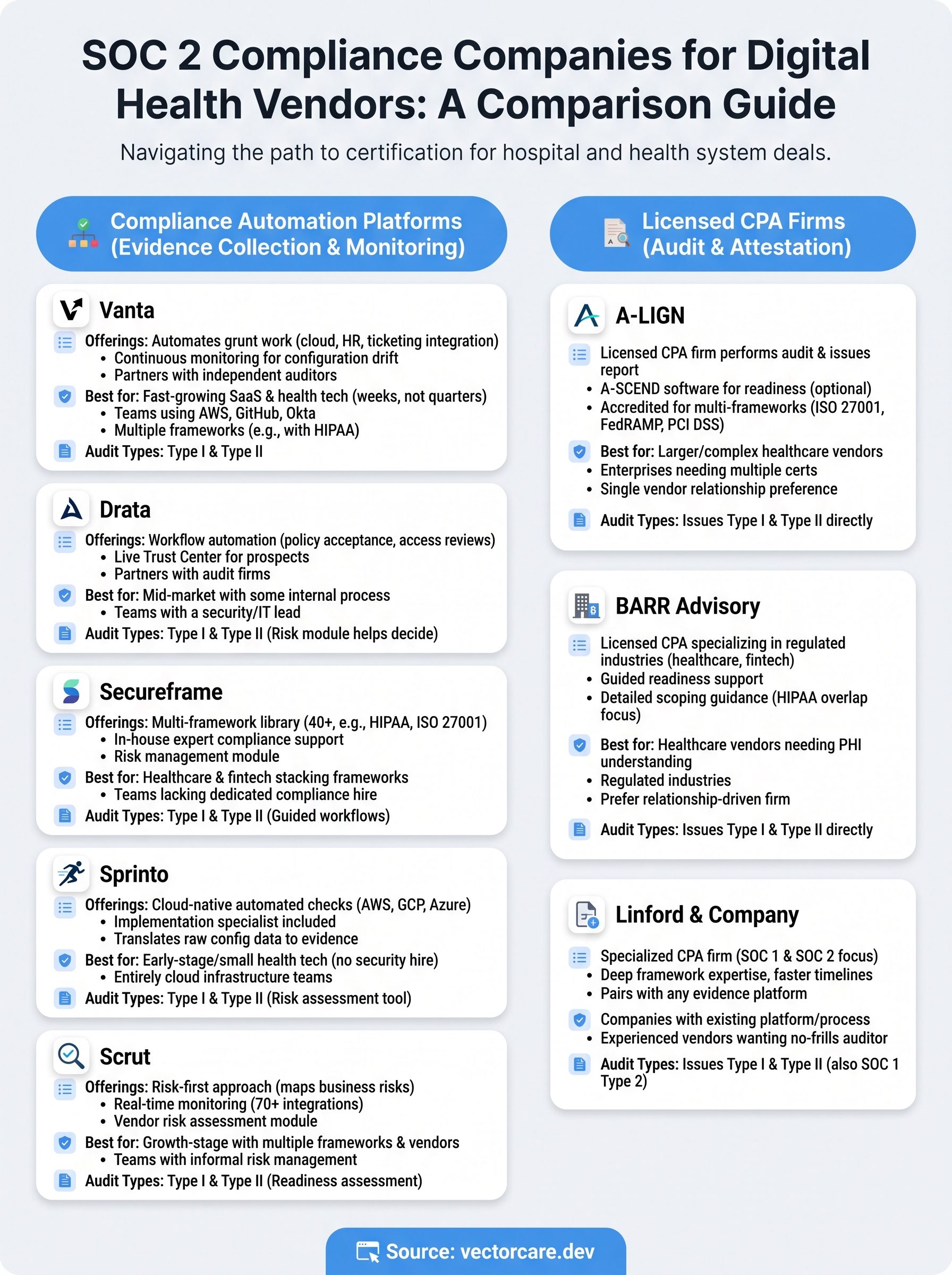
This list answers that search directly. Below you'll find eight companies that cover both sides of the process: the compliance automation platforms that handle evidence collection and continuous monitoring, and the licensed CPA firms who provides soc 2 certification through the actual audit and attestation. We break down what each one does best, who it fits, and roughly what it costs, so you're not stuck comparing vague sales pages.
At VectorCare, we work with healthcare vendors every day who need HIPAA compliance software and SOC2 compliance alongside their EPIC integrations, so we've seen firsthand which soc 2 certification companies actually deliver for teams in this space versus which ones just add friction.
1. Vanta
What it offers
Vanta built its name automating the grunt work of a SOC 2 audit: pulling evidence from your cloud accounts, HR system, and ticketing tools, then mapping it to the controls an auditor needs to see, and it's worth understanding how Vanta's SOC 2 process works end to end before you commit. The platform runs continuous monitoring that flags configuration drift in real time, the kind of SOC 2 compliance automation that keeps you from scrambling to fix a misconfigured S3 bucket the week before your audit window opens. It's worth being clear on one thing: Vanta is not a CPA firm and doesn't issue the SOC 2 report itself. It partners with a network of independent auditors and hands them a pre-organized evidence trail, which is where most of the time savings actually come from.
Vanta doesn't replace your auditor, it makes your auditor's job fast enough that you stop paying for months of back-and-forth.
Best for
Vanta fits fast-growing SaaS and health tech companies that need their first SOC 2 report done in weeks, not quarters, and don't have a dedicated compliance hire yet. If your engineering team already lives in AWS, GitHub, and Okta, the integrations plug in with minimal setup. Teams juggling multiple frameworks at once, say SOC 2 alongside HIPAA, also benefit from the shared control library instead of building separate evidence sets for each standard.
SOC 2 audit type supported
Vanta supports both audit types, and most customers start with a Type I report to prove controls are designed correctly, then move to a Type II report after a three to twelve month observation period to prove those controls actually operated as intended over time, a split we break down in detail in SOC 2 Type I vs Type II. The platform's monitoring dashboard is what makes the Type II window manageable, since it catches control failures the moment they happen rather than at the end of the observation period.
Pricing
Vanta doesn't publish flat rate cards, and quotes depend on company size and how many frameworks you're pursuing.
- Platform subscription: typically starts around $10,000 to $15,000 per year for smaller companies
- Auditor fees: billed separately by the partnered CPA firm, usually $10,000 to $30,000 depending on scope
- Implementation: most teams budget several weeks of internal time even with automation handling evidence collection
2. Drata
What it offers
Drata competes directly with Vanta on automated evidence collection, but it leans harder into workflow automation for the people side of compliance: policy acceptance reminders, access reviews, and vendor risk questionnaires all run through the platform instead of living in spreadsheets. Its Trust Center feature lets you publish a live compliance status page for prospects, which cuts down on the security questionnaires your sales team fields during a health system deal. Like Vanta, Drata isn't a CPA firm, so the actual attestation comes from one of its partnered audit firms.
A live Trust Center answers half your buyer's security questions before they ask them.
Best for
Drata suits mid-market companies that already have some internal compliance process in place and want to formalize it rather than build one from scratch. Teams with a security or IT lead who can own the platform day-to-day get the most value here, since Drata's granularity rewards someone who checks in regularly.
SOC 2 audit type supported
Drata supports Type I and Type II audits, and its risk management module helps teams decide which one makes sense based on how mature their controls already are before committing to a longer observation window.
Pricing
Pricing follows the same custom-quote model as most platforms in this category.
- Platform subscription: generally $10,000 to $20,000 annually
- Auditor fees: separate, typically $12,000 to $25,000
- Add-ons: vendor risk management and Trust Center features can raise the total
3. Secureframe
What it offers
Secureframe pairs the usual automated evidence collection with a library of over 40 framework mappings, so if SOC 2 is your first stop but HIPAA or ISO 27001 are next on the roadmap, you're not starting from zero each time. The platform's risk management module flags gaps against your chosen framework before you ever talk to an auditor, which shortens the back-and-forth once fieldwork starts. Secureframe's SOC 2 workflow also includes its own in-house team of compliance experts who help configure controls, a step some competitors leave entirely to your internal staff.
A tool that maps your controls to five frameworks at once saves you from rebuilding evidence every time a new client demands a different certification.
Best for
Secureframe works best for healthcare and fintech vendors stacking multiple compliance frameworks at once, since the shared control library avoids duplicate evidence gathering. Companies without a dedicated compliance hire also benefit from the built-in expert support, which fills the knowledge gap a lot of startups have going into their first audit.
SOC 2 audit type supported
Secureframe supports both Type I and Type II reports, and its guided workflows walk teams through deciding which one fits their current maturity level before locking in an observation period with a partnered auditor.
Pricing
Quotes stay custom based on company size and framework count.
- Platform subscription: roughly $7,500 to $18,000 per year
- Auditor fees: separate, usually $10,000 to $25,000
- Expert support: included in most tiers, unlike some competitors that charge extra for hands-on guidance
4. Sprinto
What it offers
Sprinto targets a narrower problem than Vanta or Drata: getting cloud-native startups through their first audit without hiring a compliance person at all. The platform runs automated checks against your AWS, GCP, or Azure setup and translates raw configuration data into audit-ready evidence, cutting out a lot of the manual screenshotting teams do with spreadsheet-based approaches. Sprinto's SOC 2 process also assigns an implementation specialist to each account who walks you through control setup, which matters if this is your first framework and you don't have anyone in-house who's done one before.
Sprinto sells itself to teams who need a compliance expert on call, not just a dashboard to stare at.
Best for
Sprinto fits early-stage startups and small health tech teams without a security hire, since the hands-on implementation support fills a gap other platforms leave you to solve alone, which is often the hardest part of SOC 2 compliance for startups. It also suits companies that run entirely on cloud infrastructure and want their audit evidence pulled directly from that environment rather than assembled manually.
SOC 2 audit type supported
Sprinto supports Type I and Type II audits, and its risk assessment tool recommends which one to pursue first based on how mature your current controls are, then tracks progress toward the Type II observation window automatically.
Pricing
Sprinto keeps its published pricing more transparent than most competitors on this list.
- Platform subscription: starts around $6,000 to $12,000 per year for smaller teams
- Auditor fees: billed separately, typically $10,000 to $20,000
- Implementation support: included in the subscription rather than sold as an add-on
5. Scrut
What it offers
Scrut built its platform around a risk-first approach, meaning it starts by mapping your actual business risks before it maps controls, rather than jumping straight into evidence collection like some competitors. The dashboard pulls from over 70 integrations to monitor infrastructure, HR, and vendor tools in real time, flagging drift the same day it happens instead of at the end of a quarter. Scrut also bundles in a vendor risk assessment module, which matters if health systems are asking about your subprocessors as part of their own due diligence during contract review.

A platform that starts with your risk register instead of your control list catches problems the checkbox tools miss.
Best for
Scrut suits growth-stage companies juggling multiple compliance frameworks and vendor relationships at once, since the risk register doubles as documentation for both your SOC 2 audit and any third-party security reviews your buyers run separately. Teams that already have some internal risk management practice, even an informal one, get more out of Scrut than companies starting from a blank slate.
SOC 2 audit type supported
Scrut supports Type I and Type II audits, and its SOC 2 readiness assessment tells you upfront which controls need work before you commit to an observation period, so you're not discovering gaps midway through fieldwork with your auditor.
Pricing
Scrut publishes rough pricing bands rather than forcing every prospect into a sales call.
- Platform subscription: roughly $8,000 to $15,000 annually
- Auditor fees: separate, typically $10,000 to $22,000
- Vendor risk module: often included in mid and upper tiers
6. A-LIGN
What it offers
A-LIGN stands apart from the first five entries on this list because it's a licensed CPA firm, not a compliance automation platform. It performs the actual audit and issues the attestation report, and it also runs its own software, A-SCEND, for evidence collection and readiness tracking if you want a single vendor handling both sides. That combination matters if you're tired of coordinating between a platform team and a separate audit firm that don't always communicate well. A-LIGN also holds accreditations across a wide range of frameworks beyond SOC 2, including ISO 27001, which differs from SOC 2 in important ways, plus FedRAMP and PCI DSS, all of which show up often in RFPs from larger health systems.

Hiring the auditor and the automation vendor from the same company removes a coordination problem most teams don't see coming until fieldwork starts.
Best for
A-LIGN fits larger or more complex healthcare vendors already selling into enterprise health systems that demand multiple certifications, not just SOC 2. It also suits teams that would rather manage one vendor relationship for both readiness work and attestation instead of stitching together a platform and a separate CPA firm.
SOC 2 audit type supported
A-LIGN issues both Type I and Type II reports directly, since it's the CPA firm performing the fieldwork itself rather than partnering out the attestation like most automation platforms on this list.
Pricing
A-LIGN doesn't publish rate cards, and quotes depend heavily on scope and framework count.
- Audit fees: typically $20,000 to $50,000 for a combined Type I and Type II engagement
- A-SCEND platform: priced separately if you use their automation tooling
- Multi-framework engagements: often discounted when bundled with SOC 2 fieldwork
7. BARR Advisory
What it offers
BARR Advisory is a licensed CPA and audit firm that specializes in security and compliance for regulated industries, with healthcare and fintech making up a large share of its client base. Unlike the automation platforms earlier on this list, BARR performs the audit itself, but it also offers guided readiness support before fieldwork starts, so you're not left guessing what evidence an auditor actually wants to see. The firm publishes detailed guidance on its own site about SOC 2 scoping decisions, which helps healthcare vendors figure out whether patient data flows belong inside the audit boundary before they sign an engagement letter.
A CPA firm that explains your scoping decisions upfront saves you from an expensive mid-audit surprise.
Best for
BARR fits healthcare and highly regulated vendors that want an auditor who already understands HIPAA overlap and PHI handling, rather than one that treats every client the same regardless of industry, and teams with deeper gaps often pair it with HIPAA compliance consulting services. Companies that value a smaller, relationship-driven firm over a large national brand also tend to prefer BARR's approach.
SOC 2 audit type supported
BARR issues both Type I and Type II reports directly, and its team walks clients through choosing the right one based on how much history their controls already have in production.
Pricing
BARR quotes engagements individually after a scoping call rather than publishing fixed rates.
- Audit fees: generally $18,000 to $45,000 depending on scope and headcount
- Readiness assessment: often sold as a separate engagement before the formal audit
- Multi-year engagements: some discounting available for repeat Type II audits
8. Linford & Company
What it offers
Linford & Company is a licensed CPA firm built entirely around SOC 1 and SOC 2 audits, unlike broader firms that split attention across a dozen certification types. The firm has issued thousands of SOC reports since its founding, and that focus shows in how it scopes engagements: fewer surprises mid-audit, tighter timelines, and auditors who aren't relearning the framework on your dime. Linford doesn't sell a compliance automation platform of its own, so you'll pair it with whichever evidence collection tool you already run, whether that's an in-house spreadsheet system or one of the platforms earlier on this list.
A firm that only does SOC audits knows the framework cold instead of treating it as one certification among many.
Best for
Linford suits companies that already have their compliance platform picked out and just need an experienced, no-frills auditor to handle attestation. It also fits vendors who've been through a SOC 2 cycle before and want a firm that moves fast without a lot of onboarding overhead, rather than one still building its internal SOC playbook.
SOC 2 audit type supported
Linford issues both Type I and Type II reports directly as the performing CPA firm, and it also handles SOC 1 Type 2 certification for vendors whose health system contracts touch financial reporting controls alongside security.
Pricing
Linford quotes each engagement after a scoping call, based on headcount and system complexity.
- Audit fees: typically $15,000 to $40,000 for a Type II engagement
- Type I audits: usually priced lower, often $10,000 to $20,000
- Repeat engagements: pricing often drops after the first year once fieldwork is streamlined
9. How to choose the right SOC 2 compliance company
Start by deciding whether you need a compliance automation platform, a CPA audit firm, or both. Vanta, Drata, Secureframe, Sprinto, and Scrut, along with the other SOC 2 compliance software tools worth comparing, handle evidence collection and monitoring but still route the actual attestation through a partnered auditor. A-LIGN, BARR Advisory, and Linford & Company are the ones who provide SOC 2 certification directly, since they're licensed to perform the audit and sign the report. If you already run a mature internal process, you may only need the auditor. If you're starting from nothing, pairing a platform with a CPA firm usually gets you there faster.
Next, weigh your industry fit against your budget and timeline. Healthcare vendors selling into hospitals benefit from firms that already understand HIPAA overlap and PHI boundaries, since scoping mistakes there get expensive fast.
Pick the auditor who understands your industry before you pick the one with the lowest quote.
Use this checklist to narrow your shortlist among soc 2 certification companies, then work through a full SOC 2 audit checklist once you've picked one:
- Does the vendor issue the report directly, or partner it out to a CPA firm?
- Do they have documented healthcare or fintech clients if that's your market?
- Is Type I or Type II the right starting point given your control maturity?
- What's the total cost once you add platform fees and auditor fees together?
- How much internal staff time will readiness actually require?
Matching the answer to your team's size and industry matters more than chasing the biggest name on the list.
Getting started with your SOC 2 journey
SOC 2 certification isn't optional if you're selling into health systems, but it doesn't have to eat a year of your roadmap either. Whether you land on an automation platform like Vanta or Sprinto, a dedicated CPA firm like Linford or BARR Advisory, or a combination of both, the goal is the same: get a report in hand before it stalls your next contract. Compare your shortlist against the checklist above, get scoping calls on the calendar, and pick the vendor who already speaks your industry's language.
For healthcare vendors, SOC 2 is usually only half the compliance conversation. If you're also racing toward an EPIC integration, pairing your certification work with a platform built for HIPAA and SMART on FHIR compliance from day one saves you from solving the same problem twice. That's exactly where VectorCare fits: build and deploy your SMART on FHIR app in days instead of months.
The Future of Patient Logistics
Exploring the future of all things related to patient logistics, technology and how AI is going to re-shape the way we deliver care.
Thank you! Your submission has been received!
Oops! Something went wrong while submitting the form.