SOC 2 Compliance Checklist: A Step-by-Step PDF Guide

Searching for a soc 2 compliance checklist pdf usually means one thing: your health system prospect just asked for your SOC 2 report, and you don't have a clear path to get one. You're not alone. Most digital health startups hit this wall right when they're closing a deal, and scrambling for a generic template rarely gets you audit-ready fast enough.
This guide gives you exactly what you came for: a step-by-step breakdown of every control area auditors check, from access management to incident response, organized the way a real SOC 2 Type II audit expects to see it. You'll know what to document, what evidence to collect, and roughly how long each phase takes, so you can hand your team (or your auditor) a checklist instead of a guessing game.
We'll also flag where healthcare vendors specifically get tripped up, since SOC 2 for a clinical app touching EPIC data looks different than SOC 2 for a generic SaaS tool. If you're building EHR-connected apps, HIPAA and SOC2 compliance overlap in ways that can save or cost you months, and we'll show you exactly where those lines cross.
What a SOC 2 compliance checklist covers
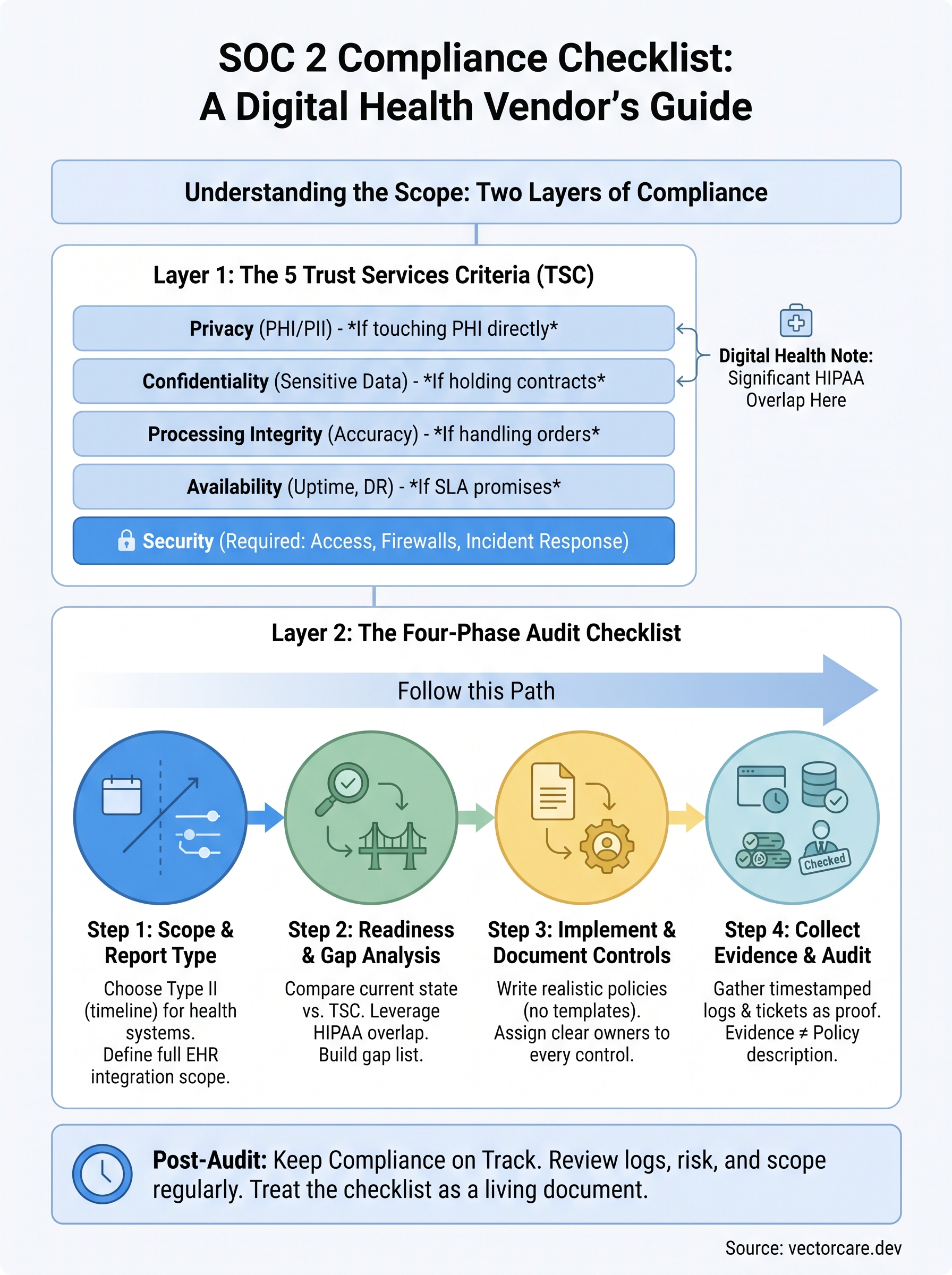
A real SOC 2 compliance checklist breaks down into two layers: the Trust Services Criteria auditors evaluate, and the project phases you run to get there. Skip either layer and you'll either miss controls or run the project blind. Most vendors only think about the first layer until an auditor sends back a list of gaps three weeks before their target close date.
The five Trust Services Criteria
Every SOC 2 report covers Security by default, plus whichever of the five Trust Services Criteria categories fit your product. Here's how they break down:
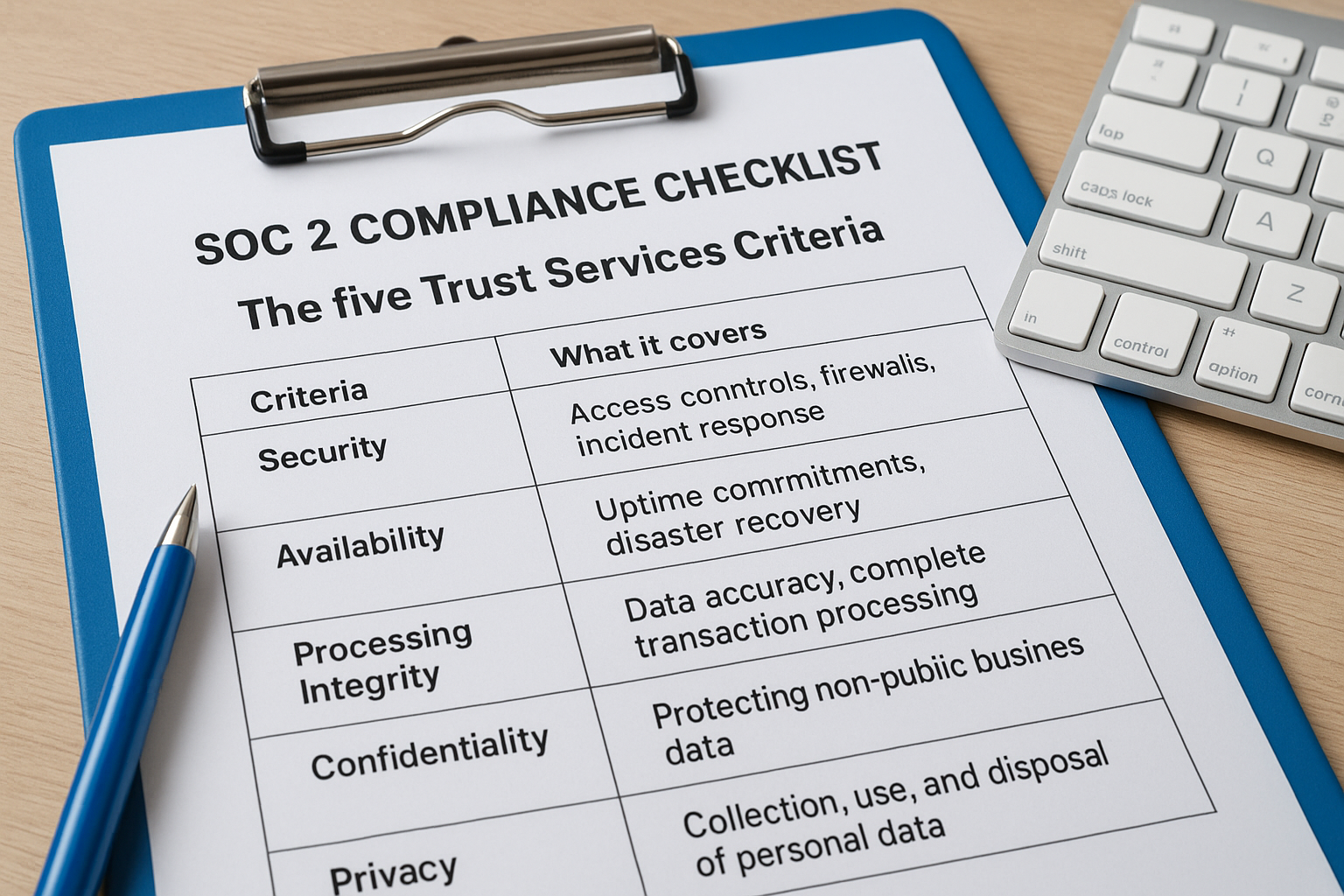
| Criteria | What it covers | Required? |
|---|---|---|
| Security | Access controls, firewalls, incident response | Always |
| Availability | Uptime commitments, disaster recovery | If your SLA promises uptime |
| Processing Integrity | Data accuracy, complete transaction processing | If you handle orders or claims |
| Confidentiality | Protecting non-public business data | If you hold sensitive contracts |
| Privacy | Collection, use, and disposal of personal data | If you touch PHI or PII directly |
A SOC 2 report only proves what you scoped it to prove, so scoping mistakes cost more than missing controls.
The four phases of the checklist
Beneath those criteria sits the audit preparation checklist itself: scoping, readiness, implementation, and evidence collection. Digital health vendors usually add a fifth layer here, since HIPAA compliance requirements overlap with SOC 2's Privacy and Confidentiality criteria but aren't identical. Treating them as one exercise saves real time.
Organizing your work this way keeps your team from duplicating effort across two frameworks. The next four sections walk through each phase in the order your auditor will actually expect to see it executed.
Step 1. Choose your report type and scope
Start by deciding between a SOC 2 Type I and a SOC 2 Type II report. Type I checks whether your controls are designed correctly on a single date. Type II tests whether those controls actually operated over a window, usually three to twelve months. Health system procurement teams almost always want Type II, so if that's your buyer, skip Type I and save the audit budget for the report they'll actually accept.
Picking Type II from day one avoids paying for two audits when only one was ever going to close the deal.
Scope comes next, and this is where healthcare vendors trip up. Your audit scope needs to name every system that touches patient data flowing to or from EPIC, not just your production app, so map out how your Epic EHR integration is built first. Walk through this list before you sign an auditor:
- Which services store or transmit PHI
- Which cloud regions and subprocessors are in scope
- Whether your EPIC integration layer counts as a subservice organization
Getting scope wrong here means redoing evidence collection later.
Step 2. Run a readiness assessment and close gaps
Before an auditor ever sees your environment, run your own readiness assessment against the Trust Services Criteria you scoped in Step 1. This is a gap analysis, not the audit itself. You're comparing what you actually do today against what a SOC 2 auditor expects to find, and writing down every mismatch before it becomes a finding.
Build your gap list
Grab your SOC 2 audit checklist and score each control area honestly:
- Access management: are offboarded employees actually removed from systems the same day?
- Vendor management: do you have signed agreements and risk reviews for every subprocessor touching PHI?
- Change management: is code review mandatory, or does it happen "most of the time"?
- Incident response: has anyone actually run a tabletop exercise in the last twelve months?
A gap you find in Step 2 costs a policy update. The same gap found by your auditor costs a delayed launch date.
Healthcare vendors often discover their HIPAA risk assessment already covers half this ground. Cross-reference it before building new documentation from scratch, since duplicating work here is the single biggest time sink in early-stage compliance projects.
Step 3. Implement and document your controls
Once your gap list is final, fix each item and write it down as you go. Auditors don't grade intentions, they grade documented controls that already existed before the audit window opened. If you fix an access issue in month three of a twelve-month Type II window, that control only proves itself for the remaining nine months.
Write policies that match reality
Don't copy a generic template and call it done. Your security policies and procedures need to describe what your team actually does, because auditors interview staff and compare answers against the written policy. Cover at minimum:
- Access control and offboarding procedures
- Change management and code review steps
- Incident response roles and escalation paths
- Vendor risk review cadence
- Data retention and disposal rules
A policy nobody follows is worse than no policy at all, since it hands your auditor a documented gap.
Assign an owner to every control
Each control needs one named owner, not a department. When an auditor asks who approved a vendor contract or reviewed a firewall rule change, "the security team" isn't an answer that survives testing.
Step 4. Collect evidence and complete the audit
Once your controls have run long enough to generate a track record, start pulling audit evidence for every item on your checklist. Evidence means screenshots, exported logs, signed tickets, and system reports that prove a control operated on a specific date, not a policy document describing what should happen. An auditor testing offboarding wants the actual deprovisioning ticket from HR and IT, timestamped within a day of the employee's last day.

Evidence without a timestamp is just a claim, and claims don't survive a Type II audit.
Build your evidence request list
Work through these categories before your auditor fieldwork begins:
- Access logs and quarterly access reviews
- Vendor contracts and risk assessment records
- Change management tickets tied to production deploys
- Incident response tickets, including any tabletop exercise notes
- Training completion records for every employee
Organize evidence by control number, not by department, since that's how your auditor will request it. Once fieldwork wraps, your auditor drafts the report, you review it for factual accuracy, and you receive your final SOC 2 report ready to hand to health system procurement teams asking for proof alongside your HIPAA documentation.
Keeping your compliance on track after the audit
Getting your SOC 2 report doesn't end the work. Your Type II window keeps running, and next year's auditor will expect the same documented controls operating without gaps. Assign someone to review access logs and vendor risk on a set schedule, not whenever an audit deadline forces it. Treat your checklist as a living document, updating it every time you add a subprocessor, change your EPIC integration, or onboard a new employee.
For healthcare vendors, the harder problem usually isn't SOC 2 itself, it's building and maintaining the actual EPIC-connected app that SOC 2 is protecting. Every custom integration adds more surface area to secure, document, and re-test. If you'd rather skip months of engineering work and compliance overhead on the integration layer itself, build and deploy your SMART on FHIR app with VectorCare and launch on EPIC's Showroom in weeks, with HIPAA and SOC 2 requirements handled from day one.
The Future of Patient Logistics
Exploring the future of all things related to patient logistics, technology and how AI is going to re-shape the way we deliver care.
Thank you! Your submission has been received!
Oops! Something went wrong while submitting the form.