SOC 2 Compliance Audit: What It Is And How It Works

If a health system or enterprise buyer just asked you for your SOC 2 report, you're not alone. Almost every serious healthcare or B2B SaaS deal now stalls until you can prove your security controls actually work. A soc 2 compliance audit is the formal way you prove that, and it's become table stakes for closing deals with hospitals, health systems, and enterprise clients who won't sign a contract without one.
This article walks through exactly what a SOC 2 audit covers, who performs it, and how the process actually runs from scoping to final report. You'll see the difference between a Type 1 and Type 2 report, what auditors check during fieldwork, and roughly how long the whole thing takes. We'll also cover the five Trust Services Criteria auditors evaluate, so you know which ones apply to your business before you start.
We wrote this from the perspective of healthcare vendors building EPIC integrations, where SOC 2 and HIPAA compliance aren't optional; they're what lets your app into clinical workflows in the first place. By the end, you'll know exactly what evidence to gather, what mistakes delay audits, and how to walk into your first assessment prepared instead of scrambling.
Why a SOC 2 compliance audit matters for your business
Enterprise buyers stopped taking vendors at their word years ago. Health systems, hospital IT departments, and large health tech companies now bake security review checkpoints directly into their procurement process, and a SOC 2 report is usually the first document their legal or IT security team asks for. Without it, your sales cycle doesn't slow down, it stops. Deals sit in limbo while a prospect's security team waits for evidence you can't produce, and eventually they move on to a competitor who already has the paperwork.

Getting a SOC 2 report done isn't about checking a compliance box for its own sake. It's about removing the single biggest bottleneck in enterprise sales for healthcare and B2B SaaS companies. Once a soc 2 compliance audit is complete, you hand over a report instead of answering a 40-page security questionnaire from scratch every time a new prospect asks. That alone can shave weeks off a sales cycle.
A SOC 2 report doesn't just prove you're secure, it proves you're sellable to buyers who require security proof before they'll sign.
What happens when you skip it
Companies that put off SOC 2 usually learn the hard way that it costs more to delay than to prepare early. Sales teams end up filling out custom security questionnaires for every deal, which eats engineering time that should go toward building the product. Procurement teams at hospitals and health systems often have a hard rule: no signed BAA or contract without a current SOC 2 Type 2 report on file. If you're building anything that touches patient data or plugs into an EPIC workflow, this isn't a soft preference, it's a hard gate.
Here's what tends to happen to vendors without a report in hand:
- Deals stall in legal review for months while security teams wait on documentation that doesn't exist yet.
- Sales reps improvise answers to security questions instead of pointing to an independent, audited report.
- Competitors with a SOC 2 report win the deal simply because they removed the friction first.
- Engineering gets pulled into ad hoc security reviews instead of shipping features, over and over, for every new prospect.
What the report actually proves to buyers
A SOC 2 report tells a buyer that an independent, licensed CPA firm examined your actual controls, not just your policies on paper, and confirmed they work the way you say they do. That distinction matters. Plenty of vendors can write a nice-looking security policy. Far fewer can produce a report from an outside auditor confirming that access controls, encryption, monitoring, and incident response actually function as designed over a real period of time.
Buyers read a SOC 2 report as a signal of operational maturity, not just security. It tells them you have defined processes for onboarding and offboarding employees, that you track who has access to sensitive systems, that you have a real incident response plan instead of a document nobody has read, and that someone outside your company verified all of it. For a health system evaluating a dozen vendors for the same clinical problem, that signal often decides who gets a meeting and who gets a form rejection.
Why this is non-negotiable in healthcare integrations
Healthcare adds a layer most B2B software categories don't deal with. If your app connects to EPIC, pulls patient data through FHIR, or touches anything covered by HIPAA, health system security teams will not move forward without both a SOC 2 report and a signed BAA. This isn't optional paperwork, it's a prerequisite baked into how hospital IT and compliance departments are structured. You can have the best clinical workflow tool on the market, but if you can't produce a SOC 2 Type 2 report, most health system procurement teams won't even schedule a technical demo.
That's also why the audit matters beyond sales. It forces you to actually build the controls that keep patient data safe, which protects you from breaches, fines, and the reputational damage that follows a security incident in healthcare. The audit is the proof, but the underlying discipline it requires is what actually keeps you, and your customers' patients, safe.
How the SOC 2 audit process works from start to finish
A soc 2 compliance audit isn't a single event, it's a sequence of phases that stretch over weeks or months depending on the report type you're pursuing. Most vendors move through four distinct stages: scoping, readiness assessment, fieldwork, and report delivery. Skipping or rushing any one of these phases is usually what turns a straightforward audit into a six-month scramble, so it helps to know what happens at each step before you sign an engagement letter with an audit firm.
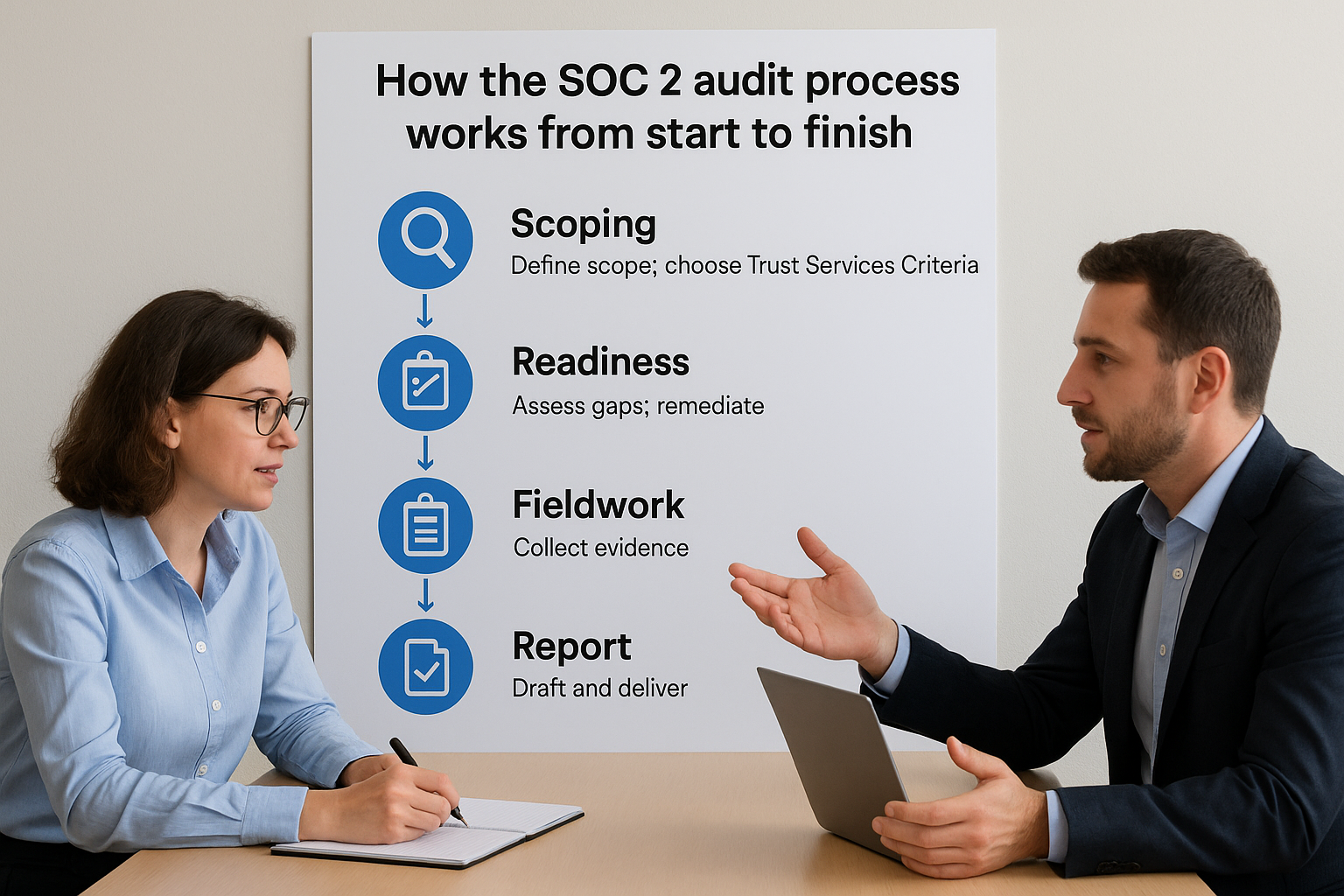
Step 1: Scoping and choosing your criteria
Before any testing begins, you and your auditor agree on which Trust Services Criteria apply to your systems and which parts of your business fall inside the audit boundary. Healthcare vendors almost always include Security as a baseline, then add Availability and Confidentiality if they're hosting patient data or guaranteeing uptime for clinical workflows. Scoping also decides your report type, meaning whether you're going for a point-in-time Type 1 snapshot or a Type 2 report that tests controls over a period, typically three to twelve months.
- Define the systems, applications, and infrastructure in scope
- Select applicable Trust Services Criteria beyond Security
- Choose Type 1 or Type 2 based on buyer requirements
- Set the observation window if pursuing Type 2
Step 2: Readiness and gap remediation
Once scope is locked, most companies run a readiness assessment, either internally or with the auditor, to find gaps before formal testing starts. This is where you discover the access reviews you forgot to document, the incident response plan that's never been tested, or the vendor risk assessments nobody updated in a year. Fixing these gaps now costs a fraction of what it costs to fail an audit test later and restart the clock.
The readiness phase is where audits are actually won or lost, not during the auditor's fieldwork.
Step 3: Fieldwork and evidence collection
Fieldwork is where the auditor examines your actual evidence: system logs, access control lists, encryption configurations, HR onboarding records, and incident tickets. For a Type 2 report, they sample evidence across the entire observation period, not just a single day, to confirm controls operated consistently. Expect the auditor to interview your engineering and security leads, request screenshots of live configurations, and cross-check your documented policies against what your systems actually do.
Step 4: Report drafting and delivery
After testing wraps, the auditor drafts findings and issues either a clean opinion or one with noted exceptions, depending on what fieldwork uncovered. You'll get a chance to review the draft and respond to any exceptions before the final report is issued, so this stage is rarely a surprise if you've been communicating with your auditor throughout. The AICPA sets the professional standards auditors follow when forming this opinion, which is why buyers trust the report as independent verification rather than self-reported compliance.
Who can perform a SOC 2 audit and how to choose one
Only a licensed CPA firm can issue a SOC 2 report. This isn't a general compliance certification that any consultant can sign off on. The AICPA restricts SOC 2 attestation to CPA firms because the report is a formal audit opinion, governed by the same professional standards that apply to financial audits. A consultant can help you prepare, build policies, or run a readiness assessment, but they cannot be the entity that issues your final report. If a vendor offers to "certify" you for SOC 2 without CPA licensure, that report won't hold up when a health system's security team checks credentials.
If the firm issuing your report isn't a licensed CPA firm, buyers will treat the report as worthless.
What to look for in an audit firm
Not every CPA firm that does SOC 2 work understands healthcare or EPIC integrations, and that gap shows up during fieldwork. Auditors unfamiliar with FHIR data flows or clinical workflow tools often ask the wrong questions or misjudge what evidence actually matters, which slows everything down. Look for a firm with a track record auditing health tech vendors, not just generic SaaS companies, since the control expectations around patient data differ from a typical B2B app.
- CPA licensure and AICPA affiliation, confirmed directly rather than taken on faith
- Healthcare or health tech audit experience, ideally with vendors integrating into EHR systems
- Realistic timeline estimates, not vague promises of a rushed turnaround
- Clear communication during fieldwork, since a responsive auditor prevents delays
- Transparent, itemized pricing, so you know what you're paying for before signing
Questions to ask before signing an engagement letter
Treat the selection process like hiring a vendor, because that's exactly what it is. Ask how many healthcare clients they've audited in the past year, how they handle Type 2 sampling across a long observation window, and what their typical turnaround looks like from fieldwork completion to report delivery. A good firm answers these questions with specifics, not general reassurances.
Sample questions for prospective audit firms:
1. How many SOC 2 audits have you completed for healthcare or health tech vendors?
2. What's your average timeline from kickoff to final report for a Type 2 audit?
3. Do you have direct experience auditing companies with FHIR or EPIC integrations?
4. How do you handle evidence sampling across a 6-12 month observation period?
5. What does your pricing structure look like, and what's included versus billed separately?
Watch for conflicts of interest
Independence matters as much as competence. The firm auditing your controls cannot also be the firm that designed or implemented those controls, since that creates a direct conflict with the independence rules auditors are bound by. Some vendors use a compliance automation platform to manage evidence collection and policy management, then hire a separate, independent CPA firm to perform the actual audit, which keeps the two functions cleanly separated. If a firm offers to both build your security program and audit it, that arrangement should raise a flag before you sign anything, regardless of how convenient it sounds.
SOC 2 Type 1 vs Type 2 audits: what's the difference
A Type 1 report tells you whether your controls are designed correctly as of a single date. A Type 2 report tells you whether those same controls actually operated correctly over a stretch of time, usually three to twelve months. That distinction sounds small, but it changes what an auditor tests, how long the engagement takes, and how much weight buyers give the final report. Most healthcare vendors treat Type 1 as a stepping stone and Type 2 as the report that actually closes deals.
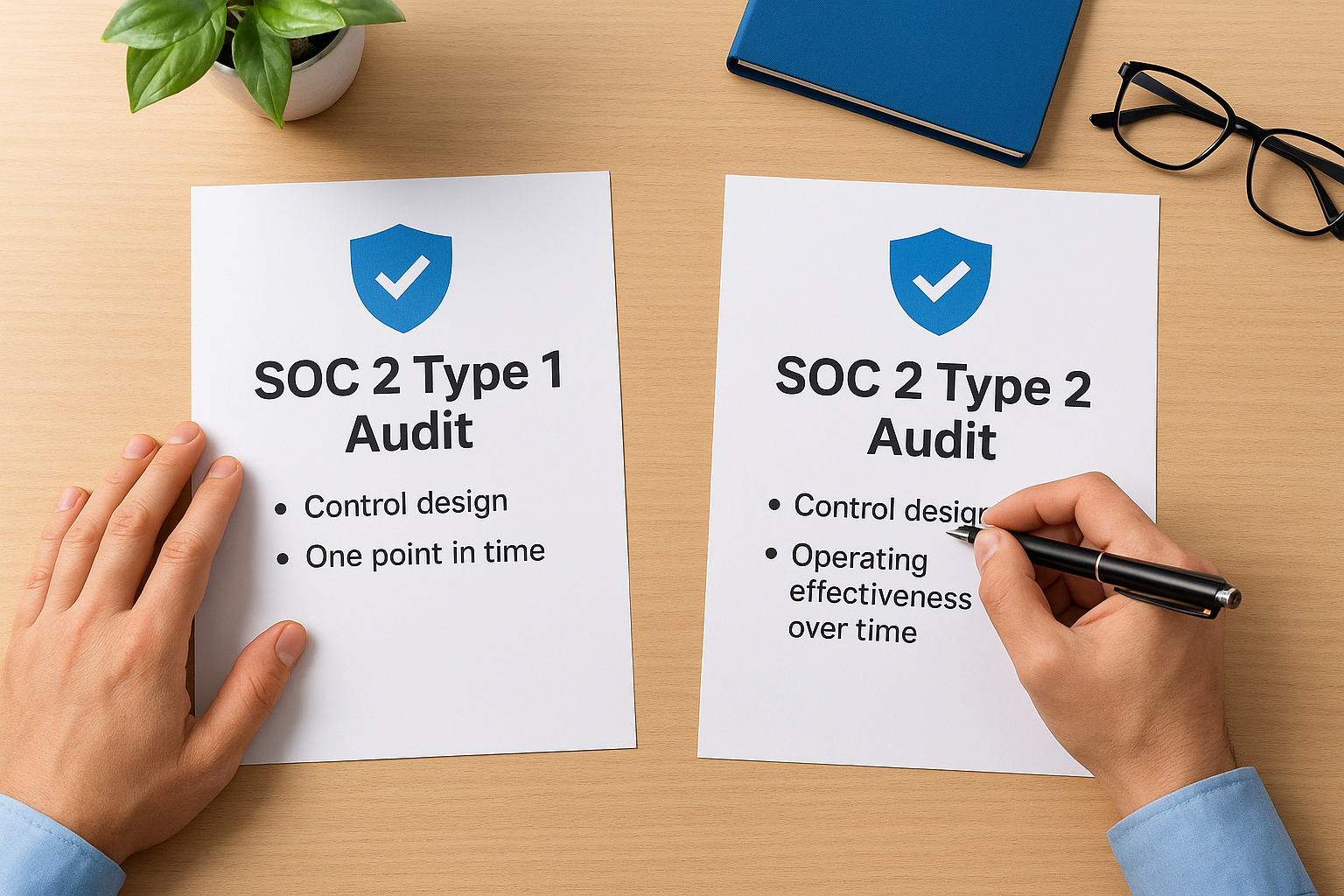
A Type 1 report proves your controls exist. A Type 2 report proves they work.
What a Type 1 report actually covers
Think of Type 1 as a snapshot. The auditor reviews your policies, system configurations, and control design on one specific day and issues an opinion on whether those controls are suitable to meet the relevant Trust Services Criteria. It's faster to complete, often finishing in a matter of weeks once evidence is ready, and it's useful if you need something to show prospects while you build toward a full Type 2 engagement. But a snapshot can't tell anyone whether your access reviews happened every month or whether your incident response plan ever got tested against a real event.
What a Type 2 report actually covers
Type 2 is where the real proof lives, because it examines whether controls operated consistently across an observation window rather than just existing on paper for one day. Auditors pull samples throughout that period: access logs from multiple months, a handful of onboarding and offboarding records, incident tickets if any occurred, and change management approvals. That sampling approach is exactly why health systems and enterprise security teams almost always ask for Type 2 specifically. It answers the question they actually care about: did this vendor's security program hold up over time, not just on the day someone cleaned up the evidence folder.
| Factor | Type 1 | Type 2 |
|---|---|---|
| What's tested | Control design, one point in time | Control design and operating effectiveness over time |
| Typical duration | Days to a few weeks of fieldwork | 3 to 12 month observation period plus fieldwork |
| Buyer perception | Acceptable as a starting point | Preferred, often required by health systems |
| Best for | New companies proving initial readiness | Vendors closing enterprise or healthcare deals |
| Evidence style | Point-in-time documentation | Samples pulled across the entire window |
Which one you actually need
If you're a healthcare vendor negotiating with a hospital or health system, assume they want a Type 2 report before you even ask. Procurement teams have seen enough vendors lean on a Type 1 report as a placeholder that many now write Type 2 directly into their vendor security requirements. A Type 1 can still buy you time early on, letting you tell prospects a Type 2 is already underway, but don't plan your roadmap around Type 1 as an end state. Budget for the full observation period from the start, because the moment a buyer's security team sees "Type 1" on your report, the next question is almost always "when's Type 2 ready?"
The trust services criteria auditors evaluate
Every soc 2 compliance audit gets measured against a set of standards called the Trust Services Criteria, published and maintained by the AICPA. There are five categories total, but you don't need all five to get a valid report. You pick the ones that match what your systems actually do and what your buyers actually care about, then your auditor tests controls against only those categories. Understanding what each one covers helps you scope your audit correctly instead of paying for testing you don't need.
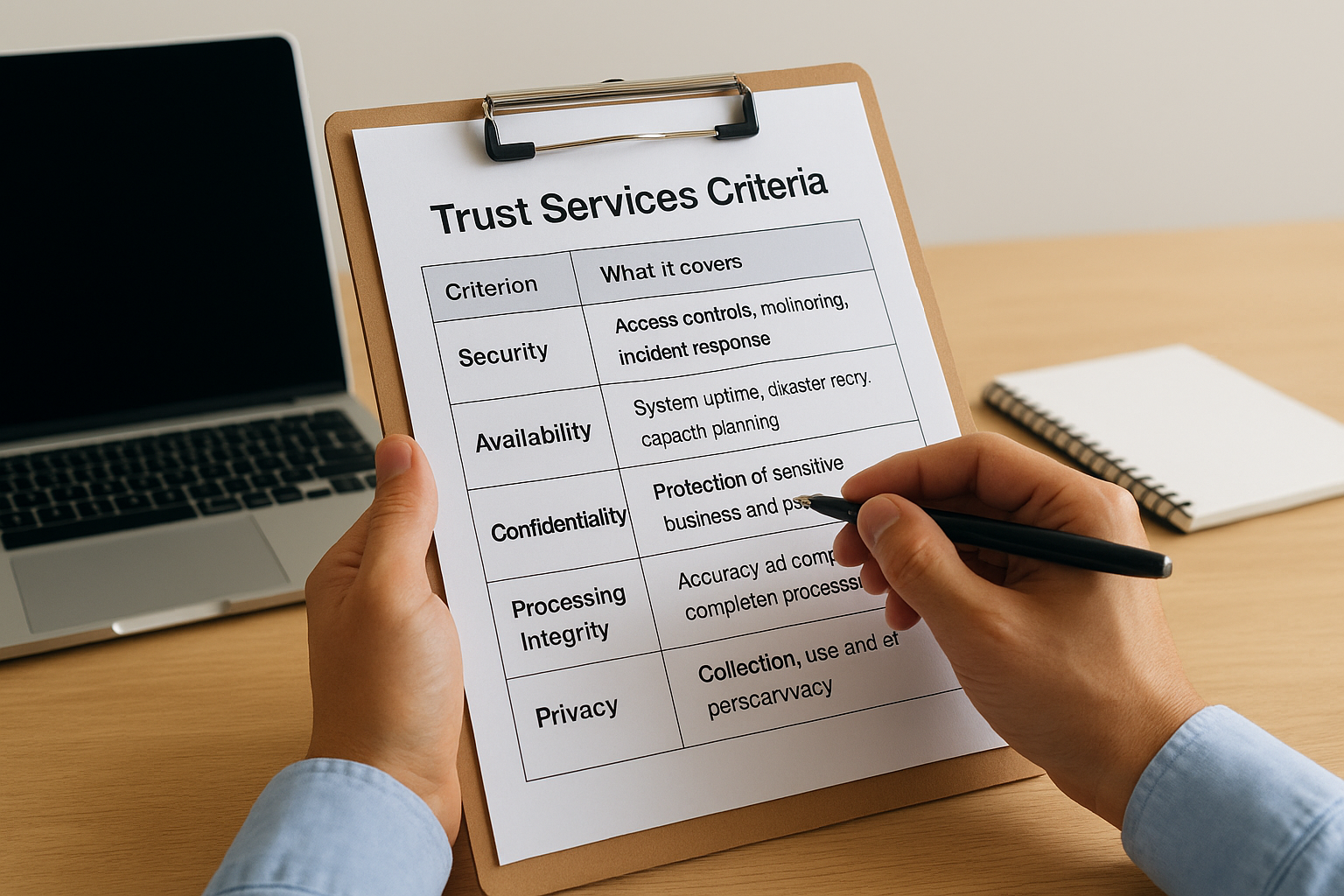
Security is the one you can't skip
Security, sometimes called the Common Criteria, is mandatory for every SOC 2 report regardless of industry. It covers access controls, network protections, change management, and how you detect and respond to incidents. Auditors check whether you enforce multi-factor authentication, whether former employees actually lose access on their last day, and whether your logging setup would catch something going wrong. No health system will accept a report missing this category, since it's the foundation every other criterion builds on.
Security is the floor every SOC 2 report has to clear. Everything else depends on what your buyers demand.
The four optional criteria and when you need them
Beyond Security, you add criteria based on what your product does and what your contracts promise. Availability matters if you're guaranteeing uptime for a clinical workflow tool. Confidentiality matters if you're handling sensitive data under an NDA or contract. Processing Integrity applies if your system performs calculations or transactions buyers rely on being accurate. Privacy applies if you're collecting personal information directly from individuals, which is less common for backend health tech vendors than you'd expect.
| Criterion | What it covers | Who typically needs it |
|---|---|---|
| Security | Access controls, monitoring, incident response | Every SOC 2 report, no exceptions |
| Availability | System uptime, disaster recovery, capacity planning | Vendors promising SLAs or continuous clinical access |
| Confidentiality | Protection of sensitive business and patient data | Vendors handling PHI or contractually confidential data |
| Processing Integrity | Accuracy and completeness of system processing | Vendors performing calculations, orders, or transactions |
| Privacy | Collection, use, and disposal of personal information | Vendors collecting PII directly from individuals |
What healthcare vendors typically need
For most EPIC-integrated applications, the practical answer is Security plus Availability and Confidentiality. Availability covers the reasonable expectation that your app won't go down mid-shift when a clinician needs it. Confidentiality covers the patient data flowing through your FHIR connections, which health system security teams will ask about directly. Processing Integrity comes into play if your app makes clinical calculations, dosage recommendations, or routing decisions that need to be provably accurate. Privacy shows up less often here since most healthcare vendors interact with data through the health system rather than collecting it straight from patients, but it's worth confirming with your auditor before you finalize scope.
How to prepare for a SOC 2 audit: a step-by-step checklist
Most vendors underestimate how much groundwork a soc 2 compliance audit requires before an auditor ever looks at a single log file. The companies that pass on the first try treat preparation as a project with owners and deadlines, not a folder of policies assembled the week before fieldwork starts. Build your checklist around the actual controls an auditor will test, not just the paperwork that looks good in a binder.
Preparation determines whether your audit takes six weeks or six months, not the auditor's schedule.
Build your control environment first
Start with the systems that touch sensitive data and the access controls around them, since that's where auditors spend the most time. You need documented policies that match what actually happens day to day, not aspirational versions written for the audit alone. Access management and change control are the two areas that trip up the most first-time vendors, because teams often skip documenting the review cadence even when the reviews themselves happen.
- Document access control policies and confirm they match reality across every system in scope
- Set up centralized logging so you can produce evidence without manual digging later
- Formalize a change management process for code and infrastructure changes
- Write an incident response plan and actually run a tabletop exercise against it
- Complete vendor risk assessments for every third party touching sensitive data
Run a gap assessment before the auditor does
A readiness assessment, whether internal or led by a consultant, exposes weak spots while you still have time to fix them cheaply. This step matters more for Type 2 engagements, since a gap discovered three months into your observation period can force you to restart the clock on that specific control. Treat every gap you find as a small project with a deadline, not a note for later, because
SOC 2 audit costs and timelines to expect
Budgeting for a soc 2 compliance audit means accounting for more than the auditor's invoice. Total cost includes the CPA firm's fee, any compliance automation software you use to manage evidence, and the internal time your team spends pulling logs and answering auditor questions. Vendors who only budget for the audit fee itself almost always underestimate the real cost by a wide margin, then get surprised when engineering time disappears into evidence requests for weeks.
Pricing varies by company size, scope, and how many Trust Services Criteria you include, but most healthcare vendors fall into a fairly predictable range. A Type 1 audit typically costs less and moves faster since there's no observation period to sample against. A Type 2 audit costs more because the auditor is testing evidence across months, not a single snapshot, and that extra sampling work shows up directly in the invoice.
| Factor | Type 1 estimate | Type 2 estimate |
|---|---|---|
| CPA audit fee | $10,000 to $30,000 | $20,000 to $60,000+ |
| Readiness/consulting support | $5,000 to $15,000 | $10,000 to $25,000 |
| Compliance software (annual) | $5,000 to $15,000 | $5,000 to $15,000 |
| Total timeline | 4 to 8 weeks | 6 to 12 months including observation window |
| Internal hours required | Moderate | Significant, spread across months |
Budget for the full observation period and the internal labor it takes, not just the auditor's invoice.
Why Type 2 timelines stretch so much longer
Most of the extra time in a Type 2 engagement comes from the observation window itself, not the fieldwork. If you choose a twelve-month window, the auditor literally cannot issue a report until twelve months of evidence exists to sample from. Shorter windows of three to six months get you a report faster, but some buyers, particularly larger health systems, expect at least six months of history before they'll treat the report as meaningful. Plan your window length around your sales pipeline, since a report that arrives after the deal you needed it for is a report that arrived too late.
Hidden costs vendors forget to budget for
Several costs show up only after the engagement starts, and they catch first-time vendors off guard almost every time:
- Remediation work for gaps found during readiness, which can mean new tooling, not just policy updates
- Staff time spent gathering evidence, answering auditor interviews, and documenting processes that were previously informal
- Re-testing fees if a control fails during fieldwork and needs correction before the report can be finalized
- Annual renewal costs, since a SOC 2 report isn't a one-time achievement, buyers expect a current report every twelve months
Renewal is the cost most vendors forget entirely. Once you have a Type 2 report, health systems and enterprise buyers expect a fresh one annually, which means the audit cycle repeats every year rather than ending once you clear the first report. Factor that recurring cost into your compliance budget the same way you'd factor in any other fixed operating expense, because skipping a renewal puts you right back where you started with buyers.

Turning your SOC 2 report into next steps
A SOC 2 report isn't the finish line, it's the credential that gets you past the gatekeepers who control whether your app ever reaches a clinician. You now know what auditors test, who's qualified to issue the report, and what it actually costs to get one done right. The vendors who treat this as a sales enabler rather than a compliance chore are the ones who close health system deals faster than competitors still fumbling through security questionnaires.
If you're building toward EPIC integration, SOC 2 is only one piece of the puzzle. You still need SMART on FHIR compliance, a signed BAA, and an EPIC Showroom listing before your app touches a real clinical workflow. That's exactly the technical heavy lifting VectorCare handles for healthcare vendors. Build and deploy your SMART on FHIR app in days instead of months, with compliance already built in.
The Future of Patient Logistics
Exploring the future of all things related to patient logistics, technology and how AI is going to re-shape the way we deliver care.
Thank you! Your submission has been received!
Oops! Something went wrong while submitting the form.