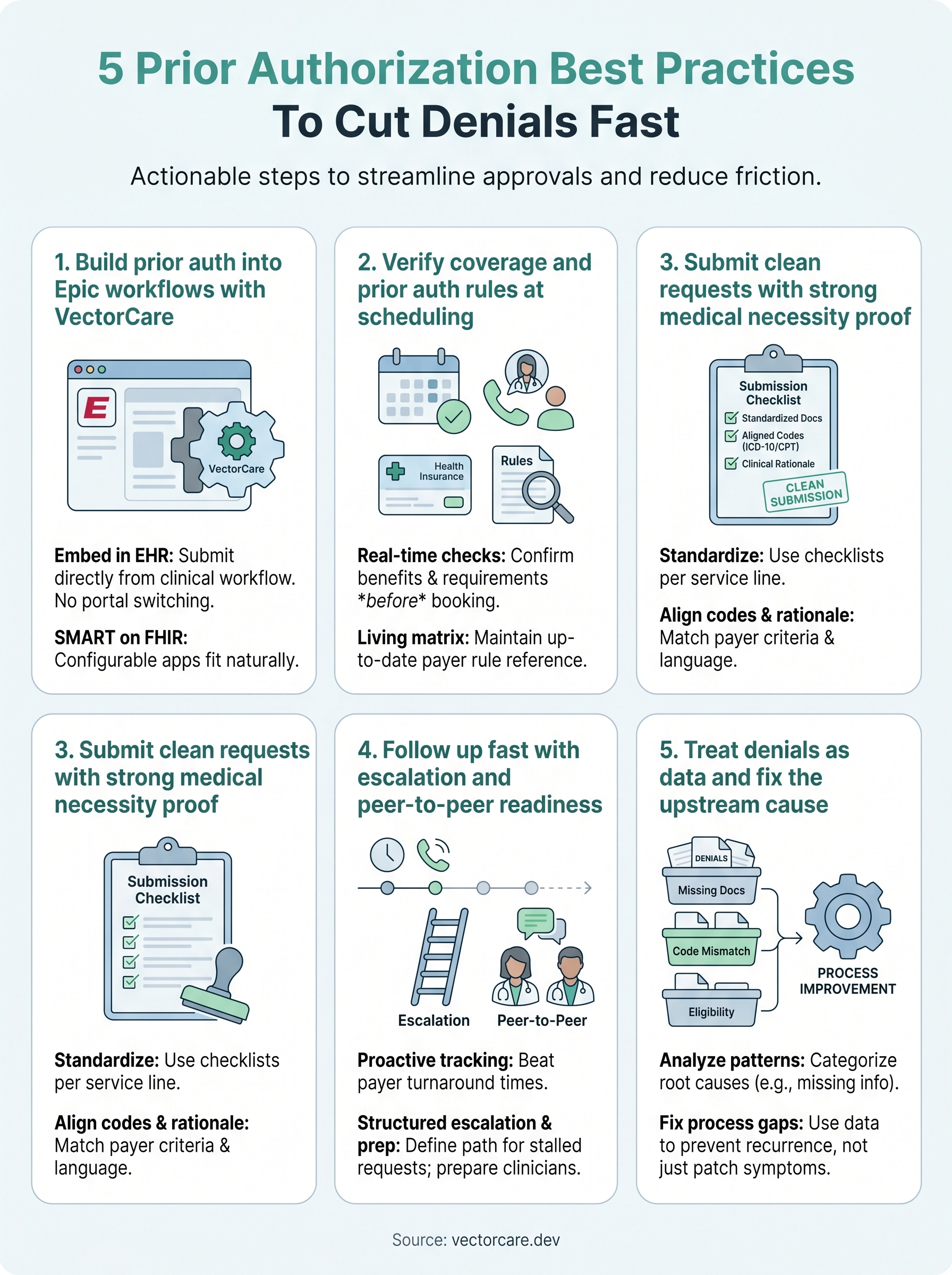
5 Prior Authorization Best Practices To Cut Denials Fast

Prior authorization eats time. The average practice spends roughly 14 hours per week on prior auth tasks, and nearly one in three claims faces delays or denials due to missing documentation, coding errors, or slow payer responses. For healthcare vendors building solutions that touch clinical workflows, understanding prior authorization best practices is essential, it's the difference between a product that health systems actively adopt and one that never gains traction.
Denials tied to prior auth failures cost providers billions each year and burn out clinicians who'd rather spend their time on patient care. If your product integrates with EPIC, the prior authorization workflow is one of the first places you need to demonstrate real value. That means embedding the solution directly into the EHR, not layering it on as a disconnected tool. At VectorCare, we help healthcare vendors build and deploy SMART on FHIR applications within EPIC, including prior auth workflows, using a no-code platform that cuts months of development down to weeks.
Below, you'll find five actionable practices that reduce prior authorization denials, streamline approvals, and help your solution become something health systems rely on daily. Each one is designed to be implemented quickly, whether you're refining an existing workflow or building one from scratch.
1. Build prior auth into Epic workflows with VectorCare
Building prior authorization directly into EPIC removes the friction that causes most denials. When clinicians submit requests from within the EHR, they work with the data they already have rather than re-entering it into a separate portal. VectorCare's no-code platform lets you configure SMART on FHIR applications that sit inside EPIC, turning prior auth from a disconnected administrative task into a step that fits naturally inside the existing clinical workflow.
Map your prior auth workflow from order to approval
Start by documenting every step in your current process, from the moment a provider places an order to the point where a payer approves or denies it. Identify where handoffs happen and where requests stall. VectorCare's visual workflow builder lets you translate that map into a working EPIC integration, so each step is clearly assigned, tracked, and visible to the right team member.

Capture required clinical data at the point of care
One of the core prior authorization best practices is collecting clinical documentation before the request leaves the building. Pre-built FHIR actions in VectorCare pull patient data directly from the EPIC record, so staff aren't chasing notes or calling providers after the fact. You configure exactly which fields trigger data capture, reducing the chance of submitting an incomplete request.
Incomplete submissions are the single most preventable cause of prior auth denials.
Automate routing, status updates, and handoffs
Once a request is submitted, automated routing rules move it to the right reviewer, notify the right team member, and update status without manual follow-up. You set the logic once inside VectorCare's drag-and-drop builder, and the workflow handles every subsequent request the same way without additional configuration.
Reduce errors with standardized fields and validations
Standardized input fields and built-in validations catch missing codes, incomplete diagnoses, and mismatched data before submission. You define required fields per service line, and VectorCare enforces them at the point of entry, stopping avoidable errors before they reach the payer.
Keep HIPAA and SOC2 controls aligned during build and launch
VectorCare builds HIPAA and SOC2 compliance into every application, including Business Associate Agreements. Your prior auth workflow launches with the security controls health systems require, so you skip a separate compliance review and go live faster.
2. Verify coverage and prior auth rules at scheduling
Catching coverage gaps at scheduling is one of the most overlooked prior authorization best practices. When you verify payer requirements before a patient arrives, you stop denials before they start rather than chasing approvals after a service is already rendered.
Run eligibility checks before you start the request
Run a real-time eligibility check the moment a patient books an appointment. Confirm active coverage, plan type, and prior auth requirements for the specific service before staff spend time on a request that may turn out to be invalid.
Maintain a living payer and plan requirements matrix
Build a reference document listing prior auth requirements by payer, plan, and service type, and update it every time you encounter a policy change. A current matrix prevents staff from applying outdated rules to new claims.

Payer policies change frequently, and an outdated reference sheet is as costly as no reference at all.
Flag services that need prior auth before the patient arrives
Configure your scheduling system to automatically flag services that require prior auth based on payer and service code. Flagging early gives your team enough lead time to submit a complete request and receive approval before the appointment date.
Set expectations with patients on timing and next steps
Tell patients upfront that prior auth approval is required and may affect their appointment. Setting clear expectations reduces no-shows caused by confusion and builds trust before they walk through the door.
Prevent delays caused by plan changes and outdated benefits
Verify benefits again 24 to 48 hours before the appointment, not just at initial scheduling. Plan changes and mid-year benefit shifts can invalidate an approval you received weeks earlier.
3. Submit clean requests with strong medical necessity proof
A clean submission is the single most reliable way to cut denials. When every required element is present and medical necessity is clearly documented, payers have less reason to push back and approvals move faster. Following these prior authorization best practices at the submission stage removes the most preventable friction in the entire process.
Standardize required documentation by service line
Build a checklist for each service type that lists exactly which clinical documents, notes, and test results the payer requires. Standardized checklists prevent staff from guessing what to include, and consistent submissions reduce the back-and-forth that stalls approvals.
Align ICD-10 and CPT or HCPCS codes with the request
Code mismatches are one of the most common denial triggers. Confirm that your ICD-10 diagnosis codes support medical necessity for the specific CPT or HCPCS procedure codes on the request before you submit.
A single misaligned code can invalidate an otherwise complete prior auth submission.
Include clinical rationale that matches payer criteria
Pull the payer's coverage policy before you write the clinical justification. Frame your rationale using the payer's own language and criteria, and reference relevant clinical guidelines where applicable. Your reviewers get exactly what they need to approve the request on the first pass.
Avoid the most common missing-info and mismatch denials
Review your last 30 denials and identify repeating patterns. The most fixable denial types typically fall into a short list:
- Missing attachments or supporting clinical notes
- Wrong modifier codes or incomplete provider information
- Diagnosis codes that don't support the requested service
Build templates for repeatable high-volume services
Create pre-filled submission templates for the services your team requests most often. Reusable templates cut preparation time and enforce documentation standards across every staff member who submits requests.
4. Follow up fast with escalation and peer-to-peer readiness
Waiting on payers without a structured follow-up plan is one of the most expensive habits in prior auth management. Proactive tracking and a defined escalation process are core prior authorization best practices that prevent approvals from expiring in a queue.
Set an internal follow-up cadence that beats payer timelines
Contact the payer before their published turnaround window closes, not after. Set a follow-up task at the 48-hour mark for urgent requests and at day three for standard ones so no request goes uncontacted.
Document every payer interaction for appeals and audits
Log the date, representative name, and outcome of every call and portal interaction. That record becomes your evidence if you need to appeal a denial or dispute a payer's claim that documentation was never received.
A single documented interaction can turn a denial into an approval during the appeals process.
Use a clear escalation ladder for stalled requests
Define exactly when a request moves from staff-level follow-up to supervisor escalation to formal expedited review. A written escalation ladder removes the guesswork and keeps stalled cases moving forward.
Prepare clinicians for peer-to-peer reviews with a script
Give your providers a one-page talking guide covering the clinical rationale, relevant guidelines, and likely payer objections before they get on the call.
Track turnaround times to target the worst bottlenecks
Monitor average approval time by payer and service type so you can direct follow-up resources to the requests that consistently run long.
5. Treat denials as data and fix the upstream cause
Every denial carries information about a process gap you can fix. Reviewing denial patterns systematically is one of the most valuable prior authorization best practices you can adopt, because it turns reactive damage control into targeted process improvement that prevents the same denial from recurring.
Categorize denial reasons into actionable buckets
Sort denials into clear categories: missing documentation, code mismatches, eligibility failures, and medical necessity rejections. Grouping by type tells you exactly which part of your workflow needs attention rather than spreading effort across unrelated fixes.
Audit a sample of submissions to find preventable patterns
Pull a random sample of 20 to 30 denied requests each month and review them against your submission checklist. Most preventable denials cluster around the same two or three root causes, and a focused audit surfaces them quickly.
Fixing one recurring root cause typically eliminates more denials than addressing ten one-off issues.
Monitor first-pass approval rate and resubmission volume
Track what percentage of requests get approved on the first submission and how many require a second attempt. A rising resubmission rate signals a new documentation gap or a payer policy change you haven't incorporated into your workflow yet.
Close the loop with training and workflow updates
Share denial data directly with the staff who submit requests. Targeted training on specific patterns you identify is more effective than general refreshers and produces measurable improvement faster.
Build dashboards that tie prior auth work to revenue and access
Connect your denial volume and approval rate metrics to revenue data so leadership sees the direct financial impact of prior auth performance and can justify the resources needed to fix it.
Put it into practice
These five prior authorization best practices work because they address the actual causes of denials rather than patching symptoms after the fact. You now have a clear path: build the workflow inside EPIC, verify coverage before the appointment, submit clean requests with solid clinical rationale, follow up on a schedule, and use denial data to fix what keeps breaking.
Start with one section. Pick the practice that matches your biggest current pain point and implement it this week. A structured follow-up cadence, a documentation checklist, or a denial audit can each produce measurable results without requiring a full process overhaul. Stack improvements over time and your first-pass approval rate will reflect it.
If you want to move faster by embedding prior auth directly into EPIC, VectorCare removes the technical barriers that slow most vendors down. Build your SMART on FHIR app with VectorCare and get your workflow live in weeks, not months.
The Future of Patient Logistics
Exploring the future of all things related to patient logistics, technology and how AI is going to re-shape the way we deliver care.
Thank you! Your submission has been received!
Oops! Something went wrong while submitting the form.