Is Google Cloud SOC 2 Compliant? Reports And Bridge Letters

If you're a healthcare vendor building applications that touch patient data, your cloud provider's security posture isn't just a technical detail, it's a deal-breaker. Health systems will ask about it. Procurement teams will demand documentation. And if you're hosting on Google Cloud Platform, the first question you need to answer is whether Google Cloud SOC 2 compliance covers your workloads and what proof you can hand over when asked.
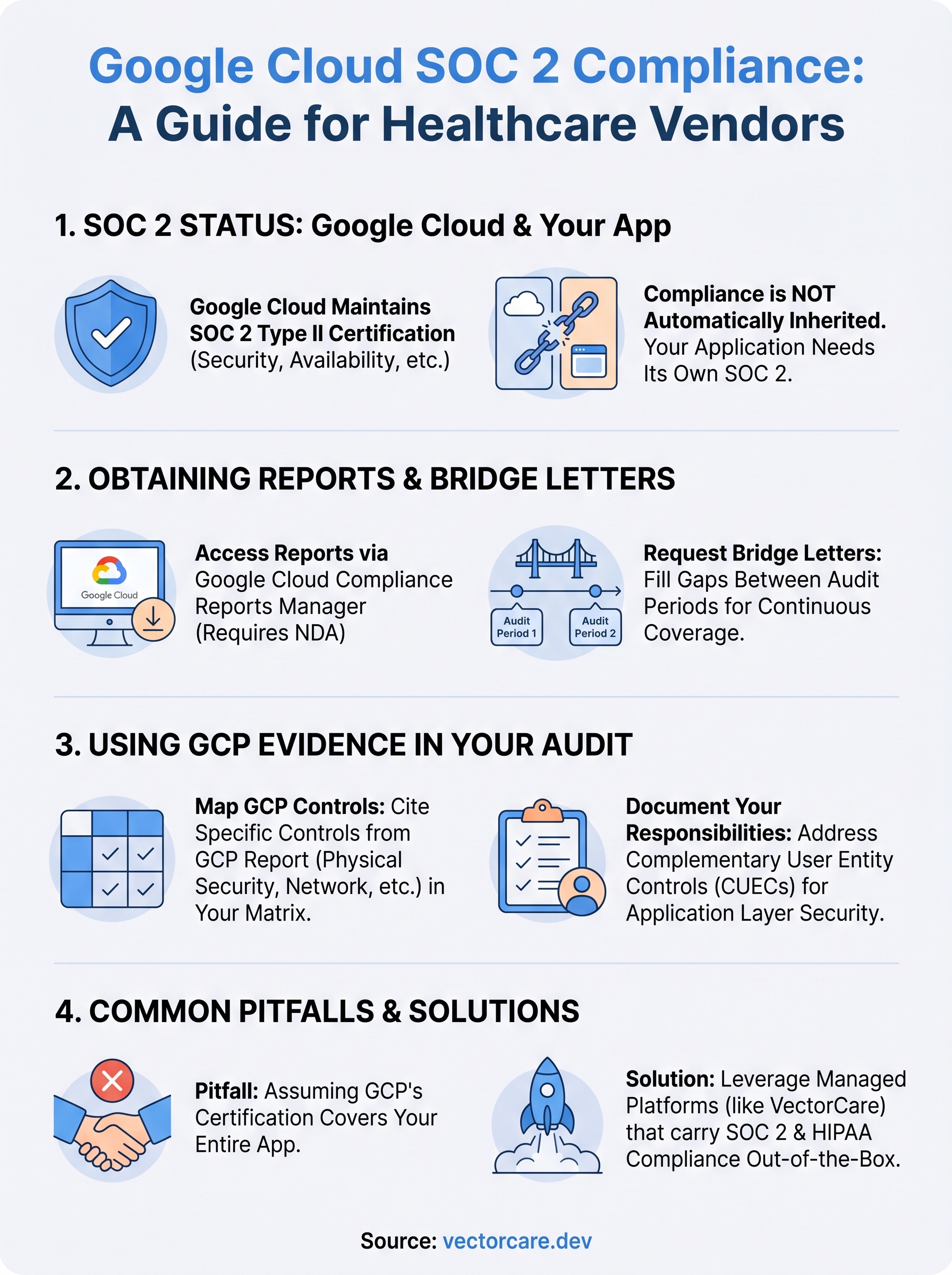
The short answer: yes, Google Cloud maintains SOC 2 Type II certification, and the reports are available to customers. But knowing that alone isn't enough. You need to understand what those reports actually cover, how to access bridge letters that fill gaps between audit periods, and, critically, where Google's compliance ends and yours begins.
That distinction matters because SOC 2 compliance isn't inherited automatically. Running your application on a compliant cloud provider doesn't make your application compliant. At VectorCare, we built our SoFaaS platform on this principle, our managed infrastructure carries its own SOC 2 and HIPAA compliance so healthcare vendors launching SMART on FHIR apps into EPIC don't have to solve that problem themselves.
This article breaks down Google Cloud's SOC 2 status, walks you through obtaining the actual audit reports and bridge letters, and explains how to use Google's security foundation as a starting point for your own compliance story, whether you're going through certification independently or working with a managed platform that handles it for you.
What Google Cloud SOC 2 compliance means
SOC 2 is an auditing standard developed by the American Institute of Certified Public Accountants (AICPA). It measures whether a service organization has controls in place that protect customer data across five Trust Services Criteria: security, availability, processing integrity, confidentiality, and privacy. A SOC 2 Type I report is a point-in-time snapshot, while a Type II report covers a period of time, typically six to twelve months, which is the one auditors and enterprise customers actually want to see.
What SOC 2 actually measures
The core of a SOC 2 audit is the security category, which every report must address. The remaining four criteria are optional, but most enterprise cloud providers include availability and confidentiality at minimum. Auditors examine whether a company's stated policies and technical controls are operating effectively across the audit period, not just whether the controls exist on paper. This is the critical difference between Type I and Type II: Type II proves the controls worked consistently over time.
A SOC 2 Type II report from a cloud provider tells you those controls were functioning throughout the audit window, which is what procurement teams and enterprise health systems need to see before signing a contract.
How Google Cloud achieved certification
Google Cloud's infrastructure undergoes annual SOC 2 Type II audits conducted by an independent third-party auditor. The audit covers a broad set of Google Cloud products and services, and Google publishes the audit scope so you can verify whether the specific services you use, such as Google Kubernetes Engine, Cloud SQL, or Cloud Storage, fall within the certified boundary. Not every product Google offers is automatically included, so checking the scope list matters before you cite GCP's report in your own compliance documentation.
Google also pursues multiple compliance frameworks simultaneously, including ISO 27001, FedRAMP, and HIPAA. That overlap means the underlying controls are well-tested and documented, which makes the SOC 2 evidence more reliable and detailed than what you'd see from a smaller provider running a single audit program.
Where your responsibility begins
Running on google cloud soc 2 certified infrastructure does not transfer compliance to your application. The shared responsibility model means Google secures the physical data centers, the hardware, and the core platform services. You own everything you build on top: your application code, your access controls, your data handling procedures, and your customer-facing security posture. If you process protected health information (PHI), that boundary becomes even more consequential, since HIPAA requirements apply to your application layer regardless of what your cloud provider covers.
Where to get Google Cloud SOC 2 reports
Google does not post its SOC 2 reports publicly. You access them through the Google Cloud Compliance Reports Manager, a self-service portal available to any customer with an active Google Cloud account. Once logged in, you can download SOC 2 Type II reports covering the current audit period and scope directly, without submitting a formal request or waiting on a sales team.
Accessing the Compliance Reports Manager
To reach the portal, log into your Google Cloud Console and navigate to the Compliance Reports section, or go directly to cloud.google.com/security/compliance/compliance-reports-manager. You will need to accept a non-disclosure agreement before downloading any report. That agreement is standard across major cloud providers and does not restrict you from sharing the report with your auditors or enterprise customers during procurement reviews.
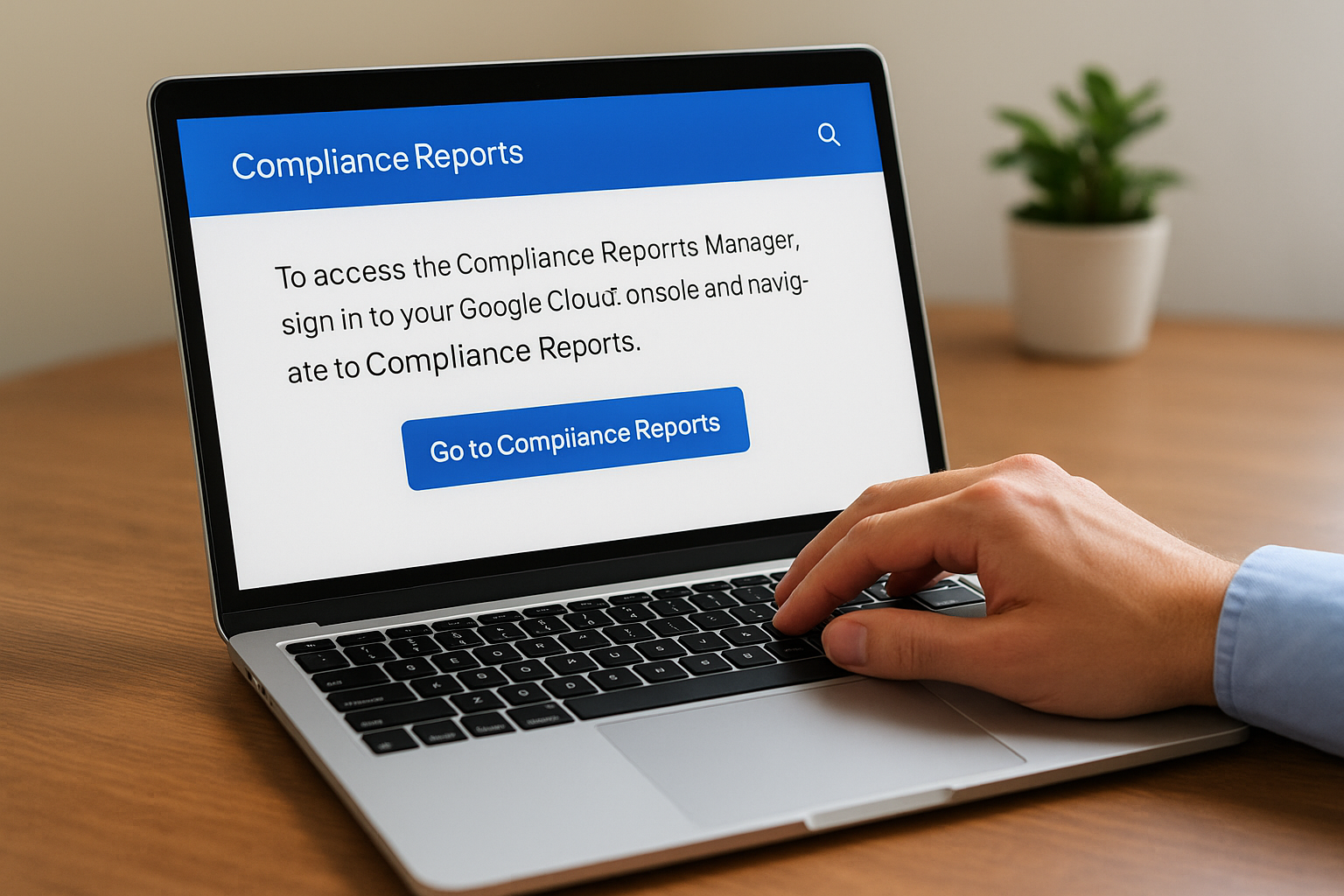
Google's Compliance Reports Manager also stores ISO 27001 certificates, FedRAMP documentation, and other framework evidence in the same location, so you can pull everything your auditor needs from one place.
What the reports contain
Each google cloud soc 2 report includes a structured set of sections your auditor will reference directly. Pay close attention to the in-scope services list in the report introduction, because if a service you rely on, such as Cloud Run or BigQuery, does not appear there, its controls are not attested in that report. Your auditor will flag that gap, so confirm service coverage before you cite any GCP evidence in your own audit package.
A typical report includes:
- Audit scope and in-scope services list
- Trust Services Criteria covered and the auditor's opinion letter
- Control descriptions and the specific tests performed
- Results of each test and any exceptions noted
What bridge letters cover and when you need them
A bridge letter is a written statement from a cloud provider confirming that no material changes have occurred in their control environment since the last SOC 2 audit report was issued. It doesn't replace the full audit report, but it fills the temporal gap between when an audit period closes and when the next one is published. If your own audit window extends beyond the coverage date of GCP's most recent report, your auditor will likely ask for one.
What a bridge letter contains
Google issues bridge letters that confirm the status of controls described in the most recent SOC 2 Type II report. A standard letter will state the original report period, the date through which the bridge extends, and whether any significant changes or exceptions occurred during that gap. It will not include new test results or updated control evidence, since that detail lives in the full report. What it gives your auditor is written assurance that the controls you relied on in your audit package were still in place and functioning during the period not covered by the report.
Bridge letters are not optional if your audit window overlaps with a gap period. Submitting a report without one when the dates don't align is one of the fastest ways to generate an auditor finding.
When to request one
You need a bridge letter when the google cloud soc 2 report on file covers an audit period that ended before your own compliance review window closes. For example, if GCP's latest report covers through March and your audit runs through June, that three-month gap needs a bridge letter to remain airtight. Request it through your Google Cloud account representative or the Compliance Reports Manager, and give yourself enough lead time since processing can take several business days.
How to use GCP evidence in your SOC 2
The GCP SOC 2 Type II report is infrastructure evidence, not a finished compliance story. Your job is to map what Google's auditors tested against the controls your own auditors need to see. Treat the report as a supporting exhibit, cite specific control descriptions that correspond to requirements in your own audit scope, and document where your application layer picks up from where Google's coverage ends.
Map GCP controls to your own control environment
Your auditor will work from a controls matrix that maps each Trust Services Criteria requirement to evidence. When you pull the google cloud soc 2 report, look for controls that address physical security, network segmentation, encryption at rest and in transit, and logical access management. For each one that GCP covers, add a row to your matrix referencing the specific control ID and test result from Google's report. This gives your auditor a traceable citation rather than a general claim.
Citing the page and control reference number from GCP's report is significantly stronger than writing "hosted on Google Cloud" in your evidence package.
You should also note which Trust Services Criteria Google's report does not address for your specific services. If a service falls outside the in-scope list, you cannot rely on GCP's evidence for that control and need to document a compensating or alternative control instead.
Document your complementary user entity controls
SOC 2 reports from infrastructure providers include a section on user entity responsibilities, sometimes called complementary user entity controls (CUECs). These are controls Google assumes you have in place for the overall system to function securely. Read that section carefully and confirm your application and operational procedures address each one. Your auditor will check whether your controls satisfy those stated assumptions, and gaps there are a common finding that slows down certification.
Common pitfalls and auditor questions
Even with the google cloud soc 2 report and a bridge letter in hand, healthcare vendors routinely run into problems during their own audits. Most of those problems come from misreading the scope of GCP's coverage or failing to anticipate the specific questions auditors ask when they see cloud infrastructure evidence in a package.
Assuming inherited compliance covers your controls
The most common mistake is treating GCP's certification as a proxy for your own. Auditors will ask directly which controls you own versus which ones you rely on Google to cover, and a vague answer signals that you haven't mapped the boundary clearly. If your evidence package says "Google handles encryption" without citing a specific control from the report and documenting your own key management practices, that becomes an immediate finding.
The shared responsibility model is not abstract during an audit. Auditors expect you to show exactly where GCP's controls stop and your application-level controls begin.
Another gap that surfaces frequently is around access management logs. GCP's report attests to platform-level identity controls, but your auditors will ask for evidence that your team enforces least-privilege access within your own GCP project, including user provisioning records, access review logs, and terminated-user offboarding procedures. Google does not produce that evidence for you.
Questions auditors commonly raise
Auditors will ask whether you reviewed the complementary user entity controls section in GCP's report and can demonstrate that your procedures satisfy each stated assumption. They will also ask whether any services you use fall outside the in-scope list, and what compensating controls you have for those gaps. Prepare a written response for each CUEC before your audit begins rather than answering verbally during fieldwork. That documentation shows your auditor a mature compliance posture and reduces the back-and-forth that extends audit timelines.
Next steps for your audit package
You now have a clear path: pull the google cloud soc 2 Type II report from the Compliance Reports Manager, request a bridge letter if your audit window extends past the report's coverage date, and build a controls matrix that maps GCP's evidence to your own requirements. Document your complementary user entity controls with written procedures before fieldwork begins, not during it.
For healthcare vendors building SMART on FHIR applications for EPIC, that compliance work multiplies fast. Every new deployment means another audit cycle, another evidence package, and another round of questions from health system procurement teams. Working with a managed platform that carries SOC 2 and HIPAA compliance out of the box removes that burden entirely and lets your engineering team focus on your core product instead of audit prep.
Launch your EPIC integration on a fully compliant platform and skip rebuilding your compliance foundation from scratch on every new contract.
The Future of Patient Logistics
Exploring the future of all things related to patient logistics, technology and how AI is going to re-shape the way we deliver care.
Thank you! Your submission has been received!
Oops! Something went wrong while submitting the form.