ISO 27001 Certification vs. SOC 2: What's the Difference?

If you're building a digital health product that needs to connect with hospital systems, you've probably hit this question during a sales call: ISO 27001 certification vs SOC 2, which one do you actually need? Health system security teams throw both terms around, and vendors often assume they're interchangeable. They aren't, and picking the wrong one (or assuming one covers the other) can stall a contract for months.
Here's the short answer: SOC 2 is an attestation report built for US buyers, most commonly requested by health systems and enterprise clients, while ISO 27001 is an internationally recognized certification tied to a formal information security management system. Many vendors selling into US healthcare need SOC 2 first, but larger or global health systems increasingly ask for both. The right choice depends on your buyers, your growth plans, and how your SOC 2 and ISO 27001 compliance roadmap fits your product timeline.
This article breaks down how each framework works, what auditors actually check, the cost and timeline for each, and how to decide whether you need SOC 2, ISO 27001, or both before you go after your next EPIC-connected health system deal.
Why the certification you choose actually matters
A compliance decision that looks like paperwork on paper turns into a revenue problem the moment your sales team hits a health system's security review. Hospital procurement teams don't ask "do you have some kind of security certification." They ask for a specific report, by name, and if you show up with the wrong one, you don't get partial credit. You get sent back to start over, often after weeks of legal and clinical stakeholders have already signed off on everything else. This is the practical reason ISO 27001 certification vs SOC 2 isn't a theoretical debate for healthcare vendors. It's the difference between closing a contract this quarter or losing it to a competitor who already has the right document in hand.
Security reviews stall deals without the right paperwork
Health system vendor risk teams work from checklists, and those checklists are usually built around what their peer institutions already require. A regional hospital network in the US will almost always ask for a SOC 2 Type 2 report, so it pays to know what SOC 2 compliance actually covers before they'll even schedule a technical review. A multinational health system, or one with European or Canadian operations, may instead ask whether you're ISO 27001 certified, since that's the standard their own compliance team recognizes. If your team assumed one covers the other, you'll find out otherwise in an email from procurement asking why your documentation doesn't match their requirements.
The wrong compliance document doesn't slow a health system deal down, it stops it cold until you produce the right one.
The cost of choosing wrong compounds
Getting this decision wrong doesn't just cost you the current deal, it costs you the next several. Once your team commits engineering and compliance resources to one framework, switching to the other means starting a new audit cycle, often six to twelve months later, while competitors who guessed correctly keep closing. Here's what that looks like in practical terms:
| Scenario | Typical Impact |
|---|---|
| Pursued SOC 2 only, buyer wants ISO 27001 | 6-12 month delay to start ISO audit cycle |
| Pursued ISO 27001 only, buyer wants SOC 2 | 3-6 month delay to complete first SOC 2 Type 2 period |
| Guessed right on first framework | Deal proceeds on original timeline |
| Pursued both without a plan | Duplicated audit prep, higher consulting spend |
These aren't hypothetical numbers. A SOC 2 Type 2 report, unlike a Type I point-in-time report, requires a minimum observation period, often three to six months of evidence collection, before an auditor can even issue the report. If you find out mid-sales-cycle that you picked wrong, that observation period alone can outlast the buyer's patience.
EPIC integration raises the stakes further
Vendors building apps that connect to EPIC face an added layer of scrutiny. EPIC's own App Orchard and Showroom review process expects vendors to demonstrate strong security posture before a listing goes live, and the health systems evaluating your app in the Showroom will run their own parallel security review on top of that. Get the compliance framework wrong here and you're not just delaying one hospital contract, you're delaying every deal that flows through your Showroom listing. This is part of why VectorCare's managed platform bakes HIPAA and SOC 2 readiness into the deployment process for SMART on FHIR apps built for EPIC, so vendors aren't guessing at compliance requirements while also trying to hit a 3-6 week launch timeline. Choosing the right framework early, before your engineering team builds around assumptions that don't match your buyers, saves months you can't get back once a health system's security team is already reviewing your submission.
How to decide between ISO 27001 and SOC 2
Most vendors overthink this decision when the answer is usually sitting in their sales pipeline. Before you commit budget to either framework, pull up your last ten security questionnaires and count how many asked for SOC 2 versus ISO 27001. That single exercise tells you more than any consultant's slide deck. Digital health vendors selling primarily to US health systems, especially those pursuing EPIC-connected deals, almost always find SOC 2 dominates that list. Vendors with a global footprint, or those selling into government-affiliated or academic medical centers with international partnerships, see ISO 27001 show up more often.
Start with who's actually asking
Your buyer list should drive this decision, not industry trends or what a competitor announced on LinkedIn. If every open deal in your pipeline is a US hospital or health system, SOC 2 is your starting point, full stop. If you're fielding requests from health systems in Canada, the EU, or the Gulf region, or if your product roadmap includes expansion there within the next 18 months, ISO 27001 deserves a serious look now rather than later. A useful gut-check question: has a prospect's procurement team ever specifically named one framework over the other? If yes, that's your answer. If you're still guessing, ask your sales team to start asking prospects directly which report they require, before the deal stalls on paperwork.
Let your pipeline, not your assumptions, decide which framework you pursue first.
Factor in timeline, budget, and team capacity
SOC 2 Type 2 typically moves faster for a first certification, mainly because the audit period can run in parallel with your existing operations rather than requiring a full management system buildout. ISO 27001 demands a documented information security management system (ISMS), which takes longer to stand up if you don't already have formal policies, risk assessments, and internal audit processes in place. If your team is small and your runway matters, that difference in setup time is significant.
Use this checklist to sanity-check your decision:
- Buyer geography: Mostly US? Lean SOC 2. Global or EU-adjacent? Consider ISO 27001.
- Sales urgency: Need a report in the next two quarters? SOC 2's audit cycle is typically faster to your first report.
- Internal maturity: Already documenting security policies formally? ISO 27001's ISMS requirement is less of a lift.
- Buyer count: Selling to many health systems at once? Either framework satisfies most, but check for name-brand requests.
- Growth plan: Expanding internationally within 12-18 months? Start ISO 27001 groundwork now, even if SOC 2 comes first.
Run through that list honestly, and the choice between ISO 27001 certification vs SOC 2 Type 2 usually stops being a debate and starts being a project plan.
Key differences between ISO 27001 and SOC 2
Once you know who's asking, it helps to understand exactly what you're being asked for, because these two frameworks aren't just different names for the same audit. ISO 27001 is a certification, issued by an accredited certification body, that confirms your organization built and maintains a formal information security management system (ISMS) against a fixed set of international requirements. SOC 2 is an attestation report, written by a licensed CPA firm, that describes how your controls performed against a set of criteria you and the auditor agree to test. That distinction, certification versus attestation, shapes everything else about how each process runs.
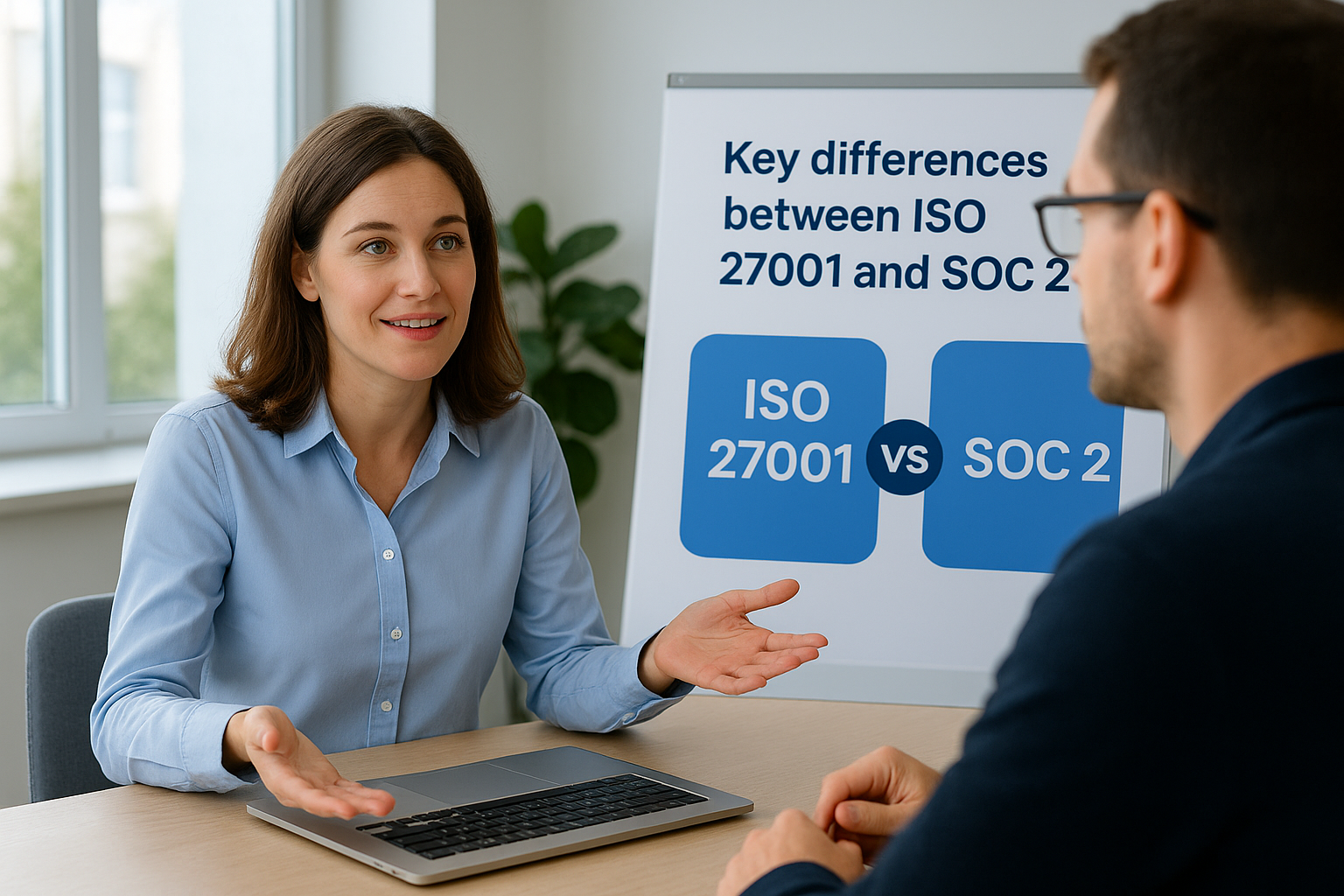
Because of that structural difference, the two documents also read very differently once they land in a health system's inbox. A SOC 2 report is a narrative document, often 40 to 80 pages, describing your systems, your controls, and the auditor's test results in detail. An ISO 27001 certificate is a short document, sometimes a single page, backed by a Statement of Applicability that lists which of the standard's 93 controls apply to your organization. Buyers who want to see the details of how you actually operate tend to ask for SOC 2. Buyers who want proof you passed an internationally recognized bar tend to ask for ISO 27001.
One is a detailed report on how your controls performed, the other is a certificate proving you met a fixed international standard.
Scope, criteria, and renewal cycles differ too
Scope is where the iso certification vs soc 2 comparison gets concrete. SOC 2 lets you choose which Trust Services Criteria to include, security is mandatory, but availability, confidentiality, processing integrity, and privacy are optional add-ons based on what your buyers care about. ISO 27001 doesn't work that way. Its controls are fixed by the standard itself, and your Statement of Applicability documents which ones apply, not whether the framework itself flexes.
| Factor | ISO 27001 | SOC 2 |
|---|---|---|
| Document type | Certification | Attestation report |
| Issued by | Accredited certification body | Licensed CPA firm |
| Scope | Fixed ISMS controls (ISO/IEC 27001, Annex A) | Chosen Trust Services Criteria |
| Renewal | 3-year cycle with annual surveillance audits | Annual re-audit (Type 2) |
| Primary audience | Global, EU, government-affiliated buyers | US enterprise and health system buyers |
Renewal timing also differs enough to affect your budgeting. ISO 27001 certificates run on a three-year cycle with annual surveillance audits in between, while a SOC 2 report only stays current for about twelve months with buyers who track report age closely.
Where ISO 27001 and SOC 2 overlap
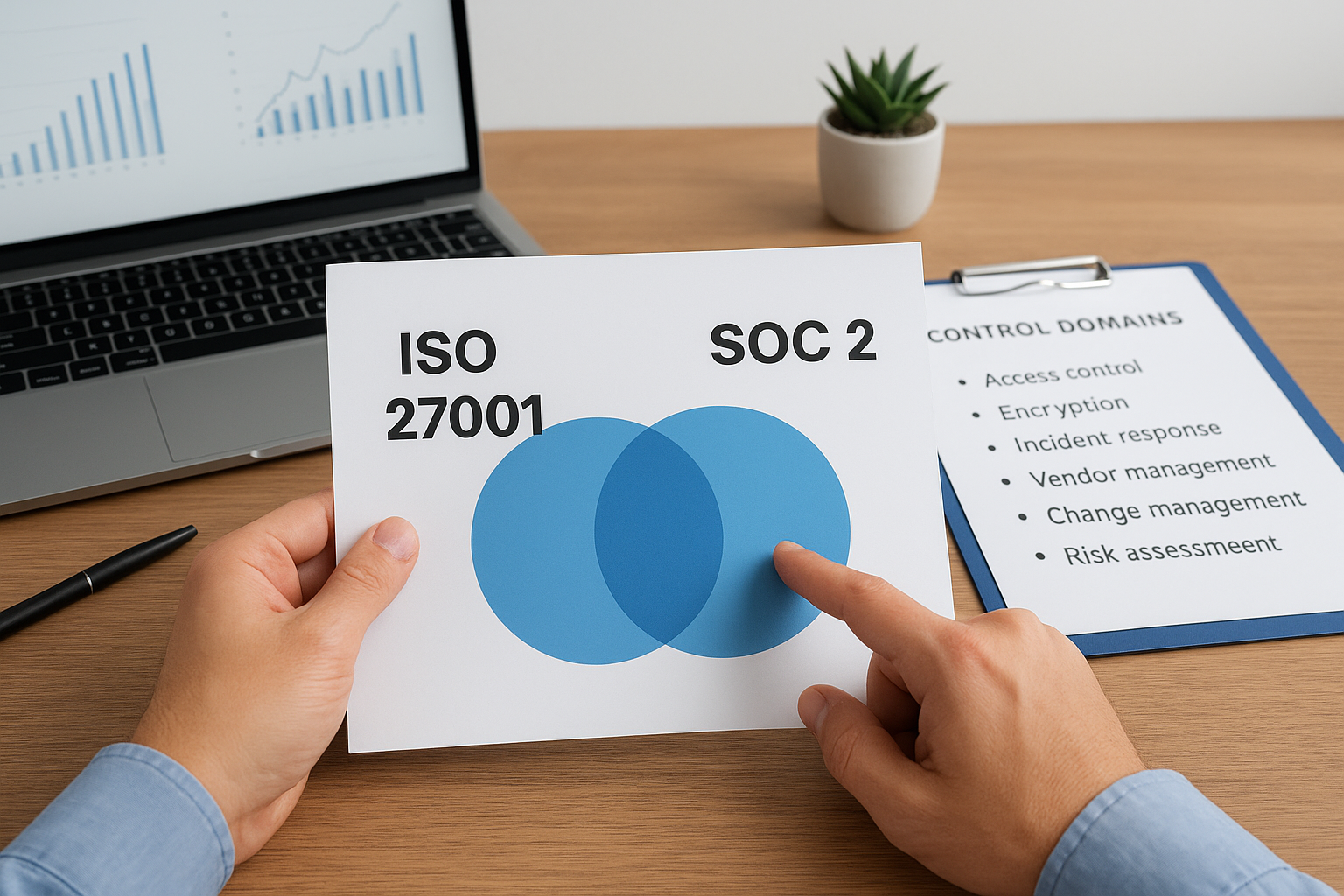
Despite the differences in format and issuing body, both frameworks pull from the same well of security fundamentals. If you're evaluating soc 2 certification vs iso 27001 and worried you'll have to build two completely separate security programs, relax. Roughly 80% of the underlying control activities, access management, encryption, logging, vendor risk, incident response, are the same activities auditors check under either framework. The names of the documents differ. The security work behind them mostly doesn't.
Shared control domains do the heavy lifting
Both frameworks expect you to demonstrate control over the same operational territory, even though they organize and label that territory differently. A team that's already worked through a SOC 2 controls checklist for one framework has done most of the mapping work for the other:
- Access control: who can reach production systems and patient data, and how you review that access
- Encryption: data protection in transit and at rest, with the encryption controls auditors expect being a near-universal requirement across both standards
- Incident response: documented plans, tested procedures, and evidence you actually followed them
- Vendor management: how you vet and monitor subprocessors touching sensitive data
- Change management: approval and testing steps before code reaches production
- Risk assessment: a documented process for identifying and prioritizing security risks
Build your control library once, and both ISO 27001 and SOC 2 auditors can test against it.
Building one program that serves both audits
Smart compliance teams don't rebuild their security program twice. Once you've documented access reviews, encryption standards, and incident response playbooks for one framework, that same evidence largely satisfies the other auditor's requests too, with adjustments to formatting and terminology rather than substance. This is the practical case for pursuing iso 27001 and soc 2 certification together rather than sequentially with a long gap in between: your team does the security work once, then packages the evidence two different ways depending on which document a buyer needs.
Vendors often discover this overlap by accident, usually after their SOC 2 auditor and ISO 27001 assessor ask for nearly identical evidence during back-to-back audit seasons. Recognizing that overlap early, before you've committed a full audit cycle to just one framework, lets you build your internal documentation with both in mind from day one. That foresight saves real audit prep hours later, and it's the reason most compliance consultants recommend mapping your control set against both standards even if you only plan to pursue one certification right now. The groundwork barely changes. The paperwork on top of it does.
Do you need both ISO 27001 and SOC 2
Some vendors need one framework, some need both, and the wrong answer usually comes from copying what a competitor did rather than looking at your own buyer list. Do you need both ISO 27001 and SOC 2 depends less on which framework is "better" and more on how many distinct buyer types you're chasing this year versus next. A single-market startup selling only to US health systems rarely needs both on day one. A vendor with active deals across US, EU, and Gulf-region health systems usually ends up pursuing both within 18 to 24 months whether they planned to or not.
When one framework is enough
One certification covers you when your buyer base is genuinely concentrated. If ninety percent of your pipeline sits with US hospital systems and EPIC-connected health networks, SOC 2 Type 2 alone answers nearly every security questionnaire you'll see. Add ISO 27001 only when a specific deal, not a hypothetical future one, requires it. Chasing a second certification before you have a buyer asking for it burns budget your engineering team could spend elsewhere.
Don't pursue a second certification until a real deal is asking for it, not a hypothetical one.
When pursuing both makes sense
Overlap gets stronger once your sales pipeline diversifies past a single region or buyer type. A vendor selling to US health systems while also fielding requests from Canadian provincial health authorities or European research hospitals will hit a wall with either framework alone. In that situation, both certifications stop being a nice-to-have and start being the cost of staying in more deals simultaneously. The good news, as covered above, is that the underlying control work overlaps heavily, so pursuing both isn't double the effort, closer to 130 to 150 percent of the effort of one.
How to sequence if you pursue both
Running both audits at once rarely makes sense for a smaller compliance team. Sequencing them, instead of stacking them, keeps prep manageable:
- Finish your first SOC 2 Type 2 cycle before starting the ISO 27001 ISMS buildout, since SOC 2's audit period gives you a natural evidence base to reuse.
- Map your existing controls against ISO 27001's Annex A before hiring an auditor, so gaps surface before you're paying for a formal gap analysis.
- Stagger renewal dates so you're not managing a SOC 2 re-audit and an ISO surveillance audit in the same quarter.
- Assign one owner across both frameworks internally, even if you use different external auditors, to avoid duplicated evidence requests landing on different desks.
Common questions about ISO 27001 and SOC 2
Vendors researching ISO 27001 certification vs SOC 2 tend to ask the same handful of questions once they've decided which framework fits their buyers. Answering them upfront saves you a round of back-and-forth with your compliance consultant later, and a few of these answers surprise teams who assumed the two frameworks were more interchangeable than they actually are.
Can one report substitute for the other?
No, not directly. A SOC 2 report describes how your controls performed during an audit period, while an ISO 27001 certificate confirms your ISMS meets a fixed international standard. Some large health systems will accept either as evidence of a mature security program, but their procurement checklist usually names one specifically. If a vendor risk analyst asks for SOC 2 and you hand over an ISO certificate, expect a follow-up request rather than automatic approval.
Neither document is a universal substitute for the other, even when a buyer seems flexible about format.
How long does each certification take?
First-time SOC 2 Type 2 reports typically take three to six months of observation before the auditor can issue anything, plus a few weeks of report drafting, and the full audit timeline from prep to report is worth mapping before you promise a date. ISO 27001 usually takes longer for a first certification, often six to twelve months, because you're building an ISMS from scratch rather than just documenting existing controls. Renewal timelines differ too:
- SOC 2 Type 2: annual re-audit to keep the report current
- ISO 27001: three-year certification cycle with annual surveillance audits
Which one do health systems ask for more often?
Generally, SOC 2 dominates among US-based health systems and hospital networks, especially those running EPIC-connected vendor programs. ISO 27001 shows up more with government-affiliated systems, academic medical centers with international research partnerships, and health systems operating outside the US. Neither answer is universal, so check your own pipeline rather than assuming national trends apply to your specific buyers.
Do I need a lawyer or consultant to pursue either?
You don't strictly need outside help, but most vendors bring in one of the HIPAA compliance consulting services or use a platform that bakes readiness into the build process, since mapping controls correctly the first time avoids costly audit findings later. Legal counsel matters more for contract language around Business Associate Agreements than for the audit itself, though healthcare vendors handling protected health information should loop counsel in regardless of which framework you pursue.
What this means for healthcare software vendors
Healthcare vendors face a compliance burden that most SaaS companies never deal with: HIPAA's privacy, security, and breach rules sit underneath whichever framework you pick, and neither ISO 27001 nor SOC 2 automatically satisfies them on their own. A SOC 2 report can include HIPAA-mapped controls if you scope the audit that way, and an ISO 27001 ISMS can incorporate HIPAA safeguards into its risk assessment, but you have to ask for that explicitly. Vendors who assume either certification covers HIPAA by default often find out otherwise when a hospital's privacy officer asks a question their compliance report never addresses.
Neither SOC 2 nor ISO 27001 automatically covers HIPAA, you have to build that mapping in on purpose.
EPIC connections add a second layer of scrutiny
Building a SMART on FHIR app for EPIC means your compliance work gets reviewed twice: once by EPIC's own App Orchard and Showroom process, and again by every individual health system that considers listing you. Epic's App Orchard and Showroom reviewers expect to see evidence of a security program before your app goes live, and the health systems browsing that listing run their own separate vendor risk assessment on top. If your SOC 2 or ISO 27001 documentation doesn't map cleanly to how your app actually handles patient data inside EPIC's workflows, you'll spend cycles explaining gaps instead of closing deals.
Why bundling compliance into deployment saves months
Most digital health startups don't have a dedicated compliance team, which is why SOC 2 compliance for startups means the framework decision, the audit prep, and the EPIC integration work all compete for the same small engineering staff. That's the exact bottleneck VectorCare's no-code platform was built to remove. Instead of your team separately researching ISO 27001 certification vs SOC 2, hiring an auditor, and then building a custom EPIC integration from scratch, VectorCare bakes HIPAA and SOC 2 readiness directly into the app-building and hosting process, alongside the SMART on FHIR compliance your EPIC listing requires.
Here's what that looks like in practice for a vendor building on VectorCare:
- Compliance groundwork included: HIPAA and SOC 2 considerations built into the deployment process rather than bolted on afterward
- EPIC Showroom submission managed: the listing and review process handled as part of the platform, not a separate project
- Deployment in 3-6 weeks: instead of the 12-18 months typical of custom-built EPIC integrations, and there are concrete reasons those builds drag on
- Managed hosting and support: ongoing monitoring so compliance posture doesn't quietly drift after launch
Running your own custom integration means the compliance framework decision lands entirely on your team's shoulders, on top of the FHIR and OAuth engineering work itself. Vendors who route that work through a managed platform spend their remaining engineering time on their actual product instead of rebuilding EPIC plumbing that hundreds of other vendors have already built before them.
Choosing your compliance path
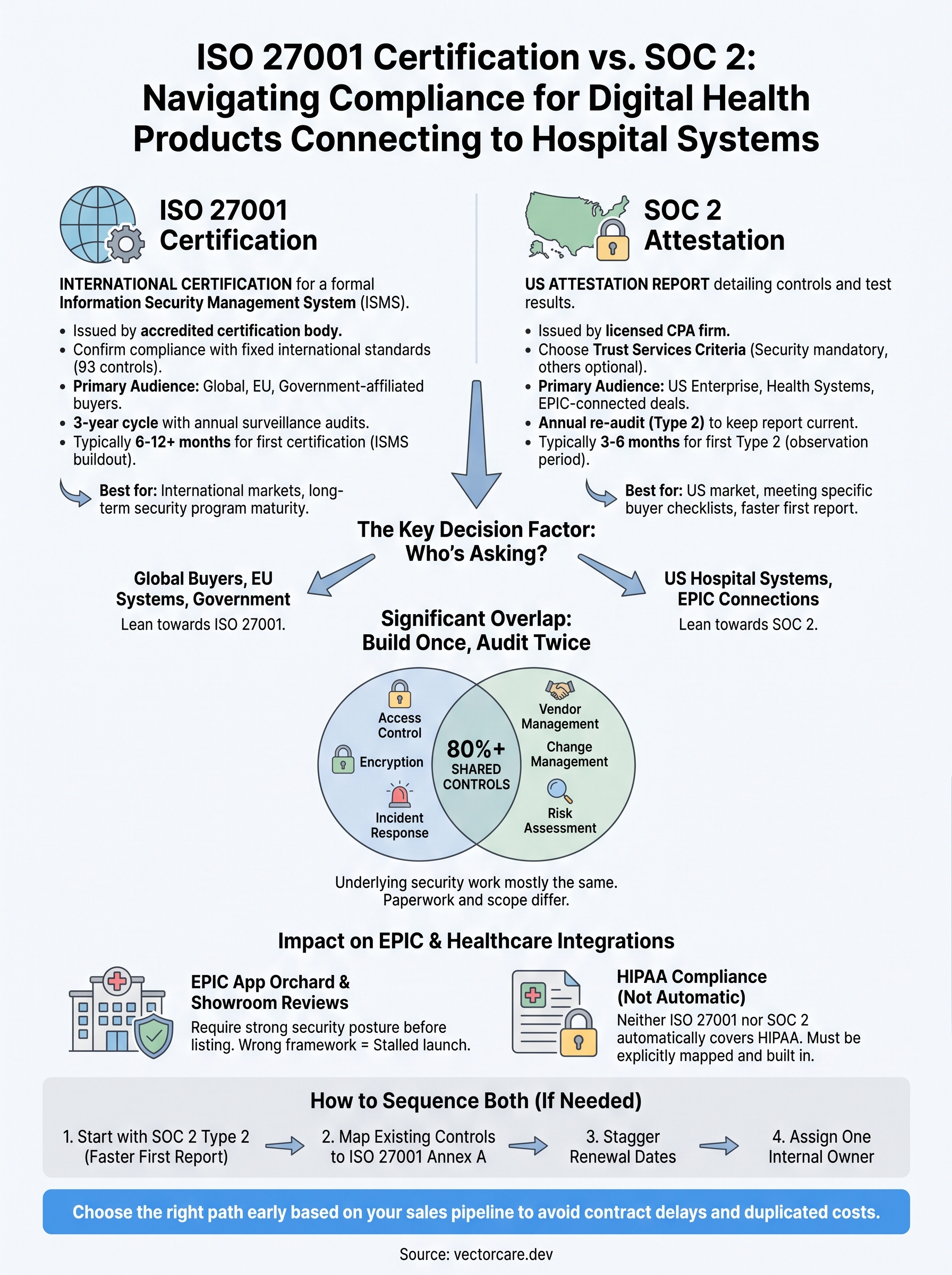
The ISO 27001 certification vs SOC 2 decision comes down to one question: who's asking? Check your pipeline, not industry trends. US health systems want SOC 2. Global or EU-adjacent buyers want ISO 27001. Some vendors need both, and that's fine, since the underlying control work overlaps more than most teams expect going in.
What you shouldn't do is let this decision sit unresolved while your engineering team burns months guessing which framework matters, or worse, building a custom EPIC integration before you've even settled on a compliance path. Every month spent debating frameworks is a month a competitor spends closing the deal you're still qualifying.
If you're building a SMART on FHIR app for EPIC, you don't have to solve compliance and integration separately. Build and deploy your SMART on FHIR app in days, with HIPAA and SOC 2 readiness baked into the process from day one.
The Future of Patient Logistics
Exploring the future of all things related to patient logistics, technology and how AI is going to re-shape the way we deliver care.
Thank you! Your submission has been received!
Oops! Something went wrong while submitting the form.