HL7 Da Vinci Project: What It Is and Why It Matters for FHIR

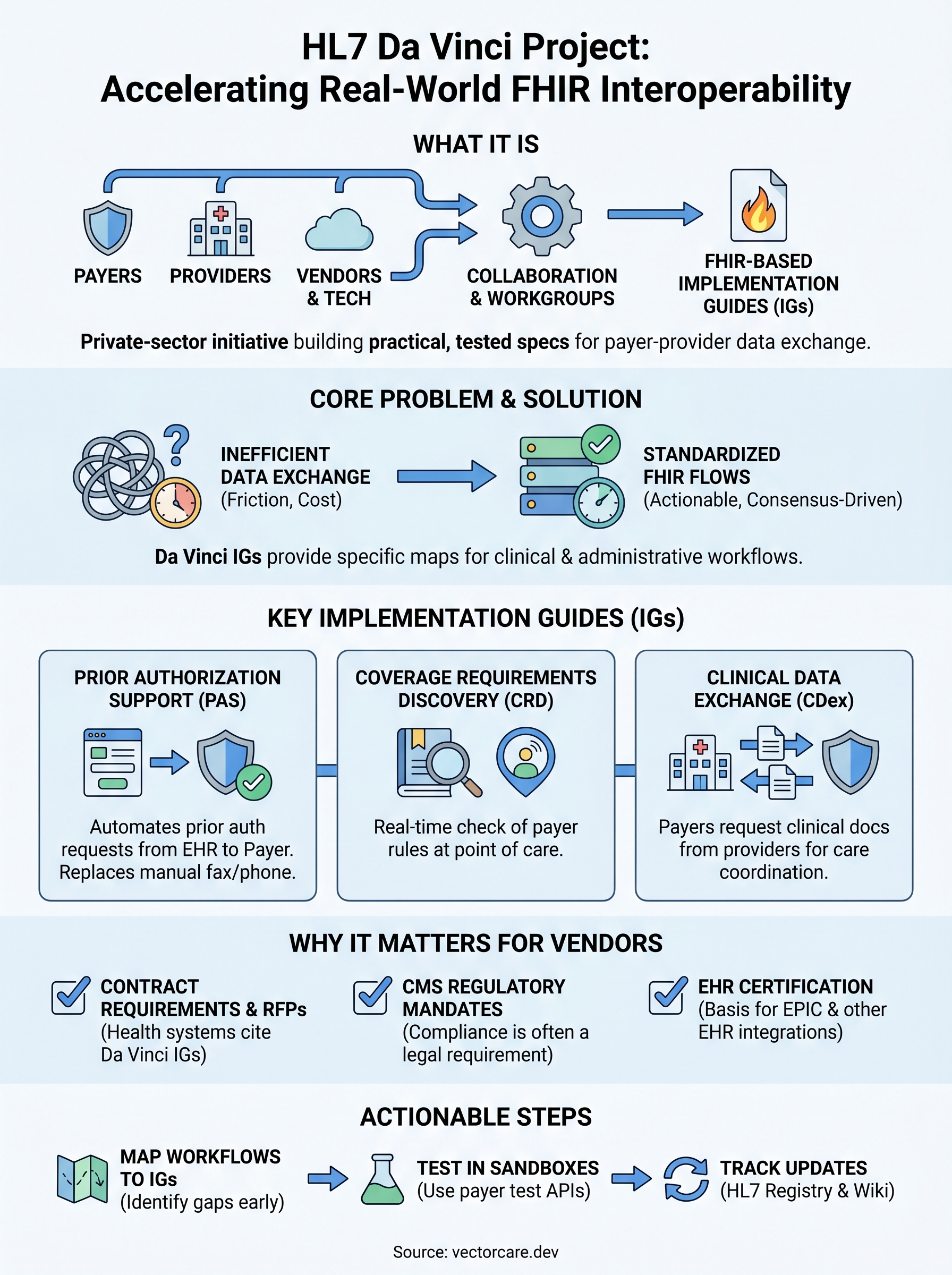
The HL7 Da Vinci Project is a private-sector initiative that brings payers, providers, and technology vendors together to build FHIR-based implementation guides for real-world healthcare data exchange. If you're a healthcare vendor working with EHR integrations, or planning to, Da Vinci's work directly shapes the standards your applications will need to support.
At its core, the project tackles a specific problem: payers and providers still struggle to exchange clinical and administrative data efficiently. Da Vinci addresses this by producing open, consensus-driven implementation guides built on HL7 FHIR, covering use cases like prior authorization, coverage requirements, and clinical data exchange. These aren't theoretical specs. Health systems and payers are actively adopting them.
For vendors building SMART on FHIR applications, especially those integrating with EPIC, understanding Da Vinci isn't optional. It's where the standards are heading. At VectorCare, we help healthcare vendors launch FHIR-compliant apps into EPIC's ecosystem without writing integration code from scratch, and Da Vinci's implementation guides are part of the technical foundation that makes standardized EHR integration possible. This article breaks down what the Da Vinci Project is, how it operates, what it has produced so far, and why it matters for your FHIR strategy.
What the HL7 Da Vinci Project is
The HL7 Da Vinci Project launched in 2019 as a voluntary industry collaboration under HL7 International, the organization responsible for setting global health data standards. Its founding members include major payers like Cigna, Humana, and Blue Cross Blue Shield plans, alongside providers, EHR vendors, and health IT companies. The goal from day one was to accelerate FHIR adoption for value-based care by building tested, implementable specifications rather than leaving the industry to figure things out independently.
How the project is structured
Da Vinci operates as a FHIR accelerator, one of several HL7-sponsored programs designed to speed up the production of FHIR implementation guides for specific domains. Each use case within the project has its own workgroup made up of subject matter experts from member organizations. These workgroups draft, review, and publish implementation guides that go through HL7's formal balloting process before becoming official standards.

Members contribute both time and technical expertise to their assigned workgroups. This structure means the specs that come out of Da Vinci reflect real operational requirements from the organizations that will actually implement them, not just theoretical design.
What counts as a Da Vinci use case
The project focuses specifically on payer-provider data exchange, covering administrative and clinical workflows where poor data flow creates friction, cost, or patient harm. Prior authorization, coverage requirements discovery, and clinical data sharing for care coordination all fall under Da Vinci's scope. Each use case gets its own implementation guide, with a defined set of FHIR resources, profiles, and interactions that systems must support to be considered conformant.
Da Vinci's implementation guides are not optional guidelines. Health systems and payers are increasingly requiring vendor conformance as a condition of doing business, which means you need to know where your solution stands against these specs.
Why the Da Vinci Project matters for FHIR
FHIR gives you a shared language for health data exchange, but a shared language alone doesn't tell you how to structure a prior authorization request or a coverage determination. The HL7 Da Vinci Project fills that gap by producing specific, tested implementation guides that map FHIR resources to actual clinical and administrative workflows. Without this layer, every organization would interpret the standard differently, making true interoperability nearly impossible.
Da Vinci moves FHIR from a general-purpose framework to a set of precise, actionable specifications that health systems and payers can point vendors to directly.
Why vendors need to pay attention
Payers and health systems are already referencing Da Vinci specs in vendor contracts and procurement requirements. If your application doesn't align with these guides, you risk losing contracts to vendors who do. CMS regulatory mandates like the Interoperability and Prior Authorization Final Rule tie directly to Da Vinci use cases, so conformance is increasingly a legal requirement, not just a best practice.
Key reasons Da Vinci matters to your product roadmap:
- Health systems cite Da Vinci IGs in RFPs and integration checklists
- CMS rules require payer APIs that align with Da Vinci specs
- EPIC and other EHRs use Da Vinci profiles as the basis for app certification
The main Da Vinci implementation guides
The hl7 da vinci project has published more than a dozen implementation guides, but a few carry the most weight for vendors building payer-provider workflows. Knowing which ones apply to your use case helps you scope compliance work early.
Prior Authorization Support (PAS)
PAS defines how providers submit prior authorization requests from EHR systems to payers using FHIR, replacing the manual fax-and-phone process. If your product touches ordering or referral workflows, PAS conformance is likely a requirement your health system customers will raise.

Aligning with PAS early in your product roadmap costs far less than retrofitting compliance after you've built your integration logic.
Coverage Requirements Discovery and Clinical Data Exchange
Coverage Requirements Discovery (CRD) lets providers check payer rules in real time at the point of care. Clinical Data Exchange (CDex) defines how payers request clinical documentation from providers. Both are referenced in CMS interoperability rules, and your solution likely intersects with at least one of them. Common workflows these guides cover include:
- Referral and order management
- Claims documentation and audits
- Care gap closure and quality reporting
How to use Da Vinci specs in real workflows
The hl7 da vinci project specs aren't just documentation to file away. You can map them directly to your product's existing workflows to identify gaps before they become contract blockers. Start by downloading the relevant implementation guide from HL7's FHIR registry, then compare each required FHIR profile against what your current integration layer sends and receives.
Treating Da Vinci conformance as a checklist item late in development is how teams end up rebuilding core integration logic under deadline pressure.
Map each workflow to a specific IG
Pick one workflow at a time. If your product handles prior authorization requests, start with PAS. If you're pulling clinical documentation for payers, start with CDex. Each IG defines required FHIR resources, mandatory fields, and allowed response codes, so you can build a direct gap analysis against your current data model.
Common starting points by workflow type:
- Ordering and referrals: PAS
- Documentation requests: CDex
- Point-of-care coverage checks: CRD
Test against real payer sandbox environments
Several major payers expose sandbox APIs that implement Da Vinci profiles. Running your integration against these environments early surfaces conformance issues before you hit production, saving you significant rework. Check the HL7 FHIR registry for current test endpoint listings alongside each published IG.
Where to find Da Vinci resources and community
The hl7 da vinci project publishes all of its implementation guides through the HL7 FHIR registry at hl7.org, where you can browse every current and past specification by use case. Each guide includes conformance requirements, example payloads, and change logs that help you track updates affecting your integration.
Bookmark the HL7 FHIR registry as your first stop whenever a health system cites a Da Vinci spec in a contract or RFP.
Getting involved in workgroups and balloting
HL7 accepts public comments during the balloting period for each implementation guide, so you don't need full membership to provide input on specs that affect your product. If your organization joins as a Da Vinci member, you gain access to workgroup meetings, draft specifications before public release, and direct communication with payer and provider participants who shape the requirements.
Staying current on updates
The HL7 Confluence wiki hosts meeting notes, project tracking, and workgroup schedules for Da Vinci. You can follow specific workgroups relevant to your use case to get notified when new drafts or ballot versions publish, giving you lead time to plan conformance updates before your customers start asking.
Key takeaways
The hl7 da vinci project gives healthcare vendors a clear, consensus-driven path to real-world FHIR interoperability. Its implementation guides, particularly PAS, CRD, and CDex, define exactly how payer-provider workflows should function, and health systems are already citing them in contracts and procurement requirements. Ignoring these specs means falling behind vendors who've already aligned their products with them.
Your next step is to map your product's existing workflows to the relevant Da Vinci IGs, run tests against payer sandbox environments, and track workgroup updates through the HL7 Confluence wiki. Conformance gaps are far easier and cheaper to close early than after a health system flags them during onboarding or a contract review.
If you're building a SMART on FHIR application and need to reach EPIC-integrated health systems faster, VectorCare's no-code EPIC integration platform handles the technical complexity so you can focus on your core product instead.
The Future of Patient Logistics
Exploring the future of all things related to patient logistics, technology and how AI is going to re-shape the way we deliver care.
Thank you! Your submission has been received!
Oops! Something went wrong while submitting the form.