Healthcare Data Exchange Standards: What They Are And How They Work

If you build software that touches patient data, you've run into an alphabet soup of standards that all claim to solve interoperability. Healthcare data exchange standards are the technical rules that let an EHR, a lab system, a monitoring device, and a third-party app all speak the same language when they move clinical data around. Without them, every integration becomes a custom translation project, and that's exactly where most digital health teams get stuck.
This article breaks down the standards that actually matter today: HL7 v2, the messaging format still running most hospital plumbing, and FHIR, the modern API-based standard that's now mandatory for EPIC and other major EHRs. You'll see how each one structures data, where they're used, and why FHIR has become the default for new integrations rather than a nice-to-have.
We'll also cover how these standards connect to real-world requirements like SMART on FHIR authorization and ONC certification, since understanding the standard is only half the job. Knowing how it works in practice determines whether your integration ships in weeks or drags into a year-long engineering slog.
Why healthcare data exchange standards matter
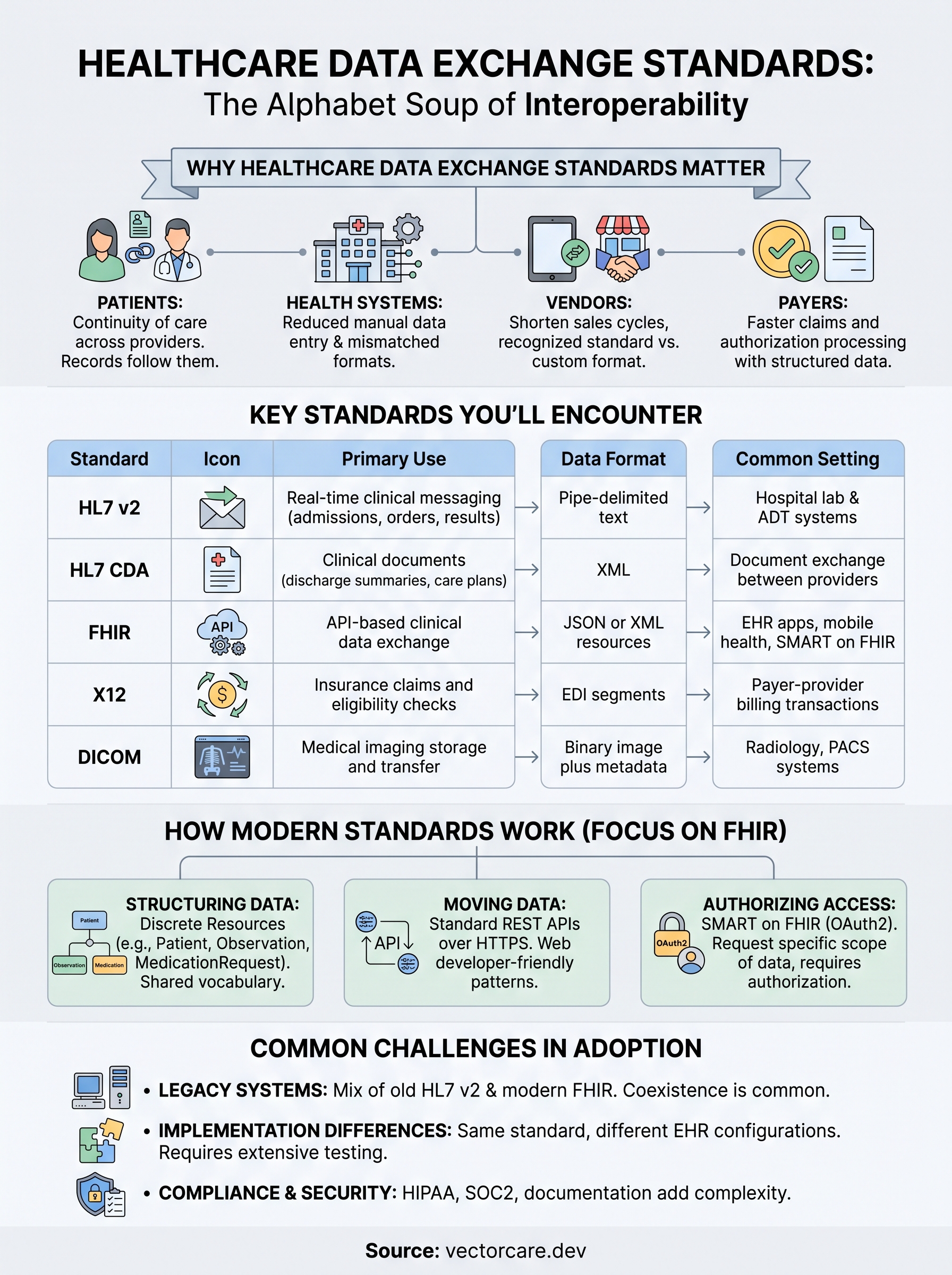
Patients see multiple providers over a lifetime, and each one runs different software. A cardiologist's EHR, a hospital's lab system, and a home health monitoring app all store data differently unless they agree on a common structure. Healthcare data exchange standards exist to solve that agreement problem at scale, so a blood pressure reading captured on a device in someone's living room can land in the same chart a specialist reviews weeks later. Skip the standard, and you're left building point-to-point translators for every pair of systems, a job that never actually finishes because someone always adds a new system.
Businesses feel this gap directly when they try to sell into health systems. A remote patient monitoring company with a great product still has to prove its data will show up correctly inside EPIC, Cerner, or whatever EHR the hospital runs. Health systems won't sign a contract on a promise; they want proof the integration follows recognized interoperability standards like FHIR. That's the difference between a six-week pilot and a stalled procurement process that drags on for a year while IT reviews custom API documentation nobody else has vetted.
Standards turn interoperability from a custom engineering project into a repeatable checklist.
The cost of skipping standardization
Organizations that build custom, one-off integrations pay for it twice: once in engineering time, and again in maintenance. Every EHR upgrade, every schema change, every new partner system requires someone to revisit the custom code and confirm it still works. Standardized data exchange shifts that maintenance burden onto a shared spec that thousands of other organizations also rely on, which means bugs get caught faster and fixes get documented publicly instead of living in one engineer's head.
Who actually benefits
The payoff shows up differently depending on where you sit in the healthcare ecosystem:
- Patients get continuity of care instead of repeating their history at every visit, because records follow them between providers.
- Health systems reduce the manual data entry and phone-tag that comes from mismatched formats between departments.
- Vendors and startups shorten sales cycles because they can point to a recognized standard instead of asking IT teams to trust a proprietary format.
- Payers process claims and prior authorizations faster when clinical data arrives in a structured, predictable shape rather than a scanned PDF.
Regulatory pressure has made standards mandatory, not optional
Regulators stopped treating interoperability as aspirational years ago. The Office of the National Coordinator for Health IT (ONC) requires certified EHR technology to support specific data exchange capabilities, and the CMS Interoperability and Patient Access rule pushes payers and providers toward FHIR-based APIs for sharing claims and clinical data. You can read the specifics directly from ONC's own certification program at healthit.gov. Vendors that ignore these requirements don't just lose a competitive edge, they risk being locked out of health system procurement altogether, since most RFPs now explicitly ask whether a product supports FHIR and SMART on FHIR authorization. That regulatory backdrop is exactly why understanding these standards has moved from a nice technical detail to a business requirement for anyone selling software into clinical settings.
How healthcare data exchange standards work
Every healthcare data exchange standard solves three separate problems: how to structure clinical data, how to move it between systems, and how to control who's allowed to see it. Miss any one of those pieces and the integration breaks somewhere, even if the other two are perfect. Understanding this three-part split makes it much easier to figure out which standard you actually need for a given project instead of treating "FHIR" or "HL7" as one monolithic requirement.
Structuring the data
Standards define a shared vocabulary so a lab result means the same thing everywhere. HL7 v2 organizes data into segments and fields inside a pipe-delimited message, while FHIR breaks clinical concepts into discrete resources like Patient, Observation, and MedicationRequest, each with a defined set of fields. Codes systems like LOINC for labs and SNOMED CT for clinical terms sit underneath both, so a glucose reading carries the same identifier whether it's inside an HL7 message or a FHIR resource.
A standard only works if both systems agree on what a piece of data means, not just how it's formatted.
Moving the data
Transport is where the two standards diverge most. HL7 v2 typically moves over point-to-point interfaces using protocols like MLLP, often triggered by an event such as a patient admission. FHIR uses standard REST APIs over HTTPS, the same pattern web developers already use for any modern API, which is a big reason it's replaced older approaches for new healthcare interoperability projects.
Authorizing access
Moving data safely requires proving who's asking for it. This is where SMART on FHIR authorization comes in: it layers OAuth2 on top of FHIR so an app can request exactly the scope of data it needs, like read-only access to a single patient's medications, and nothing more. EPIC and most major EHRs now require SMART on FHIR for any third-party app requesting patient data, which means the authorization layer isn't optional plumbing, it's the gatekeeper for whether your integration gets approved at all.
Key standards you'll encounter in healthcare IT
Beyond HL7 v2 and FHIR, a handful of other healthcare data exchange standards show up often enough that you should recognize them even if you never build directly against them. Some handle documents instead of discrete data, some handle billing instead of clinical content, and some predate FHIR by decades but still run in production at hospitals that haven't migrated. Knowing what each one actually does keeps you from assuming every integration request means the same technical work.
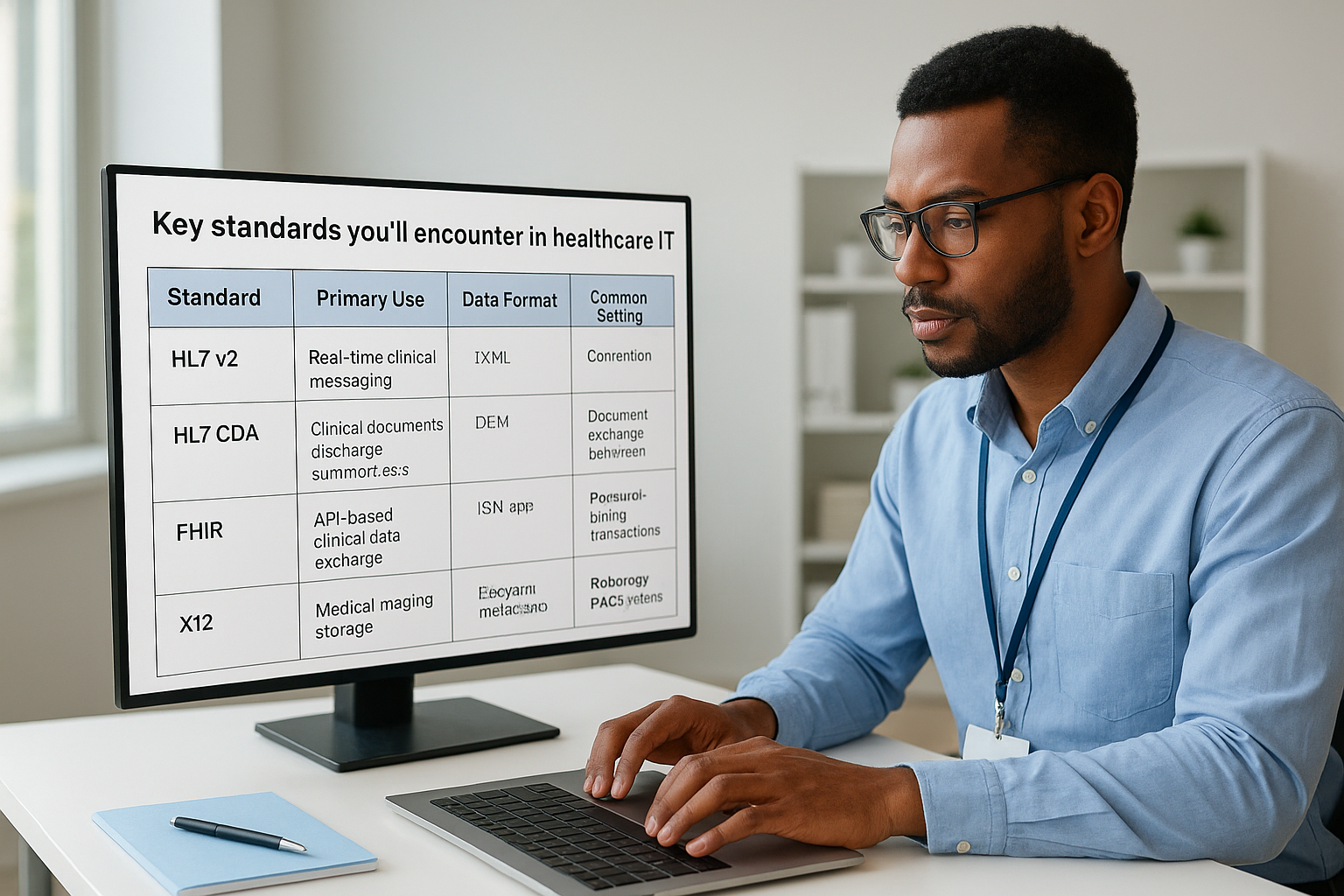
| Standard | Primary Use | Data Format | Common Setting |
|---|---|---|---|
| HL7 v2 | Real-time clinical messaging (admissions, orders, results) | Pipe-delimited text | Hospital lab and ADT systems |
| HL7 CDA | Clinical documents (discharge summaries, care plans) | XML | Document exchange between providers |
| FHIR | API-based clinical data exchange | JSON or XML resources | EHR apps, mobile health, SMART on FHIR |
| X12 | Insurance claims and eligibility checks | EDI segments | Payer-provider billing transactions |
| DICOM | Medical imaging storage and transfer | Binary image plus metadata | Radiology, PACS systems |
CDA and X12 still handle real work
Documents haven't disappeared just because APIs exist. HL7 CDA carries structured clinical documents like discharge summaries between systems that need a full narrative record, not just a single data point, and it still underpins the Continuity of Care Document format many EHRs generate. Meanwhile, X12 transactions move the claims and eligibility data that keeps the billing side of healthcare running, a workflow that FHIR hasn't fully replaced despite CMS pushing payers toward FHIR-based APIs for other parts of the process.
Why FHIR has become the default for new builds
FHIR keeps winning new projects because it maps cleanly onto how modern software already gets built, with REST endpoints, JSON payloads, and OAuth2 security that any web developer recognizes on sight. You can review the full resource specification directly from the standard's maintainers at HL7.org's FHIR page, which lists every resource type and the fields it supports.
If you're starting a new EHR integration today, FHIR is the standard you should default to, not the one you should have to justify.
Vendors building for EPIC specifically will run into FHIR as a hard requirement rather than a choice, since EPIC's App Orchard listing process mandates SMART on FHIR compliance for any app requesting patient data.
Common challenges in adopting data exchange standards
Knowing a standard exists doesn't mean implementing it is simple. Healthcare data exchange standards leave room for interpretation, and that flexibility creates real friction for vendors trying to connect to EPIC or any other EHR. The gap between "technically FHIR-compliant" and "actually works in production" is where most integration timelines blow past their original estimate.

Legacy systems slow everyone down
Hospitals rarely run one system. Most run a mix of decades-old HL7 v2 interfaces alongside newer FHIR endpoints, and a vendor integrating with a large health system often has to support both simultaneously. Ripping out an HL7 v2 interface that still triggers lab orders correctly isn't worth the risk to most IT departments, so legacy infrastructure and modern APIs end up coexisting indefinitely, which means your integration team needs to understand both eras of the standard, not just the current one.
The same standard, implemented differently everywhere
FHIR defines resources, but it doesn't force every EHR vendor to populate every field the same way. One EPIC instance might store a diagnosis code in a slightly different structure than another EPIC instance at a different hospital, depending on configuration choices made by that hospital's IT team. This is often called the "FHIR is a standard, not a guarantee" problem, and it means testing against one EHR sandbox doesn't guarantee your app works against every live deployment.
A standard reduces variation, but it doesn't eliminate it, so budget time for testing against real instances, not just documentation.
Compliance and security add their own layer
Security requirements compound the technical challenge. Every integration touching patient data has to satisfy HIPAA, and increasingly SOC2, on top of getting the data format and authorization flow right. Teams without dedicated compliance staff often underestimate how much documentation and auditing this requires, which stalls launches even after the FHIR integration itself is technically finished.
Smaller vendors feel the resource gap hardest
Smaller digital health companies face this squeeze the most directly. Building and maintaining FHIR expertise, SMART on FHIR authorization, and compliance documentation in-house can easily consume the engineering budget that a startup needs for its core product, which is exactly the gap that pushes many vendors toward managed integration platforms instead of building everything from scratch.
The road ahead for health data exchange
FHIR isn't going away, and the standards built on top of it, like SMART on FHIR authorization, will only get more entrenched as CMS and ONC tighten their requirements. Healthcare data exchange standards will keep evolving, but the direction is set: structured, API-based, and increasingly mandatory for anyone who wants a contract with a health system. The vendors who treat this as a compliance checkbox now will have an easier time adapting when the next rule change lands than the ones still running custom point-to-point integrations.
Understanding the standard is the easy part. Building, testing, and maintaining a compliant SMART on FHIR app that actually gets listed on EPIC's Showroom is where most teams lose months they don't have. If you'd rather skip that timeline entirely, see how VectorCare gets your app built and deployed in weeks.
The Future of Patient Logistics
Exploring the future of all things related to patient logistics, technology and how AI is going to re-shape the way we deliver care.
Thank you! Your submission has been received!
Oops! Something went wrong while submitting the form.