Epic App Orchard Review: What It Is and How It Works

If you're searching for an epic app orchard review, you're probably weighing whether to list your product there and wondering what actually happens after you submit. Maybe you've heard the marketplace changed names, or you're confused about how SSO fits into the approval process. That confusion is normal. Epic doesn't publish a step-by-step guide, and most of what's online is either outdated or written by people who never went through the process themselves.
This article breaks down what App Orchard actually is, why Epic rebranded it to Showroom, and how the listing and epic app orchard sso requirements work in practice. You'll get a clear picture of the technical prerequisites, the timeline you should realistically expect, and what health systems actually look for when they browse the marketplace for vendors.
We work with digital health vendors every day at VectorCare, building and listing SMART on FHIR apps for EPIC integration, so we've seen the approval process from the inside. Combined with what other developers report in epic app orchard reviews across forums and case studies, this gives you a grounded, practical view instead of guesswork.
Why Epic App Orchard matters for healthcare vendors
Epic runs the electronic health record system at roughly 250 health systems and thousands of hospitals across the country, which makes it the default gatekeeper for any digital health product that needs to touch clinical data. When a hospital IT team wants to add a remote monitoring tool, a decision support engine, or a referral platform, the first place they look isn't a Google search. It's Epic's vendor marketplace, the Showroom, the rebranded version of what used to be App Orchard. If your product isn't listed there, you're invisible to the exact buyers who have the budget and the mandate to purchase.
The marketplace health systems actually use
Being findable inside Epic's own ecosystem changes how sales conversations start. Instead of convincing a hospital's security and IT teams that your integration is safe from scratch, a Showroom listing signals that Epic has already reviewed your app's technical compliance. That shortcut matters because health system procurement cycles are notoriously slow, and anything that removes a step gets your deal moving faster.
A Showroom listing turns your app from an unknown risk into a pre-vetted option health systems already trust.
What a listing signals to buyers
Health system buyers treat a Showroom listing as a proxy for technical credibility and security maturity. It tells them your app already speaks SMART on FHIR, already handles OAuth correctly, and already passed Epic's own scrutiny. That's a lot of due diligence a hospital's security team doesn't have to redo manually.
Here's what changes for vendors once they're listed:
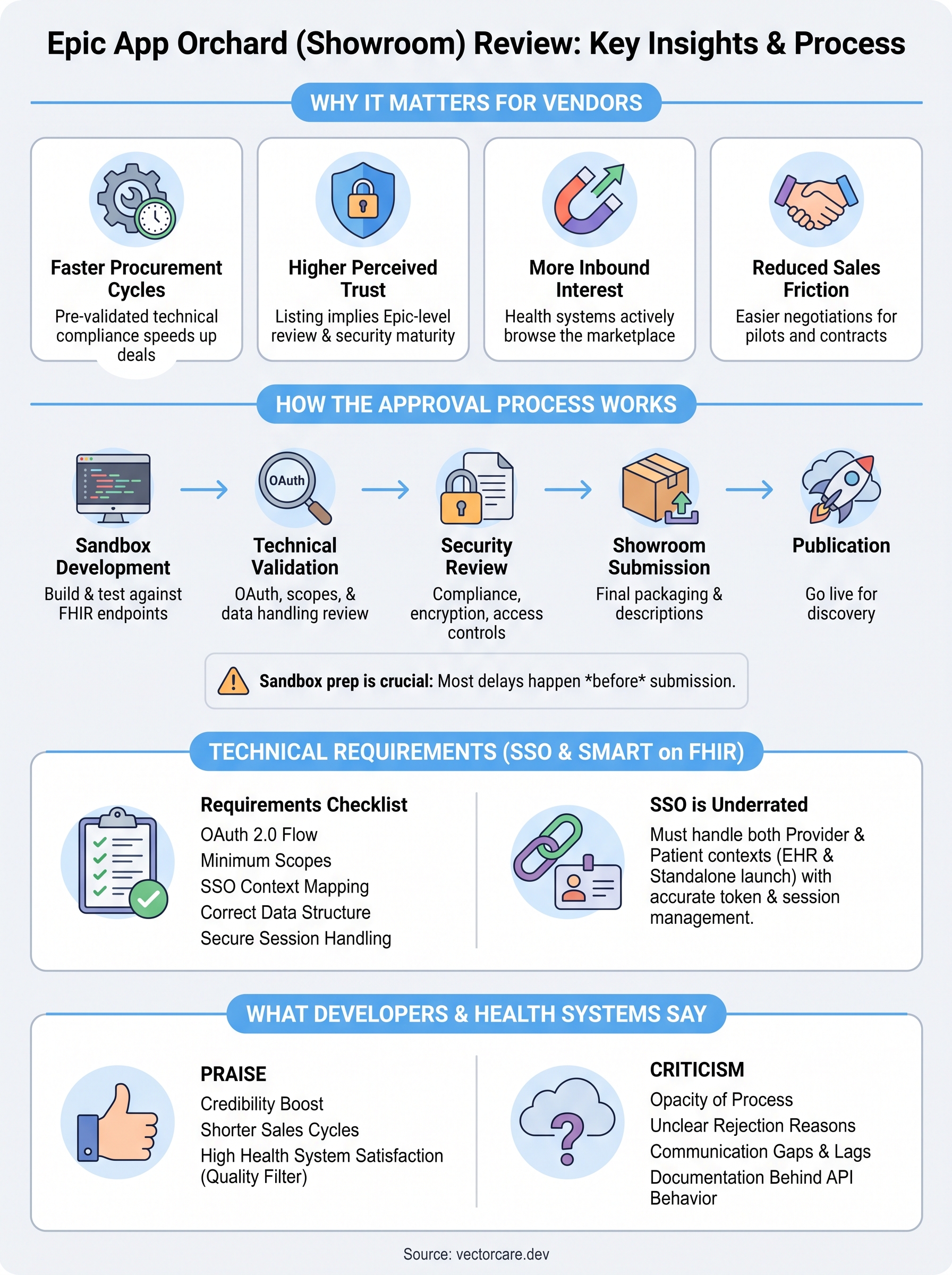
- Faster procurement conversations because IT teams skip re-validating your integration from zero
- Higher perceived trust since the listing implies Epic-level review
- More inbound interest from health systems actively browsing for solutions in your category
- Reduced sales friction when negotiating pilot agreements or contracts
Skipping the marketplace doesn't mean you can't sell to Epic-based health systems, but it does mean every deal starts from zero trust, and that adds months to timelines that are already long enough.
How the Epic App Orchard approval process works
Epic's approval process, from sandbox build to getting your app into Epic, starts well before you submit anything. You need a working SMART on FHIR app, a registered developer account in Epic's sandbox, and proof that your integration handles patient data correctly under real-world conditions. Skipping this prep work is the single biggest reason vendors get stuck in review limbo for months instead of weeks.

The stages you'll go through
Getting listed typically follows a predictable sequence, even though Epic doesn't publish it as a formal checklist:
- Sandbox development: build and test your app against Epic's test FHIR endpoints
- Technical validation: Epic reviews your OAuth flow, scopes, and data handling
- Security review: your compliance posture (HIPAA, encryption, access controls) gets scrutinized
- Showroom submission: final packaging, screenshots, and descriptions for the listing
- Publication: your app goes live for health systems to discover
Most delays happen before submission, not during Epic's review itself.
Why timelines vary so much
Vendors who arrive with a fully compliant SMART on FHIR build move through review in weeks. Teams that show up with gaps in their OAuth implementation or incomplete data mapping can wait months while they iterate, which is a big part of why Epic integration drags on. Health systems and Epic itself expect a certain baseline of technical maturity, and reviewers won't shortcut that just because you're eager to launch. That's precisely why platforms built for this process, like VectorCare, front-load the compliance work so nothing surprises you mid-review.
SSO and SMART on FHIR requirements you must meet
Epic won't list anything that doesn't speak SMART on FHIR fluently, and that standard isn't optional or negotiable. Your app needs to authenticate through OAuth 2.0, request only the scopes it actually uses, and pull data through Epic's FHIR APIs rather than any workaround or legacy interface. Reviewers test this against real clinical workflows, not just sandbox demos, so half-finished implementations get flagged immediately.

The SSO piece vendors underestimate
Getting epic app orchard sso right means your app has to support both provider-facing and patient-facing launch contexts, depending on your use case, and it helps to know how SSO and OAuth differ in healthcare apps. That means handling the EHR launch sequence and standalone-launch flows correctly, refreshing tokens without breaking sessions, and mapping user context (patient, encounter, provider) accurately every time. Hospitals won't tolerate an app that logs a clinician out mid-shift or pulls the wrong patient's chart.
Get SSO wrong once during review, and you'll restart the technical validation clock.
Requirements checklist
| Requirement | What Epic checks |
|---|---|
| OAuth 2.0 flow | Correct token exchange and refresh handling |
| Scopes | Minimum necessary access, no over-requesting |
| SSO launch context | Accurate patient/provider/encounter mapping |
| Data mapping | FHIR resources returned match expected structure |
| Session handling | No token leakage or premature logout |
Meeting every line here before submission is what separates a three-week review from a three-month one.
Epic App Orchard reviews: what developers and health systems say
Search enough forums and vendor case studies, and a pattern emerges in most epic app orchard reviews: developers respect Epic's technical rigor but resent the opacity of the process. Nobody complains that the standards are too strict. The complaints center on communication gaps, unclear rejection reasons, and reviewers who go quiet for weeks without explanation.
What developers praise
Teams that get through the process consistently mention how much credibility the listing buys them afterward. Once live, sales cycles shorten because health system IT staff already trust the security vetting behind a Showroom entry. Several vendors report that inbound interest from hospitals actively browsing categories exceeded what their own outbound sales team generated in the same quarter.
The Showroom listing itself becomes a sales asset, not just a technical checkbox.
What developers criticize
The recurring frustration is Epic's lack of a published timeline or clear feedback loop when something fails review. Vendors describe resubmitting the same OAuth configuration three or four times without a clear explanation of what changed between attempts. Others note that documentation lags behind actual API behavior, so sandbox testing doesn't always predict production results. Health systems themselves, on the other hand, report high satisfaction with listed apps precisely because the review process filters out poorly built integrations before they ever reach a hospital's network.
Is Epic App Orchard the right path for your app?
If your product needs to touch clinical data at a hospital running Epic, the Showroom listing isn't optional, it's the price of entry. The epic app orchard review process is rigorous but predictable once you know the checkpoints: sandbox validation, SSO context handling, and security review. Vendors who prepare a fully compliant SMART on FHIR build before submitting move fast. Those who don't get stuck resubmitting for months.
The real question isn't whether to list, it's whether you want to build the compliance and OAuth infrastructure yourself or let a team that's done it dozens of times handle it. Most digital health startups don't have engineers to spare for months of FHIR configuration work.
If you'd rather skip the guesswork and get listed in weeks instead of quarters, build and deploy your SMART on FHIR app in days and get it in front of health systems already browsing the Showroom for solutions like yours.
The Future of Patient Logistics
Exploring the future of all things related to patient logistics, technology and how AI is going to re-shape the way we deliver care.
Thank you! Your submission has been received!
Oops! Something went wrong while submitting the form.