EHR Software Development Services: What They Include

If you're evaluating ehr software development services, you're probably staring down a health system contract that requires EPIC connectivity, and you need to know what you're actually buying before you sign a statement of work. Vendors in this space throw around terms like FHIR, SMART on FHIR, and App Orchard without explaining what's included, what's extra, and what takes months versus weeks.
This article breaks down exactly what EHR software development services cover, from custom API integration and OAuth authentication to compliance work like HIPAA and SOC2 documentation. You'll see how these engagements typically get scoped, priced, and delivered, and where the hidden costs usually show up.
We'll also walk through the difference between traditional custom builds and newer no-code alternatives, since that choice can swing your timeline from 12-18 months down to a matter of weeks. By the end, you'll have a clear checklist for comparing vendors and deciding which approach actually fits your team's budget, deadline, and technical bandwidth.
Why EHR software development services matter
Healthcare vendors chase EHR integration because health systems demand it, not because it's a nice-to-have feature. A hospital system evaluating your remote patient monitoring platform or clinical decision support tool will ask one question before signing anything: does it work inside Epic? If your answer involves a roadmap instead of a working demo, that deal stalls. This is why EHR software development services exist as a distinct category, separate from generic software consulting. The work touches clinical data, patient safety, and regulatory exposure all at once, and getting it wrong costs more than a missed deadline.
The real cost of skipping this step
Vendors who try to shortcut the steps to integrate with Epic EHR usually hit the same wall: their app works in a sandbox but fails the moment a real health system's security team reviews it. That review process checks for things generic developers rarely anticipate, like proper OAuth 2.0 scoping, audit logging, and FHIR resource validation against Epic's FHIR API and its specific implementation guide. Skipping proper EHR interoperability solutions planning tends to produce a familiar list of consequences:
- Contracts stuck in procurement for six months or longer while security teams request fixes
- Engineering teams pulled off product work to patch integration gaps discovered late
- Failed App Orchard submissions that require a full resubmission cycle
- Health systems quietly moving to a competitor that already has a working Epic connection
A vendor without a working Epic integration isn't competing on features, they're competing to get in the room at all.
What health systems actually require
Health systems don't just want data exchange, they want proof that your application won't create liability. That means documented compliance with HIPAA, evidence of SOC2 controls, and a signed Business Associate Agreement before any patient data touches your servers. On top of that, Epic itself gatekeeps access through its App Orchard (now called the Showroom) listing process, which reviews your app's security posture, data handling, and clinical workflow fit before health systems can even discover it. According to the Office of the National Coordinator for Health IT, interoperability standards like FHIR exist precisely to reduce the friction and risk of moving clinical data between systems, but meeting those standards still requires real engineering discipline, not just a checkbox.
The engineering math most startups miss
Most digital health teams budget for building a feature, not for building and maintaining a compliance-grade integration layer. The gap between those two efforts is where projects blow past their timelines and budgets.

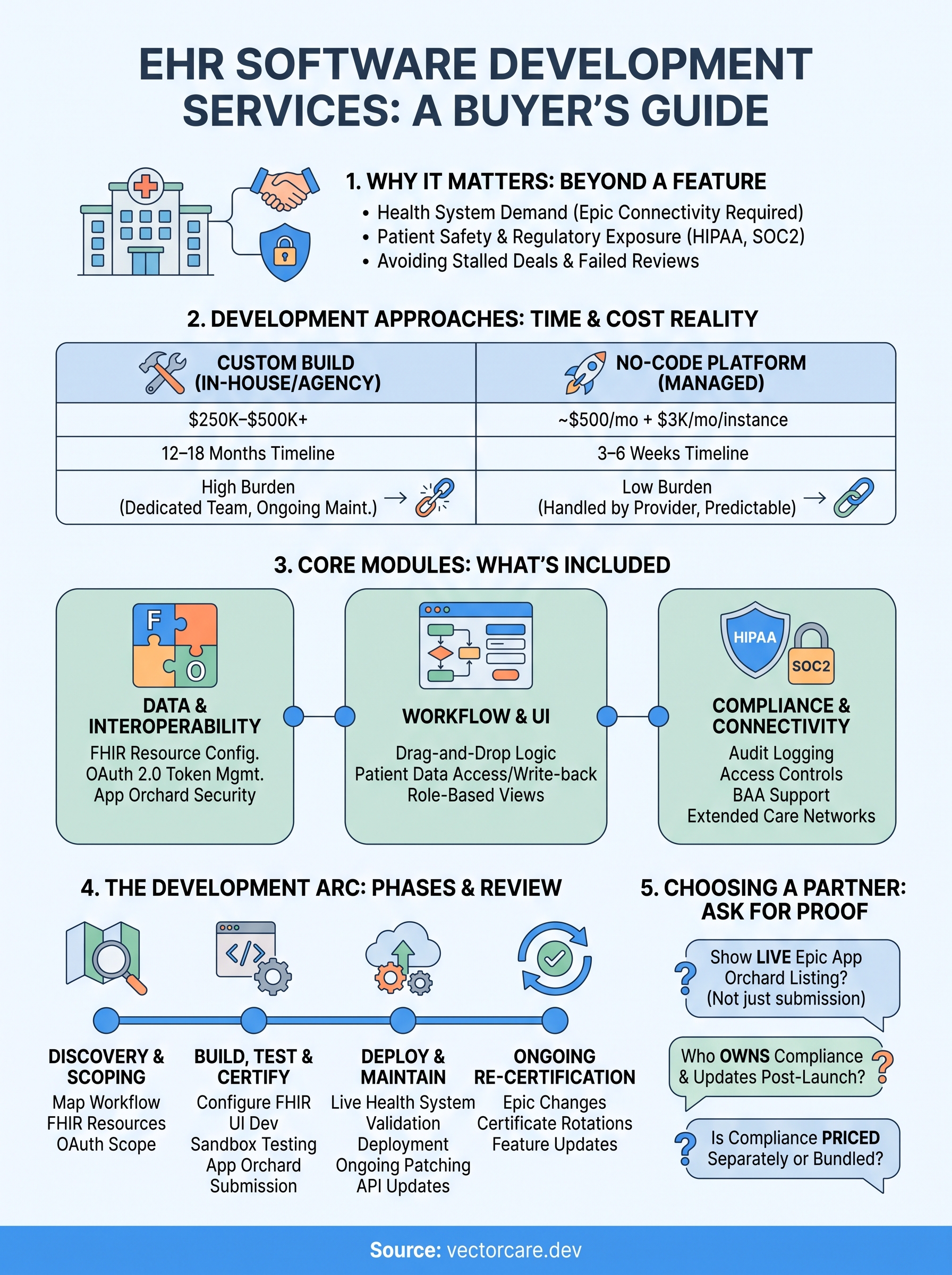
| Approach | Typical cost | Typical timeline | Ongoing burden |
|---|---|---|---|
| In-house custom build | $250K–$500K+ | 12–18 months | Dedicated FHIR/OAuth engineers, continuous maintenance |
| Freelance/agency contract | $150K–$300K | 6–12 months | Knowledge walks out the door when the contract ends |
| No-code managed platform | ~$500/month + $3K/month per instance | 3–6 weeks | Handled by the platform provider |
That cost gap explains why so many digital health startups delay their Epic strategy until a contract forces the issue, and why that delay usually backfires once you see what actually stretches an Epic integration out. Custom API integration work built under deadline pressure tends to skip documentation and testing steps that come back to bite you during a health system's security review. Understanding this math up front, before you're negotiating a statement of work, puts you in a much stronger position to evaluate whether a traditional build or a managed platform actually fits your timeline and budget.
How EHR software development services work
Most EHR software development services follow a similar arc regardless of vendor: discovery, build, compliance review, and deployment. What changes between a traditional agency and a managed platform is how much of that arc you own versus how much gets handled for you. Understanding each phase helps you spot where a vendor's quote is hiding extra work, and where a faster timeline is realistic rather than a sales pitch.
Discovery and scoping
Every serious engagement starts by mapping your clinical workflow against Epic's FHIR resources: what patient data you need to pull, what you'll write back, and which users touch the app inside the EHR. Scoping also decides your integration path, since SMART on FHIR development for a launch-in-context app looks nothing like a standalone app pulling bulk data through backend services. Vendors who skip a real scoping conversation and jump straight to a fixed quote are usually underestimating the OAuth and workflow complexity, which shows up later as change orders.
Build, test, and certify
Once scope is locked, engineers configure or code the FHIR calls, OAuth 2.0 authentication, and the UI that lives inside Epic's interface. Testing happens in two stages: first against Epic's sandbox environment or the SMART Health IT sandbox, then against a health system's non-production instance during their own validation process. Certification is the part outsiders underestimate most, since Epic's App Orchard (Showroom) review checks security posture, data handling, and clinical fit before your app can get into Epic and be listed. A typical build sequence looks like this:
- Configure FHIR resource calls and OAuth scopes
- Build workflow logic and UI inside the EHR context
- Test against Epic's sandbox
- Submit for App Orchard/Showroom review
- Validate against a live health system instance
- Deploy to production
The App Orchard review, not the coding itself, is where most timelines quietly double.
Deployment and ongoing maintenance
Deployment isn't a one-time event, since Epic updates its FHIR APIs and security requirements on its own schedule, and your app has to keep pace. That means hosting a SMART on FHIR app with real uptime monitoring, patching OAuth token handling when Epic rotates certificates, and re-certifying features as Epic's implementation guide evolves. Traditional builds leave this maintenance burden on your own engineering team indefinitely, which is exactly the ongoing cost that platforms like VectorCare absorb through managed hosting and support instead. Weighing who owns that long-term maintenance work matters just as much as comparing the upfront build cost, since it determines whether your engineers spend next year shipping product or babysitting an integration.
Core features and modules included in EHR projects
When you scope ehr software development services, you're really scoping a set of distinct modules that all have to work together inside Epic's environment, which is easier to see once you know how EHR integration works. Vendors rarely build a single monolithic app, they assemble a data layer, a UI layer, and a workflow layer, then wire authentication and logging through all three. Knowing what each module actually does helps you catch a vendor's quote that's missing a piece, or padded with something you don't need.

Data exchange and interoperability layer
At the core sits the FHIR resource configuration that pulls and pushes patient data: demographics, medications, lab results, observations, and whatever else your clinical use case needs. This layer also handles OAuth 2.0 token management, since every FHIR call to Epic has to carry a valid, scoped token that respects patient consent and user role. Getting this piece wrong doesn't just break a feature, it fails Epic's App Orchard security review outright.
Clinical workflow and UI modules
Beyond data access, your app needs a UI that lives inside Epic's interface without feeling bolted on, covering things like intake forms, order entry, referral routing, or assessment tools depending on your service line. This is where drag-and-drop workflow logic matters most, since clinicians won't tolerate an extra five clicks buried in a launch-in-context app. Most projects include some combination of these modules:
- Patient data pull (demographics, meds, labs, vitals)
- Write-back actions (orders, notes, referrals)
- Approval flows and routing logic
- Notification triggers for care teams
- Role-based UI views for different clinical staff
- Audit logging tied to every data access event
If a module doesn't map to a real clinical workflow, it's scope creep, not a feature.
Compliance and connectivity modules
Security and compliance aren't bolted on at the end, they're built into every module above from the start. That includes audit logging for HIPAA compliance, SOC2-aligned access controls, and documentation that a health system's security team will actually request during review. Connectivity modules also extend past Epic itself, since many vendors need care coordination and post-acute placement workflows that route data to transportation, DME, home health, or analytics partners once the core Epic integration works.
Why module scope drives your quote
Every module above adds engineering time, testing cycles, and a line item to your statement of work. Vendors who quote a flat fee without listing these modules explicitly are usually estimating from a template, not your actual clinical workflow. Platforms built specifically for this space, like VectorCare's no-code workflow builder, pre-package these modules as configurable components instead of custom code, which is exactly why the same scope that takes a traditional build 12-18 months can ship in weeks.
Custom builds vs off-the-shelf vs FHIR integrations
Once you understand the modules involved, the next decision is which delivery model actually builds them. Healthcare vendors evaluating ehr software development services usually land on three paths: a fully custom build from scratch, an off-the-shelf EHR product you adapt, or a FHIR-based integration layered onto your existing app. Each path trades speed, control, and cost differently, and picking the wrong one for your situation is the single most common reason projects stall.

Custom builds: full control, full ownership
Building from scratch means your engineers own every line of code, including OAuth flows, FHIR resource handling, and the Epic App Orchard and Showroom listing submission itself. That control comes with a real price tag, since you're staffing engineers who understand Epic's implementation guide well enough to pass a health system's security review on the first try. Teams choose this route when their clinical workflow is unusual enough that no pre-built template fits, but most digital health startups don't actually need that level of customization for a standard intake, referral, or monitoring use case.
Off-the-shelf EHR software: fast but rigid
Buying an off-the-shelf EHR product solves a different problem than integration does, since these tools give you a full record system rather than a way to plug your existing service into Epic. Vendors selling into hospitals that already run Epic don't need another EHR, they need their app to talk to the one already installed. Off-the-shelf systems also lock you into someone else's data model and UI, which rarely maps cleanly onto the clinical workflow you're trying to embed.
FHIR integrations: the practical middle path
A FHIR-based integration lets your existing product connect directly into Epic without rebuilding your core service or replacing what a hospital already runs. This is the path most vendors actually need, since it keeps your product intact while satisfying the interoperability standard health systems require.
The right model isn't the one with the most features, it's the one that gets you inside Epic without rebuilding what already works.
| Model | Best for | Timeline | Control level |
|---|---|---|---|
| Custom build | Unique, complex clinical logic | 12-18 months | Full, but full burden too |
| Off-the-shelf EHR | Replacing a legacy record system | 6-12 months | Limited, vendor-defined |
| FHIR integration (no-code) | Embedding an existing product into Epic | 3-6 weeks | Configured, not coded |
Platforms like VectorCare sit squarely in that third column, turning what used to require a custom build into a configuration exercise instead.
Compliance and security requirements to expect
Compliance isn't a phase you tack onto ehr software development services at the end, it's a set of requirements baked into every module from day one. Health systems and Epic itself both run their own review before your app touches a single patient record, and vendors who treat compliance as paperwork instead of engineering discipline get caught during that review, not before it.
HIPAA and BAAs come first
HIPAA compliance requirements set the baseline for anything touching protected health information, and no health system will let your app near patient data without a signed Business Associate Agreement in place first. Beyond the paperwork, HIPAA's Security Rule safeguards and standards require specific technical controls your build has to demonstrate, not just claim. The HHS Security Rule guidance spells out the categories reviewers check:
- Encryption for data at rest and in transit
- Role-based access controls tied to user identity
- Audit logging for every access to patient data
- Documented breach notification procedures
- Signed BAAs with every subcontractor touching PHI
SOC2 controls prove the process, not just the promise
SOC 2 compliance goes further than HIPAA by requiring evidence that your access controls and change-management processes actually run the way you say they do. A SOC 2 Type II audit reviews those controls over months, not a single point in time, so a vendor claiming SOC2 compliance without an active audit trail is overstating their position. Health system security teams increasingly ask for the SOC2 report directly during procurement instead of accepting a checkbox on a vendor questionnaire.
Epic's App Orchard review adds a third layer
Epic runs its own App Orchard security review before listing any app in the Showroom, checking OAuth scoping, data handling, and clinical workflow fit on top of whatever HIPAA and SOC2 already cover. This review catches issues generic compliance checklists miss, like a FHIR call requesting broader data access than the actual workflow needs.
Compliance built after the fact is compliance that fails the first real review.
Vendors that bundle HIPAA and SOC2 compliance into the platform itself, the way VectorCare's compliance-ready architecture does, skip the scramble to retrofit these controls under contract deadline pressure.
What EHR development services typically cost and take
Price tags for ehr software development services vary so widely that vendors often can't give you a straight number without a scoping call first. That's not evasiveness, it's because the same project can cost $250,000 or $6,000 depending on whether you're staffing a custom build or configuring a managed platform. Knowing which cost drivers actually move the number lets you tell a realistic quote from a padded one.
Where the money actually goes
Breaking a quote into its real components stops you from comparing apples to oranges when vendors present wildly different totals. A traditional custom build spreads cost across several buckets that a no-code platform collapses into a flat subscription:
- FHIR resource mapping and OAuth setup: 20-30% of engineering hours
- Workflow and UI development inside Epic's interface: 25-35%
- Compliance documentation (HIPAA evidence and SOC 2 Type II audit pricing): 10-15%
- App Orchard/Showroom submission and revisions, on top of Epic App Orchard fees and tiers: 10-20%
- Ongoing maintenance and re-certification: recurring, often underbudgeted entirely
That last line item is the one most startups forget to price out, and it's the one that never stops accruing once your app is live.
Timeline math nobody quotes upfront
Engineering time is only half the timeline. Health system procurement, security review, and Epic's own App Orchard review timeline add months that no vendor controls directly. A custom build often spends as long waiting on review cycles as it does writing code, which is why a 12-month engineering estimate frequently turns into an 18-month real-world delivery.
The number that matters isn't the engineering estimate, it's the date your app actually goes live in a health system.
Hidden costs that blow past the quote
Quotes rarely include what happens after Epic changes something. Certificate rotations, FHIR API version updates, and re-certification after a workflow change all generate unplanned engineering hours that a fixed-price contract didn't anticipate. Recurring costs like these are exactly why a no-code deployment model changes the math: instead of budgeting for a variable maintenance team, you pay a predictable monthly fee and the platform absorbs the update cycle.
A realistic budget conversation
Setting expectations early avoids the mid-project scramble that happens when a fixed quote runs out before the app passes review. Before signing anything, ask a vendor to break out compliance work, what FHIR certification actually costs, App Orchard submission, and post-launch maintenance as separate line items, not one bundled number. Vendors who can't separate those costs usually haven't scoped the project closely enough to hit their own timeline, let alone yours.
How to choose an EHR software development partner
Picking a vendor for ehr software development services comes down to one question: can they show you a working Epic integration, not just a portfolio of healthcare-adjacent apps? Plenty of agencies list "healthcare experience" without ever having passed an App Orchard review, and that gap only surfaces after you've signed a contract and your timeline is already slipping.
Ask for proof, not promises
Before you sign anything, push past the sales deck and ask for specifics that a vendor without real Epic experience can't fake. A short list of questions separates vendors who've actually shipped inside Epic from ones who are learning on your dollar:
- Can you show a live app currently listed in Epic's App Orchard/Showroom?
- Who owns the BAA and SOC2 documentation once the app goes live?
- What happens when Epic rotates a certificate or updates a FHIR resource?
- Is compliance work priced separately, or bundled into a flat fee that hides the real cost?
- What's your actual App Orchard approval rate, not just submission count?
A vendor who can't show a live Epic listing is asking you to fund their first attempt.
Match the model to your team's bandwidth
Your choice of partner should follow from the build model you picked earlier, not the other way around. If your team has dedicated FHIR and OAuth engineers with time to spare, a traditional custom API integration shop might fit. If your engineers are better spent on your core product, a managed, no-code platform removes the maintenance burden entirely instead of just deferring it. Vendors offering EHR interoperability solutions as a side service, rather than their core business, tend to underprice the compliance and re-certification work because they haven't lived through a full Epic update cycle themselves.
Weigh long-term ownership, not just launch speed
A fast launch means little if your team inherits an unmaintainable integration six months later. Ask who handles certificate rotations, who re-certifies features after Epic changes its implementation guide, and who answers when a health system's security team flags something during renewal. Platforms built specifically around this model, like VectorCare's managed hosting and support, fold that ownership into the monthly fee instead of leaving it as an unplanned line item on your engineering roadmap a year from now. That distinction, more than any single feature list, is what separates a partner from a vendor who disappears after the App Orchard listing goes live.
Putting the pieces together
Every piece covered here, discovery, FHIR configuration, compliance documentation, App Orchard review, ongoing maintenance, adds up to one decision: do you staff a custom build or configure a managed platform. EHR software development services aren't optional if a health system contract requires Epic connectivity, but the traditional path of $250K and 12-18 months isn't your only option anymore. The math favors teams who treat compliance and re-certification as engineering work from day one, not paperwork bolted on before a demo.
If your engineers are better spent building your core product than babysitting OAuth tokens and certificate rotations, a no-code path gets you the same Epic listing without the headcount. You've seen what a real quote should include and what questions expose a vendor who's learning on your dollar. Build and deploy your SMART on FHIR app in days with VectorCare instead of months, and skip the parts of this process that never needed to be hard.
The Future of Patient Logistics
Exploring the future of all things related to patient logistics, technology and how AI is going to re-shape the way we deliver care.
Thank you! Your submission has been received!
Oops! Something went wrong while submitting the form.