CMS Interoperability and Patient Access Rule: What It Requires

If you sell software to hospitals or health plans, someone on your team has probably asked whether you're ready for the CMS Interoperability and Patient Access Rule. It's not a niche compliance footnote. CMS finalized it to force health plans and providers to open up patient data through standardized APIs, and it now shapes how any vendor touching claims or clinical data has to build.
This rule requires impacted payers to expose patient access APIs built on FHIR, publish provider directory data, and support data exchange at admission, discharge, and transfer. It applies to Medicare Advantage plans, Medicaid, CHIP, and QHP issuers on the federal exchanges, and it directly affects any vendor whose product connects to those systems. The goal is simple: patients get their own health data through the apps of their choice, without manual record requests.
In this article, you'll get a plain breakdown of what the rule actually mandates, who has to comply, and what it means for your integration roadmap if you're building tools that plug into EHRs like EPIC.
Why the CMS Interoperability and Patient Access Rule matters
What changes for patients
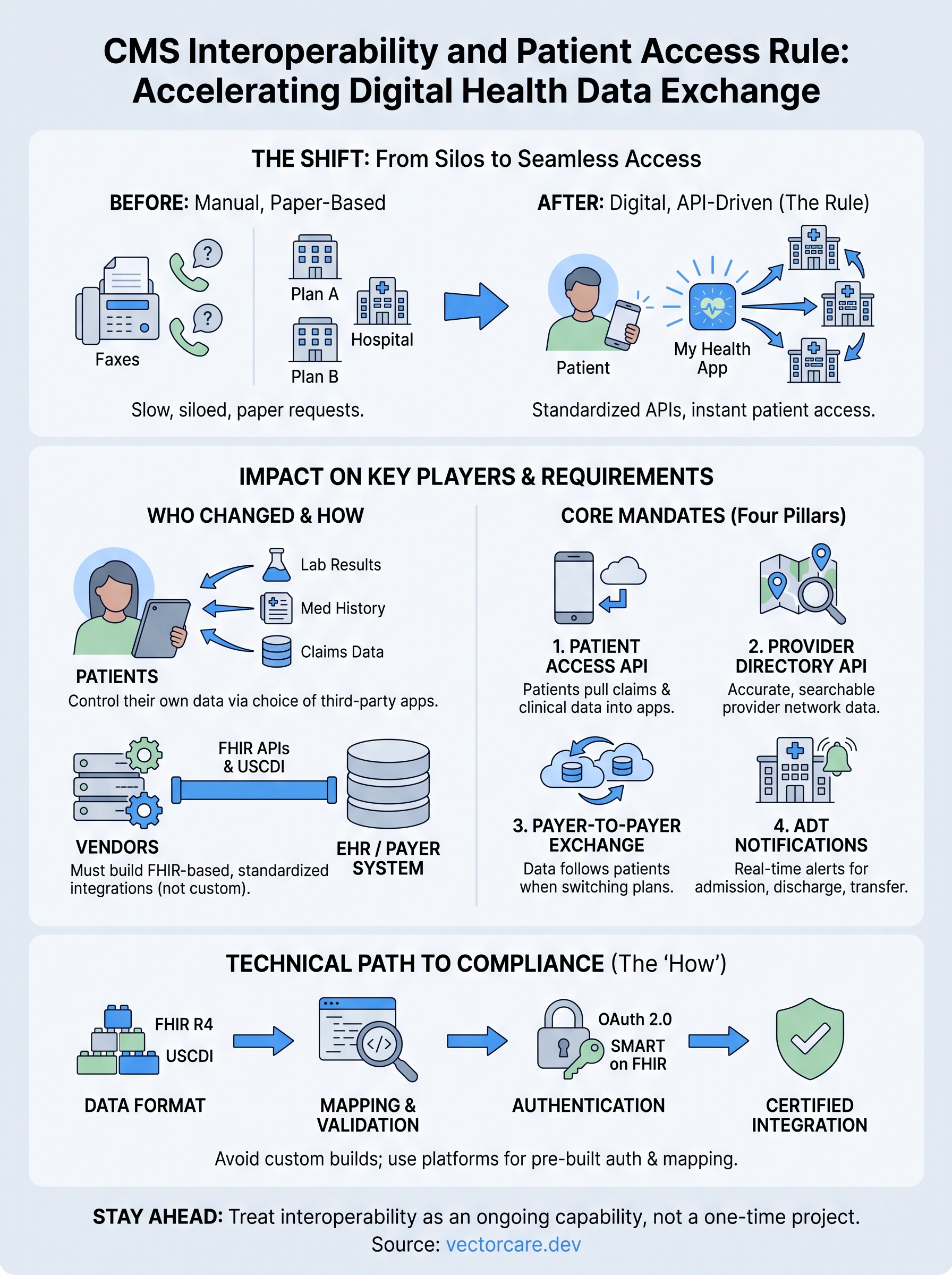
Before this rule, getting your own medical records often meant faxed forms, phone tag, and weeks of waiting. The CMS Interoperability and Patient Access Rule flips that by requiring payers to expose claims, encounters, and clinical data through standardized patient access APIs that any approved app can call. A patient managing diabetes can now pull lab results, medication history, and claims data into a single app instead of chasing down three different portals. This isn't a minor convenience upgrade. It's a structural shift in who controls health data, moving power from institutions toward the person the data is actually about.
The rule turns patient data access from a paperwork favor into a technical obligation.
What changes for vendors
Vendors feel this shift just as directly as patients do. Health systems now expect any product touching patient data to plug into FHIR-based APIs without custom one-off engineering, because that's what the rule requires from their side. If your app can't consume or produce data in that format, you become the bottleneck in a workflow that's supposed to move automatically. That shows up in procurement conversations fast:
- Health systems ask upfront whether your product supports SMART on FHIR
- Slow or manual integrations get flagged during vendor evaluations
- Compliance gaps delay or kill health system contracts that depend on clean data exchange
Vendors who treat this as a checkbox exercise miss the bigger opportunity: interoperability readiness has become a competitive differentiator, not just a regulatory line item on a security questionnaire.
Who must comply and what the rule requires
The rule targets specific payer types, not every healthcare organization in the country. CMS-regulated payers include Medicare Advantage plans, state Medicaid and CHIP programs, and Qualified Health Plan issuers on the federal exchanges. If your vendor product integrates with any of these payers, or with providers exchanging data on their behalf, you inherit their compliance obligations by extension.
The core mandates
Each regulated payer must build and maintain four things: a patient access API, a provider directory API, payer-to-payer data exchange, and support for admission/discharge/transfer notifications. Here's how those break down:
| Requirement | What it does |
|---|---|
| Patient Access API | Lets patients pull claims and clinical data into third-party apps |
| Provider Directory API | Publishes accurate, searchable provider network data |
| Payer-to-Payer Exchange | Moves patient data when someone switches health plans |
| ADT Notifications | Alerts providers of care transitions in near real time |
If you connect to a regulated payer's systems, you're building against these four requirements whether or not you call yourself a covered entity.
Vendors serving these payers, including EHR-adjacent tools, need to confirm which mandates apply before scoping any new integration. See the CMS Interoperability and Patient Access final rule for the full regulatory text.
How to comply with the rule's technical requirements
Meeting the CMS Interoperability and Patient Access Rule on paper is one thing. Actually building compliant infrastructure is where most vendors get stuck. The technical spec isn't optional guidance, it's a set of specific standards you have to implement correctly or your integration gets rejected during certification.
Build on FHIR R4 and USCDI
Start with HL7 FHIR R4 as your data format and map your fields to the United States Core Data for Interoperability (USCDI) version currently required. Skipping this mapping step is the most common reason integrations fail review, because payers and EHR vendors validate against USCDI element by element.
Authenticate with OAuth 2.0 and SMART on FHIR
Every patient-facing API call needs OAuth 2.0 authorization following the SMART App Launch framework. A minimal scope request looks like this:
GET /authorize?response_type=code&client_id=your_app&scope=patient/*.read launch/patient&redirect_uri=https://yourapp.com/callback
Compliance isn't about having FHIR somewhere in your stack, it's about implementing the exact version and auth flow CMS specifies.
Get your scopes, token refresh logic, and consent screens right before you ever submit for testing. Reworking auth flows after a failed review costs weeks you don't have.
Key deadlines and enforcement timeline
CMS didn't leave compliance dates vague. The original Patient Access API requirement took effect July 1, 2021, after a COVID-related delay from the initial January 2021 target. Provider directory obligations landed on the same schedule, and payer-to-payer data exchange followed with its own enforcement discretion period before CMS locked it in.
The dates that matter now
Subsequent rulemaking, particularly the 2023 CMS-0057-F update, layered on new obligations that vendors building for 2026 and beyond need to track.
| Requirement | Effective Date |
|---|---|
| Patient Access API | July 1, 2021 |
| Provider Directory API | July 1, 2021 |
| Payer-to-Payer Exchange | January 1, 2022 (enforcement phased in) |
| Prior Authorization API | January 1, 2027 |
Missing a deadline doesn't just risk a fine, it risks losing the health system contract that depended on you being ready.
Regulated payers face civil monetary penalties for noncompliance, and that pressure rolls downhill to any vendor whose integration isn't ready when the payer's deadline hits. Treat these dates as your dates too, because your health system contracts get evaluated against them either way.
Common compliance challenges and how to solve them
Most vendors don't fail the CMS Interoperability and Patient Access Rule because of bad intentions. They fail because building compliant FHIR infrastructure from scratch eats months of engineering time nobody budgeted for.
Mapping FHIR resources correctly
Getting USCDI mapping wrong is the top reason integrations bounce back from certification review. Teams without dedicated FHIR expertise often guess at resource structures instead of validating against the spec, and that guesswork shows up as rejected submissions weeks before a launch deadline.
Managing OAuth and consent flows
Building a secure SMART on FHIR auth flow from zero means handling token refresh, scope negotiation, and consent screens correctly on the first try. Get any piece wrong and you're reworking authentication instead of shipping features.
The fastest path around these challenges is skipping the custom build entirely.
Here's what actually causes most delays:
- No in-house FHIR or SMART App Launch expertise
- Underestimating certification review timelines
- Treating compliance as a one-time project instead of ongoing maintenance
Platforms built specifically for EPIC integration solve this by handling the FHIR mapping and auth work for you.
Staying ahead of interoperability requirements
The CMS Interoperability and Patient Access Rule isn't going away, and the 2027 prior authorization deadline means the requirements only get more demanding from here. Vendors who treat FHIR compliance as a one-time project keep getting caught off guard by new USCDI versions and updated certification checks. Building this infrastructure yourself means months of engineering time spent on auth flows and resource mapping instead of the product features that actually win contracts.
Smart teams skip that tradeoff entirely. Instead of hiring FHIR specialists or reworking failed submissions, they use a platform that already handles the OAuth flows, USCDI mapping, and EPIC certification work. That's the faster path to a compliant, contract-ready integration without the twelve-month engineering slog.
If you're ready to stop guessing at SMART on FHIR specs and start shipping, build and deploy your app in days with VectorCare.
The Future of Patient Logistics
Exploring the future of all things related to patient logistics, technology and how AI is going to re-shape the way we deliver care.
Thank you! Your submission has been received!
Oops! Something went wrong while submitting the form.