12-Point Business Associate Agreement Checklist for HIPAA

A single missing clause in your BAA can turn a routine HIPAA audit into a six-figure penalty. For healthcare vendors pursuing EHR integrations, especially with EPIC, every data-sharing relationship you enter requires a legally sound Business Associate Agreement. Yet most vendors either copy a template they found online or rely on whatever their partner hands them, without verifying that it actually covers what HIPAA demands. A thorough business associate agreement checklist is the difference between real compliance and expensive assumptions.
At VectorCare, we handle HIPAA and SOC2 compliance as part of our no-code SMART on FHIR platform, including executing BAAs with every healthcare vendor we work with. That experience has shown us exactly where agreements fall short, and how those gaps create risk when you're trying to get listed on the EPIC Showroom or close contracts with health systems. Compliance isn't a nice-to-have; it's a deal prerequisite.
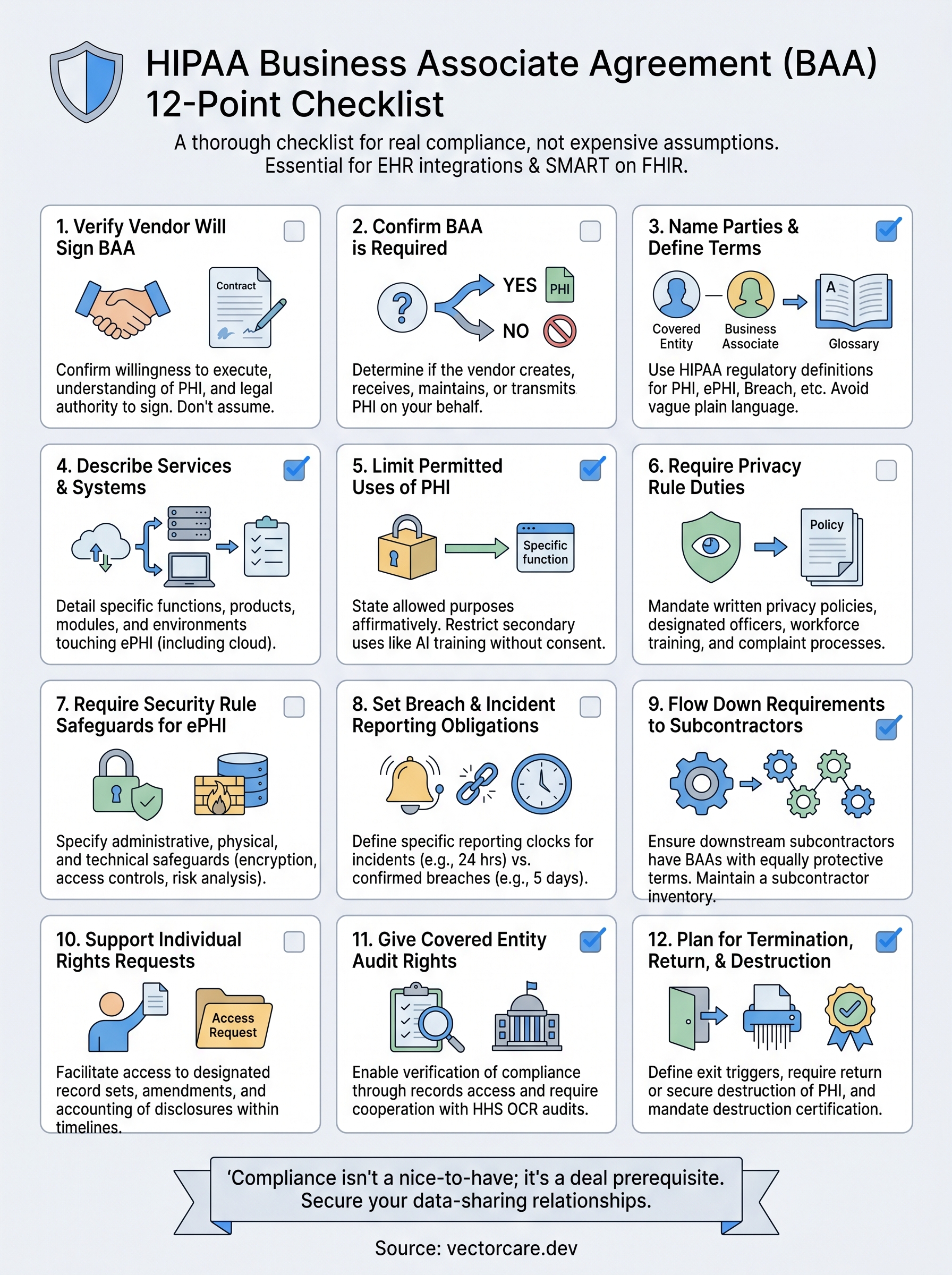
This article breaks down the 12 essential elements every BAA must include to satisfy HIPAA requirements. You'll get a clear, actionable checklist covering permitted uses of PHI, breach notification obligations, subcontractor requirements, termination provisions, and more. Whether you're drafting a new agreement or auditing one you already signed, this guide gives you a concrete framework to verify nothing got missed.
1. Start with a vendor that will sign a BAA
Before you negotiate a single clause, you need to know whether your vendor will sign a BAA at all. Willingness to execute a BAA is the baseline requirement, and without it, the rest of your business associate agreement checklist becomes irrelevant. Some vendors flat-out refuse, or they offer watered-down "data processing addenda" that don't satisfy HIPAA's requirements. Screen for this before you invest time in due diligence.
What to confirm before you negotiate
Your first move is to ask the vendor directly: "Will you sign a HIPAA Business Associate Agreement?" That question alone filters out vendors who are unwilling or unqualified to handle protected health information. Before you sit down to negotiate terms, confirm that the vendor understands what PHI is, has internal compliance policies for handling it, and has executed BAAs with other covered entities or business associates before.
Confirm that the person you're speaking with has actual authority to execute legal agreements on behalf of their organization. Wasting weeks negotiating terms only to learn that final approval sits with a different team creates unnecessary delays and signals that the vendor lacks a mature compliance process.
What to verify for SMART on FHIR and EHR integrations
For SMART on FHIR and EPIC integrations, the BAA conversation takes on additional complexity. When your application pulls patient data from an EHR, that data flow typically involves ePHI passing through multiple systems, including your platform, your cloud infrastructure, and potentially third-party APIs. Verify that the vendor covers each environment in scope, not just the front-end application.
Confirm that the BAA explicitly names the systems, environments, and data flows that touch ePHI, because a generic agreement that references only "the services" will not hold up under scrutiny from a health system or HHS auditor.
Ask whether the vendor holds prior EPIC Showroom listings or current SMART on FHIR compliance documentation. A vendor with that track record has already navigated the technical and legal requirements that health systems expect, which significantly reduces your risk during onboarding.
Red flags that signal you should walk away
Certain behaviors during early conversations tell you a vendor is not a safe partner for PHI:
- They claim a BAA is "not necessary" without citing a legitimate HIPAA exception
- They offer only a terms-of-service update instead of a standalone executed agreement
- They cannot name a single point of contact responsible for HIPAA compliance
- They argue that SOC2 certification automatically satisfies HIPAA obligations without distinguishing the two frameworks
- They push back on audit rights or refuse to disclose subcontractor relationships
Any one of these signals a compliance gap that puts your covered entity customers at direct regulatory risk. Document your reasoning and move on.
2. Confirm you actually need a BAA
Not every vendor relationship requires a BAA, and signing one when it isn't necessary can create confusion around data responsibilities and slow down your onboarding process. Before you run through your business associate agreement checklist, take a moment to verify that a BAA is actually required for this specific relationship and this specific vendor.
How HIPAA defines a business associate
HIPAA defines a business associate as any person or entity that creates, receives, maintains, or transmits PHI on behalf of a covered entity or another business associate while performing functions outside of direct treatment, payment, or healthcare operations. The phrase "on behalf of" carries the legal weight here. If the vendor performs a function directly for your organization that involves PHI, they qualify as a business associate and a BAA is required before any data exchange begins.
A vendor that processes claims data, hosts patient records, or runs analytics on clinical outcomes is almost certainly a business associate regardless of how they label their service.
Common exceptions that do not require a BAA
Some relationships fall outside HIPAA's BAA requirement entirely. Conduit providers that transport PHI without accessing or storing it, such as certain courier services or basic internet service providers, are not business associates under HIPAA. A vendor whose staff only incidentally encounters PHI while performing unrelated facilities maintenance also typically falls outside the requirement, provided that access is not routine, systematic, or intentional.
A quick decision test you can apply to any vendor
Ask two direct questions about every vendor you evaluate. First, does the vendor touch PHI as part of delivering their service to you? Second, does that contact happen on your behalf rather than as a standalone, unrelated function? If both answers are yes, you need a signed BAA before any data flows between your systems and theirs. If either answer is no, document your reasoning and retain that record in case HHS ever asks you to justify the decision.

3. Name the parties and define key terms
Sloppy definitions are the source of most BAA disputes. Before you move to substantive obligations, make sure your agreement identifies every party correctly and establishes shared definitions for the terms that will govern the entire relationship. This step alone prevents ambiguity from turning into a scope fight months after you sign.
Definitions that prevent scope fights later
Your business associate agreement checklist should include a definitions section that mirrors HIPAA's statutory language while adding specificity for your particular engagement. At minimum, define "covered entity," "business associate," "protected health information," "electronic protected health information," "breach," "security incident," and "subcontractor." Pull these definitions directly from 45 CFR Part 164 rather than paraphrasing, because any deviation from regulatory language creates interpretive gaps that neither party can reliably resolve without legal review.
Incorporating HIPAA's regulatory definitions by reference, rather than rewriting them in plain English, keeps your agreement aligned with HHS enforcement expectations and removes ambiguity from the start.
How to describe PHI and ePHI in plain language
Most BAAs define PHI too broadly or too narrowly. Describe the specific categories of health information the vendor will access, such as lab results, medication records, or scheduling data, so both parties understand what actually requires protection. Call out ePHI explicitly if the vendor accesses electronic data through an EHR, because HIPAA's Security Rule applies exclusively to ePHI and requires separate safeguards that the Privacy Rule alone does not mandate.
How to handle affiliates, workforce, and agents
Your definitions section must clarify whether the BAA covers only the named vendor entity or also its affiliates and subsidiaries. Define "workforce" consistently with HIPAA's definition, which includes employees, volunteers, trainees, and contractors. Confirm that the term "agent" captures any individual acting on the vendor's behalf, because that language determines who the vendor is legally responsible for when PHI is mishandled.
4. Describe the services and systems in scope
A BAA that names the parties but fails to specify what the vendor does with PHI is missing its functional core. Your business associate agreement checklist should require a detailed description of services covered, because "the services" as a catch-all phrase gives neither party clear guidance on what the agreement actually governs. Specificity here protects you during audits and prevents disputes when your vendor adds capabilities or changes how data flows through their systems.
How to document what the vendor will do
Describe the vendor's specific functions in concrete terms: data storage, clinical analytics, patient scheduling, billing support, or whatever applies to your engagement. Each function should answer how PHI is involved, whether the vendor creates, receives, maintains, or transmits it, and in what context. Avoid vague language like "technology services" because it cannot reliably guide compliance decisions when circumstances change.
This documentation also serves as your internal compliance record if HHS ever questions whether you had appropriate agreements in place. Keeping function-level descriptions alongside the signed BAA is a straightforward practice that many vendors overlook until an audit surfaces the gap.
How to list products, modules, and environments
Name each product, module, and environment that touches ePHI, including production systems, staging environments used with real data, and any backup or archive systems. If your vendor operates in the cloud, specify whether the agreement extends to their cloud provider infrastructure, because HIPAA still applies regardless of where ePHI physically resides.

Failing to name every environment that processes ePHI leaves entire portions of your data ecosystem outside the BAA's protection.
How to avoid gaps like personal email and shadow IT
Require the BAA to explicitly prohibit PHI transmission through unapproved channels. Shadow IT creates real compliance exposure that a vague services description cannot address. To close this gap, the agreement should specifically bar:
- Personal email accounts
- Unauthorized file-sharing tools
- Unapproved mobile applications
5. Limit permitted uses and disclosures of PHI
Every BAA must spell out exactly what the vendor is allowed to do with the PHI you share. Without clear limits, a vendor can justify nearly any use of patient data by pointing to ambiguous contract language. Your business associate agreement checklist must include a dedicated section that defines permitted uses and disclosures with enough precision to leave no room for interpretation.
How to write clear allowed purposes
State the allowed purposes in affirmative, specific terms rather than relying on a blanket prohibition of "all other uses." If you hired the vendor to process prior authorizations, the BAA should say exactly that. Naming the specific functions the vendor performs ties the permission directly to the service delivered, and any use outside those named functions requires separate written authorization before the vendor can proceed.
At minimum, your permitted uses clause should cover:
- Care management tied directly to the contracted function
- Payment processing and claims support
- Healthcare operations the vendor performs on your behalf
How to restrict secondary use like analytics and AI training
Vendors that operate data platforms often reserve the right to use de-identified patient data for product improvement, benchmarking, or AI model training. Your agreement must explicitly prohibit these secondary uses unless you have reviewed and approved them in writing. Require the vendor to seek your consent before they aggregate, anonymize, or otherwise repurpose any data derived from the PHI you share.
If your BAA is silent on AI training and analytics, you are implicitly permitting uses that your covered entity customers never agreed to.
How to handle legal disclosures and minimum necessary
Some disclosures are legally required, such as responses to court orders or government investigations. Your BAA should require the vendor to notify you before disclosing PHI in response to a legal demand whenever advance notice is legally permissible. Also confirm that the agreement incorporates HIPAA's minimum necessary standard, which limits any disclosure to the smallest amount of PHI required to fulfill the stated purpose.
6. Require Privacy Rule compliance duties
Your vendor must do more than avoid obvious violations. They need active, documented Privacy Rule obligations written directly into the agreement. This section of your business associate agreement checklist ensures the vendor commits to specific behaviors, not just passive acknowledgment of HIPAA's existence.
Safeguards that the contract should require
Your BAA should require the vendor to implement administrative and organizational safeguards that limit how their staff interacts with PHI. These safeguards must go beyond a general statement of intent. Require the vendor to maintain written privacy policies, conduct periodic reviews of those policies, and apply them consistently across every function that touches patient data.
A BAA that requires safeguards "appropriate to the size and complexity of the organization" without naming specific controls gives the vendor too much room to do too little.
At minimum, the agreement should require the vendor to:
- Designate a Privacy Officer responsible for policy development and oversight
- Limit PHI access to workforce members with a documented, role-based need
- Maintain written records of privacy policy reviews and updates
Workforce training and policy requirements
Require the vendor to train every workforce member who handles PHI before they access it and annually thereafter. Training alone is not enough. The BAA should also require the vendor to maintain training completion records and make those records available to you upon request. Untrained staff is one of the most common root causes of Privacy Rule violations, and your contract should close that gap before it opens.
How to handle complaints and privacy incidents
Your agreement must require the vendor to maintain a complaint intake process that accepts and documents concerns from individuals about how their PHI is handled. Require the vendor to notify you of any complaint related to your data within a defined timeframe and to share the outcome of their internal review before closing the matter.
7. Require Security Rule safeguards for ePHI
The Privacy Rule governs how PHI is used and shared, but HIPAA's Security Rule applies exclusively to electronic protected health information and requires vendors to implement specific, documented controls. Your business associate agreement checklist must include Security Rule obligations, because a BAA that addresses privacy without covering security leaves ePHI exposed every time a vendor employee opens a patient record on a laptop or an API call returns clinical data to a third-party system.
Administrative safeguards you should require
Administrative safeguards form the foundation of Security Rule compliance. Require the vendor to maintain a risk analysis and risk management program that identifies, evaluates, and addresses threats to ePHI on an ongoing basis, not just at contract signing. The BAA should also require a designated Security Officer with documented authority to develop and enforce security policies across the vendor's entire workforce.
A vendor that cannot produce a current risk analysis has almost certainly not implemented the downstream controls that analysis is supposed to drive.
Physical and technical safeguards to call out explicitly
Physical safeguards limit unauthorized physical access to systems that store or process ePHI. Your agreement should require workstation controls, facility access policies, and device and media disposal procedures that permanently destroy data before hardware leaves the vendor's possession. On the technical side, require encryption of ePHI at rest and in transit, automatic session timeouts, unique user identification, and audit logging that captures every access event with a timestamp and user identifier.

Evidence you should request during due diligence
Do not accept a vendor's self-attestation as proof that Security Rule safeguards are actually in place. Request a SOC2 Type II report or an equivalent third-party assessment, because those reports document whether controls operated consistently over a defined period. Also ask for the vendor's most recent penetration test summary and any remediation steps taken after findings were identified.
8. Set breach and incident reporting obligations
Your business associate agreement checklist must include precise breach reporting requirements. Vague language like "prompt notification" creates disputes the moment an actual incident occurs, because "prompt" means different things to a vendor trying to contain a situation and a covered entity facing regulatory deadlines.
What the vendor must report and when
Require the vendor to report two distinct categories of events: a confirmed breach of unsecured PHI and any security incident, even those that turn out to be unsuccessful attempts. HIPAA requires reporting of both, and your agreement should treat them separately. Set a specific clock for each, for example, 24 hours for security incidents and no more than five calendar days for confirmed breaches, giving you time to complete your own required notifications before federal deadlines arrive.

Requiring a shorter internal reporting window than HIPAA's 60-day maximum gives you enough runway to investigate, assess harm, and meet your breach notification obligations to HHS and affected individuals.
What details the notice must include
A breach report without sufficient detail is nearly useless when you are trying to respond quickly. Your BAA should specify that every breach notice must include the date of the breach, the date the vendor discovered it, a description of the PHI involved, the number of individuals affected, and the steps the vendor has already taken to contain and mitigate the incident. Requiring a structured format rather than a free-text email makes your internal review faster and your documentation cleaner.
How to align timelines with HIPAA breach notification rules
HIPAA gives covered entities 60 calendar days from discovery to notify HHS and affected individuals of a breach. Your agreement must account for that window by requiring the vendor to report incidents to you well before that deadline expires. Require the vendor to cooperate with your forensic investigation, provide additional details as they become available, and document their containment actions in writing so your final breach report to HHS reflects a complete account of what happened.
9. Flow down requirements to subcontractors
Your vendor does not operate in isolation. They use cloud platforms, analytics tools, and development partners that may all touch ePHI as part of delivering their service to you. Your business associate agreement checklist must require the vendor to flow down HIPAA obligations to every subcontractor they engage, because HIPAA holds business associates directly responsible for the actions of their subcontractors under the Omnibus Rule.
How to create a downstream BAA chain
Require your vendor to execute a written BAA with each subcontractor before that subcontractor accesses any PHI. The terms in those downstream agreements must be at least as protective as the obligations your vendor carries under their agreement with you. This creates a chain of accountability that extends HIPAA's requirements through every layer of your vendor's supply chain, not just the top level.
A subcontractor that accesses ePHI without a signed BAA in place exposes your covered entity customers to the same breach liability as if your own organization had failed to execute the agreement.
How to require subcontractor oversight and documentation
Require the vendor to maintain a current inventory of every subcontractor that receives or processes PHI on their behalf. That list should include the subcontractor's name, the specific function they perform, and the date their BAA was executed. Ask the vendor to make this inventory available to you upon request, because HHS auditors can ask covered entities to demonstrate that their entire data ecosystem is covered by compliant agreements.
How to handle cloud providers and shared responsibility
Cloud providers introduce a shared responsibility model that BAAs must address directly. Your vendor's agreement with you should confirm that their cloud infrastructure provider has signed a BAA and that the vendor understands which security controls the provider covers versus which ones the vendor must implement independently. Require the vendor to document that division in writing so neither party assumes the other is handling a control that nobody actually owns.
10. Support individual rights requests
HIPAA gives individuals specific rights over their own health information, and your business associate agreement checklist must require your vendor to actively support those rights, not just acknowledge that they exist. When a patient exercises their rights through a covered entity, the covered entity often needs cooperation from its business associates to fulfill the request. If your BAA does not obligate the vendor to help, you are the one who faces a compliance failure when deadlines pass.
Access requests and designated record sets
Your BAA must require the vendor to make PHI within designated record sets available to you upon request so you can fulfill individual access rights under 45 CFR 164.524. Require the vendor to maintain a clear definition of which records qualify as a designated record set for their specific function, because the answer varies depending on whether the vendor performs clinical, billing, or operational work on your behalf.
Vendors that cannot quickly locate and produce PHI from a designated record set put you at direct risk of missing your legal obligations to the individual who requested access.
Amendments and accounting of disclosures
Require the vendor to accept and implement amendment requests that you forward after an individual demonstrates their PHI is inaccurate or incomplete. The BAA should obligate the vendor to update their records accordingly and notify any downstream parties that received the original data. Also require the vendor to maintain a log of all disclosures that fall outside treatment, payment, and operations, because individuals have the right to request an accounting of those disclosures going back six years.
Timeframes that keep you inside the 30-day rule
HIPAA gives covered entities 30 days to fulfill an access request, with one 30-day extension available if you notify the individual in writing. Your BAA must require the vendor to respond to your data requests within a window that leaves you adequate time to review, compile, and deliver the response before your regulatory clock expires. Set an internal vendor deadline of no more than 10 business days to build in sufficient buffer.
11. Give the covered entity audit and oversight rights
Signing a BAA does not end your compliance obligations. Your business associate agreement checklist must include explicit audit and oversight rights that let you verify, at any time, that the vendor is actually living up to what they agreed to on paper. Without these rights written into the contract, you have no formal mechanism to demand evidence of compliance before HHS comes looking for it.
What records the vendor must make available
Your BAA should require the vendor to maintain complete and organized records of their compliance activities and make those records available to you within a defined timeframe upon request. Specify exactly which records qualify, including risk analyses, training logs, security incident reports, subcontractor BAA inventory, and audit logs. A vendor that cannot produce current documentation within a reasonable window is signaling that the underlying controls may not exist.
Requiring records within 10 business days of your request gives you a practical enforcement mechanism without creating an unworkable operational burden for the vendor.
Cooperation with HHS OCR investigations and audits
Your agreement must require the vendor to cooperate fully with any investigation or audit initiated by HHS Office for Civil Rights. That cooperation must include providing records, making personnel available for interviews, and responding to document requests within the timeframes OCR specifies. Require the vendor to notify you immediately upon receiving any OCR inquiry so you can coordinate your response and retain legal counsel before the agency begins its formal review.
Ongoing monitoring and reassessment expectations
A BAA executed at contract signing reflects your vendor's compliance posture at one point in time. Your agreement should require the vendor to conduct annual security risk assessments and share summary findings with you. Require periodic attestations confirming that all required safeguards remain in place, particularly after the vendor undergoes significant changes like system migrations, acquisitions, or workforce reductions.
12. Plan for termination, return, and destruction
What happens when the relationship ends matters as much as how it starts. Your business associate agreement checklist must address termination, data return, and destruction in explicit terms, because a vendor that holds onto PHI after contract expiration creates ongoing liability that survives the agreement itself.
Termination triggers, cure periods, and mitigation steps
Your BAA should define the specific conditions that allow either party to terminate the agreement. Violations of HIPAA obligations, failure to remediate a confirmed breach, or material non-compliance with Security Rule safeguards should all trigger your right to exit. Require a written cure period of no more than 30 days for non-material violations before termination takes effect, and document any mitigation steps the vendor must take during that window to contain further risk to PHI.
Return or destruction rules and documentation
Once the relationship ends, require the vendor to return or securely destroy all PHI they hold, including copies on backup systems, archives, and any subcontractor environments that received your data. Set a clear deadline, typically 30 to 60 days after the effective termination date, and require written certification confirming that destruction occurred in compliance with NIST media sanitization guidelines or an equivalent documented method.
A vendor that cannot produce a destruction certificate after contract termination leaves you with no way to confirm that patient data is no longer in circulation.
Transition support so operations do not break on exit
Require the vendor to provide structured transition assistance for a defined period after termination to prevent operational disruption for you and your covered entity customers. That assistance should include data exports in a standard, usable format, access to historical records you need for audit or continuity purposes, and documented cooperation with any successor vendor you engage. Build this obligation into the agreement before you sign, because few vendors offer it voluntarily once the contract ends.
Next steps
Working through this business associate agreement checklist gives you a solid baseline, but reviewing a checklist and having compliant agreements in place are two different things. For every vendor relationship that touches PHI, verify that your signed BAA covers all 12 elements outlined here before any data flows between your systems.
If you are a healthcare vendor building toward EPIC EHR integration, compliance documentation like a signed BAA is not a back-office formality. Health systems review it before they allow you into their clinical workflows, and EPIC Showroom reviewers expect it as part of your submission package. Getting your SMART on FHIR application to market faster means having these requirements handled upfront, not renegotiated after a health system flags a gap in your compliance documentation.
VectorCare handles BAAs, HIPAA compliance, and SMART on FHIR technical requirements as part of a single managed platform. Start building your EPIC integration today and skip the compliance scramble entirely.
The Future of Patient Logistics
Exploring the future of all things related to patient logistics, technology and how AI is going to re-shape the way we deliver care.
Thank you! Your submission has been received!
Oops! Something went wrong while submitting the form.