What Is Epic Showroom? Epic’s Vendor Marketplace Explained

If you're a healthcare vendor trying to sell into health systems that run Epic, you've probably heard someone mention the Showroom. Maybe a prospect brought it up during a sales call, or you spotted it in an RFP requirement. Either way, understanding what is Epic Showroom matters because it directly affects how health systems discover and evaluate third-party solutions like yours.
Epic Showroom is where hospitals and clinics go to find applications, services, and products that integrate with their Epic EHR environment. Think of it as Epic's curated marketplace, a directory that health systems trust when they're looking for vendors who've already proven their technology works within Epic's ecosystem. Getting listed there isn't just a nice-to-have; for many vendors, it's the difference between landing contracts and getting passed over.
This article breaks down exactly what Epic Showroom is, how it works, what it takes to get listed, and why it matters for your go-to-market strategy. We built VectorCare Dev SoFaaS specifically to help healthcare vendors launch SMART on FHIR apps and get into Epic Showroom in weeks, not months, so this is a topic we know inside and out. Whether you're exploring your first Epic integration or looking for a faster path to the Showroom, you'll walk away from this guide with a clear picture of the opportunity in front of you.
What Epic Showroom is and how it works
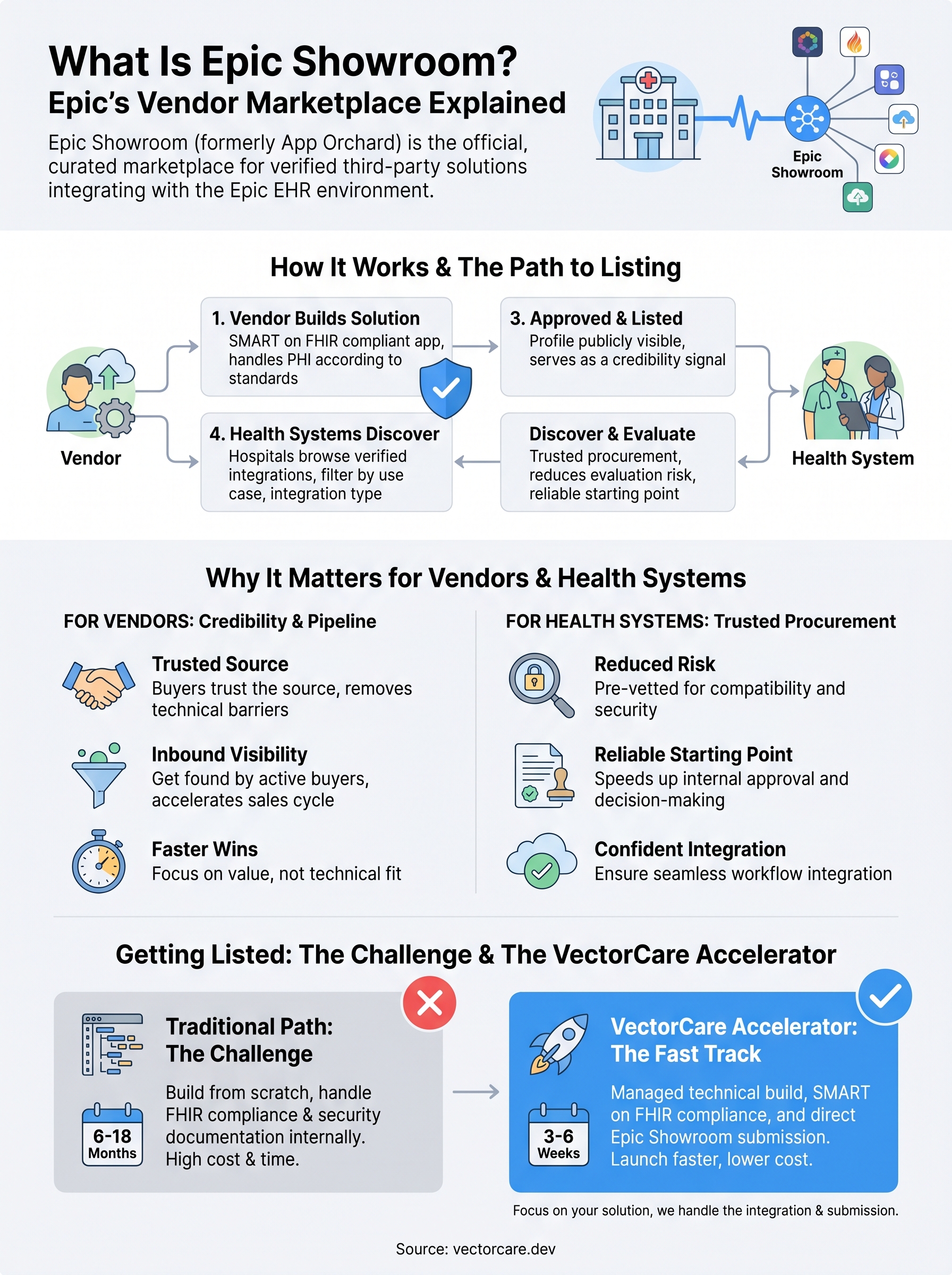
Epic Showroom (formerly called the App Orchard) is Epic's official vendor marketplace, hosted and maintained by Epic Systems. It gives health systems a single, verified place to browse third-party applications and services that have been reviewed and approved to work within the Epic EHR environment. When a hospital's IT or procurement team wants to extend Epic's capabilities, the Showroom is one of the first places they look. Understanding what is Epic Showroom means recognizing that it functions as both a discovery tool for buyers and a credibility signal for vendors.

A listing in Epic Showroom signals to health systems that your solution has already cleared Epic's technical review, which removes a major barrier in the sales process.
How the listing and review process works
Epic doesn't let any vendor add themselves to the Showroom without scrutiny. To get listed, your application must go through a formal review and approval process managed by Epic directly. This involves demonstrating that your app meets Epic's technical requirements, including SMART on FHIR compliance, and that it handles patient data according to healthcare privacy standards. Epic reviews the integration, tests its behavior inside the EHR environment, and decides whether it qualifies for a listing.
Once approved, your Showroom profile becomes publicly visible to health systems searching for solutions in your category. The listing typically includes details about what your app does, which Epic modules it integrates with, and how health systems can request access or a demo. Health system decision-makers can filter by use case, integration type, and other criteria, so your listing needs to clearly communicate your value to reach the right buyers at the right stage of their evaluation.
What you can find inside Epic Showroom
Epic Showroom covers a wide range of solution categories, from clinical decision support and remote patient monitoring to revenue cycle tools, patient engagement apps, and specialty care workflows. When health systems search the marketplace, they can filter results by specialty, workflow type, and integration method, which means your listing competes directly against other vendors serving the same use case.
Categories and solution types
The marketplace includes both standalone applications and service-layer integrations, so the range of what you'll find is broad. Solutions built on SMART on FHIR sit alongside middleware connectors, analytics platforms, and specialty workflow tools. To understand what is Epic Showroom at a practical level, picture a structured, searchable catalog where every entry has passed Epic's technical review and carries a meaningful degree of credibility with health system buyers.
A listing in the right category, with clear documentation of your integration's scope, dramatically improves how often health systems actually find your solution during procurement.
Your Showroom profile needs to communicate what clinical problem you solve and which Epic modules your app connects with, because health system evaluators use those details to narrow their shortlist quickly and move toward a final decision.
Why Epic Showroom matters for vendors and health systems
Understanding what is Epic Showroom goes beyond knowing it's a catalog. It operates as a trust mechanism that carries real commercial weight for anyone selling into health systems, and it shapes how buyers evaluate solutions before they ever reach your sales team.
For vendors: credibility and pipeline
A Showroom listing shortens your sales cycle because health system buyers already trust the source. When procurement teams evaluate vendors, a verified Epic listing removes the question of whether your integration actually works, which means you spend less time proving technical fit and more time closing deals.
Getting listed in Epic Showroom is often the single most effective step a healthcare vendor can take to increase your win rate with health systems.
Your listing also generates inbound visibility you cannot replicate through outbound alone. Health systems actively search the Showroom when building vendor shortlists, which puts you in front of buyers who are already looking for a solution like yours.
For health systems: trusted procurement
Health systems use the Showroom to reduce evaluation risk when adding new tools to their Epic environment. Every listed vendor has cleared Epic's technical review, so IT teams are not starting due diligence from scratch. This gives procurement teams a reliable starting point they can bring to clinical and administrative stakeholders with confidence, which speeds up their internal approval process considerably.
How vendors get listed in Epic Showroom
Getting listed requires more than building a functional app. You need to submit your application directly to Epic and pass a formal technical review that validates your integration before any health system ever sees your profile or considers your solution.
The core requirements
To understand what is Epic Showroom from a vendor's side, know that Epic holds every applicant to the same baseline: SMART on FHIR compliance and documented proof that your app handles protected health information according to HIPAA standards. Epic tests your integration directly inside its environment and reviews how your app behaves within clinical workflows before approving your listing.

Most vendors significantly underestimate how long the review and submission process takes, which pushes their entry into health system sales cycles back by months.
What slows vendors down
The technical requirements are only part of the challenge. Many vendors spend 6 to 18 months building a compliant integration from scratch before they're even in a position to submit anything to Epic for review.
Your FHIR expertise, security documentation, and integration architecture all need to be fully in place before Epic will evaluate your application. This is exactly why many vendors look for a managed submission path rather than absorbing the entire technical burden internally.
Common questions and misconceptions
When vendors start researching what is Epic Showroom, a few misunderstandings come up repeatedly. The biggest one is that a Showroom listing automatically generates sales. It doesn't. Your listing creates visibility and credibility, but you still need to actively work your pipeline and follow up with health systems that find you through the marketplace.
Does a listing in Epic Showroom guarantee health system approval?
No. A Showroom listing confirms technical compatibility with Epic, but health systems still run their own procurement process. Clinical champions, IT sign-off, legal review, and budget cycles all factor into a final decision. Your listing gets you past the first filter, but winning contracts requires active engagement after that.
Think of your Showroom listing as your entry ticket, not your closing argument.
Is the App Orchard the same as Epic Showroom?
Yes. Epic rebranded the App Orchard to Epic Showroom, so you will see both terms used across vendor documentation, RFPs, and health system conversations. They refer to the same marketplace and the same listing and review process.
If someone asks whether you're in the App Orchard, they're asking the same question as whether you're listed in Epic Showroom. Using either term in a conversation with a health system buyer will land the same meaning.
Next Steps
Now you have a complete picture of what is Epic Showroom, how it works, and what it takes to get your solution listed. The marketplace gives you real commercial leverage with health systems, but only after you clear Epic's technical review and have a compliant SMART on FHIR integration ready to submit.
The path from "we need an Epic integration" to "we're live in the Showroom" is where most vendors lose months and significant budget. Your engineering team can build this from scratch, but that route typically takes 12 to 18 months and costs well over $500,000 before you submit a single line of documentation to Epic.
VectorCare handles the entire technical build, SMART on FHIR compliance, and Epic Showroom submission for you, getting your app live in 3 to 6 weeks instead of over a year. If you're ready to move faster, start building your SMART on FHIR app today.
The Future of Patient Logistics
Exploring the future of all things related to patient logistics, technology and how AI is going to re-shape the way we deliver care.
Thank you! Your submission has been received!
Oops! Something went wrong while submitting the form.