SOC 2 Audit Cost: Type 1 vs Type 2 Fees And Total Costs

SOC 2 Audit Cost: Type 1 vs Type 2 Fees And Total Costs
Healthcare vendors pursuing EPIC EHR integrations face a critical compliance requirement: SOC 2 certification. But before you commit to the audit process, you need to understand what you're actually paying for. The SOC 2 audit cost ranges widely, from $20,000 to over $100,000, depending on your audit type, company size, and existing security posture. Without a clear breakdown, many organizations underestimate total expenses and blow their compliance budgets.
This guide covers the real numbers behind Type 1 and Type 2 audits, what auditors charge versus what you'll spend on readiness, and how organizational complexity affects pricing. Whether you're a digital health startup or an established clinical decision support vendor, you'll walk away knowing exactly what to budget for SOC 2 certification.
At VectorCare, we built our SMART on FHIR platform with SOC 2 compliance baked in, so healthcare vendors integrating with EPIC don't have to shoulder these audit costs themselves. But if you're evaluating a build-versus-buy decision or need certification for other parts of your business, understanding these costs is essential for planning your path to market.
Why SOC 2 audit costs vary so much
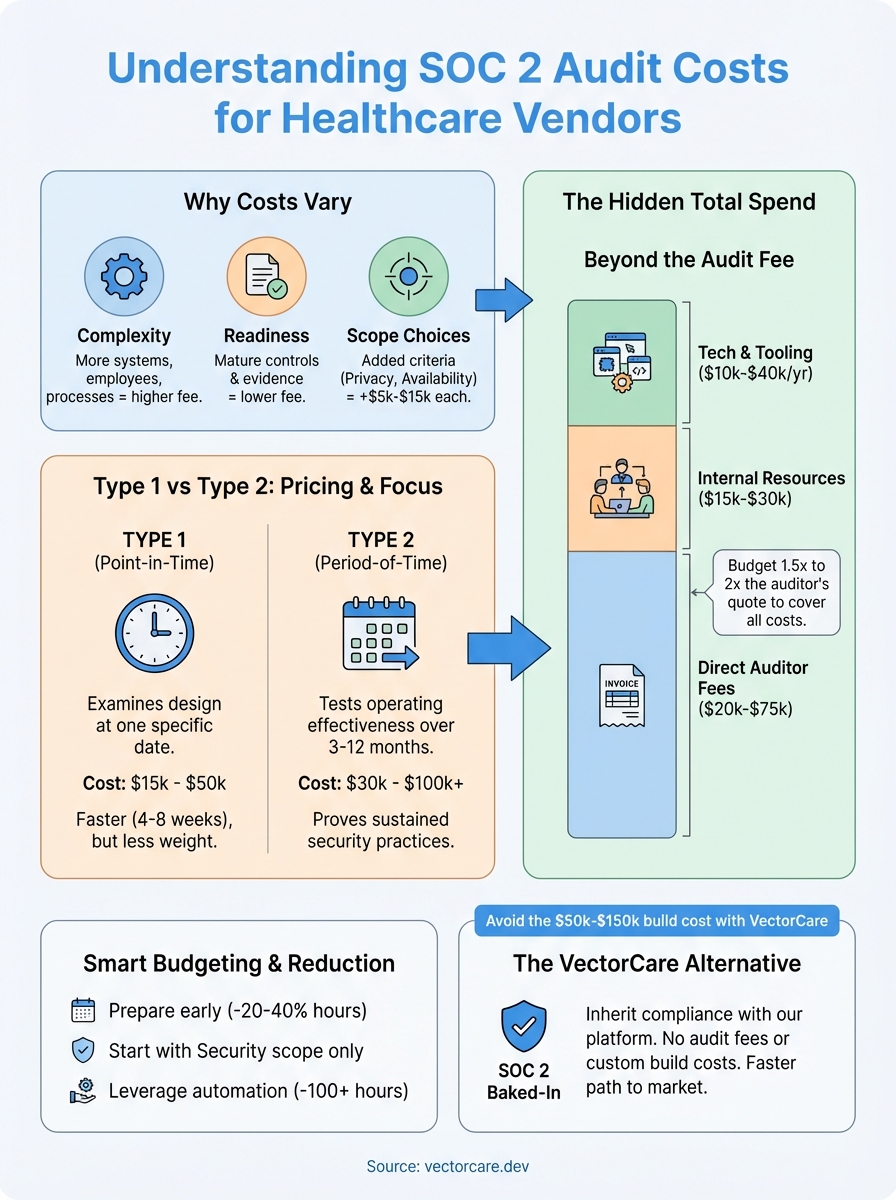
The SOC 2 audit cost swings wildly because auditors essentially bill you for the hours they spend validating your controls. A five-person startup with basic cloud infrastructure might spend $20,000 on a Type 1 audit, while a 100-employee SaaS company with complex multi-tenant systems could hit $75,000 for the same report type. You're not paying for a standardized checklist. You're paying for the time it takes auditors to examine your specific environment, interview your team, and document their findings.
Three primary factors drive your total bill: organizational complexity, audit readiness, and scope choices. Most vendors discover these variables only after receiving their first quote, which leads to sticker shock and budget overruns. Understanding these factors upfront lets you estimate costs accurately and avoid surprises during the engagement.
Your organization's size and complexity
Auditors charge more when they need to review more systems, more employees, and more processes. A healthcare vendor with 10 employees running everything on AWS might need 80 audit hours, while a vendor with 50 employees, multiple offices, and hybrid infrastructure could require 200+ hours. Each additional system you integrate (databases, payment processors, monitoring tools) adds examination time to the audit.
Your team structure also matters. If three people handle all IT operations and security, auditors can complete interviews quickly. When responsibilities spread across 15 departments and multiple contractors, auditors spend more time mapping processes and validating controls. Distributed teams add complexity because auditors need to verify that your security policies apply consistently across all locations.
The more moving parts in your infrastructure and organization, the more time auditors need to validate that everything meets SOC 2 requirements.
Your existing security controls
Companies with mature security programs pay less because auditors find evidence faster. If you already maintain detailed access logs, regular vulnerability scans, and documented incident response procedures, the audit moves quickly. Auditors can pull reports, verify timestamps, and check boxes without waiting for you to generate evidence.
Organizations starting from scratch face higher preparation costs and longer audit timelines. Your auditor might identify 30 control gaps during the readiness phase, and you'll need to implement fixes before the formal audit begins. Each gap you address before the audit starts reduces total spend by eliminating back-and-forth evidence requests and follow-up testing.
Auditor selection and scope decisions
Big Four accounting firms (Deloitte, PwC, EY, KPMG) typically charge $50,000 to $150,000 for SOC 2 audits, while specialized boutique firms might quote $20,000 to $60,000. You're not necessarily getting better quality with the higher price, but larger firms often carry more brand recognition with enterprise clients. Some healthcare systems specifically require audits from recognized national firms, which locks you into higher pricing.
Scope choices dramatically affect your bill. The basic SOC 2 covers security (the Trust Services Criteria), but you can add availability, confidentiality, processing integrity, and privacy criteria. Each additional criterion adds $5,000 to $15,000 to your audit cost because auditors need to test more controls and document more evidence.
SOC 2 Type 1 vs Type 2 costs
Type 1 and Type 2 audits measure different things, which directly affects pricing. A Type 1 audit examines whether your security controls exist and are properly designed at a single point in time, typically costing $15,000 to $50,000. A Type 2 audit tests whether those controls actually operated effectively over a period (usually 3 to 12 months), which runs $30,000 to $100,000+. The price gap exists because Type 2 requires significantly more auditor time to review months of evidence and validate consistent control operation.

Type 1 audit pricing
Type 1 audits cost less because auditors only need to verify that your controls are properly documented and theoretically functional on a specific date. Your auditor reviews policies, interviews staff, and inspects system configurations to confirm everything looks correct. Most small to mid-sized healthcare vendors pay between $20,000 and $40,000 for Type 1 reports, with larger organizations reaching $50,000 when complexity increases. You receive certification faster (typically 4 to 8 weeks), but many enterprise healthcare systems won't accept Type 1 reports as sufficient proof of security maturity.
Type 2 audit pricing
Type 2 audits cost significantly more because auditors must test continuous control effectiveness rather than point-in-time design. Your auditor samples evidence throughout the audit period, reviews logs and tickets, and validates that your team followed procedures consistently. Expect to pay $35,000 to $75,000 for a standard Type 2 audit as a smaller vendor, with costs climbing to $100,000+ for organizations with complex infrastructure or multiple Trust Services Criteria.
Type 2 reports carry more weight with enterprise clients because they prove your controls actually work over time, not just on paper.
The soc 2 audit cost difference between Type 1 and Type 2 reflects the fundamental question: do you want to prove your controls exist, or do you want to prove they work? Most healthcare vendors pursuing EPIC EHR integrations ultimately need Type 2 certification because health systems demand evidence of sustained security practices.
What makes up the total SOC 2 spend
Your total SOC 2 audit cost extends far beyond the auditor's invoice. Most healthcare vendors budget only for the audit firm's fees and discover halfway through the process that they need to spend another $30,000 to $60,000 on preparation, tools, and internal resources. Understanding these hidden costs upfront prevents budget overruns and lets you allocate funds correctly across all compliance activities.

Direct auditor fees
The auditor's bill covers examination services, report preparation, and management letter delivery. This fee includes the hours your audit team spends reviewing evidence, testing controls, interviewing staff, and documenting findings. You'll typically pay between $20,000 and $75,000 for the audit engagement itself, depending on your organization's size and the report type you choose. Auditors bill either as a fixed fee or hourly, with most firms preferring fixed-price engagements to avoid scope disputes.
Internal resource costs
Your team will spend hundreds of hours preparing documentation, gathering evidence, and responding to auditor requests. A typical SOC 2 audit requires your security, IT, and compliance staff to dedicate 20% to 40% of their time over 2 to 4 months. For a healthcare vendor paying engineers $150,000 annually, this translates to $15,000 to $30,000 in internal labor costs just for audit support. You'll also need executives for interviews and department heads to validate control implementations.
Internal preparation time often exceeds the auditor's engagement hours, making it your largest hidden cost.
Technology and tooling expenses
Passing SOC 2 requires specific security tools and monitoring systems. You'll need to implement or upgrade endpoint detection, vulnerability scanning, log management, access control systems, and compliance automation platforms. Expect to spend $10,000 to $40,000 annually on these tools, with most vendors needing at least 4 to 6 new software subscriptions to meet control requirements. Some organizations hire consultants to fill gaps in their security program, adding another $15,000 to $50,000 to preparation costs.
How to estimate your SOC 2 budget
Calculating your soc 2 audit cost requires a bottom-up approach that accounts for both direct and indirect expenses. Most healthcare vendors underestimate their total spend by 30% to 50% because they only budget for the auditor's invoice. You need to build a comprehensive budget that includes audit fees, internal labor, technology investments, and contingency reserves for unexpected gaps. Start by determining your report type (Type 1 or Type 2), then layer in preparation costs based on your current security maturity.
Start with your base audit fee
Your auditor's quote serves as the foundation for budget planning. Small healthcare vendors with under 25 employees typically pay $20,000 to $40,000 for Type 1 audits and $35,000 to $60,000 for Type 2 reports. Mid-sized organizations with 25 to 100 employees should budget $40,000 to $75,000 for Type 2 certification. Add $5,000 to $15,000 for each additional Trust Services Criterion beyond security (availability, confidentiality, processing integrity, privacy). Request quotes from at least three firms to establish your baseline number.
Add preparation and tool costs
Budget $15,000 to $50,000 for internal preparation work, including staff time, documentation creation, and control implementation. Your team will need security tools for vulnerability scanning, log management, access control, and compliance automation, which typically cost $10,000 to $40,000 annually. Factor in consultant fees if you lack internal security expertise, which runs $15,000 to $50,000 for most engagements. These preparation costs often match or exceed your direct audit fees.
Budget at least 1.5x to 2x your auditor's quote to cover all compliance expenses from start to finish.
Include contingency reserves
Set aside 15% to 25% of your total budget for unexpected costs like remediation work, additional auditor hours, or tool upgrades discovered during the audit. Organizations typically encounter 5 to 10 control gaps that require fixes before certification, each potentially costing $2,000 to $10,000 to address. This buffer prevents budget overruns when your auditor identifies issues that need immediate attention.
How to reduce SOC 2 costs without cutting corners
You can slash your soc 2 audit cost by 30% to 50% without compromising certification quality or security standards. The key lies in reducing auditor hours through better preparation, smarter scope decisions, and efficient use of existing tools. Most healthcare vendors waste money by starting audits before they're ready or selecting overly broad scopes that don't match their business needs.
Prepare your controls before engaging an auditor
Implement your security controls and documentation at least 3 to 6 months before contacting an auditor. When you start the formal audit with controls already operating and evidence already collected, auditors spend less time waiting for information and more time validating what already exists. This preparation cuts audit hours by 20% to 40%, directly reducing your fees. Run a gap assessment yourself or hire a consultant for $5,000 to $15,000 to identify missing controls early, rather than discovering them during the expensive audit phase.
Organizations that complete readiness work before the audit starts typically save $10,000 to $30,000 compared to those who remediate issues mid-audit.
Choose the right audit scope
Limit your Trust Services Criteria to what your customers actually require. Most healthcare systems only demand the security criterion for EPIC integrations, so adding availability, confidentiality, or privacy criteria unnecessarily inflates costs by $5,000 to $15,000 each. Start with security only for your first audit, then expand scope in future years if specific clients request it. Similarly, exclude internal systems and departments that don't handle customer data from your audit boundary.
Leverage automation and existing tools
Use compliance automation platforms that generate audit evidence automatically rather than manually collecting logs and screenshots. These tools cost $5,000 to $15,000 annually but save your team 100+ hours of evidence gathering work. Choose security solutions that already integrate with your existing infrastructure instead of adding standalone tools that require separate configuration and monitoring. Many cloud providers like AWS and Azure offer built-in compliance features at no extra cost that satisfy multiple SOC 2 control requirements.
What to do next
Understanding your soc 2 audit cost helps you budget accurately, but eliminating it altogether accelerates your path to market. Healthcare vendors pursuing EPIC integrations face a choice: spend $50,000 to $150,000 building SOC 2 compliance into your custom integration, or leverage a platform that already carries certification. The difference reshapes your timeline from 18 months to 6 weeks and redirects engineering resources toward your core product rather than compliance infrastructure.
VectorCare's SMART on FHIR platform comes with SOC 2 compliance baked in, so you inherit our certification instead of building your own. Your applications run on our audited infrastructure, eliminating audit fees, preparation costs, and ongoing compliance maintenance. This approach works particularly well for digital health startups and clinical vendors who need EPIC integration fast without the engineering burden. You focus on your healthcare solution while we handle the compliance complexity that health systems demand.
The Future of Patient Logistics
Exploring the future of all things related to patient logistics, technology and how AI is going to re-shape the way we deliver care.
Thank you! Your submission has been received!
Oops! Something went wrong while submitting the form.