Token Management: What It Is And How It Works

If you've ever hit a wall trying to keep an integration authenticated for more than an hour, you already know why token management matters. It's the practice of issuing, storing, refreshing, and revoking the digital credentials that let systems talk to each other securely, whether that's a payment processor tokenizing a credit card, an app authenticating a user, or an API client calling an LLM. Get it wrong and you get expired sessions, security gaps, or a support queue full of "why did my connection break" tickets.
So what is token management, exactly? It's the full lifecycle behind those credentials: generating a token, defining its scope and expiration, refreshing it before it dies, and revoking it the moment access should end. The mechanics shift depending on context, but the core lifecycle stays the same across payments, authentication, and API access.
In healthcare integrations, this shows up constantly with OAuth 2.0 tokens tied to SMART on FHIR connections to EPIC. This article breaks down how token management works in practice, the different types you'll encounter, and why handling it correctly is non-negotiable when patient data is on the line.”
Why token management matters for security and trust
Every system that exchanges data over an API is making a bet: that the credential presented at the door is legitimate, current, and scoped to exactly what it should be. Token management is what makes that bet safe. When you issue a token with the right expiration, the right scope, and a clean revocation path, you're telling every downstream system "trust this, but only for this long and only for this much." Skip that discipline and you're handing out keys that never expire, that open more doors than they should, or that nobody remembers how to take back.
Poor token management doesn't just cause outages, it quietly turns convenience into exposure.
What happens when token management fails
Failure here rarely looks dramatic at first. A token that never expires sits in a config file for years. A refresh token gets logged in plaintext during a debugging session. An old integration partner loses its contract but keeps working credentials because nobody built a revocation step into the offboarding process. None of these show up as a breaking incident on day one. They show up eighteen months later as a breach notification.
Consider how these failure modes compare:
| Failure Mode | What Goes Wrong | Typical Consequence |
|---|---|---|
| No expiration set | Token stays valid indefinitely | Long-lived attack surface if leaked |
| Overly broad scope | Token grants more access than needed | Lateral movement after compromise |
| No revocation process | Access can't be cut off cleanly | Former vendors/employees retain access |
| Tokens stored in logs/code | Credentials leak through normal operations | Silent, hard-to-detect exposure |
| No refresh strategy | Sessions die unpredictably | Broken integrations, support burden |
Governments and industry bodies treat this seriously for a reason. The NIST digital identity guidelines spell out specific requirements for token lifetimes, binding, and revocation precisely because loose token handling is one of the most common paths to unauthorized access.
The trust equation behind every integration
Trust between two systems isn't established once and left alone. It has to be renewed, checked, and occasionally revoked, which is exactly what a token lifecycle does mechanically. A short-lived access token combined with a longer-lived refresh token lets a system stay "logged in" without ever holding a permanent, all-powerful credential. That's the entire point: limited blast radius. If a token leaks, the damage window is measured in minutes, not months.
Users and partners also feel the effects even when they never see a token directly. A patient using a portal, a vendor pulling data from an EHR, or a payment processor authorizing a charge all depend on tokens working invisibly and correctly. Session reliability is trust made tangible. When tokens refresh smoothly, nobody notices. When they don't, every dropped connection erodes confidence in the platform, even if the underlying data was never actually at risk.
Why healthcare data raises the stakes
Healthcare integrations push these stakes higher because the data behind the token is protected health information, not just a shopping cart total. A leaked payment token might cost someone a fraudulent charge that gets reversed. A leaked FHIR access token can expose diagnosis codes, medications, and clinical notes tied to a real patient. That difference is why HIPAA-covered entities and their vendors are expected to treat token handling as a compliance control, not just an engineering detail.
Auditors and health systems will ask pointed questions: How long do your tokens live? How do you revoke access when a contract ends? Where are refresh tokens stored, and who can read them? Vendors who can't answer confidently lose deals, not just security points. That's the practical reason token management shows up so often in vendor security reviews for anything touching EPIC or another EHR, and it's why getting the lifecycle right from day one matters more in healthcare than almost anywhere else.
How to manage tokens through their lifecycle
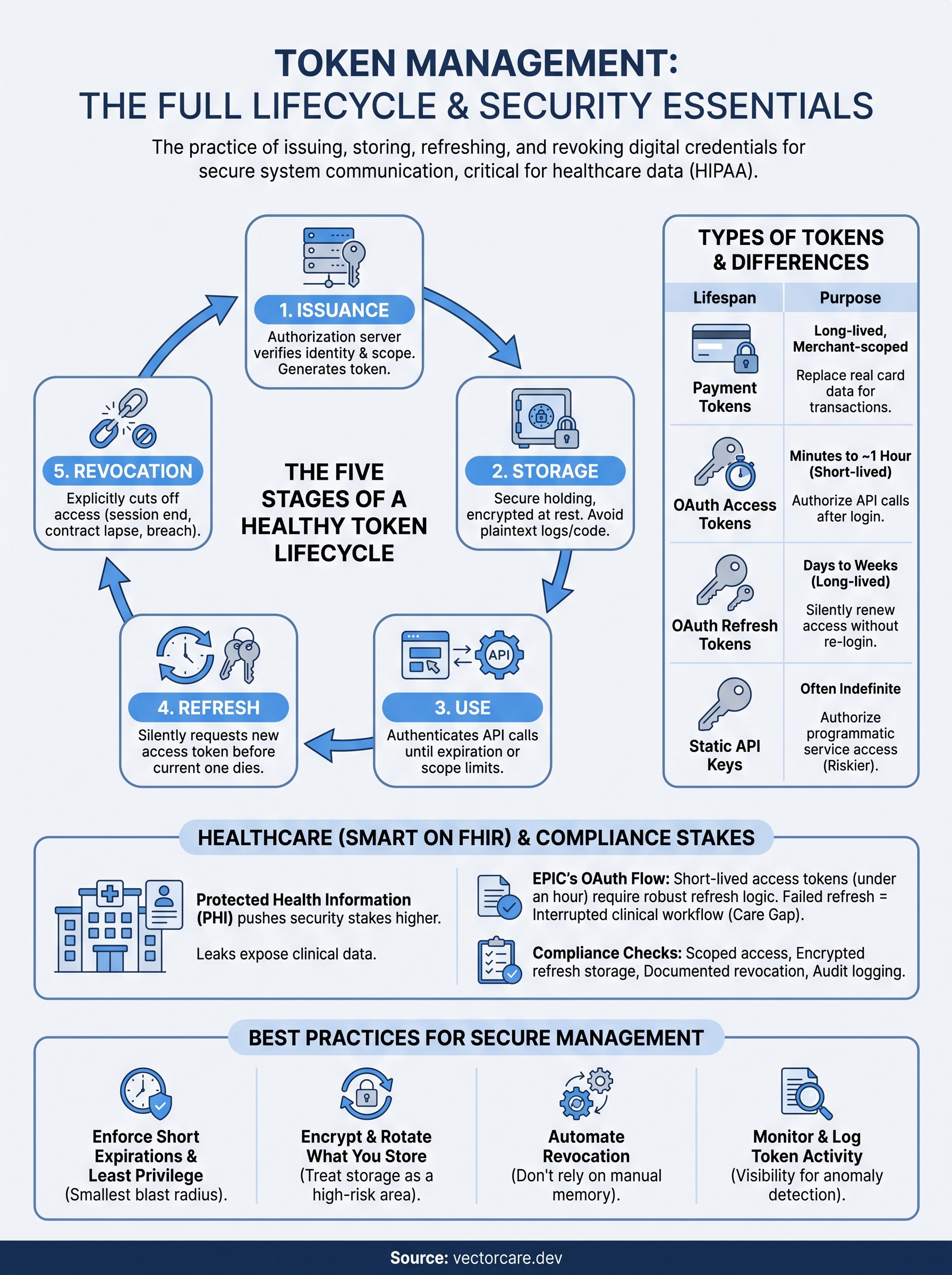
Every token, regardless of context, moves through the same five stages: issuance, storage, use, refresh, and revocation. Token management means having a deliberate process for each stage instead of treating tokens as fire-and-forget strings you paste into a config file. Skip a stage and you inherit the failure modes covered above: tokens that never die, tokens nobody can find, tokens nobody can kill.
The five stages every token passes through
Here's what a healthy lifecycle looks like in practice:
- Issuance – an authorization server (like EPIC's OAuth endpoint) generates a token after verifying identity and scope.
- Storage – the token gets held somewhere secure, never in plaintext logs or client-side code.
- Use – the token authenticates API calls until it expires or its scope no longer covers the request.
- Refresh – before expiration, a refresh token requests a new access token without forcing a full re-login.
- Revocation – access gets cut off explicitly, whether because a session ended, a contract lapsed, or a breach was detected.
A token lifecycle only works if every stage has an owner; a lifecycle with a missing step is just a countdown to failure.
Storing tokens without creating new risk
Just because a token is short-lived doesn't mean storage is trivial. Access tokens typically live in memory or short-lived server-side caches, while refresh tokens need encrypted storage since they're valid for days or weeks. Committing either to a repository, a log file, or a browser's local storage without encryption defeats the entire point of scoping and expiration. Treat storage as the stage where most real-world leaks actually happen, because it is.
Refreshing before things break
Refresh logic determines whether users and integrations experience token management at all. A well-built system refreshes tokens quietly in the background, before the current one expires, so nobody hits a dead session mid-workflow. A poorly built one waits until a call fails, then tries to recover, which is exactly when clinical workflows in an EHR integration can't afford a delay.
A typical refresh request looks like this:
POST /oauth2/token
Content-Type: application/x-www-form-urlencoded

grant_type=refresh_token
&refresh_token=abc123...
&client_id=your-app-id
Revoking access cleanly
Revocation is the stage most teams underbuild, usually because it only matters when something has already gone wrong or a relationship has ended. Building an explicit revocation endpoint, and tying it to offboarding checklists for vendors and employees alike, closes the gap that turns an old integration into standing, unmonitored access. Done right, revocation takes seconds. Done wrong, it takes an incident report to discover it never happened at all.
Types of tokens you'll encounter and how they differ
Not every token does the same job, even though they all answer the same question of "what is token management" at a technical level: prove identity or authorization without exposing the underlying secret. Payment tokens, authentication tokens, and API tokens all substitute a safe placeholder for something sensitive, but what they protect and how long they live varies a lot. Knowing the differences matters because applying payment-grade rules to an API token, or API-grade rules to a refresh token, creates gaps that attackers eventually find.
Payment tokens
Payment tokenization swaps a real card number for a randomly generated token that's useless outside the specific merchant or processor relationship that created it. Visa and Mastercard both run tokenization networks specifically so a stolen token can't be replayed elsewhere, which is why a leaked payment token is far less catastrophic than a leaked card number. These tokens are typically long-lived by design, since they're meant to represent a stored card for repeat purchases, but they're scoped tightly to one merchant relationship.
Authentication tokens
Authentication tokens prove who's making a request, and OAuth 2.0 splits this job into two pieces: a short-lived access token that authorizes API calls, and a longer-lived refresh token that quietly renews access without forcing a login. SMART on FHIR connections to EPIC run entirely on this pattern, issuing access tokens that typically expire in under an hour alongside refresh tokens that can last days or weeks. Session cookies and ID tokens (common in OpenID Connect) fall into this same family, proving identity rather than payment.
The shorter a token's life, the smaller the damage window if it leaks.
API and LLM tokens
API keys and LLM tokens serve a narrower purpose: authorizing programmatic access to a service, often tied to usage limits or billing rather than a human session. Many API keys are dangerously long-lived by default, which is why platforms increasingly push developers toward OAuth-style tokens with real expiration instead of a static key pasted into an environment variable. LLM providers add another wrinkle, since "tokens" there also refer to units of text processed, a naming collision that trips up newcomers reading API documentation for the first time.
Here's how the three main categories stack up:
| Token Type | Typical Lifespan | Primary Purpose | Common Risk |
|---|---|---|---|
| Payment token | Long-lived, merchant-scoped | Replace card data for transactions | Merchant-side leak if not scoped tightly |
| OAuth access token | Minutes to about an hour | Authorize API calls after login | Short exposure window if leaked |
| OAuth refresh token | Days to weeks | Renew access tokens silently | High-value target if stolen |
| Static API key | Often indefinite | Authorize service/programmatic access | No expiration, hard to rotate |
Seeing these side by side makes the design tradeoffs obvious. Static keys are simple but risky over time, OAuth tokens are more complex but self-limiting, and payment tokens trade lifespan for tight merchant scoping. Whatever category you're working with, the underlying discipline is the same one covered throughout this article.
Best practices for secure, reliable token management
Good token management isn't a single setting you flip once. It's a set of habits applied consistently across every integration, vendor, and internal service that touches a credential. The teams that avoid breach notifications and 2 a.m. outage calls aren't smarter than everyone else, they've just turned these practices into defaults instead of afterthoughts.
Enforce short expirations and least privilege
Short-lived access tokens paired with scoped permissions should be the starting assumption, not a security team's wishlist item. A token that expires in 15 minutes and only reads one data type does far less damage if it leaks than one that lives for a month and touches everything. Apply the same logic to every new integration:
- Set the shortest access token lifetime the workflow can tolerate
- Request only the scopes the app actually uses, never broader defaults
- Re-evaluate scope whenever a feature is added, not just at launch
- Treat "it's easier to just ask for full access" as a red flag, not a shortcut
Encrypt and rotate what you store
Storage is where most real leaks happen, so encrypt refresh tokens and API keys at rest, and never let them land in application logs, error messages, or version control. Rotating credentials on a schedule, rather than only after an incident, limits how long a compromised token stays useful even if nobody notices the compromise right away. OWASP's guidance on secrets management covers the specific patterns worth following here, and it's worth treating as required reading for anyone building the storage layer.
Automate revocation instead of relying on memory
Manual revocation fails because someone forgets, and someone always eventually forgets. Building automated triggers, contract ends, employee offboards, suspicious activity detected, into your revocation process removes the dependency on a human remembering a manual step three months from now.
If revoking access requires someone to remember to do it, it will eventually not happen.
Monitor and log token activity
Visibility turns token management from a set of rules into a system you can actually verify is working. Logging issuance, refresh, and revocation events, without logging the token values themselves, lets you spot anomalies like a token being used from an unexpected location or refreshed far more often than a normal workflow requires. Pair that logging with alerts on failed refresh attempts, since a spike often signals either an expired credential nobody rotated or an attacker probing for a valid session. None of this needs to be elaborate; a simple audit trail beats no audit trail every time, and it's usually the first thing an auditor or a health system's security team will ask to see.
Token management for SMART on FHIR and EHR integrations
SMART on FHIR turns everything covered so far into a specific, non-negotiable protocol rather than a set of best practices. EPIC's OAuth 2.0 implementation issues an access token after a user or app authenticates and consents to specific scopes, like Patient.read or Observation.read, and that token is the only thing standing between your integration and a patient's actual medical record. Get the scope wrong, and you're either blocked from data you legitimately need or, worse, holding access to data you never should have requested.
How EPIC's OAuth flow handles tokens
EPIC follows the standard SMART on FHIR launch sequence: authorization request, user consent, token issuance, and then API calls authenticated by that token until it expires. Access tokens in this flow are deliberately short-lived, often expiring in under an hour, which forces every integration to build real refresh logic instead of assuming a session will just stay open. Vendors connecting to EPIC also have to register their app, define its exact scopes ahead of time, and pass EPIC's own security review before a token gets issued in production at all, not just in a sandbox.
Why refresh logic matters most in clinical workflows
A dropped token in a clinical setting isn't a minor inconvenience, it's a nurse mid-intake losing access to the exact data field they need, or a remote monitoring app failing to log a reading during an active patient encounter. That's why refresh timing matters more here than in almost any other API context: a token that dies mid-workflow doesn't just annoy a user, it can interrupt care coordination that a clinician is actively relying on.
In a clinical workflow, a failed token refresh isn't a bug report, it's a care gap.
The compliance layer you can't skip
HIPAA doesn't mention OAuth tokens by name, but every health system reviewing a vendor's security posture will ask how tokens are issued, stored, refreshed, and revoked, because that's exactly where a BAA-covered integration either holds up or falls apart. EPIC's own App Orchard and Showroom review process checks for this directly, and vendors who can't demonstrate a clean token lifecycle, encrypted refresh token storage, scoped access, a real revocation path, get stuck in review or rejected outright.
| Requirement | Why EPIC/Health Systems Check It |
|---|---|
| Scoped access tokens | Prevents over-broad data exposure |
| Encrypted refresh token storage | Protects long-lived credentials at rest |
| Documented revocation process | Required for contract termination and offboarding |
| Audit logging of token events | Needed for HIPAA-aligned security reviews |
Where this gets hard for vendors without a dedicated team
Building this correctly, from scratch, is exactly the kind of work that eats months of engineering time before a vendor writes a single line of the feature they actually wanted to ship. That's the gap platforms like VectorCare exist to close: the token lifecycle, EPIC's OAuth requirements, and the Showroom submission process get handled as part of the platform itself, so a vendor's team spends its time on clinical workflow logic instead of debugging refresh tokens at 2 a.m.
What good token management looks like
Good token management is boring, in the best sense. Tokens expire on schedule, refresh quietly in the background, and disappear the moment access should end. Nobody notices it working, because that's the entire goal: invisible reliability backed by real discipline behind the scenes. Whether you're tokenizing a payment, authenticating a user, or authorizing an LLM call, the same lifecycle applies, issue, store, use, refresh, revoke, and every skipped stage becomes a future incident report.
Healthcare integrations raise the bar further, since a clean OAuth lifecycle is what separates a vendor who passes EPIC's review from one stuck debugging refresh tokens instead of shipping features. If your team is staring down months of engineering work just to handle SMART on FHIR token logic correctly, you don't have to build it from scratch. See how VectorCare handles it for you and get back to building the product you actually set out to ship.
The Future of Patient Logistics
Exploring the future of all things related to patient logistics, technology and how AI is going to re-shape the way we deliver care.
Thank you! Your submission has been received!
Oops! Something went wrong while submitting the form.