Information Blocking Penalties: Fines, Enforcement & Exceptions

If you're building health tech that touches patient data, you've probably heard the term thrown around in vendor contracts or compliance reviews: information blocking penalties. These aren't hypothetical. The Office of the Inspector General (OIG) and the Office of the National Coordinator (ONC) have real enforcement teeth under the 21st Century Cures Act, and the numbers involved can stop a growing digital health company cold.
Here's the direct answer: certified health IT developers and health information networks face civil monetary penalties of up to $1 million per violation, while healthcare providers face disincentives tied to Medicare reimbursement rather than flat fines. But not every data-sharing decision counts as blocking. The Cures Act carves out eight specific exceptions, and knowing them is often the difference between a defensible privacy practice and an actionable violation.
This article breaks down exactly who gets fined, how much, and under what conditions. We'll cover enforcement actions to date, the practical exceptions that protect legitimate business decisions, and how EHR integrations like EPIC connections factor into your compliance exposure. If you're a vendor weighing build-versus-buy on FHIR integration, this is the regulatory backdrop you can't skip.
Why information blocking penalties matter now
Enforcement isn't a distant threat anymore. The Department of Health and Human Services finalized its information blocking penalty framework in mid-2023, and OIG has been actively investigating complaints since. If you run a health tech company that touches EHR data, this shift changes how you evaluate vendor contracts, data-sharing agreements, and even your own product roadmap.
From guidance to enforced law
For years, information blocking existed mostly as a policy concept, something compliance teams flagged in memos but rarely saw litigated. That changed when OIG published its final rule establishing civil monetary penalties, giving the agency actual authority to investigate complaints and issue fines. The agency now accepts complaints through a public portal, and each substantiated case can trigger penalties calculated per violation, not per company. A single vendor with a widespread data-access restriction across hundreds of client sites could theoretically face liability that multiplies fast.
A single information-blocking practice applied across your customer base can turn into hundreds of separate violations under the per-instance penalty structure.
Vendors bear more exposure than providers
Health IT developers and health information networks carry the heaviest financial risk, since they face direct civil monetary penalties rather than reimbursement-based disincentives. Consider who's most exposed right now:
- Certified EHR module developers who restrict API access
- Health information exchanges that charge unreasonable data-transfer fees
- Digital health platforms that delay releasing patient data without a valid exception
- Vendors bundling data access behind proprietary interoperability fees
The EPIC integration angle
Many digital health vendors first encounter information blocking risk when negotiating access to EPIC's FHIR APIs. If your integration approach creates friction, delays data flow, or requires unnecessary technical hurdles for health systems to share patient information with your platform, regulators can view that as blocking, even if it wasn't intentional. Building compliant, transparent integrations from day one isn't just good practice; it's how you avoid becoming a test case for the next enforcement wave. You can review the ONC's official framework directly through the HealthIT.gov information blocking resources page.
How information blocking penalties are calculated
Calculating your actual exposure depends entirely on what kind of entity you are, since the Cures Act treats developers, networks, and providers differently. Civil monetary penalties apply only to certified health IT developers and health information networks or exchanges, and OIG calculates them per violation rather than per complaint. That distinction matters enormously if a single blocking practice touches dozens of health systems at once.
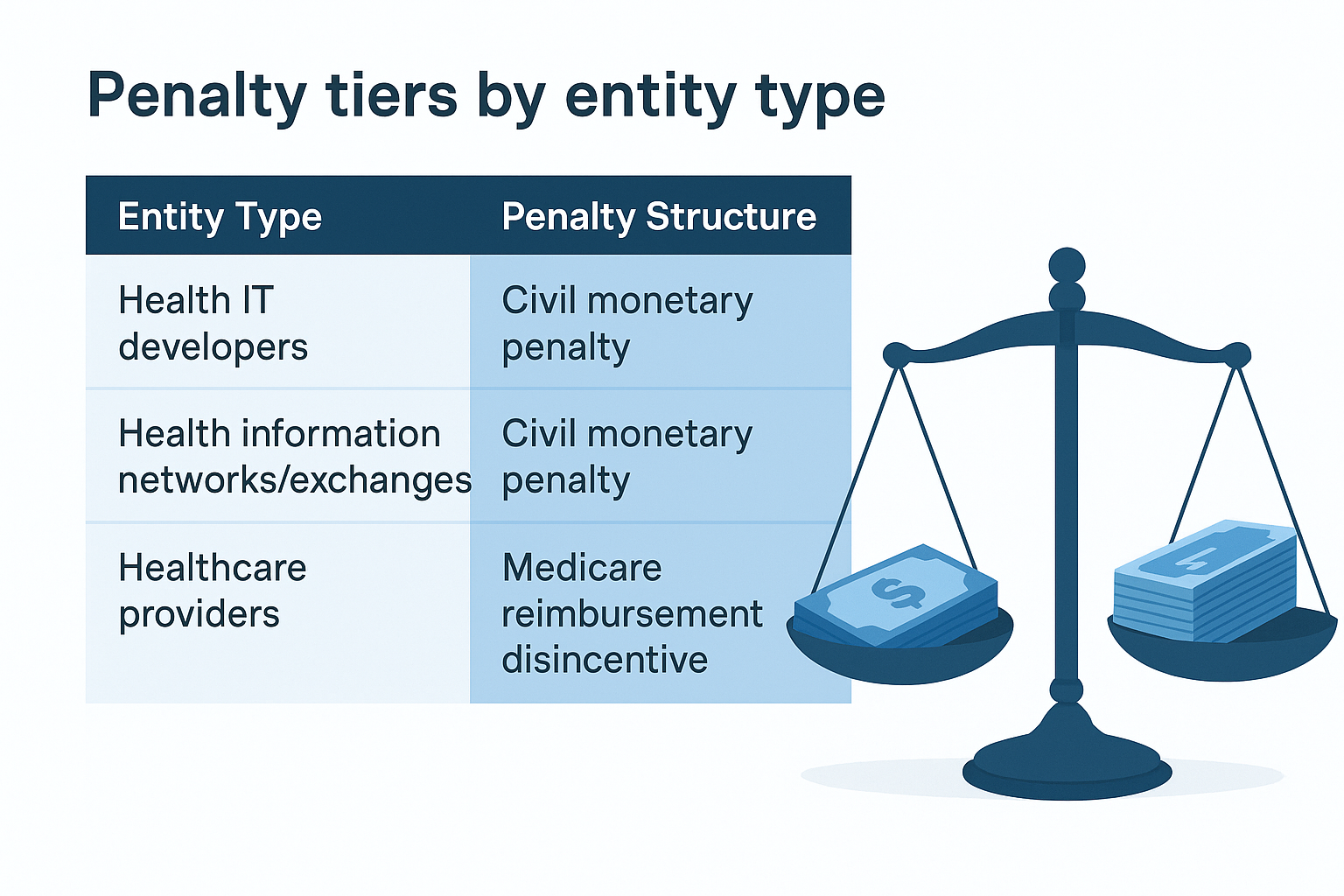
Penalty tiers by entity type
| Entity Type | Penalty Structure | Maximum Amount |
|---|---|---|
| Health IT developers | Civil monetary penalty | $1,000,000 per violation |
| Health information networks/exchanges | Civil monetary penalty | $1,000,000 per violation |
| Healthcare providers | Medicare reimbursement disincentive | Varies by program (MIPS, Promoting Interoperability, Shared Savings) |
Per-violation math adds up fast
Since OIG counts violations individually, a restrictive API policy applied across 50 client health systems could theoretically generate 50 separate penalty calculations, not one. That's how a single engineering decision turns into seven-figure exposure quickly.
One flawed data-access policy multiplied across your client base can push penalty exposure well past a million dollars.
Inflation adjustments push numbers higher
Under the Federal Civil Penalties Inflation Adjustment Act, OIG revisits these figures periodically, and the $1 million ceiling has already climbed slightly since the rule's original publication. Vendors budgeting for compliance risk should assume penalties trend upward, not down, especially as enforcement matures and case precedent accumulates.
Who enforces the rules and how cases unfold
Two federal agencies split the work, and understanding their roles helps you know where a complaint actually lands. The Office of the Inspector General investigates and penalizes, while the Office of the National Coordinator sets the technical standards and certification requirements that define what counts as blocking in the first place. Knowing which agency handles what matters if you ever need to respond to an inquiry.
OIG's investigative authority
OIG accepts complaints from patients, providers, and competing vendors through its public reporting portal, then decides which ones warrant a full investigation. Not every complaint triggers action. OIG prioritizes cases involving patient harm, widespread practices affecting multiple health systems, or long-standing patterns rather than isolated incidents. You can read OIG's own enforcement priorities on the HHS OIG information blocking page.
How a typical case unfolds
A case generally moves through these stages:
- Complaint submission through the OIG portal
- Preliminary review to confirm jurisdiction and severity
- Formal investigation with document requests and interviews
- Settlement negotiation or civil monetary penalty determination
- Public disclosure of substantiated findings
Investigations rarely move fast, but they rarely disappear either once OIG opens a file.
Regulators favor settlements over drawn-out litigation, since most vendors would rather correct a practice quietly than fight a public penalty. Still, the paper trail from an investigation follows your company, and health systems increasingly ask vendors directly about any past information blocking findings during procurement.
Exceptions that can limit your penalty exposure
Not every restriction on data sharing counts as information blocking. The Cures Act built in eight exceptions, and if your practice fits squarely within one, you have a legitimate defense against a complaint. Regulators expect you to document why an exception applies, not just claim it after the fact.
The eight recognized exceptions
ONC groups the exceptions into two buckets: reasons you can decline to fulfill a request, and reasons your response can be reasonable and necessary even if delayed.
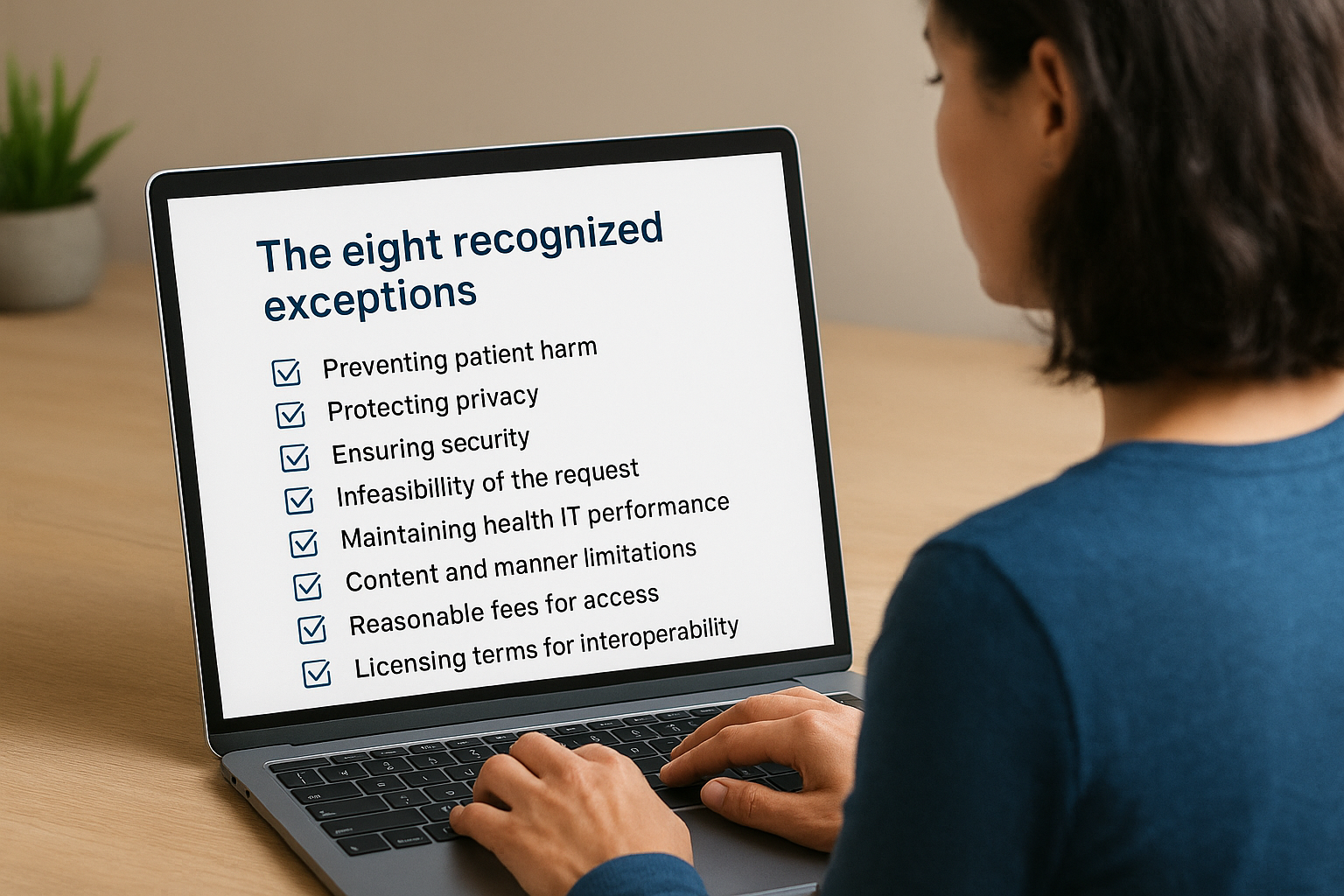
- Preventing patient harm
- Protecting privacy
- Ensuring security
- Infeasibility of the request
- Maintaining health IT performance
- Content and manner limitations
- Reasonable fees for access
- Licensing terms for interoperability elements
Fitting an exception isn't automatic protection. You still need documented, consistent policies proving the restriction was reasonable and necessary.
Where vendors get tripped up
Most enforcement risk comes from the security exception and the infeasibility exception, since both require clear, written criteria applied consistently across all requesters. If you deny one health system's data request but grant a similar one to another without documented justification, you've likely undermined your own defense. Vendors building EPIC integrations should map every access restriction to a specific exception before launch, not after a complaint arrives. The full exception text and conditions live on ONC's information blocking exceptions page, and it's worth reading closely before finalizing any API access policy.
Staying ahead of information blocking risk
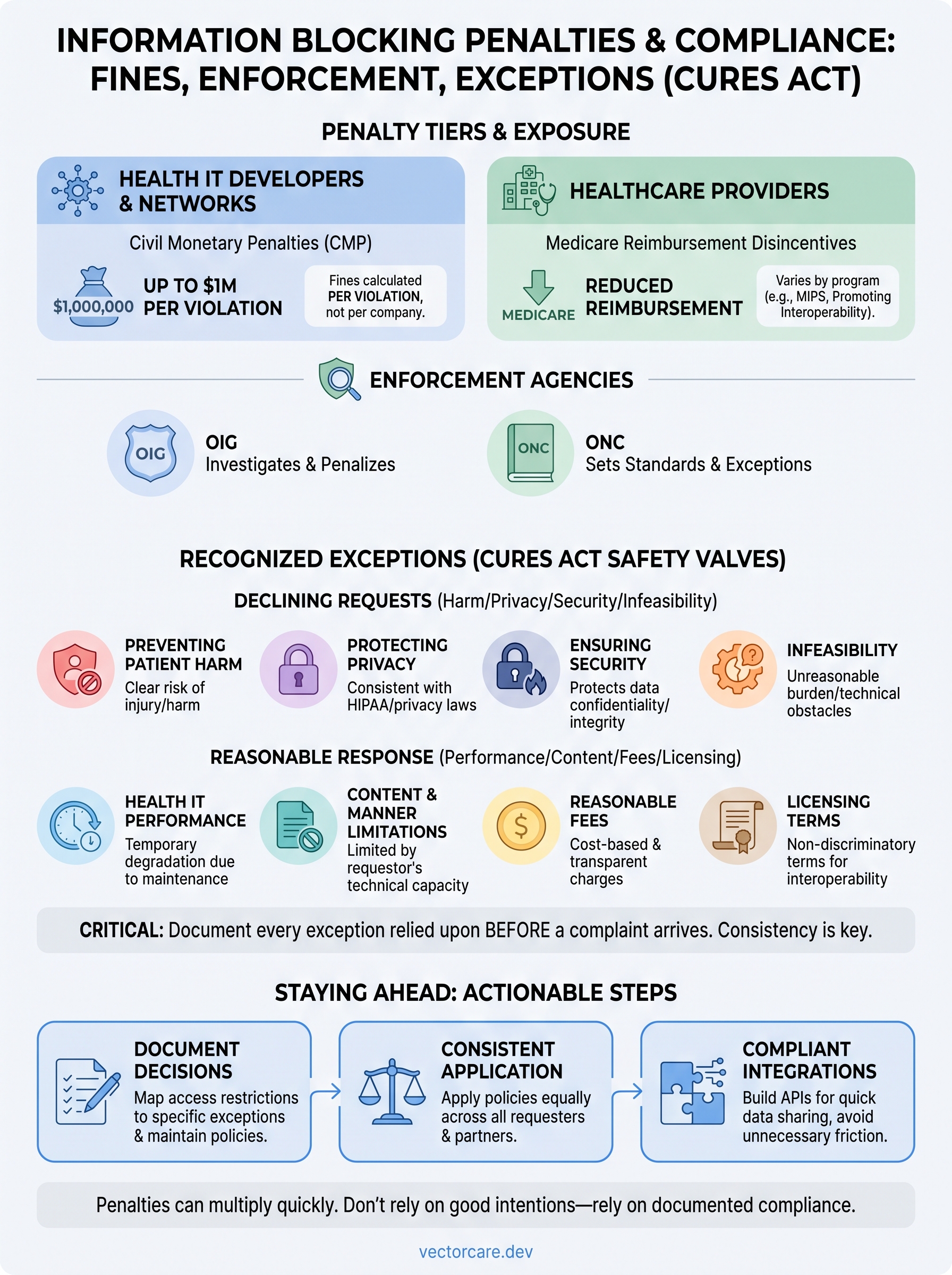
Penalties this steep don't leave room for guesswork. If you're building health tech that connects to EHR systems, your compliance posture depends on documented decisions, not good intentions. Map every access restriction to a specific exception, keep your policies consistent across every requester, and treat your EPIC integration like a regulated product from day one, not an afterthought bolted on before launch.
Quick recap for your team:
- Know your entity type and matching penalty structure
- Document every exception you rely on, before a complaint arrives
- Build integrations that share data quickly, not ones that create friction
Getting this right takes engineering time most digital health teams don't have to spare. That's exactly the gap VectorCare closes, handling FHIR compliance, EPIC Showroom listing, and secure data access so your team never has to weigh product speed against regulatory risk. Build and deploy your SMART on FHIR app in days instead of gambling on custom integration work.
The Future of Patient Logistics
Exploring the future of all things related to patient logistics, technology and how AI is going to re-shape the way we deliver care.
Thank you! Your submission has been received!
Oops! Something went wrong while submitting the form.